
The pill organizer on the counter still has two compartments full, and your mother swears she took both doses. A neighbor walked her home from the corner store last Tuesday. On Sunday the smoke alarm went off and the burner was still on when your brother arrived.
None of that looked like an emergency. That's the trap families fall into. They wait for one dramatic event, when the signal is usually a pattern that's been building for months.
The question worth asking isn't what stage of dementia your parent is in. It's what supervision they need now, and whether the people around them can deliver it. That reframing matters, because when to go to memory care is a capacity and cost decision long before it's a medical milestone.
Warning Signs That Point Toward Memory Care
Most families arrive with some version of the same worry. Is this just what dementia looks like, or is this the point where home supervision stops being enough?
The diagnosis doesn't answer that. Memory care becomes the right setting when cognitive decline combines with measurable loss of daily function, unsafe behavior, or supervision that isn't reliably available at home. Age alone doesn't decide it, and neither does a label on a chart.
A large cohort study in JAMA identified factors that predict nursing-home placement. Living alone was associated with a 74% higher hazard (HR 1.74, 95% CI 1.49-2.02). At least one activity-of-daily-living dependency raised the hazard by 38% (HR 1.38, 95% CI 1.20-1.60). An MMSE score of 20 or below raised it by 52% (HR 1.52, 95% CI 1.33-1.73), and at least one difficult behavior raised it by 30% (HR 1.30, 95% CI 1.11-1.52).
Those factors stack. A widow who lives alone, needs hands-on help bathing, and has started leaving the house at dusk carries several serious risks at once, not one.
| Sign | What it looks like | Often manageable at home when | Memory care worth considering when |
|---|---|---|---|
| Wandering or getting lost | Leaves home or gets lost in familiar places | Doors are alarmed and a supervised routine works | Exit-seeking continues despite alarms and locks |
| Medication errors | Missed, doubled or wrong doses | A pill organiser and one daily check are enough | Errors continue while a caregiver manages all medication |
| Falls | Repeated falls, often at night or in the bathroom | Home modifications reduce the hazards | Falls keep recurring despite modifications and supervision |
| Bathing, toileting or dressing | Needs hands-on help with basic hygiene | Help is scheduled and predictable | Help is needed around the clock and care is resisted |
| Nighttime disruption | Waking, agitation or wandering after dark | A caregiver can rest with monitoring | Nights need continuous supervision and caregiver sleep is lost |
| Aggression | Hitting, shouting or refusing care | Triggers are known and easy to avoid | Behaviors are frequent, unpredictable or unsafe for helpers |
| Unsafe stove use | Leaves the stove on or forgets food | Stove is disabled and meals are delivered | Cooking risks continue even with appliances locked out |
One row filled in rarely decides anything. Two or three that persist after you've already installed the locks, booked the aide and used the day program do.
While you're sorting out what's cognitive and what isn't, rule out the simpler explanations. If your parent misses half of a conversation and then answers a question wrong, the problem may start in the ears. Reading up on research on untreated hearing loss risks is worth an hour before you attribute every missed cue to dementia.
Practical rule: If two or more signs persist after home modifications, scheduled home care and respite, stop troubleshooting alone and arrange a professional safety and care-needs assessment.
How Memory Care Differs From Other Care Levels
Assisted living is a hotel with a concierge. Someone helps with the bags, arranges dinner, checks in during the day. Memory care is a hotel built around a secure, supervised routine, where the corridors are designed so nobody gets lost, the exits are quiet, and every staff member on the floor expects confusion instead of being startled by it.
This choice comes up constantly. The Alzheimer's Association estimates that 7.4 million Americans age 65 and older were living with Alzheimer's dementia in 2026, about 11%, roughly 1 in 9 of that age group, and 74% of affected people are 75 or older.
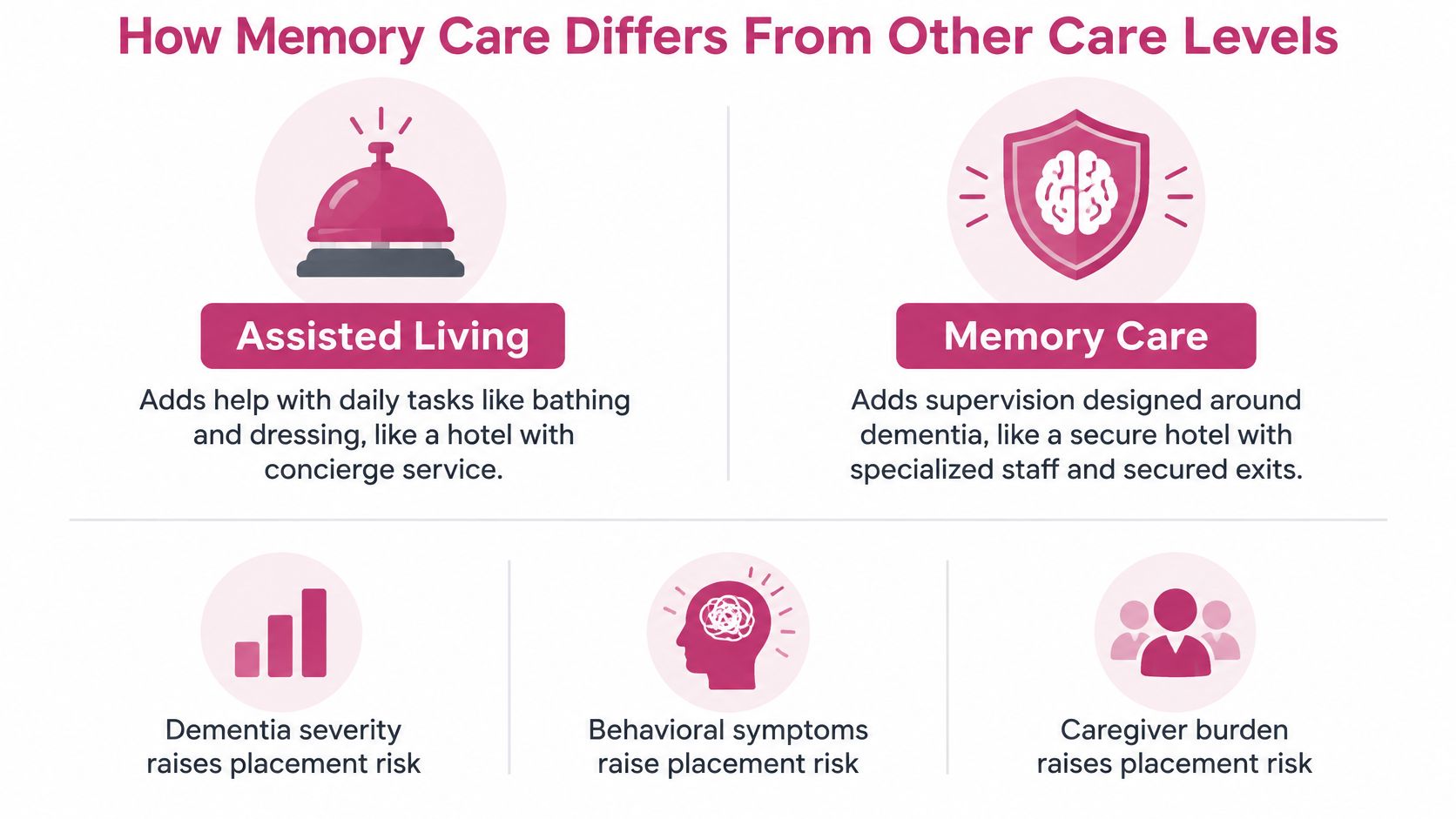
What the secured design changes in practice is small and constant. Keypad entries and obscured exits replace the argument at the front door. Color-coded walls and a memory box outside each room replace the daily search for the right bedroom. Staff trained in dementia care read agitation as communication, so a refusal at bath time gets handled as discomfort or fear rather than defiance.
| Option | Best fit | Supervision | Secured environment | Dementia staffing | No longer safe when |
|---|---|---|---|---|---|
| Home modifications | Person stays home with alarms, locks, grab bars and stove controls | Depends on family presence | No | Not applicable | Risks continue despite the changes |
| Scheduled paid home care | Person stays home with visits for personal care and medication | Limited to booked hours | No | Varies by agency and caregiver training | Supervision gaps remain or paid hours keep rising |
| Respite or adult day services | Short breaks and daytime structure for a caregiver at home | Daytime or short-term only | Not usually | Varies by program | Nights and emergencies go uncovered |
| Assisted living | Housing with daily help for personal care, medication and meals | Daily help, not continuous dementia supervision | Not usually | General personal care training | Wandering, behaviors or nighttime risks need secured, dementia-trained care |
| Memory care | Specialized housing for dementia | Round-the-clock supervision and structured routines | Yes | Staff trained in dementia care | Acute medical instability needs continuous nursing |
| Nursing home | Skilled nursing and rehabilitation | 24/7 clinical and nursing care | Varies by unit | Nurses and aides; dementia units vary | Complex wounds, intensive rehab or continuous nursing are the main need |
Families tend to pick the row with the most help in it. Pick the row whose design matches your risk list instead. If you want a closer look at what the daily program includes, this overview of memory care services walks through the staffing and programming differences.
Write down your loved one's top three needs, find the row that covers all three, and note anything no row covers. That gap is the question to ask each community when you tour.
When to Move and How to Score the Decision
There's no date on a calendar for this. An NIHR School for Social Care Research briefing on move timing found no consensus on an optimal move date, and concluded that timing is individual and contextual, not tied to symptom severity. The same briefing notes that many moves happen during crisis or distress, which tells you advance planning is still the exception.
That crisis pattern is a serious danger. Say your father falls in the bathroom on a Friday. He's discharged from the hospital Tuesday with a list of facilities that have a bed open this week. You choose in four days from whatever is available, not from what fits him. Touring while things are still stable keeps the choice in your hands.

Three Triggers That Mean It's Time to Tour
A systematic review and meta-analysis found that greater dementia severity, behavioral and psychological symptoms, functional impairment, and caregiver burden all consistently raise long-term-care placement risk. Living with a caregiver lowered it (HR 0.72, 95% CI 0.56-0.92), and each additional functional deficit raised it (HR 1.10 per deficit, 95% CI 1.03-1.16).
Translate that into three conditions. You're ready to tour when the care plan needs several daily interventions your family can't reliably sustain, when the person needs 24-hour response, or when they need secured protections and dementia-trained staff. Any one of those is enough to start looking.
Rule Out What's Reversible First
Sudden decline isn't always progression. A urinary tract infection, a new medication, uncontrolled pain, dehydration or delirium can all produce a sharp drop in function that looks like the disease advancing. Get a clinician to check those before you make a permanent decision based on a bad fortnight.
The Readiness Score You Can Run This Week
The scoring takes about an hour and gives you something better than a gut feeling.
- Score safety. Count last month's incidents: wandering, medication errors, falls, stove incidents, nighttime wake-ups. Use a number, not a feeling.
- Score caregiver strain. Add up daily supervision hours, lost sleep, work hours missed, and whether the main caregiver has seen a doctor about their own health this year.
- Score care complexity. Count hands-on help with bathing, toileting, dressing and medication, then add medical needs such as wound care or insulin.
- Test each option in order. Start at the least restrictive row in the table below and stop at the first option that controls every risk you scored.
- Set the review date. If you choose a trial of extra support, put 30 days in the calendar and re-score. Trials without a date become years.
| Option | The trial you run | The result that ends the trial |
|---|---|---|
| Home modifications | Alarms, locks, grab bars and stove controls installed and used consistently for 30 days | Risks continue despite the changes |
| Scheduled paid home care | Visits for personal care and medication at set hours | Supervision gaps remain or paid hours keep climbing |
| Respite or adult day services | Short breaks and daytime structure, a few days a week | Nights and emergencies go uncovered |
| Assisted living | Daily help with personal care and meals | Wandering, behaviors or nighttime risks need secured, dementia-trained care |
| Memory care | Secured environment, dementia-trained staff and structured routines | Acute medical instability needs continuous nursing |
| Skilled nursing | Continuous clinical and rehabilitative care | Complex wounds, intensive rehab or continuous nursing are the main need |
Dementia stage alone won't tell you when memory care is the answer. Your scores will.
When Staying at Home Stops Being Sustainable
Staying home longer isn't automatically the kinder choice. It can be financially and medically unsafe for the caregiver, not only difficult for the person with dementia.
A 2025 national cohort of 95,831 people with dementia receiving home healthcare found that 81.7% had a subsequent hospitalization during follow-up, and higher visit frequency was associated with greater hospitalization risk, though that partly reflects how sick people already were, according to the study in PubMed Central.
Caregiver health is the trigger families skip. In the same analysis, 74% of dementia caregivers reported being somewhat to very concerned about maintaining their own health, and caregivers had roughly twice the odds of hospitalization compared with non-caregivers.
The money side is just as incomplete. Among U.S. People with dementia who paid out of pocket for home care, 51% spent more than $1,000 per month, versus 26% of people without dementia. A 2024 peer-reviewed study of care partners reported that 90% of those paying for in-home help or respite paid more than $100 per week, and 30% paid more than $500 per week. Remember that the Alzheimer's Association reported dementia caregivers were providing nearly 31 hours of unpaid care per week in 2023, which is most of a second job.
Here's where home stops adding up:
- Nights need coverage every single night. Once that starts, you're staffing a shift rather than helping out.
- The caregiver misses work most weeks. Lost wages belong in the math, not outside it.
- The caregiver's own health is sliding. Missed checkups, new blood pressure medication, constant exhaustion.
- Emergency visits repeat. Two hospital trips in a season means the plan isn't working.
Build one monthly total for the home path: paid hours, overnight coverage, home modifications, missed wages, caregiver health costs and emergency visits. Then build the same total for a move, including whether Medicaid or long-term-care benefits apply. If you're still weighing paid help at home, this guide to assisted living at home explains how scheduled care hours get structured.
Candid trade-off: Memory care usually costs more per month than four hours of daily home care. It often costs less than 24-hour care, and it costs far less than a caregiver who ends up hospitalized.
Three Families Weigh the Decision
The three situations below are composites, built from the patterns that come up most often. They aren't real clients, but the scoring process in each one is exactly what you'd run.

Case one: mild memory loss with dusk wandering. A 78-year-old woman forgets names and repeats questions, and she's started walking toward the main road around dinnertime. Her daughter installs door alarms, enrolls her in a day program three days a week, and visits twice daily. Six weeks later, the exit attempts happen only when the routine breaks.
The deciding signal was that a supervised routine controlled the behavior. They didn't move yet. They set a review date and re-scored.
Case two: moderate dementia with nights that never settle. A man gets up four times a night, opens the back door twice, and his wife hasn't slept more than three hours straight in a month. Locks, a door alarm and an overnight aide reduce the exits but not the wake-ups, and the aide hours keep climbing.
The deciding signal was that nights required continuous supervision his wife couldn't provide. The family chose a secured memory care unit with dementia-trained staff, and she slept for the first time in weeks.
Case three: a fall that forces the timeline. A woman breaks a hip after a nighttime fall, and the hospital wants her discharged in five days. Her family arranges a short skilled nursing stay for rehabilitation, then moves her to memory care for ongoing supervision once therapy ends.
The deciding signal was medical instability first, cognition second. Treat the acute problem in the setting built for it, then choose the long-term setting.
The common thread across all three is that the decision followed the risks and the caregiver's real capacity, not the stage of the illness. One family moved early by choice, one moved after a trial failed, and one had the decision made for them by a hospital discharge planner.
Raising a Move With a Reluctant Parent
Lead with the specific incidents, not the label. "You left the stove on twice last month and the pan caught fire" is a conversation about safety. "We need to talk about memory care" is a conversation about losing independence, and it ends in the hallway.
Ask the physician to explain the findings directly. A clinician's account of the cognitive testing and the fall risk lands differently than a daughter's summary, and it takes the accusation out of the room.
Then ask what matters most, and mean it. Routine, the neighborhood, a pet, the church group, the Tuesday card game. Those answers should decide which communities you show first, because a place that can't protect any of them will be resisted no matter how good the care is.
Lower the stakes with a trial. A short respite stay of two weeks gives everyone real information, and it comes with a built-in review date instead of a permanent verdict.
Before the conversation, agree among the siblings on the risks and the next step. One voice in the room beats three competing opinions, and your parent will notice the difference immediately.
Avoid deciding during a crisis. That's when choices are narrowest and tempers are shortest. If your parent can no longer weigh the decision, identify the legal decision-maker, check the advance directives and confirm that person's authority before you sign anything. For a longer script on the conversation itself, this guide to talking to parents about assisted living covers openings that don't trigger a shutdown.
Five Steps to Take This Week
- Count the signs. Go back through the warning-sign table and write down which ones have persisted for more than a month. A pattern you can describe is far more useful to a physician or an advisor than a general worry.
- Complete the readiness scores with the main caregiver in the room. Strain gets underreported when the person carrying it is trying to protect everyone else from the answer.
- Request a medical review if the decline is recent. Infection, medication effects, pain and delirium are all reversible, and none of them require a move.
- Ask for help comparing options. Our care quiz narrows down the best starting point on the care continuum, and an advisor can price local memory care against home care with you; call (862) 398-2006 when you're ready. Ask specifically about admission criteria and staffing ratios, not just availability.
- Tour at least two secured memory care communities. Ask how staff are trained in dementia care, what the daily routine looks like, how they respond to nighttime wandering, and what staff turnover has been in the past year. If a move looks likely within a year, start clearing the house now, and this guide to downsizing help for older adults makes the sorting less overwhelming.
The best time to plan is before a crisis picks the facility for you. A folder of notes, two tours and a review date cost you a weekend. A rushed discharge decision costs you the choices you'd have wanted.
If you're holding a list of warning signs and no clear next step, Life Senior Placement can help you turn that into a plan. We offer free, objective guidance that compares memory care, assisted living and home care options near you, so you can see which setting matches the risks you've written down. Visit Life Senior Placement to start your search, or call to talk through your situation with an advisor before the next emergency makes the decision for you.