
Most families hear the same advice when an older parent begins struggling at home: aging in place is safer, more comfortable, and cheaper than assisted living. That advice is incomplete. Staying home can preserve routines and independence, but it can also create a patchwork of caregivers, unpaid family labor, missed medications, unsafe transfers, and escalating bills that no one calculated at the start.
The right question isn't, “Can we keep Mom or Dad at home?” It's, “Can we build a reliable care system at home that remains safe, affordable, and resilient when needs increase?” Assisted living at home can work well, but only when the family treats it as a structured care model rather than occasional help.
Redefining Assisted Living at Home
Assisted living at home is not just a caregiver visiting for companionship. A genuine home-based assisted living plan may require private-duty aides, clinical oversight, medication coordination, transportation, meal support, home modifications, family communication, and a backup plan for nights, weekends, illness, and emergencies.
That distinction matters because intermittent home health and ongoing personal care are different services. A nurse or therapist may visit for a defined clinical purpose, but that visit doesn't provide supervision between appointments. A personal care aide may help with bathing, dressing, toileting, mobility, meals, and household routines, but the aide usually isn't a substitute for a medical team or a secure memory care environment.
The demand is real. The Federal Reserve Bank of San Francisco's discussion of the home care sector notes that about 90% of adults age 65 and older want to age in place, while HHS estimates that 70% will need long-term services and support at some point, for an average of three years and often longer. The 65+ population has grown to more than 56 million Americans, and the 85+ population has exceeded 6.5 million.
What a complete home model includes
A workable plan starts with the senior's actual daily needs, not with the number of hours a family hopes to purchase. Assess:
- Personal care: bathing, dressing, toileting, grooming, transfers, and continence support.
- Health management: medication organization, appointments, therapy, wound care, and symptom monitoring.
- Household routines: meals, laundry, cleaning, errands, transportation, and bill organization.
- Supervision: wandering risk, falls, confusion, unsafe cooking, or leaving doors open.
- Family coordination: who receives updates, who makes decisions, and who responds when a caregiver cancels.
Home-based care is especially important for people with complex cognitive needs. In 2024, around 2.7 million Medicare-funded home health users received services, and roughly one-third lived with dementia, according to the Federal Reserve Bank of San Francisco's cited analysis. That shows how in-home support now serves more than people who need light housekeeping or occasional companionship.
Practical rule: If the plan depends on one family member being available every time a paid caregiver is late, the plan isn't complete.
The safest home arrangements combine paid assistance with clinical supervision and environmental changes. Families should decide early whether the home can accommodate equipment, whether someone can respond rapidly to a crisis, and whether the senior can remain safe during the hours when nobody is physically present.
The True Cost of Aging in Place
Home care often looks affordable when a family prices one visit or a few weekly hours. The calculation changes when a senior needs daily assistance, multiple shifts, transportation, overnight coverage, or a second caregiver to protect against cancellations.
Home health aide services in the United States cost around $27 per hour, and agencies commonly sell care in four-hour blocks, according to the market and affordability analysis from MMCgin Investment's assisted living market outlook. A single four-hour block can therefore exceed $100 per day before adding evenings, weekends, holidays, transportation, agency fees, or family backup.
The more useful comparison isn't an hourly rate. It's the total cost of keeping a residence operational while care needs rise.
| Cost Factor | Assisted Living at Home | Assisted Living Facility |
|---|---|---|
| Personal care | Billed by the hour or in agency blocks, with additional coverage required as needs grow | Usually bundled into a monthly rate with care-level adjustments |
| Housing | Mortgage or rent remains separate | Private or shared residence is part of the community package |
| Meals | Groceries, meal delivery, and preparation remain separate | Regular meals are commonly included in the monthly arrangement |
| Transportation | Family, rides, or paid transportation must be arranged | Community transportation may be available, depending on the provider |
| Medication support | Family, aides, nurses, or a pharmacy must coordinate the system | Medication reminders or management may be built into the care plan |
| Overnight and backup coverage | Family or additional paid staff must cover gaps | Staff are present on-site, though the level of response varies |
| Home safety | Modifications, maintenance, and monitoring are the family's responsibility | The setting is designed around accessibility and shared support |
A household may also pay for lawn care, repairs, emergency call systems, adult day services, respite care, and a family member's lost work time. These expenses don't always appear on a home care quote, but they affect whether the arrangement can last.
Harvard's analysis found that only 8% of older households in its GAPS category could afford daily assistance at home without drawing down assets, while 16% couldn't afford any paid personal care assistance at home, as reported in the MMCgin analysis. Those figures make one point clear: a preference for home doesn't automatically make home financially feasible.
The hidden operational price
Family caregivers often fill the gaps without sending an invoice. The Population Reference Bureau's analysis of family care for older Americans reports that the number of family caregivers regularly helping older adults with daily activities at home rose from 18.2 million in 2011 to 24.1 million in 2022, a 32% increase.
Among older people with disabilities receiving long-term services and supports at home, about two-thirds receive all care exclusively from a family caregiver. People with three or more activities of daily living limitations receive an average of 9 hours of assistance per day, rising to about 11 hours per day for adults age 85 and older with similar impairment.
Use this assisted living cost comparison as a starting point, then build a household-specific budget. Include every hour that a family member spends driving, supervising, calling providers, covering shifts, and responding to emergencies.
Home care is financially strongest when needs are intermittent, the home requires few modifications, and family support is dependable. It becomes fragile when the senior needs several daily shifts, constant supervision, or care that cannot tolerate a staffing gap.
Building a Safe Home Care Architecture
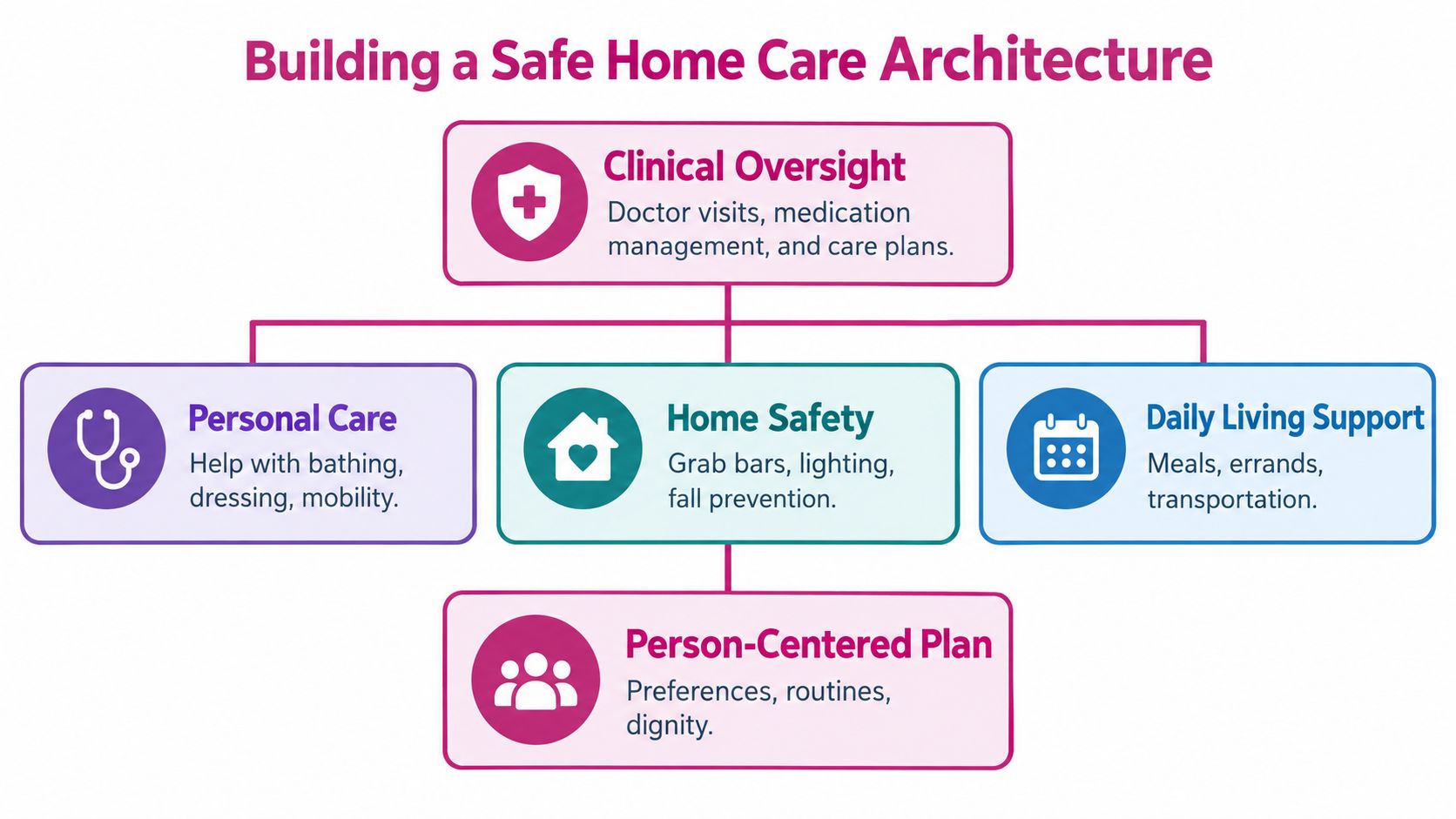
A safe home care plan has layers. Personal care is only one layer. Without clinical coordination, fall prevention, medication oversight, and a response plan, a family may end up placing more responsibility on an aide who wasn't hired or trained to manage every risk.
A multidisciplinary review of aging-at-home models found the strongest evidence for person-centered care that combines whole-person assessment, care planning, and integrated health and social support. The same review linked home modifications with fewer falls, less help needed with daily activities, and delayed nursing-home admission. Read the review of person-centered aging-at-home interventions for the evidence behind this bundled approach.
Start with clinical oversight
Assign one person to own the care plan. That may be a primary care physician, geriatric care manager, nurse, or another qualified professional who can coordinate information across providers. The plan should identify diagnoses, medication responsibilities, fall history, mobility limits, nutrition concerns, emergency contacts, and signs that require escalation.
Medication management deserves special attention. A pill organizer doesn't solve the problem if the senior forgets whether a dose was taken, takes duplicate medication, or can't recognize a change in instructions. Establish who orders refills, who observes administration when needed, and who contacts the prescriber after a missed dose or side effect.
Engineer the environment
Walk through the home as if you were the senior. Look for loose rugs, poor lighting, narrow routes, unstable furniture, slippery bathroom surfaces, and stairs that become dangerous after fatigue or illness. Grab bars, improved lighting, bathroom redesign, clear pathways, and properly fitted mobility equipment can make a larger difference than adding another hour of companionship.
Mobility equipment should support the person's actual transfer and seating needs, not merely fill space in the living room. Families researching options that may support safer sitting and standing can review lift chairs for elderly independence with Top Mobility, then confirm suitability with a clinician or occupational therapist.
Build daily support around preferences
The final layer is practical and personal. Meals should reflect dietary needs and familiar routines. Transportation should cover medical appointments and essential errands. Sensors, door alerts, or check-in systems can add information, but they don't replace a person who knows how to respond.
Write down the schedule and assign ownership for every task. A care plan should also state what happens when a caregiver calls out, the senior refuses care, a fall occurs, or confusion increases. If nobody knows who makes the next call, the architecture has a gap.
Recognizing the Safety and Care Thresholds
Home care stops being appropriate when the family can no longer guarantee safe coverage, timely response, or competent supervision. The transition usually becomes necessary before a dramatic crisis, although families often wait until a fall, hospitalization, or caregiver breakdown forces the decision.
Look closely at four thresholds:
- Continuous supervision: The senior wanders, leaves appliances on, opens the door to strangers, or becomes unsafe when alone.
- Medication dependence: Missed, duplicated, or mismanaged medication requires observation that the home schedule can't reliably provide.
- High physical dependence: Transfers, toileting, repositioning, or bathing require more than one person or specialized equipment.
- Unstable staffing: The agency cannot consistently cover shifts, or family members repeatedly absorb cancellations and overnight duties.
Dementia often changes the equation quickly. A person may physically manage a familiar room but still lack the judgment to respond to a fire alarm, avoid unsafe food, or remain inside the home. Behavioral symptoms, nighttime wakefulness, resistance to care, and repeated exit-seeking can exceed what one aide can safely manage in a private residence.
Compare the risks, not just the settings
Facility care offers an organized environment with staff presence, shared meals, activity programming, and established escalation procedures. It isn't automatically superior, and the quality of oversight varies by provider, but a community may be better equipped for people who need regular observation and coordinated support.
In-home HCBS can offer comfort and familiarity, but a comparative Medicaid analysis found that users were 1.3 percentage points more likely to be hospitalized each month, had 0.3 fewer days at home per month, and generated higher Medicaid spending than assisted-living residents. The findings in the comparative analysis of Medicaid HCBS and assisted living don't mean every home plan is unsafe. They show why fragmented delivery needs strong assessment, medication support, and rapid escalation protocols.
A safe plan must work on the worst ordinary day, not only when every caregiver arrives on time.
Families should also take cognitive care seriously. AARP reports that nearly 1 million people live in assisted living, about 44% of residents have Alzheimer's or dementia, and more people age 85 and older now live in assisted living than in nursing homes, according to the senior care trends analysis from Rising Trends. These figures point to a growing concentration of people with higher support needs in residential settings.
Transition when the home plan requires constant family rescue, when the senior can't be left alone safely, or when the needed care exceeds what available workers can provide. Waiting for an emergency removes choice from the family.
How to Arrange In-Home Support Services
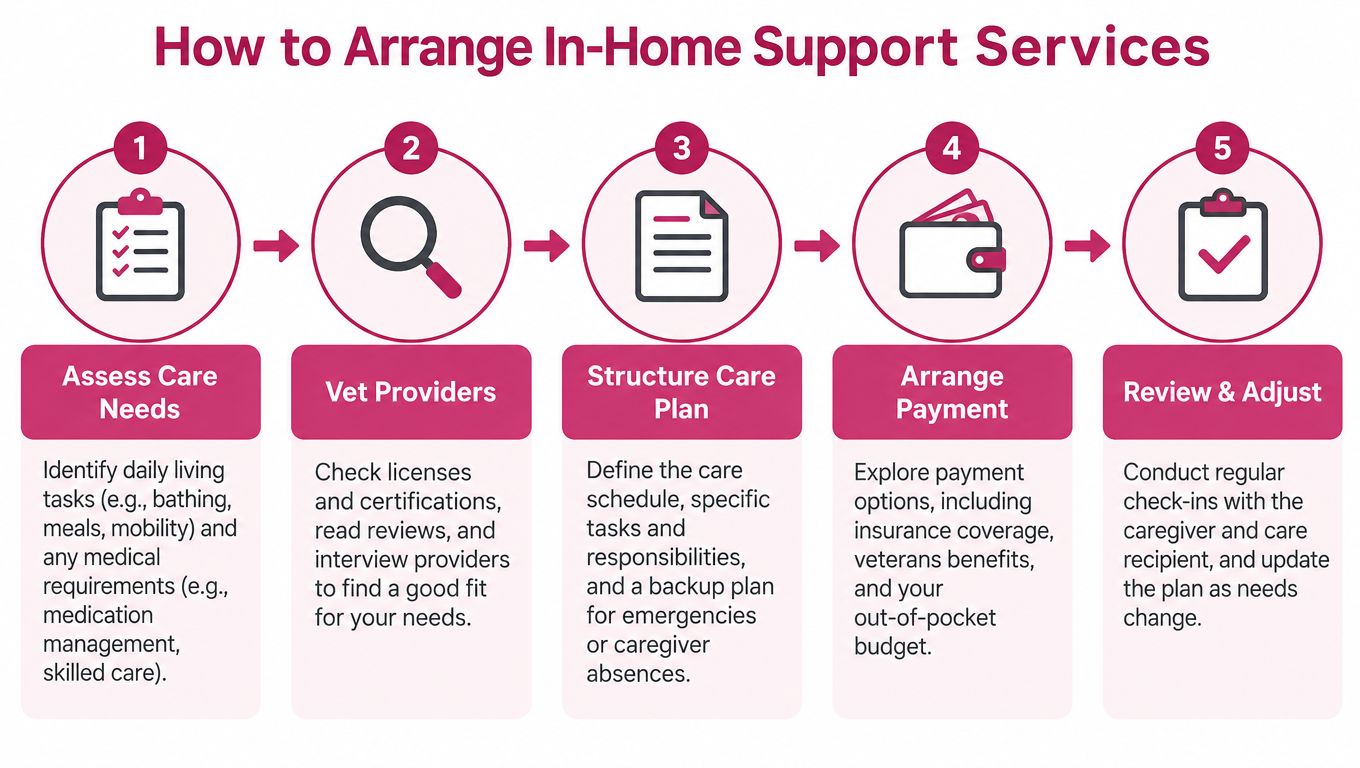
Start with a written assessment before calling agencies. Record what the senior can do independently, what requires cueing, and what requires hands-on help. Include diagnoses, mobility equipment, continence needs, meal preferences, sleep patterns, medication responsibilities, behavioral concerns, and the hours when family members can realistically help.
Use a disciplined selection process
Assess the care gap. Separate tasks that need a home health professional from tasks that a personal care aide can perform. Ask the physician, hospital discharge planner, or therapist to clarify restrictions and warning signs.
Vet the provider. Confirm licensing, insurance, employee screening, training, supervision, minimum shift requirements, cancellation procedures, and replacement coverage. Ask who visits the home, how often the agency checks quality, and what happens when the assigned aide isn't a fit.
Write the care plan. List exact duties rather than using a broad phrase such as “help with activities.” Specify bathing, transfer assistance, meal preparation, medication reminders, walking routines, laundry, and communication expectations.
Set up payment. Review private funds, long-term care insurance, veterans benefits, Medicaid eligibility, and any state programs that may apply. Medicare and Medicaid rules vary by service and location. The Government Accountability Office overview of long-term and assisted care coverage explains why families must verify coverage instead of assuming a program will pay for room, board, or ongoing personal care.
Review and adjust. Schedule a recurring family check-in. Look for falls, missed appointments, weight changes, new confusion, caregiver turnover, and rising out-of-pocket spending. A care plan that no longer matches the senior's abilities needs revision, not wishful thinking.
For families who live apart, location check-ins can provide useful situational information between visits. If you're evaluating technology, compare live location check-in tools and ask whether the product supports the senior's privacy, consent, and actual routine.
Families can also review home care options and services while comparing agency coverage, caregiver qualifications, and scheduling policies. Don't choose on price alone. The cheapest hourly quote can become the most expensive option if missed shifts force a family member to leave work or delay a needed transition.
When to Transition to Facility Placement
A move to assisted living, memory care, or skilled nursing isn't a failure of home care. It can be the responsible next step when the home environment no longer delivers consistent safety or when the senior needs a coordinated level of support that private caregivers can't sustain.
The first task is to identify the required level of care. Assisted living may fit someone who needs help with daily activities but doesn't require intensive nursing. Memory care may be more appropriate when dementia creates wandering, behavioral, or supervision needs. Skilled nursing belongs in the conversation when the person requires ongoing clinical care, rehabilitation, or medical monitoring beyond an assisted living setting.
Begin before the crisis
Families should gather medical records, medication lists, therapy notes, hospital discharge paperwork, financial information, and a clear description of daily behaviors. A placement advisor can use that information to narrow the search rather than sending the family to tour communities that can't meet the senior's needs.
A structured placement process should answer practical questions:
- Can the community manage the senior's mobility and transfer needs?
- Does it provide memory support or secure access?
- How does it handle medication administration and changing care needs?
- What services are included, and which create additional charges?
- How quickly can the community accept a resident after hospitalization?
- What happens if the senior's needs increase?
Use assisted living placement guidance to organize the comparison, then verify every promise directly with the community. Tour at different times when possible. Observe whether staff know residents by name, whether common areas feel supervised, and whether residents appear engaged or isolated.
In New Jersey, families may also use a local placement service to compare assisted living, memory care, nursing homes, independent living, and home care providers. Life Senior Placement offers no-cost guidance, verified listings, structured intake, curated matches, tour coordination, and advisor support across the selection and move-in process. Its compensation comes from participating communities, so families should still ask how recommendations are generated and what options are included.
Professional guidance is most valuable when time is short. After a hospitalization, a family may need to compare clinical fit, availability, location, budget, and admission requirements at once. A clear shortlist can reduce delays, but the family should remain involved in evaluating the environment and agreeing to the plan.
Making the Right Choice for Your Family
A senior who needs help with breakfast, bathing, and transportation may thrive at home with a reliable schedule, suitable modifications, and family involvement. A senior who needs supervision through the night, has repeated falls, or cannot safely manage medication may need a setting designed for continuous support.
The decision should be reviewed whenever the senior has a hospitalization, meaningful fall, new diagnosis, worsening confusion, repeated caregiver cancellation, or a sharp increase in family hours. Don't wait for a single catastrophic event to prove that the arrangement has failed.
Use three tests:
- Safety: Can someone respond appropriately whenever help is needed?
- Sustainability: Can the family afford the full arrangement without exhausting assets or overloading one caregiver?
- Dignity: Does the plan respect the senior's preferences while providing the supervision and assistance required?
There isn't one correct setting for every family. Assisted living at home may preserve independence when needs are manageable and the support network is dependable. Facility placement may offer greater stability when supervision, coordination, and rapid response have become too difficult to provide privately.
Review the plan, involve the senior whenever possible, and ask for outside guidance before the family reaches exhaustion. The right choice is the one that protects safety and dignity without pretending that money, staffing, or family energy are unlimited.
Life Senior Placement helps New Jersey families compare home care, assisted living, memory care, nursing homes, and independent living based on care needs, budget, location, and availability. Visit Life Senior Placement to request a structured intake and get practical support with matched options, tours, and the next step.