
Your mother says she's fine. Tuesday's pills are still in the organizer on Thursday, and the kettle sat on the burner again. You've been driving over after work, filling the gaps without a plan, and the sentence you keep rehearsing is the one you're afraid to say.
How to talk to parents about assisted living works better when you stop trying to win and start treating your parent as a co-designer. In New Jersey that means short talks about safety, money, and which decisions stay theirs, not one meeting that ends with a building already picked.
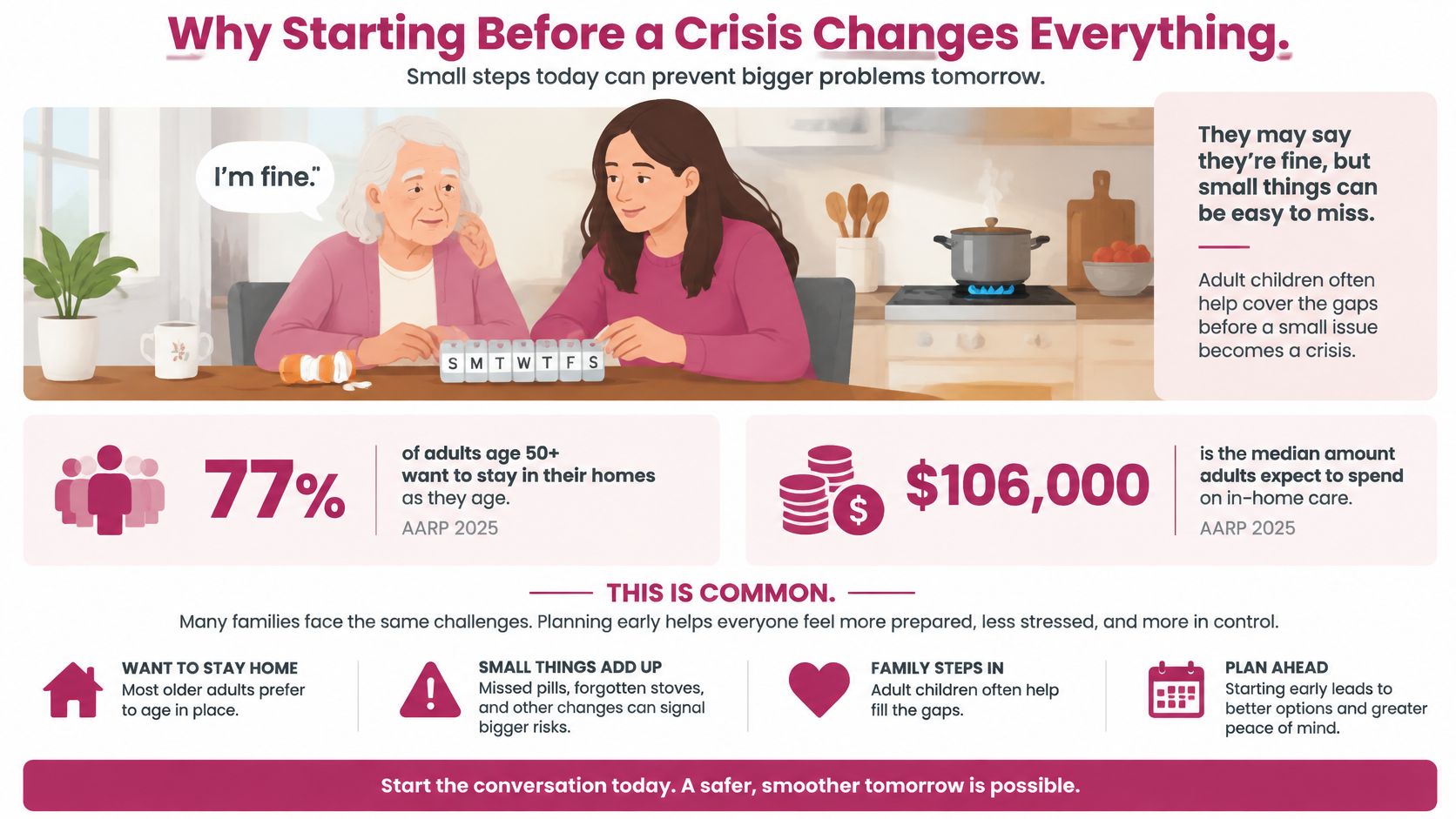
Why Starting Before a Crisis Changes Everything
That kitchen scene is ordinary, not a private failure. AARP's 2025 national caregiving research reported that more than 51 million Americans, nearly one in five adults, were caring for someone age 50 or older, and those caregivers spent approximately 26 hours per week, up from 22 hours per week in 2020. Plenty of families are doing what you are doing. The difference is whether anyone has said it out loud.
Timing decides whose plan this becomes. Talk now and your parent can still name what they want, push back, and set conditions. Wait for a fall or a hospital stay and the same decisions get made in days, around them rather than with them, by whoever happens to be in the discharge meeting. An early conversation keeps your parent the co-designer. You can compare assisted living, memory care, home care, and nursing care as real choices instead of accepting whatever has a bed open. Treat assisted living as one option inside a broader care plan, not an order to pack.
Before anyone sits down, write three notes. What help does your parent really want? Which daily tasks are getting hard? What setting would feel safe and acceptable to them? Bring those notes into the conversation so the agenda comes from their answers, not your fears. The same season often brings new helpers and new money pressure, so it is worth learning how to help protect loved ones from scams before strangers start calling about "benefits."
How to Plan the Conversation in Five Steps
Don't open with "You need assisted living." Build a structured talk that keeps your parent's control intact, then write down what you agreed.
- Write three items alone. Before the meeting, your parent and each sibling document current safety and daily-living concerns, preferred outcomes, firm priorities, and acceptable trade-offs on cost, location, privacy, and care intensity. Writing alone prevents the loudest voice from setting the agenda in the driveway.
- Name a lead and a note-taker. One person runs the clock. One person writes. Everyone else agrees the parent speaks first. If two siblings both "just want to say one thing," the parent hears a hearing, not a conversation.
- Match the clock to the trigger. Don't start in the hour after an argument, a discharge, or a missed bill. Use the table while you pick the day.
| Situation | Best time to start | Who should attend | First session length |
|---|---|---|---|
| Routine check-in, no incident | Within the next one to three months | Adult children and parent | 30 to 45 minutes |
| After a fall or near miss | Within two weeks, before any care decision | Parent, one sibling, physician if the parent agrees | 45 minutes |
| After hospitalization | As soon as discharge planning begins | Parent, family, hospital social worker or case manager | 30 to 45 minutes plus follow-up |
| Early memory changes noticed | Now, while the parent can state preferences | Parent, spouse, family, physician | 45 minutes, split into two sessions |
| Caregiver exhaustion | This month | Caregiver first, then parent | 30 minutes each |
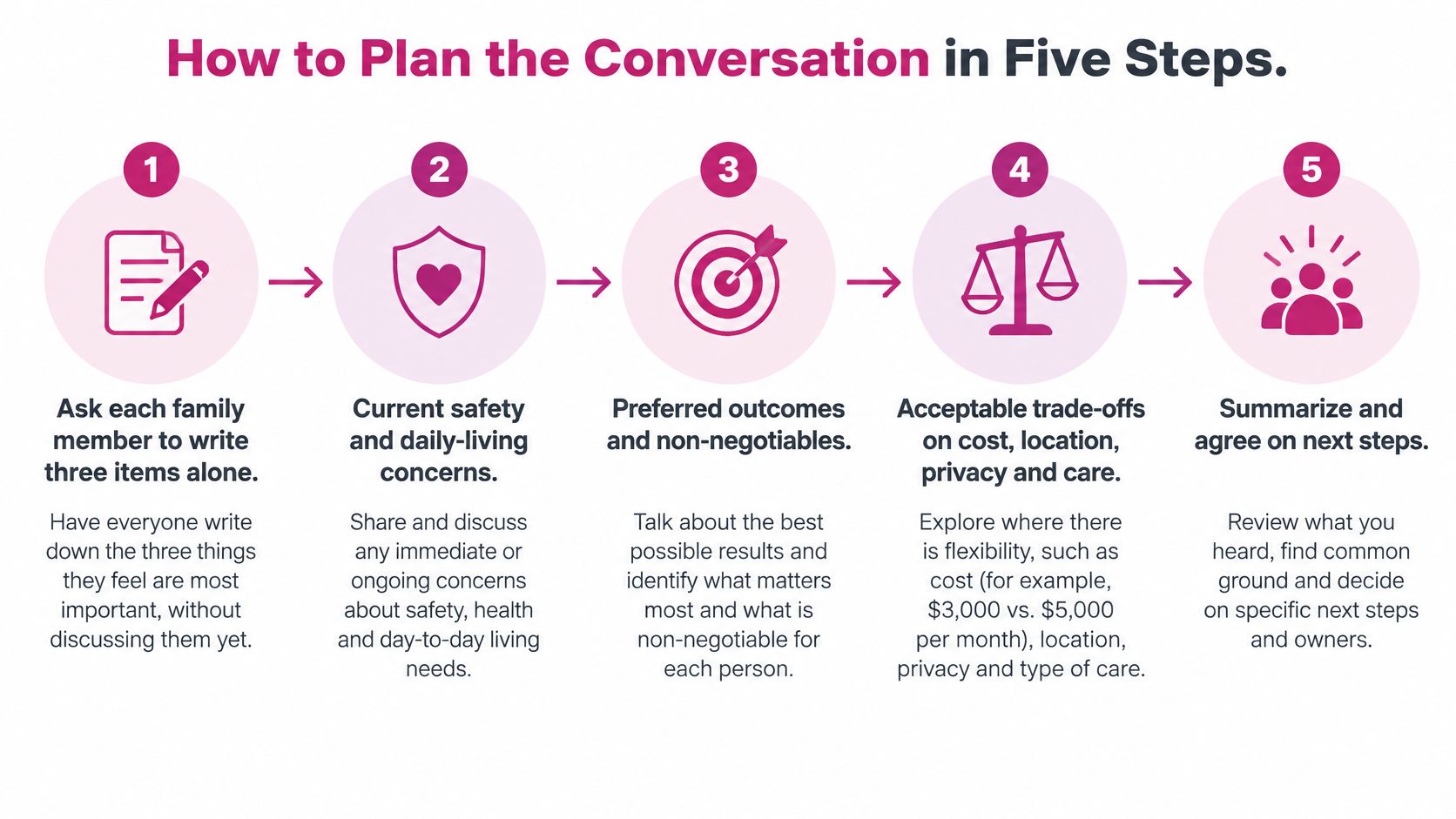
- Open on facts, not a building. The first session is 30 to 45 minutes and aims at agreeing about problems. Missed doses, a near fall, unpaid bills. Save community names for a later meeting.
- Leave with one page. List next steps, an owner for each, and a date to meet again. Typical owners cover a clinical assessment, a budget review, and community visits.
A pilot with nine families (36 participants) found that independent preparation and a structured exchange helped families spot perceptual differences, negotiate a shared assessment, and make more even care changes. That small sample is a feasibility signal, not a success rate you can bank on.
Practical rule: Ask permission before you share health details with a sibling, a physician, or a case manager. Control over information should shift gradually as health changes. Micromanaging, accidental disclosure, and a parent who feels watched are the usual ways this meeting fails.
If a doctor should hear the plan, tell your parent first and ask who calls. A surprise "the doctor already agrees" ends trust faster than a hard fact about the stove.
A short walk-through of how a calm first meeting sounds can help you rehearse tone before you try it at the kitchen table.
Opening Lines That Keep Your Parent in Control
The useful question isn't "How do I convince them?" It's "How does my parent keep control?" A 2024 meta-analysis and qualitative synthesis found that autonomy in residential care includes involvement in entering care, treatment decisions, and everyday living, not only the ability to do tasks alone. Care settings often cut that autonomy to reduce risk, especially when cognition is changing. In New Jersey, pushback on assisted living or memory care is often fear of house rules, not a refusal of help.

Lines that hand the agenda back
Use one line per stage, then stop talking.
Name a fact and ask permission. "Mom, I noticed the stove was on twice this week. Can I tell you what worried me?" Permission keeps the fact from sounding like a verdict.
Invite their list first. "What feels hardest right now?" Their ranking is the agenda. Yours can wait.
Ask what they fear losing. "If we add help, what are you most afraid of giving up?" House, morning routine, visitors, and privacy usually surface here. Safety needs and lifestyle preferences are different lists. Don't mix them.
Offer two or three real options. "We could add a morning aide, try adult day two days a week, or tour one assisted living that keeps your own schedule. Which is worth a look?" One option is an ultimatum.
Write down what stays theirs. Daily routine, meals, visitors, finances, and timing of any move. Say it out loud so it isn't a vague promise.
Close by restating. "What I heard is that nights alone worry you, and you won't give up Sunday lunch with Ellen. The options on the table are a trial aide and one tour. Did I get that right?" Asking them to restate the options catches a misunderstanding before it hardens.
Say a daughter stopped reading her father a list of failures and asked him to rank what bothered him. He put stairs first and meals second. The debate became a page he helped write. That composite is illustrative, not a promise that ranking always lands this cleanly.
Three ways this talk goes bad
- Micromanaging the discussion: Correcting every sentence makes your parent defend the past instead of planning the next month.
- Disclosing health details they didn't choose to share: A group text to cousins about memory changes feels like surveillance.
- Making them feel watched: Cameras, pill counts announced at dinner, and surprise drop-ins read as distrust.
A less coercive talk often speeds a good decision because your parent helps design the move instead of resisting one written without them.
Answering the Objections You Will Hear
"I'm not going anywhere" is usually fear of losing the house, not a final legal position. Pushing harder, with more brochures or a louder safety speech, makes the fear look justified. Listen, name the feeling, ask one question, then offer a small next step.
| Objection | What it often means | Response to try | Next step to propose |
|---|---|---|---|
| "I'm not going anywhere." | Fear of losing home and routine | Ask which home risks worry the family most and what would make home safer | List three home risks and test one fix for 30 days |
| "It's too expensive." | Worry about money and about becoming a burden | Share a realistic monthly budget and compare options on the same criteria | Review income, savings and benefits in a separate session |
| "I'm not that bad." | Protecting identity and independence | Describe specific observed events, not labels | Agree on one measurable concern to monitor |
| "I don't want to live with old people." | Fear of institutional life and losing peer connection | Tour a community with activities and residents close to the parent's interests | Visit two communities and compare activity calendars |
| "You just want me out of the house." | Feeling distrusted or unwanted | Ask what would make them feel included in the decision | Write down the decisions that stay with the parent |
| "Let me think about it." | Need for time and control | Agree on what they will think about and a date to revisit | Set a follow-up date within two to three weeks |
When they're capable and still unsafe
A parent who still drives, cooks, and pays bills can be unsafe in one lane, medications or stairs, while fine in others. Recent qualitative work found that older adults often keep autonomy through compensatory strategies until outside help becomes necessary, and that standard activities-of-daily-living scores miss the point. Assessment should follow personal goals and what the caregiver sees.
Physical independence is the ability to do a task without help. Decision-making autonomy is choice and control. They're related, and they aren't the same. Accepting help isn't "failing."
"The goal is not to take over; it is to add support where it protects the activities you want to keep doing."
Compare a staged test with a permanent move. Home care, respite, adult day, or a short-term trial can sit next to assisted living or memory care. Many fears about rules, roommates, and loss of routine are the same ones covered in addressing common fears about assisted living. Ask which step they'd test first.
If they refuse and the risk is climbing, check capacity for that specific choice, confirm who holds the healthcare proxy or durable power of attorney, and ask the physician to assess the concrete risk. In an emergency, call for care first and negotiate later.
Money, Paperwork and Care Level Talking Points
Money belongs in its own session, with the parent in the room. Genworth's Cost of Care Survey tracks national median costs for assisted living, but a national average is not a New Jersey quote. Prices move with town, apartment type, and the service package, so the only figures that matter for this decision are the written ones each community hands you.
Base rent is not the bill
Base rent often covers the apartment and some meals. Medication management, personal care, transportation, and memory support commonly sit on top as add-on charges. Ask every community for a written fee schedule before anyone falls in love with a lobby. Agree which services are essential, who pays, and what a realistic monthly budget is. Postponing that talk tends to leave fewer affordable choices, not a cheaper one.
Treat your parent as the person approving the budget, not the person being billed. Lay the fee schedule in front of them and let them mark which services they want. A parent who chooses the package keeps control of it.
| Funding source | What to verify | Common surprise |
|---|---|---|
| Private savings and pension income | Monthly income compared with base rent plus expected care level | Care fees rise as needs increase |
| Long-term care insurance | Elimination period, daily benefit and whether the facility type is covered | The benefit may cover only part of the monthly cost |
| VA Aid and Attendance | Veteran or surviving spouse eligibility and income and asset rules | The application can take several months |
| New Jersey Medicaid Assisted Living Program | Income and asset limits and whether the community participates | Not every licensed community accepts Medicaid |
| Home equity or sale of the home | Timing, taxes and whether proceeds are needed for care | A rushed sale can force an urgent move |
A wider map of payment mixes sits in this guide to ways to pay for assisted living without draining savings. Bring it to the money meeting so the session stays on verification, not slogans.
Paperwork to raise in that session
- Healthcare proxy: Who speaks to clinicians if your parent can't.
- Durable power of attorney: Who can pay bills and sign if they choose to delegate.
- Advance directive: What treatment they do and don't want.
- Admission contract signer: Who is financially responsible, and whether a family member is being asked to guarantee the bill.
That last line matters more than families expect. Some contracts ask an adult child to sign as a responsible party, which can put personal funds on the hook. Read that clause before anyone signs, and let your parent name their own proxy and agent rather than assigning roles for them.
Confirm each community's New Jersey license and read the contract before you choose. If home care or independent living still fits clinically, put those prices on the same page. A lower-support option is a real alternative, not a consolation prize.
Turn the Talk Into Tours and a Decision
The first conversation should not pick a building. Split what follows into three meetings, one for finances, one for clinical needs, and one for tours, each with a named owner. In 59 observed family meetings for older adults, meetings averaged 38 minutes, covered about nine topics, and scored 41 out of 100 on a shared-decision measure. Longer meetings scored higher. A 30 to 45 minute first talk, then separate sessions, matches that pattern better than one overloaded afternoon.
Compare assisted living, memory care, home care, and nursing care against the criteria you already agreed: supervision, medications, mobility, dementia security, activities, transportation, staffing, total monthly cost, and what happens if needs rise. Keep the shortlist small and matched to those criteria. A long list, or a fear-based pitch, shuts the talk down.
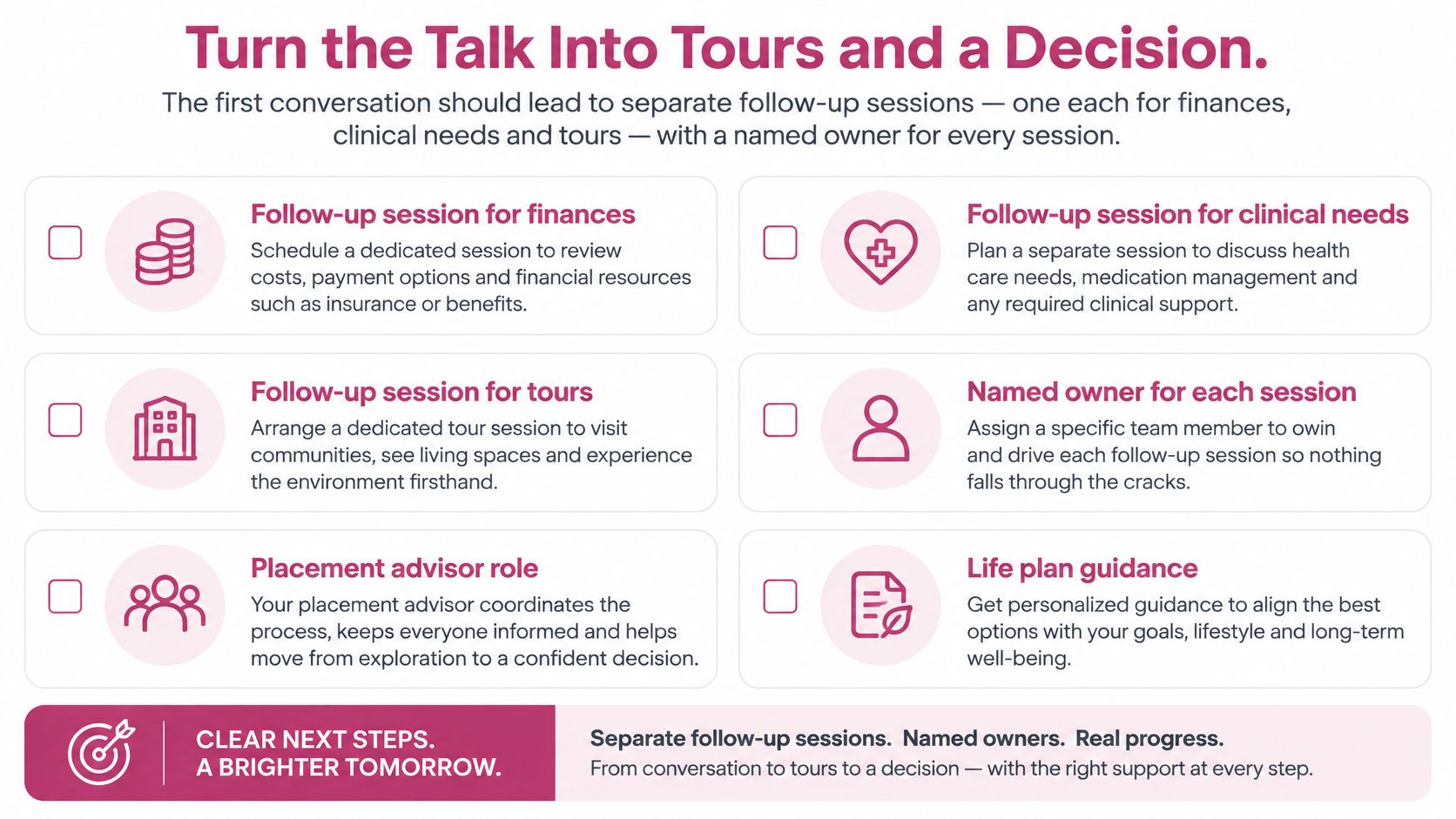
On a tour, check night staffing, medication management, dementia security if it applies, the activity calendar, transportation, total monthly cost with add-ons, the move-in process, and the path if care needs increase. Confirm the community's New Jersey license yourself. A practical question list is in questions to ask assisted living communities before you sign.
Life Senior Placement, a New Jersey placement service, is one way families narrow that list. It takes a structured intake on health needs, budget, preferences, and location, then offers a shortlist of licensed, vetted communities, coordinates tours, and builds side-by-side comparisons. Families pay nothing because participating communities compensate the service. Ask any advisor to explain that arrangement before you share records.
Close the loop with three actions. Set a decision date. Name who calls each community. Agree on the trigger, another fall, another missed week of medications, or caregiver burnout you can't sustain, that would force a second look even if the first answer was wait.
If you want a shortlist instead of a statewide search on your own, Life Senior Placement matches New Jersey families with assisted living, memory care, and related care using your parent's health needs, budget, and the decisions they want to keep. The service coordinates tours and comparisons at no cost to families. Visit Life Senior Placement when you're ready to turn the conversation into scheduled visits.