
The advice arrives before the diagnosis does. Home care is cheaper, someone says, and it's what she wants anyway, so try that first and only look at a community when it stops working. Both halves of that sentence can be true, and the plan built on them can still collapse in the first month, because neither half answers the question that decides the outcome.
Home care isn't a product you buy once. It's a schedule you have to fill every week, including the overnight shifts, the aide who calls out sick, and the Sunday after a hospital discharge. Assisted living isn't a discount either, but it does sell something home care can't: a building where somebody is already awake.
Families argue about the monthly number first and the coverage question last. I'd flip that order. Settle who handles the 2 a.m. Bathroom trip and the missed shift, then price both options on the same monthly basis, then compare. Start with the two columns most comparison charts get wrong.
Home Care and Assisted Living Side by Side
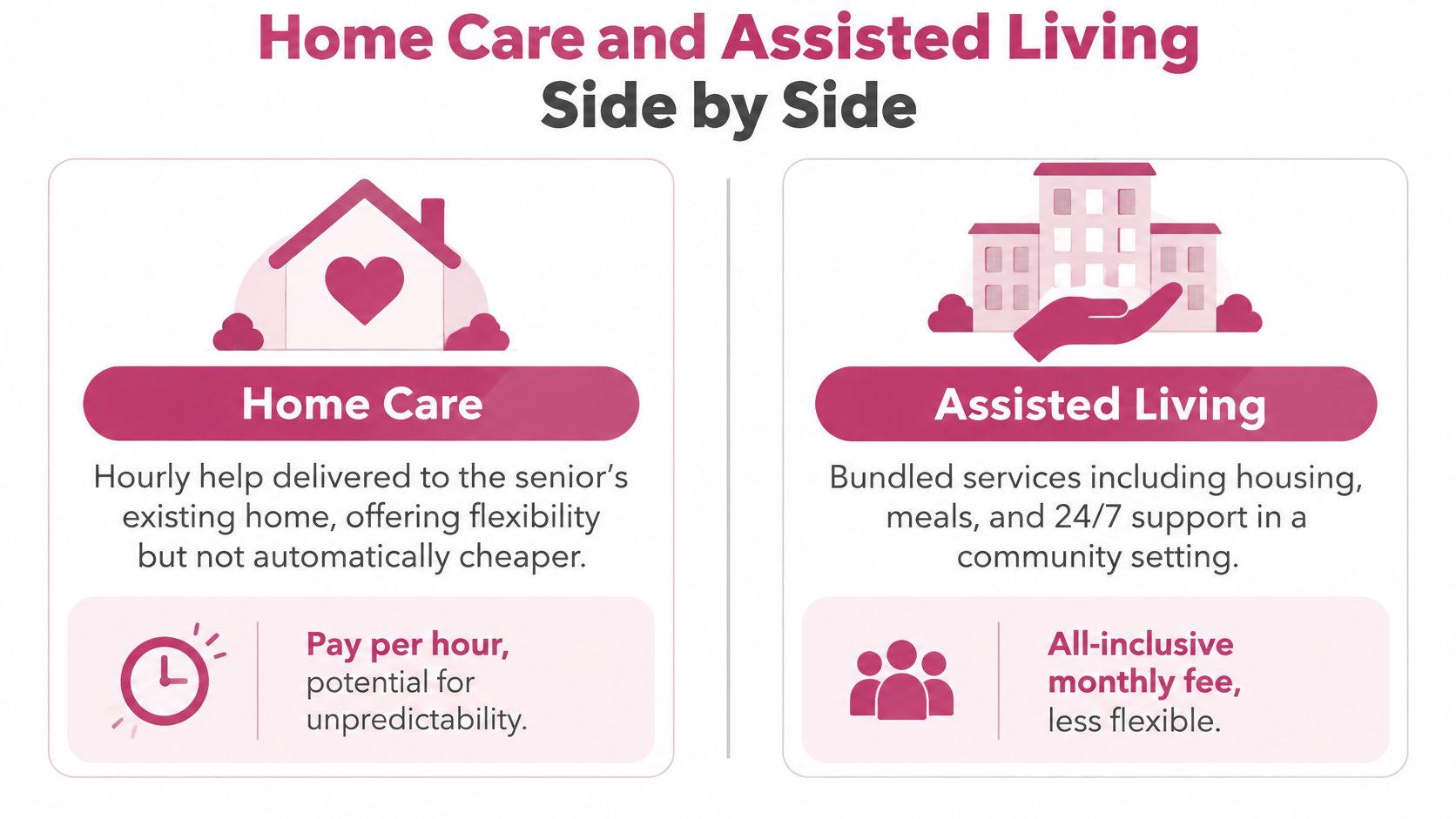
Home care is hourly help delivered in the home your parent already lives in. Assisted living is a residential arrangement that bundles housing, meals, supervision and daily personal care into one monthly fee.
| Home care and assisted living compared on the criteria families use | Home care | Assisted living |
|---|---|---|
| Where care is delivered | Senior's own house or apartment | Residential community with a private or shared unit |
| How it is priced | Hourly, from about $30 to $38 for non-medical aide help | Monthly bundle with a baseline rate plus tiered care fees |
| Coverage overnight | Only if overnight hours are purchased or family covers them | Staff on site around the clock |
| Meals, housekeeping and activities | Purchased separately or handled by family | Included in the residential model |
| Schedule flexibility | A few hours a week up to full 24/7 care | Set daily routine within the community |
| Staffing predictability | Agency availability and hours requested set the schedule | Community staffing levels set coverage; shortages occur here too |
| When needs rise | Add hours or a second aide on a new schedule | Move to a higher care tier, often at a new fee level |
| Best fit for | Stable needs, strong family backup, strong attachment to home | Growing daily help needs, safety concerns when alone, social isolation |
The two columns aren't priced in the same unit, and that's where most family comparisons break down. One is a bundle with tiered add-ons. The other is an hourly purchase layered on a mortgage or rent, utilities, groceries, property taxes and maintenance, all of which keep arriving whether or not an aide walks through the door. Convert both to a single monthly figure before anyone forms an opinion.
A second trap is the word flexibility. Home care can be scheduled from a few hours a week up to full 24/7 coverage, while assisted living fixes a baseline and charges more as care needs climb. The flexible option is only flexible if the hours you need can be staffed.
Everything that follows hangs on three tests, and any one of them can override the other two:
- Cost on a like-for-like basis. Same monthly unit, same care level, housing included on the home side of the ledger.
- Fit between needs and setting. A written task list checked against what each model covers, not what the brochure implies.
- Coverage when someone is missing. Nights, weekends, holidays, sick days, and the week after a fall.
The visual below condenses the same contrast into one frame.
For a second pass on the money side, Velma's assisted living cost comparison lays out the trade-offs from the family's side of the table, which helps when a relative keeps quoting one number at you. Keep this table next to the quotes you collect. Every row is a question a provider will answer in writing if you ask it plainly.
What Each Model Includes Day to Day
Preference is measured, not assumed. In 2024, 75% of adults age 50 and older said they preferred to remain in their own homes as they aged, according to the AARP home and community preferences survey. That single finding explains why home care opens almost every family conversation, and why it needs a real test rather than automatic approval.
Home care sends caregivers to the senior's home to help with personal care, companionship and daily tasks so they can stay at home safely. It is delivered as a scheduled visit: an aide arrives at eight, handles bathing and breakfast, works through the morning medication list, and leaves at noon. The service is only as continuous as the schedule. Caregivers assist with daily activities, medication management, and specialized physical and emotional support at home, which is a wider scope than most families expect on day one. The line between companion help and hands-on care still matters, and non-medical home care explains which tasks an aide can take on and which ones need a nurse involved.
Assisted living offers housing and support with personal care for seniors who value independence but need some daily assistance, in a safe, welcoming community. The same morning looks different: staff help with dressing, medication and meals, and the building absorbs the cooking, laundry, housekeeping and activity calendar. Nobody has to coordinate a shift schedule, because the shifts belong to the community.
Write the task list before you tour anything
Build the inventory on paper, with your parent, and use the identical list for every option you evaluate:
- Personal care. Bathing, dressing, grooming, toileting, and whether transfers need one person or two.
- Medication. Who fills the pillbox, who watches it go down, and who notices a missed dose.
- Food. Three meals, special diets, and what happens on a day when nobody feels like cooking.
- The house. Laundry, cleaning, yard work, and the repairs that go unattended.
- Getting out. Medical appointments, groceries, church, and the pharmacy run.
- Company and movement. How many hours alone per day, and what fills them.
- The bad day. A fall, a fever, a UTI, a confused evening. Who is called, and how fast can they arrive.
Bring that list to every tour and every agency call. A provider who can't speak to each line isn't answering your question.
What Each Option Costs in New Jersey
The monthly totals are easy to compare and easy to misread. Assisted living combines housing, meals, supervision and help with daily activities. Home care charges by the hour, while the senior's housing costs continue. The 2024 Genworth and CareScout cost of care survey reported national annual medians of $70,800 for assisted living, $75,504 for homemaker services, and $77,792 for a home health aide. That works out to about $6,292 a month for homemaker services and $6,483 for a home health aide. From 2023, assisted living and homemaker rates rose 10%, while home health aide costs rose 3%.
A newer benchmark puts non-medical home care at $80,080 a year, or about $6,673 a month, assuming 44 hours of care a week. CareScout's 2025 Cost of Care Survey reports that figure, equivalent to roughly $35 an hour.
New Jersey assisted living has a state median of $8,710 a month, the fifth highest in the country. Local prices vary. In Elmer, assisted living typically costs $4,800 to $7,500 monthly, with higher rates for advanced personal care or two-person transfers. Around Wall, base rates generally range from $5,500 to $9,200 a month. Extensive physical help or memory care can raise the cost.
| Monthly cost benchmarks by setting and location | Monthly figure | Basis or note |
|---|---|---|
| New Jersey median assisted living | $8,710 | State median, fifth highest in the country |
| US median homemaker services (2024) | $6,292 | About $75,504 a year, hourly help with cooking and cleaning |
| US median home health aide (2024) | $6,483 | About $77,792 a year, hands-on personal care |
| US median non-medical home care (2025) | $6,673 | About $80,080 a year assuming 44 hours a week |
| Elmer, NJ assisted living | $4,800 to $7,500 | Rises with advanced personal care or two-person transfers |
| Wall Township, NJ base assisted living | $5,500 to $9,200 | Higher with extensive physical help or memory care |
| In-home non-medical aide | $30 to $38 per hour | Monthly total depends on weekly hours scheduled |
Build one monthly number you can defend
Multiply weekly care hours by 4.3, then by the hourly rate. Add housing costs that continue at home. For example, 44 hours a week at $35 an hour comes to roughly $6,650 a month, before mortgage, utilities and groceries. For assisted living, add the tiered care fee for the help your parent needs to the base rate.
The chart below compares annual benchmarks, though they measure different services.
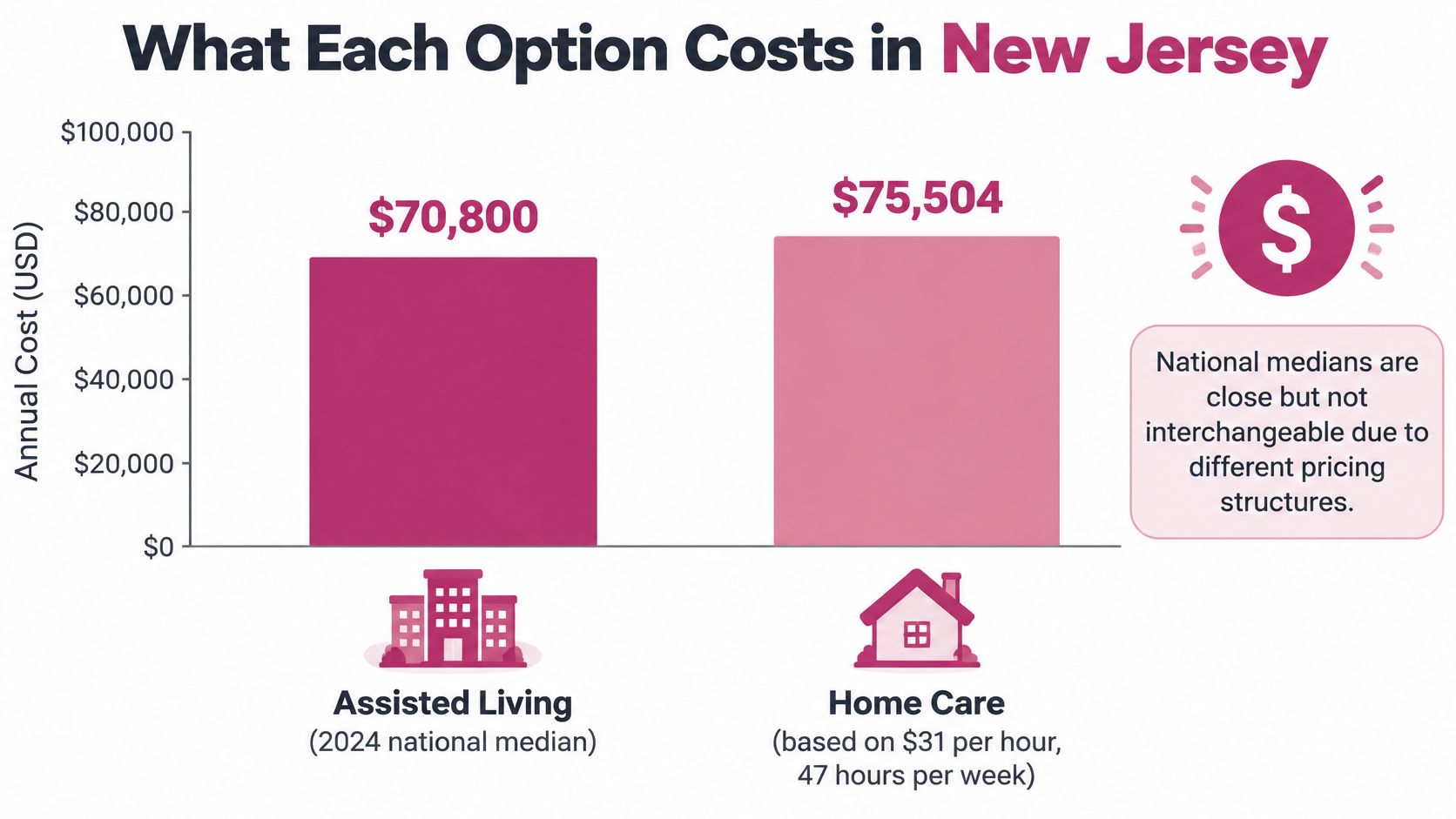
For home care, the schedule drives the monthly bill. The guide to how much home care costs explains how weekly hours affect the total. Ask each provider for a written quote based on the same care needs. These are broad ranges, not quotes, and pricing is set by each provider. Two nearby communities may charge different amounts for the same level of help.
How Each Option Is Paid For in New Jersey
The funding question splits long before it reaches the monthly total. Most New Jersey families pay privately at first, drawing on savings, a pension, or equity released from the house. Private pay works the same on both sides, and it buys the time needed to sort out everything else.
Long-term care insurance is the next place to look, and the policy language decides more than the premium did. Read which settings the policy names, whether the benefit is a daily cap or a monthly reimbursement, how long the elimination period runs, and what triggers payment. A policy that covers assisted living but not home care, or one that reimburses a fraction of the daily rate, eliminates one column of your comparison.
Medicaid long-term care can pay for certain assisted living and home-based services in New Jersey, but eligibility turns on income and asset limits, and waiting lists can apply. Start the application early, well before the money runs out, because a rushed filing in the middle of a hospital discharge rarely goes smoothly.
Read the policy before the brochure. A daily benefit cap that looks generous on assisted living may cover only a few hours of aide time, and the gap comes out of the family's pocket.
Veterans and surviving spouses may qualify for VA Aid and Attendance, a monthly pension add-on that can be applied to either setting. Medicare generally does not pay for ongoing non-medical custodial help in either setting, so keep short-term skilled rehabilitation and long-term daily care in separate budget lines. Mixing them is how families end up expecting coverage that never existed.
Three questions to put to each option
- What is covered. Housing only, or personal care, medication support, meals, laundry and transportation.
- Under which program or policy. Private pay, long-term care insurance, Medicaid, or a VA benefit, named specifically.
- What the monthly net cost is after benefits. The number the family writes the check for.
Verify current rules with the New Jersey Division of Aging Services or an accredited benefits counselor before building a budget on them. Thresholds change, and a plan that assumed last year's figures can fail at renewal.
Matching Care Needs to the Right Setting
The right setting depends less on a preference for home or community living than on whether every needed hour can be covered safely. A 2025 systematic review of unmet needs among older adults living at home found gaps across health management, socialization, practical home care, information access, technology, and interaction with the health system. Practical home care needs appeared in 25 of the reviewed articles.
Separate the question of whether a senior can remain physically in the house from whether the plan covers medication, meals, toileting, transfers, fall prevention, transportation, social contact, and urgent-care escalation. These needs often involve activities of daily living and the support they require. Listing which tasks need help gives families and providers a clearer basis for matching care to daily routines.

The practical test is coverage continuity. Who handles overnight needs, caregiver absences, recovery after a fall, or dementia-related behavior that worsens after dark? Scheduled home care can leave gaps between visits, including around medication timing, toileting, transfers, meals, and fall response. Family members may fill those hours, but their unpaid time belongs in the comparison. Assisted living provides housing, meals, activities, and daily support, with staff present in the community.
Assisted living may not be suited to complex medical needs requiring round-the-clock medical supervision or rehabilitation. Nursing home care provides those services. For dementia care, ask who is available at night, how secured areas work, and how staff document incidents. When home care includes transfers, medication timing, or behavior support, ask whether the provider's team has advanced training in complex conditions such as dementia and palliative care.
The seven questions that decide fit
- Medication. Who manages it, and who notices a missed dose?
- Meals. Who prepares them, and who notices if your parent stops eating?
- Transfers. Can one person safely help your parent move from bed to chair, or are two people needed?
- Falls. Who responds, and what happens next?
- Overnight. Who is available, and how often does anyone check?
- Social contact. How many waking hours would your parent spend alone, and who covers them?
- Escalation. Who calls the doctor, who calls 911, and who contacts you?
If three or more needs require someone present daily or nightly, identify who will cover each hour before committing to a home care plan.
Staffing, Backup Coverage and Unpaid Family Hours
A plan on paper isn't care on the calendar. The 2025 caregiving factsheet from the Administration for Community Living reports that 88% of provider organizations experienced moderate or severe staffing challenges, 62% turned away new referrals because of inadequate staffing, and home care worker turnover approached 75% in 2024. Read those three figures together and the practical conclusion is uncomfortable: home care is not automatically the more dependable option.
The hardest hours to fill are the ones families need most. Nights, weekends, holidays, dementia care, and a short-notice discharge from a hospital are exactly where agencies struggle, and a plan built around three shifts a day can fail even when the budget is fully funded.
The question to ask: not "can you provide twelve hours a day" but "how many of those hours are guaranteed, and who walks in when the assigned aide doesn't?"
Then there's the labor nobody invoices. Family caregivers provide an average of 27 hours of care weekly, and nearly one quarter provide more than 40 hours, carrying employment and health costs that never appear on a care bill. Those hours are the hidden subsidy under many home care plans, and they're the first thing to break when a caregiver gets sick or a job changes.
Assisted living is more predictable on coverage because housing, meals, activities and basic supervision are integrated, so a missed shift doesn't leave a hole in the day. Communities face their own staffing pressure, and the good ones will tell you their ratio rather than their philosophy.
What to ask before signing
- Guaranteed versus requested hours. Which hours are contractually promised, and which are best efforts?
- The replacement procedure. If an aide doesn't arrive, who covers the shift, how fast, and do you get a call or do you make one?
- Minimum shift length. Short visits carry travel charges and often a two or four hour minimum.
- Overtime, holiday and travel fees. These should be in writing, not discovered on an invoice.
- Family backup capacity. Name the second and third person, and the hours they can realistically cover.
- Escalation protocol. What the aide does in the first ten minutes after a fall or a sudden change.
- Plan review cadence. Life Home Care builds regular check-ins and assessments into the schedule so the plan adjusts as needs change instead of after a crisis.
If the arrangement depends on one unpaid family member for more than a few hours a week, write the backup plan down before anyone signs. The plan that only works when one person never gets sick is not a plan.
Which Option Fits Your Situation
Four factors decide this: cost, care intensity, overnight risk, and whether the needed hours can be staffed. Whichever one is binding in your family's case is the one that picks the setting.
| Which setting usually fits each situation | Usually a better fit | Why | Check first |
|---|---|---|---|
| Stable needs, strong family backup | Home care | Keeps the home and routine, and cost tracks hours used | A written backup plan for missed shifts |
| Dementia with night-time wandering | Assisted living with memory care | Staff present overnight and trained for dementia behaviors | Overnight staffing ratio and secured areas |
| Discharge from hospital on short notice | Assisted living if a bed is available, or home care with a confirmed start date | Availability often decides the timing of the placement | Confirmed start date and replacement procedure |
| Couple with different care needs | Split arrangement or a community with two care levels | One partner may need more help than the other can provide | Whether the community prices each partner separately |
| Complex medical needs requiring skilled nursing | Nursing home care | Round-the-clock medical supervision and rehabilitation | Physician involvement and clinical staffing levels |
The switch points are worth knowing before you need them. Home care becomes hard to sustain when required hours pass what the budget and the family backup can absorb, usually at the point where two or three shifts a day are needed and one of them runs overnight. Assisted living becomes the wrong answer when the need moves from supervision to clinical care: wound care, IV therapy, complex medication titration, or a resident who needs a nurse on site rather than on call.
The choice isn't binary for a parent who's still independent. Independent living suits active seniors who want community, amenities and freedom from home maintenance, with care available if needs change, and it buys time without locking in a care tier or a schedule.
I'd also stop treating this as a one-time verdict. Needs move in steps, not curves, and a fall or a hospital stay can reset the whole calculation in a week.
Price Your Options and Book Your Tours
Work through this in order, and keep every document you produce, because the second conversation is always easier than the first.
- Write the inventory. Daily tasks, weekly hours needed, and the overnight picture, taken from the task list and the seven fit questions. One page, shared with siblings, agreed before any tour.
- Price both sides monthly. Convert aide hours to a monthly figure and add housing costs on the home side. On the residential side, add the baseline fee and the tiered care charge for the level of help needed.
- Confirm the funding. Match long-term care insurance, Medicaid eligibility and any VA benefit to the setting each one covers, and note the net monthly cost after benefits.
- Ask for written quotes at the same care level. Local ranges aren't quotes, and each provider sets its own price, so compare documents rather than memories of a phone call.
- Request the staffing details. Guaranteed hours, the replacement procedure, overnight coverage, and the escalation steps for a fall or sudden change.
- See two of everything. Tour at least two communities or interview two home care agencies, and ask each one how the plan changes when needs rise.
- Decide against the binding criterion. The quote that answers your hardest question wins, even if it isn't the cheapest line on the page.
Life Senior Placement provides free, objective guidance to help families evaluate those local options, and an advisor can price real openings rather than published ranges. Families can call us at (862) 398-2006 for guidance on local assisted living and home care services, or start with the care quiz that helps narrow down what level of help makes sense. Revisit the decision whenever the care plan changes, after a fall, a hospital stay, or a jump in overnight needs, because the setting that fit six months ago may not fit now.
Life Senior Placement works with New Jersey families on exactly this decision, comparing home care, assisted living, memory care and nursing homes against your parent's health needs, budget and preferred town at no cost to you. An advisor can price real options instead of ranges, check what's currently available for a short-notice discharge, and walk you through tours with the same checklist used here. Visit Life Senior Placement to take the care quiz or set up an intake call.


