Only 3 of 150 caregivers interviewed weekly for six months said publicly funded home care was sufficient, while 69 others described their support as very limited in hours and tasks, according to a Canadian mixed-method study summarized in a 2025 scoping review on PubMed. That gap reframes nursing home vs home care. You're not choosing a label or an hourly rate. You're choosing a care package, including who covers the hours nobody has scheduled.
Nursing Home vs Home Care at a Glance
A nursing home provides round-the-clock skilled care inside a licensed facility, while home care sends scheduled caregivers to the senior's own home.
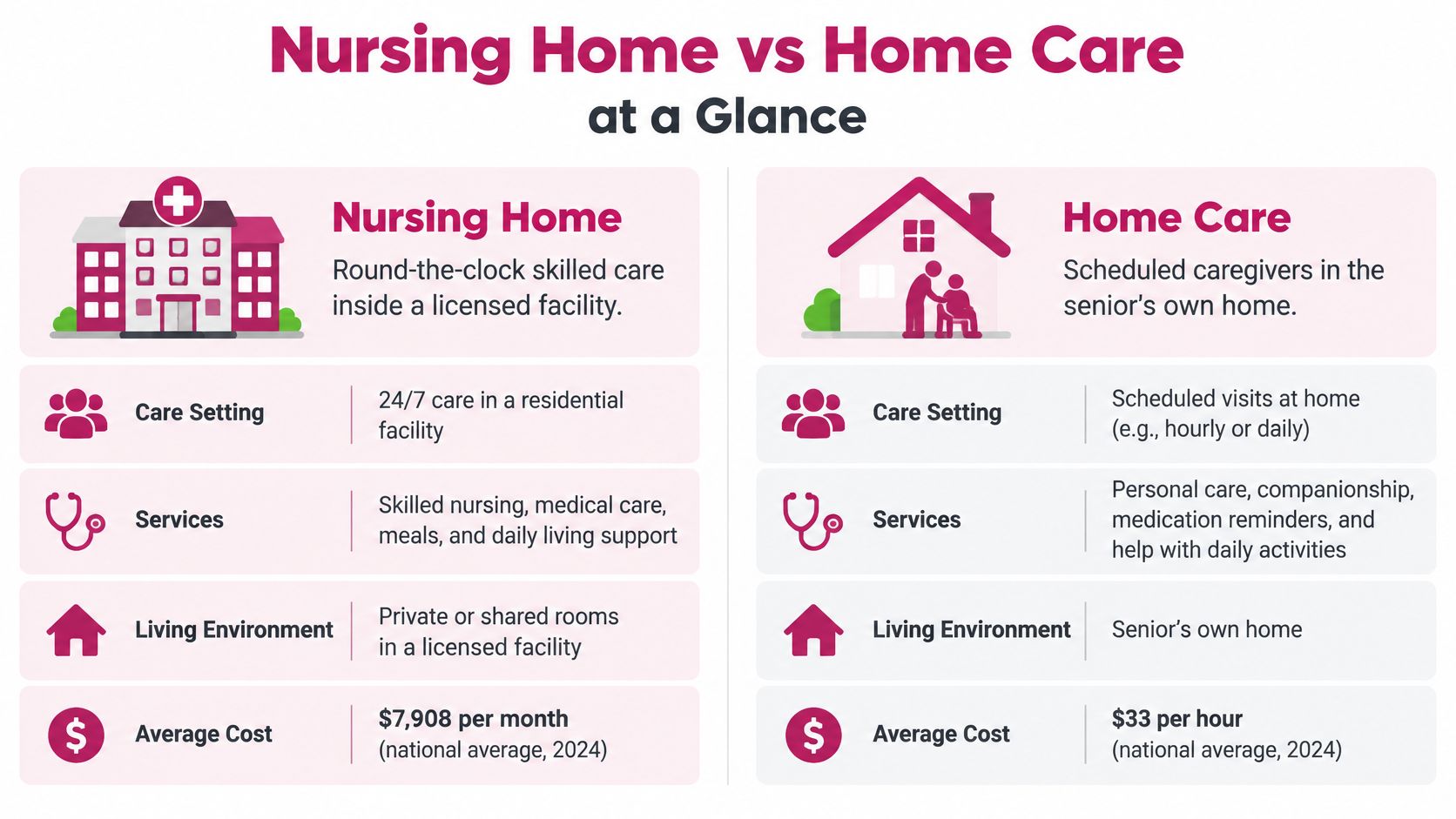
| Criterion | Nursing home | Home care |
|---|---|---|
| Care setting | Licensed residential facility with resident rooms | The senior's own home |
| Coverage hours | 24 hours a day, every day | Scheduled hours, from a few per week to 24/7 |
| Clinical oversight | On-site nursing and physician orders | Registered nurse supervision of the care plan; skilled visits only when ordered |
| Staffing | Shift-based nursing and aide teams | Assigned aides or agency caregivers, varying by agency |
| Typical fit | Complex medical needs, rehabilitation, unsafe nights | Stable needs, aging in place, a home that is workable |
| Regulation | State licensing of the facility and its staff | State licensing of agencies and their staff |
What the Table Can't Show
The table hides how much care sits behind each label. Home care might mean help twice a week, a daily visit, or staff in the house around the clock. Those are three different safety plans, not variations of one service.
It also can't measure staff stability. A facility can have people on site all night and still rely on unfamiliar workers who don't know a resident's routine. A home arrangement can feel personal and calm until the regular aide cancels.
Say one senior needs two hours a day for bathing and dinner, sleeps safely, and can reach the bathroom alone. Another needs hands-on transfers and toileting at 3 a.m. The first case fits scheduled home support. The second turns on overnight staffing, not daytime preference.
Practical rule: Decide the night and clinical rows first. They usually eliminate one option before cost or location enters the discussion.
Test every other row against the actual hours required, the reliability of the people filling them, and whether family members can cover the gaps without becoming the unpaid night shift.
How Each Setting Is Built, Staffed and Regulated
The settings solve different problems. One concentrates staff, equipment and residents in a building designed for supervision. The other brings selected help into a private home and leaves the household responsible for everything outside the visit.
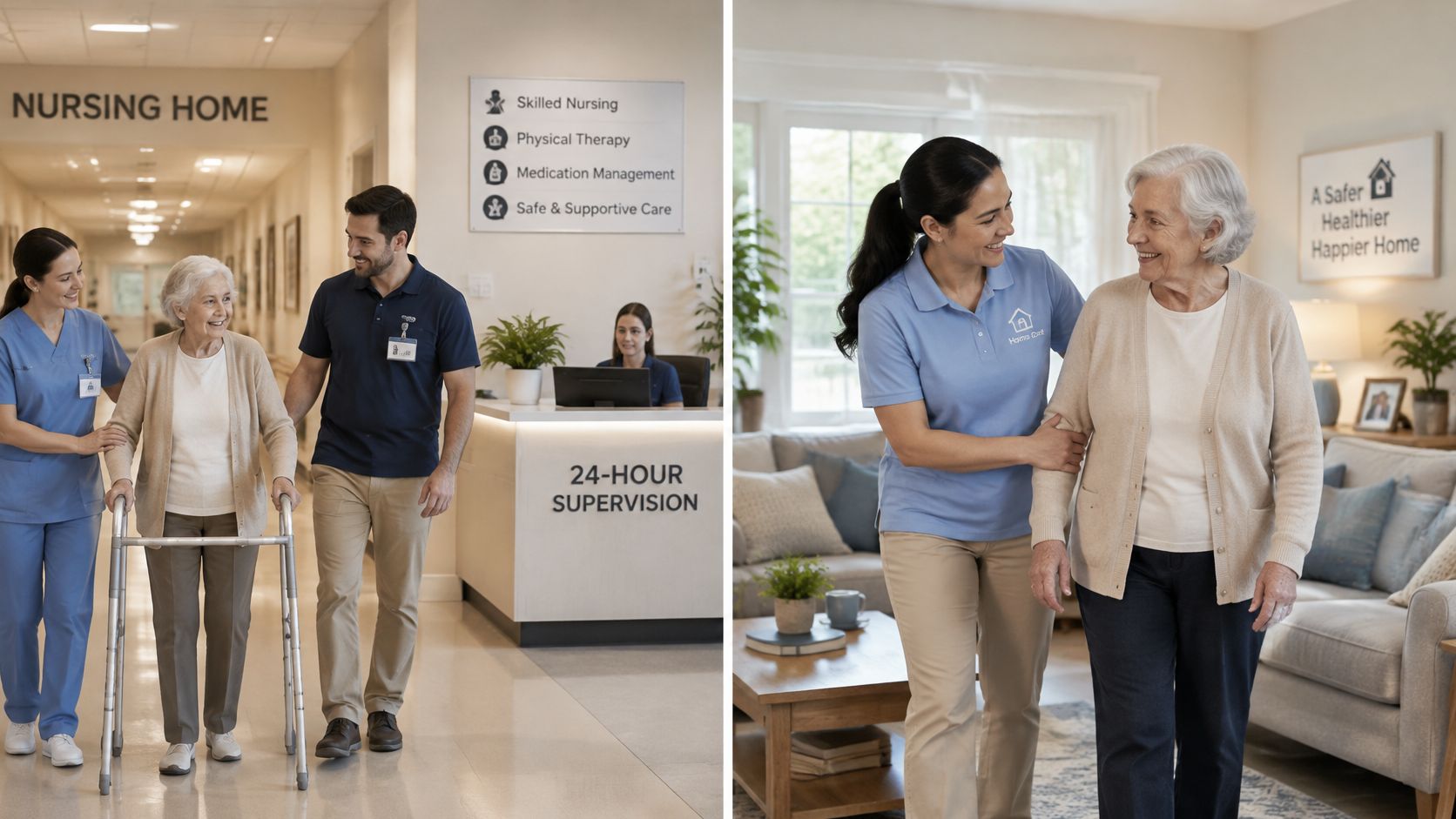
Nursing Homes as Licensed Facilities
Nursing home care provides round-the-clock medical supervision and rehabilitation for seniors with complex health needs. It's built for continuous supervision, skilled nursing and residents whose medical or functional needs can't be safely managed at home.
The scale is substantial. The CDC's National Center for Health Statistics nursing home care page reported 14,700 nursing homes, approximately 1.6 million licensed beds, and about 1.2 million residents in 2022. That's roughly 75% of licensed capacity in use, based on those resident and bed figures. The same CDC page reported that for-profit organizations owned 72.4% of these facilities.
Ownership isn't a quality verdict, but it belongs on your checklist. Ownership can shape staffing models, investment decisions and who answers when care falls short. Ask who owns the facility, who manages daily operations, and whether those are different organizations.
Home Care as a Scheduled Service
Home care sends caregivers to the senior's home to help with personal care, companionship and daily tasks so they can stay at home safely. Typical help includes bathing, dressing, meals, mobility support and medication reminders. Skilled nursing or therapy visits are separate clinical services, added when ordered and supervised under applicable rules.
Families often blur that boundary. Our guide to non-medical home care separates personal assistance from skilled clinical care, a distinction that matters when a care plan assumes an aide can handle tasks outside the aide's role.
Licensing also differs. A nursing home is licensed as a facility and its staff. A home care provider is licensed as an agency and its staff. That means you're evaluating a building-based system in one case and a dispatch, supervision and backup system in the other.
The video below gives a useful visual contrast before you start calling providers.
Before shortlisting anyone, run two checks:
- Confirm the exact license type: Ask for the license category, not a general assurance that the provider is licensed.
- Confirm employment: Ask whether caregivers are employed directly or supplied through another agency, because supervision and replacement depend on that answer.
Which Setting Fits Post-Acute, Dementia and Long-Term Needs
Start with the situation during the hardest part of the day, not the senior's best afternoon. Home-based care is clearly the growth direction. The Bureau of Labor Statistics employment projections overview reported approximately 4.3 million home health and personal care aide jobs in 2024 and projected the occupation to add about 739,800 jobs over the 2024 to 2034 decade, a 17.0% increase. Growth expands what's possible at home. It doesn't make every home safe for every level of need.
| Care situation | Usually better fit | Deciding factor |
|---|---|---|
| Recovery after hospital stay or surgery, needing daily therapy | Nursing home for short-term rehab | Rehabilitation intensity and daily skilled nursing |
| Dementia with night wandering or unsafe nights | Memory care or nursing home | Secured setting and overnight staffing |
| Dementia, stable, daytime supervision needed | Home care with dementia-trained aides | Familiar surroundings and steady caregivers |
| Help with bathing, meals and medication, no skilled needs | Home care | Personal care hours that match the need |
| Frequent transfers, incontinence or repeated falls | Nursing home | Hands-on help around the clock |
| Needs covered by a few hours a day, family nearby | Home care | Paying only for the hours used |
Three Cases That Show the Deciding Factor
After surgery or a hospital stay, rehabilitation intensity usually decides. If recovery requires daily therapy plus skilled nursing, a short facility stay can concentrate both in one place. Our explainer on what a skilled nursing facility is clarifies how that post-acute role differs from long-term residence. A person who needs occasional therapy visits and can move safely between them presents a different case.
Stable mid-stage dementia can work at home when the person sleeps through the night, accepts help and has consistent caregivers. Life Home Care's team undergoes advanced training to manage complex conditions, including dementia and palliative care, which is the level of preparation to look for rather than general companionship alone. Families wanting more detail on routines, safety and caregiver consistency may find a dementia care guide for Peterborough families useful as background, even when they're arranging care elsewhere.
A senior who needs bathing, meal preparation and medication reminders for a few hours a day usually doesn't need a facility. The care requirement is predictable, daytime based and contained. Home care lets the family buy those hours without paying for a residential bed.
Escalation Signals
Watch for needs that break the boundaries of a scheduled visit:
- Repeated nighttime toileting or transfers: Someone must be awake, nearby and physically able to help.
- Wandering: A locked routine isn't enough if the person can leave unnoticed.
- More than one fall in a month: Treat this as an escalation test, especially when the senior can't get up or call for help.
- Medication regimens needing nurse oversight: Reminders don't substitute for clinical judgment.
- No reliable backup caregiver: One cancellation can leave essential care undone.
One signal is a warning to redesign the plan. Two or more together usually mean the home setup has reached its limit.
Choose according to the most intensive daily need, not the average day. Averages hide the transfer at night, the missed medication and the hour when nobody is present.
Staffing Continuity and Day-to-Day Safety
Neither setting's label guarantees dependable care. A nursing home isn't automatically stable because staff work in shifts, and home care isn't automatically personal because care happens in a familiar room. Reliability comes from the staffing system underneath.
Where Each Model Breaks Down
On the facility side, the HHS ASPE nursing homes and facilities page reports that nursing homes continue to face recruitment and retention problems and that reliance on contract staff remained high after the COVID-19 pandemic. Rotating or agency workers may be competent, but they may not know that a resident becomes agitated before dinner, needs a particular transfer technique, or has stopped eating.
Home care has the opposite exposure. A stable aide can notice small changes and preserve routines, yet one canceled visit can remove the only person scheduled to provide bathing, meals or supervision. Families frequently identify poor continuity as a negative home care experience, particularly when caregivers change without a proper handoff.
The comparison is therefore not building versus house. It's depth of coverage versus consistency of caregiver. A facility may replace an absent worker more easily. A home agency may offer a better match, but only if it has an actual bench when that match is sick.
Life Home Care keeps a dedicated backup team of caregivers ready so care stays consistent. All its care plans are supervised by registered nurses, and all staff meet or exceed state licensing requirements. Those are concrete system features to verify with any provider you're considering, not marketing phrases to accept at face value.
Five Staffing Tests to Run
Ask each nursing home and agency the same questions, and request written answers:
- Vacancy and turnover: What are the current vacancy and turnover rates for direct-care staff?
- Agency share: On a typical shift or week, what share of care is delivered by agency or contract staff?
- Call-out procedure: Who finds the replacement, how fast, and what happens if no replacement is available?
- Clinical supervision: Who supervises changes in appetite, mobility, skin condition or cognition, and how quickly do they respond?
- Task-specific training: Have the staff who will provide care been trained for dementia, transfers or the other tasks in the plan?
Don't accept "we're fully staffed" as an answer. Ask who's on the schedule, who replaces them, and who supervises the handoff.
Separate custodial assistance from skilled nursing and rehabilitation while you ask. A provider may cover bathing reliably and still lack the clinical structure your family member needs. The better choice is the staffing model that can deliver the required tasks every day, including weekends, nights and the day the regular caregiver doesn't arrive.
What Each Option Costs and the Hidden Family Workload
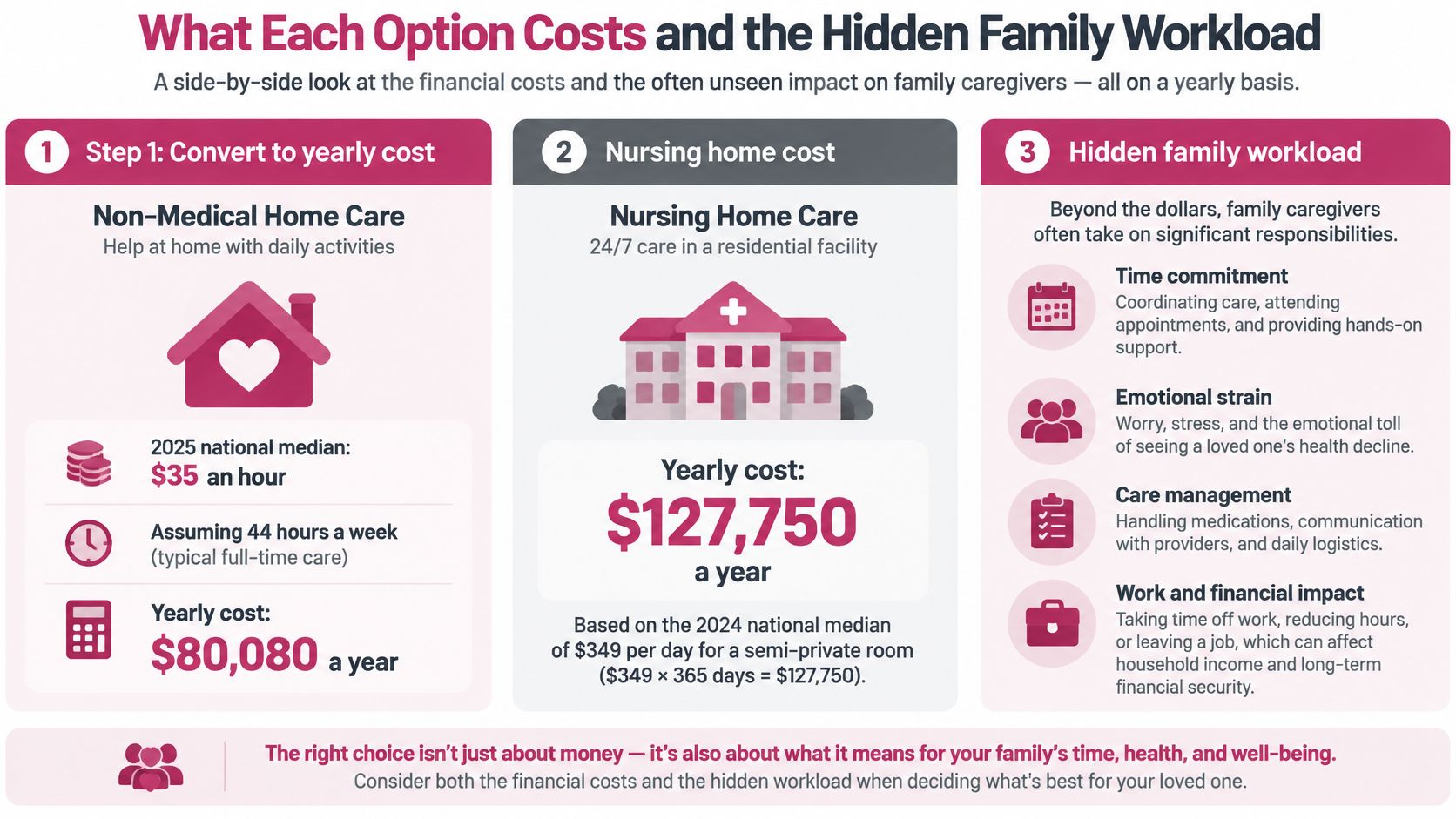
Don't compare an hourly home care rate with a monthly facility bill. Put both on an annual basis, find the point where scheduled hours overtake the room rate, then price the unpaid work that the home care invoice leaves out.
Step One Convert Both Prices to a Year
The CareScout 2025 Cost of Care Survey results set the 2025 national median cost of non-medical home-care assistance at $35 per hour, approximately $80,080 annually when modeled at 44 hours per week. The same survey put a semi-private nursing-home room at a median of $315 per day, or $114,975 annually, and a private room at $355 per day, or $129,575 annually. Its data were collected nationally from long-term-care providers between July and November 2025.
| Option | Rate | Cost estimate |
|---|---|---|
| In-home care, national median (non-medical aide, 44 hours a week) | $35 per hour | $80,080 a year |
| In-home care, break-even against a semi-private room | $35 per hour | About 63 hours a week, about $114,975 a year |
| Nursing home, semi-private room, national median | $315 per day | $114,975 a year |
| Nursing home, private room, national median | $355 per day | $129,575 a year |
The break-even is simple arithmetic. At $35 an hour, roughly 63 paid hours a week cost about the same over a year as the semi-private room. Below that level, home care can cost less in direct payments. Above it, the facility may cost less even before household expenses enter the calculation.
New Jersey families should also localize the comparison. The New Jersey median cost for a nursing home semi-private room is $12,775 a month. In-home care averages $30 to $38 per hour for licensed non-medical aide assistance, and total monthly expenses depend on how many weekly hours are scheduled. Home care schedules range from a few hours a week to full 24/7 care, so ask for your schedule priced in full. Our guide to how much home care costs can help you structure that request.
Step Two Compare Packages, Not Rates
The modeled home care figure covers 44 hours a week. It doesn't, by itself, provide overnight supervision, continuous nursing, meals, facility-based rehabilitation or round-the-clock emergency response. Nursing-home pricing bundles lodging, meals, staffing, routine monitoring and 24-hour availability.
That bundling explains why a simple price ranking misleads. Four hours of aide service a day may be an excellent buy for bathing, lunch and a safety check. It isn't one-sixth of a nursing home in any practical sense, because it leaves the remaining 20 hours to the senior, family members or additional paid help.
Step Three Count the Family's Unpaid Hours
Now list the work that continues after the aide leaves:
- Overnight supervision: Being available for toileting, confusion, falls or wandering.
- Missed work: Leaving early for appointments, covering cancellations or handling emergencies.
- Transportation: Driving to clinicians, pharmacies and therapy, plus waiting time.
- Medication coordination: Ordering refills, organizing doses and watching for missed tablets.
- Backup coverage: Replacing an aide who cancels, sometimes with little notice.
- Household costs: Supplies, food, utilities, transportation and home modifications.
Families frequently report insufficient service duration and content, difficulty finding information and poor continuity. Even when the paid service performs well, someone still owns the gaps between visits. If that person is reducing paid work, sleeping badly or performing transfers they can't do safely, the home plan has a cost. It doesn't appear on the agency invoice.
Analyst's rule: If family labor is required for safety, count it as part of the care package. A plan isn't cheaper because its hardest hours are unpaid.
Payment sources require the same precision. Medicare generally covers only short skilled rehabilitation stays, so ask each provider which parts of the proposed plan are private pay and which require a clinical order or eligibility decision. Don't build a long-term budget around a short rehabilitation benefit.
Ask for a written care plan before relying on any rate. It should show total weekly hours, weekend and overtime treatment, backup coverage, supplies, transportation and likely home modifications. Compare that complete weekly schedule with the facility room rate. If required coverage approaches the break-even, or family members are filling unsafe nights to stay below it, the nursing home may be the more honest and sustainable purchase.
Confirm the Setting Before You Sign
Finish the decision on paper before touring schedules and sales conversations narrow your attention. You're testing whether a specific provider can meet specific needs at a sustainable total cost.
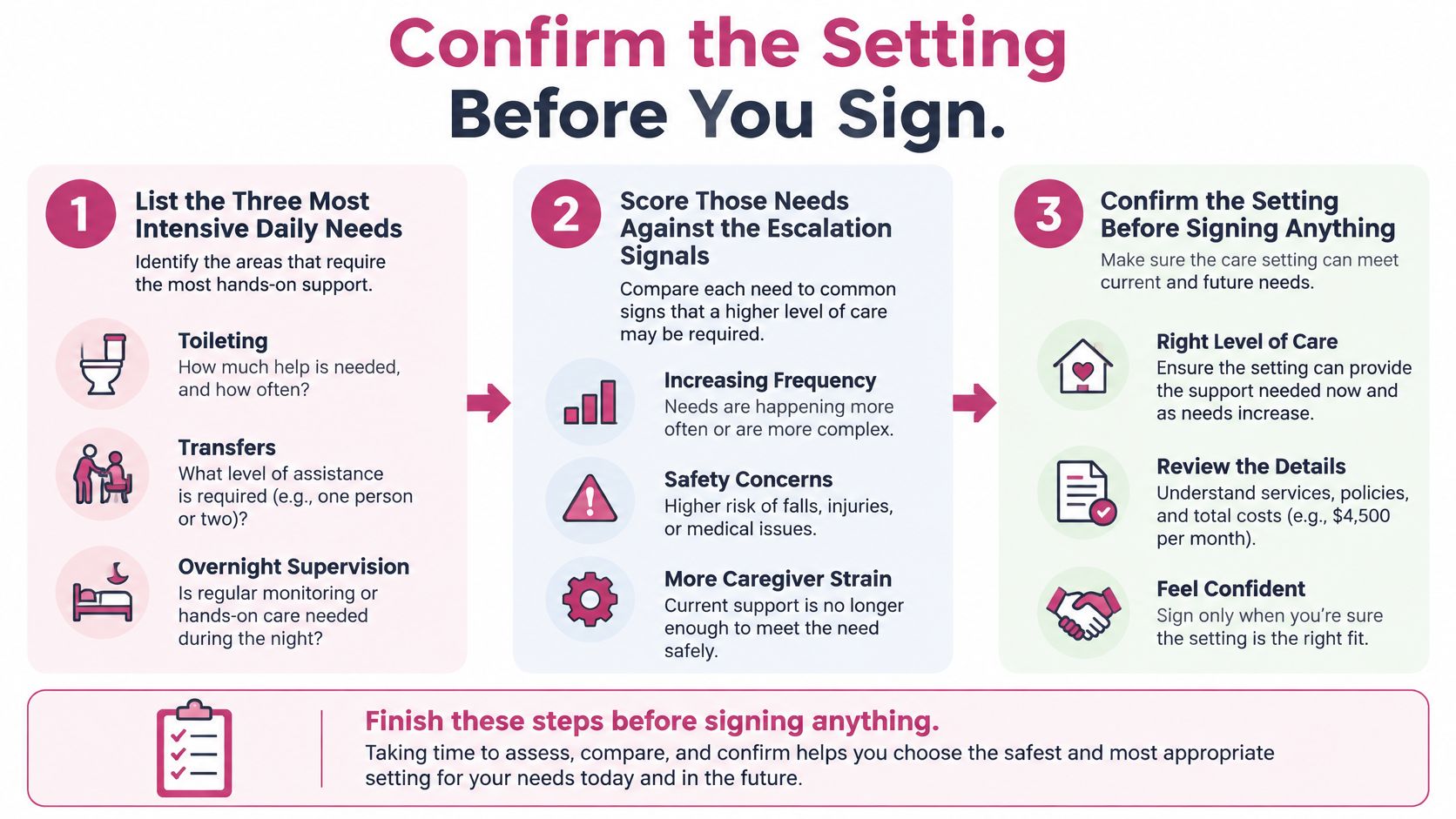
A Four Step Confirmation Check
- List the three most intensive daily needs. Write down the hardest tasks, such as toileting, transfers, medication oversight or overnight supervision. Include when each happens and what goes wrong if nobody helps.
- Score the escalation signals. Mark repeated nighttime help, wandering, frequent falls, complex medication needs and lack of backup. One signal calls for a stronger plan. Two or more together usually mean the home setup has reached its limit.
- Total every weekly hour. Add scheduled visits, gaps, nights, family coverage and backup time. Compare that total with the break-even for paid home care, then ask whether family members can sustain their share.
- Run the five staffing tests. Put vacancy, agency-staff use, call-out coverage, clinical supervision and task training to each provider. Record the answers side by side so you're comparing systems, not impressions from separate conversations.
Follow the Branch Your Scores Support
If the scores point to a facility, compare nursing homes on license type, ownership and staffing stability. Ask how rehabilitation, dementia supervision or nighttime transfers are staffed on the least favorable shift, not only during a weekday tour.
If the scores point home, confirm the hour total and backup plan in writing and request the care plan before service begins. The document should name who's responsible when the regular caregiver cancels and who supervises clinical changes. Don't sign a schedule that only works when every family member stays healthy and available.
Life Senior Placement offers a care quiz that helps families narrow down what level of help makes sense. It also provides free, objective guidance to help families evaluate local options and choose care settings. Families can call Life Senior Placement at (862) 398-2006 for guidance on local assisted living and home care services.
Set a review date when care starts. A fall, hospital stay, new symptom, or caregiver change can alter the daily picture quickly, and a scheduled review prevents the family from absorbing each increase unnoticed. Revisit the three hardest needs, the unpaid hours, and the escalation score.
The setting should follow the most intensive daily need, not the average day, the lowest advertised rate or the family's hope that nighttime problems will stay rare.
If your scores point in different directions, use Life Senior Placement for free, objective help comparing New Jersey nursing homes, home care providers and other care settings against your family's needs, schedule and budget. An advisor can help you turn the checklist into a vetted shortlist, coordinate the next steps and revisit the choice if the care picture changes.