
In New Jersey, home care typically tracks roughly $33 to $34 per hour nationally, and a 44-hour weekly plan produces about $75,000 to $78,000 annually. That single figure understates a real family's bill because your schedule, your parent's clinical needs, and who you hire can shift the total dramatically. If you're pricing care this week, don't shop for the lowest hourly rate. Shop for the schedule that keeps your parent safe without paying for hours you don't need.
A Real Question With a Complicated Answer
An adult daughter in Parsippany opens three home care websites at her kitchen table after her mother comes home from the hospital. One agency lists an hourly rate, another pushes a live-in package, and a third won't quote anything until someone visits the house. She adds up what she thinks is a modest plan, then realizes she hasn't accounted for nights, weekends, or help with bathing.
That's the normal starting point. Families ask how much is home care expecting one number, then discover the question really contains four separate decisions. How many hours does your parent need, which tasks require a trained aide, where in New Jersey do you live, and what happens when the regular caregiver is sick?
Why a Few Hours Change Everything
A small scheduling mistake isn't small over a year. Add a morning visit you forgot to count, extend a shift because your parent can't be left alone after dinner, or discover that a two-hour need bills as a longer minimum shift, and the weekly total moves fast. Multiply that gap across months and you've built a budget that fails by winter.
I've sat with families who planned carefully around daytime help, then got blindsided by nighttime wandering. The daytime plan wasn't wrong. It was incomplete. The honest question isn't what care costs in the abstract. It's what your parent's actual week costs, including the risky hours you'd rather not think about.
Price the week your parent lives, not the week you wish they lived.
Start by writing down when help is needed, not when it's convenient to admit it. Note the morning routine, medication times, meals, toileting, transfers, and bedtime. Mark which moments involve fall risk or confusion. That map, not a headline rate, is what an agency will price, and it's what determines whether home care is sustainable or quickly outgrows your budget.
How Home Care Is Priced
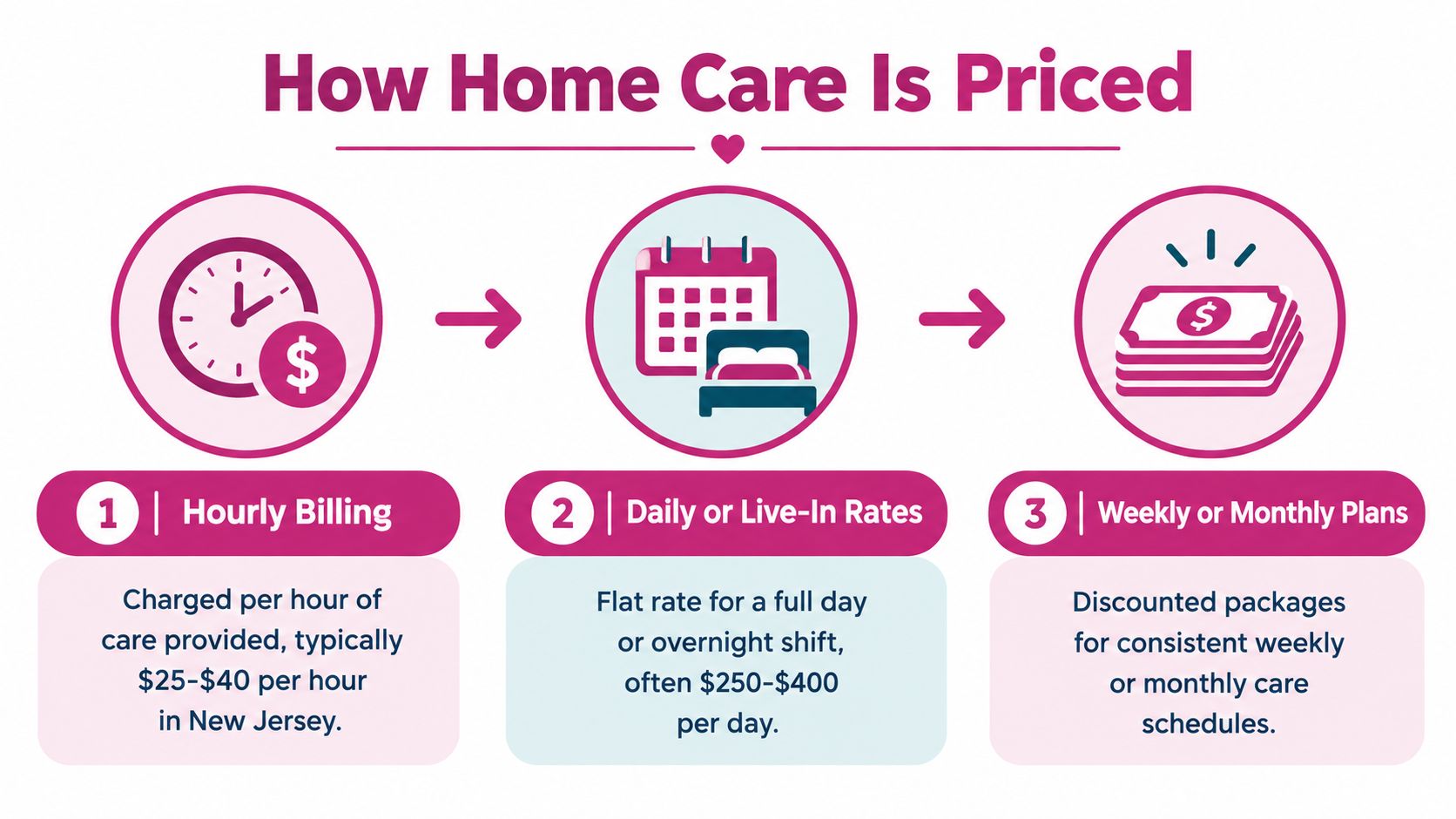
Most agencies sell care in two ways, and confusing them leads to bad comparisons. The first is hourly billing. You buy a block of time, the aide clocks in and out, and you pay for the hours worked subject to the agency's rules. The second is live-in care, where a caregiver stays in the home and you pay a flat daily or weekly rate tied to sleep time and breaks.
The visual below shows how those models are usually packaged before you ever see a contract.
What Hourly Billing Really Includes
Hourly quotes come with conditions you need in writing. Ask about minimum shifts, how partial hours are rounded, weekend or holiday differentials, and mileage if the aide drives your parent to appointments. A lower hourly rate with a long minimum can cost more than a higher rate for a short visit.
- Minimum shift: The shortest visit the agency will staff, which matters for bathing or medication help.
- Differential: Extra charges that may apply at night, on weekends, or on holidays.
- Mileage and errands: Whether driving, parking, and waiting time are billed separately.
- Assessment fees: Whether the initial evaluation and care plan are charged or included.
How Live-In Pricing Differs
Live-in care isn't 24 hours of active work at an hourly rate. Contracts define a set number of bed hours, uninterrupted sleep, and breaks. If your parent wakes repeatedly at night, the agency may say live-in no longer fits and move you to hourly round-the-clock staffing with multiple caregivers. That change can transform the bill overnight.
You also need to know who employs the caregiver. An agency handles screening, supervision, payroll, insurance, and replacements. A registry or independent hire may quote less because you're taking on employer duties and backup risk yourself. Before comparing any two quotes, confirm you're comparing the same model, and review the difference between home care and home health care so nonmedical help isn't priced as skilled care, or the reverse.
Typical Cost Ranges in New Jersey
Use national medians as a floor for planning, not as a promise for a New Jersey quote. Genworth and CareScout reported a national median hourly rate of $33 for homemaker services and $34 per hour for a home health aide in the 2024 Cost of Care Survey results. Homemaker services cover nonmedical household tasks such as cooking, cleaning, and errands. A home health aide provides hands-on help with bathing, dressing, and eating.
That distinction sounds tidy, but families often see the categories blur. The same survey noted that two-thirds of surveyed home care agencies charged the same rate for homemaker and home health aide services, a detail included in the source above. Don't assume light housekeeping will automatically bill at a bargain rate. Ask each agency how it defines the visit and which tasks trigger the aide rate.

Converting Hours Into a Household Budget
At the survey's common planning assumption of 44 hours of care per week, those medians equal $75,504 per year for homemaker services and $77,792 per year for home health aide services, as reported in the survey source cited earlier. That's the math families miss when they hear an hourly rate and think it's manageable. A full-time schedule at home quickly becomes a second housing payment, even before add-ons.
Build your estimate upward from your own schedule. Start with required hours, then add likely extras that headline figures leave out, such as holiday coverage, supplies, transportation, and reassessments as needs change. If you hire independently, employer costs sit on top of the caregiver's pay. If you use an agency, ask what's bundled and what's billed separately.
Budget rule: Get the all-in weekly price for your exact schedule, then judge the hourly rate inside it.
For a New Jersey family, I recommend treating the national median as a sanity check only. Get local written quotes, convert each one to weekly, monthly, and annual totals, and compare those totals side by side. That's how you spot a quote that's cheap per hour but expensive per week.
Why the Same Service Costs More in One Zip Code
Geography isn't a footnote in home care pricing. It's a budget driver. Labor supply, local wages, travel time, and demand shape what agencies must charge to staff a shift reliably. A family member in another state paying less doesn't mean you're being overcharged in New Jersey.
The state comparison makes the spread concrete. According to Genworth and CareScout's release of the 2024 survey, California annual medians were $86,944 for homemaker services and $89,232 for home health aides, compared with Georgia at $64,064 and $66,352, a gap of roughly $22,880 per year in both categories.
Annual Home Care Costs by Location
| Location | Homemaker Services (Annual) | Home Health Aide (Annual) |
|---|---|---|
| National median | $75,504 | $77,792 |
| California | $86,944 | $89,232 |
| Georgia | $64,064 | $66,352 |
The monthly view helps families who budget by paycheck. The same release puts California at roughly $7,245 per month for homemaker services and $7,436 for a home health aide, while Georgia sits near $5,339 and $5,529, figures reported in the source cited above. That's not a rounding error. It's the cost of staffing care in a different labor market.
Growth rates also diverge, so last year's quote goes stale at different speeds. Georgia homemaker costs rose 12% and home health aide costs rose 7%, compared with California increases of 6% and 5%, according to the release cited above. Nationally, homemaker services increased 10% while home health aide services increased 3% in that survey year.
Don't import a sibling's out-of-state number into a New Jersey plan. Collect several local quotes for the same tasks and schedule. Differences between nearby agencies can reflect staffing depth, supervision, travel distance, and what's included. Pay attention to those differences, because the cheapest local quote can become the most expensive if it can't reliably fill shifts.
Matching the Schedule to the Real Need
Your schedule shape determines your pricing lane. Families rarely need a generic block of care. They need help at specific, sometimes awkward moments, and those moments don't all bill the same way.
The breakdown below maps common schedules so you can place your parent's routine in the right category before requesting quotes.
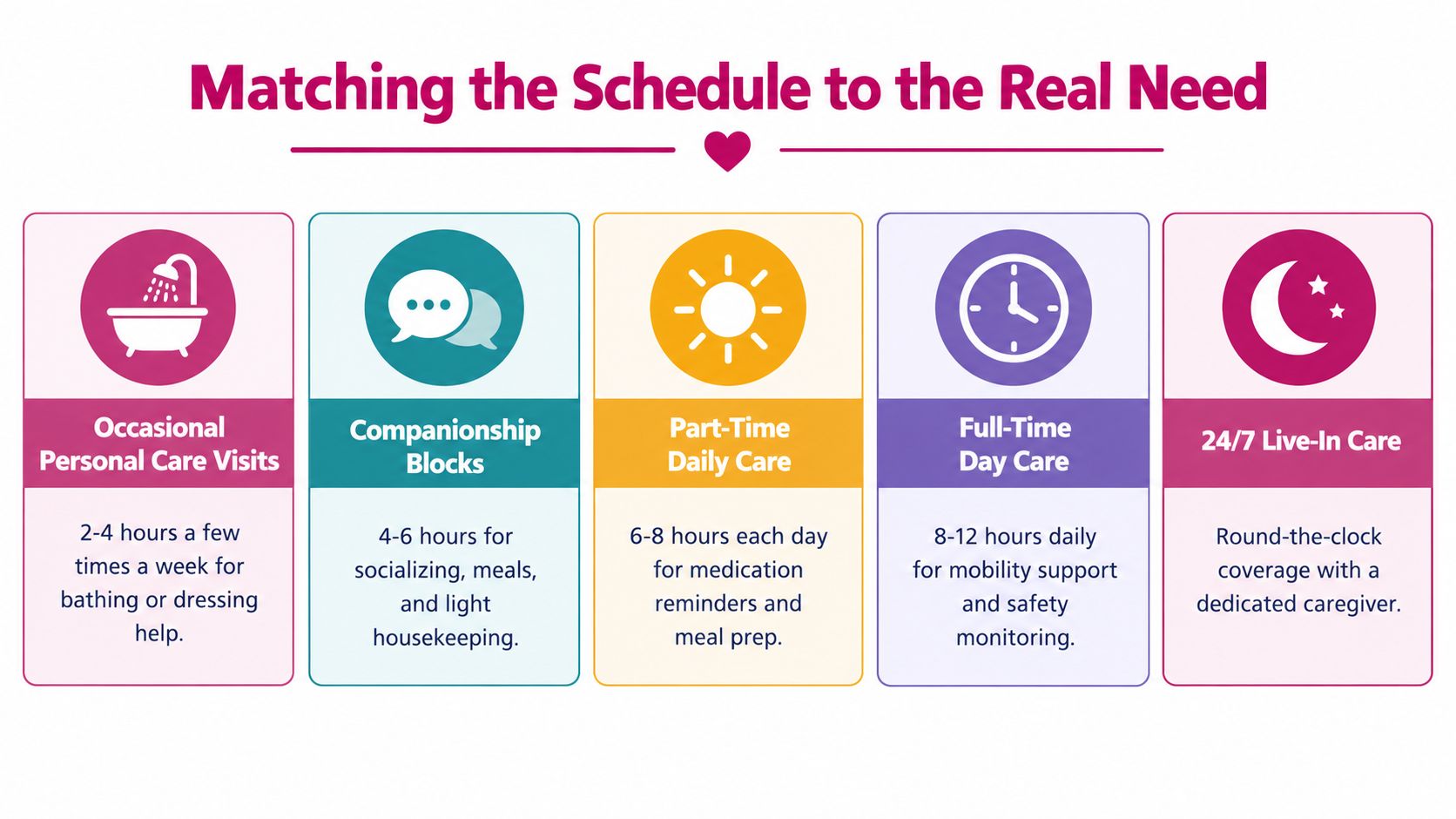
Five Schedule Shapes to Price Separately
- Occasional personal care: Short visits for bathing, dressing, or medication setup, where minimum shifts and travel can dominate the price.
- Daily blocks: Morning or daytime coverage for meals, mobility, supervision, and household tasks, usually the easiest shape to staff consistently.
- Overnight supervision: Night coverage for toileting, wandering, or fall risk, priced according to whether the caregiver can sleep or must stay awake.
- 24/7 care: Continuous coverage through live-in arrangements or rotating hourly shifts, with very different costs and sleep rules.
- Skilled nursing: Clinical tasks that require licensed staff rather than a nonmedical aide.
The skilled lane changes the math entirely. CareScout's 2025 Cost of Care Survey release placed the national median for non-medical home care at $35 per hour, equivalent to $80,080 annually at 44 hours weekly, with private-duty nursing at $90 per hour or $160 per visit. Don't pay nursing prices for companionship, and don't ask an aide to perform clinical work outside their scope.
Continuous hourly coverage deserves special caution. When a person needs constant supervision, the same hourly logic that looks reasonable for a daily visit can exceed $25,000 monthly, a scenario described in connection with the 2025 figures cited above. At that point, compare live-in rules carefully and weigh facility options too, especially when deciding between home care and assisted living for a spouse in New Jersey. Loyalty to staying home shouldn't override safety or arithmetic.
Five Factors That Move the Final Number
Five variables explain most of the gap between a quoted rate and the invoice you pay. Review each one before you sign, because agencies structure them differently.
The checklist below summarizes where quotes diverge after the headline hourly figure.
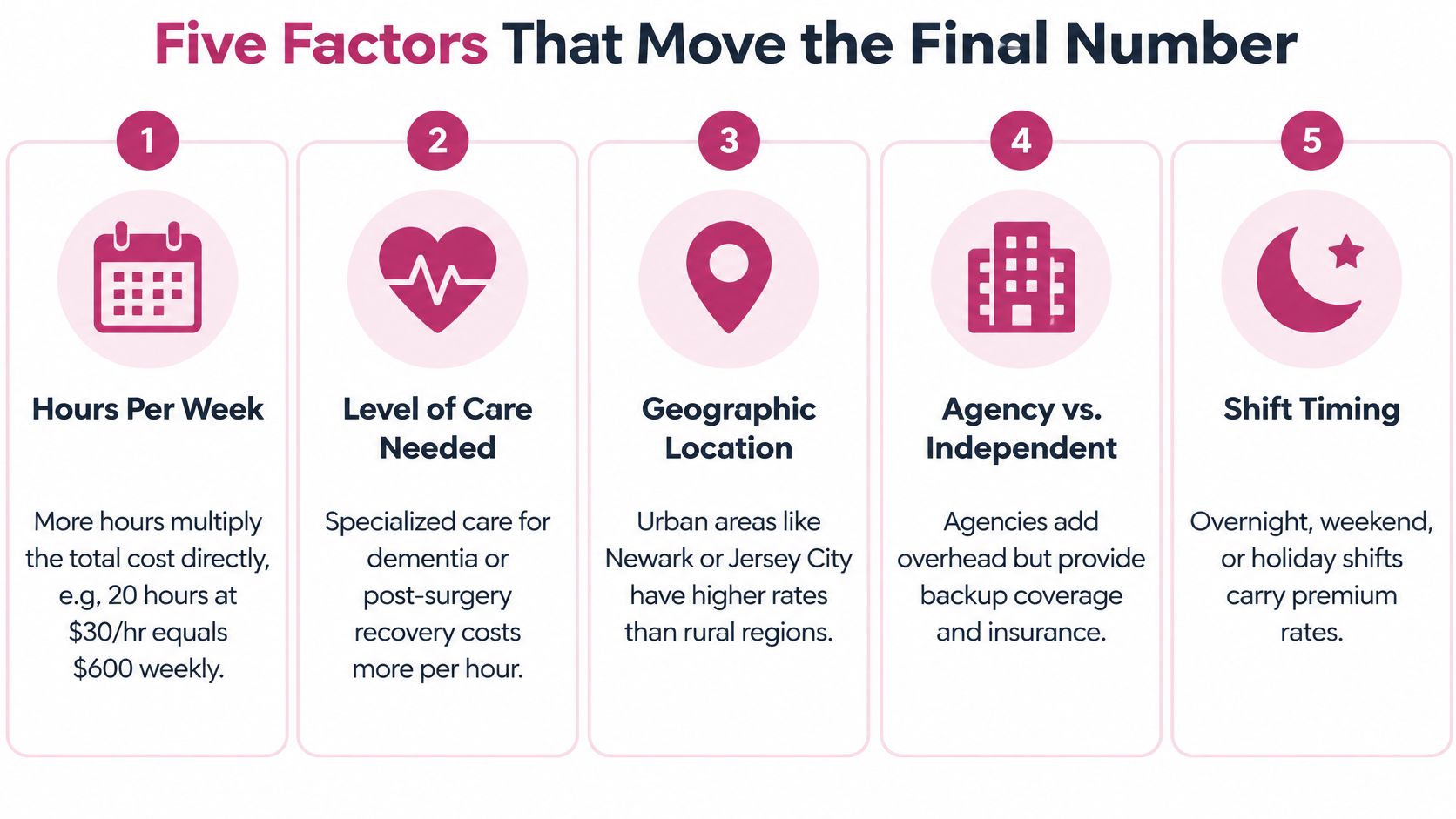
Hours per week is the multiplier. More hours don't just add cost, they can push you into overtime, multiple caregivers, or a different pricing model. Clinical complexity comes next. Dementia behaviors, transfers, incontinence care, wound-related tasks, and post-surgical limits require more experienced staff and closer supervision, and some tasks require licensed clinicians.
Agency versus independent hiring reshapes the comparison. Agency pricing typically bundles screening, payroll handling, insurance, supervision, and replacement coverage. An independent caregiver may quote a lower wage, but you carry employer responsibilities and you solve callouts yourself. Backup coverage isn't a luxury when your parent can't be left alone. It's part of the actual price.
Watch the video below for additional context on evaluating care arrangements before you lock in a schedule.
Contract Clauses Worth Reading Twice
- Minimums and surcharges: Short-visit minimums, holiday rates, mileage, and fees for schedule changes.
- Rate changes: How much notice you get before an increase and whether any rate lock applies.
- Cancellation terms: What you owe if a shift is cancelled late or care ends suddenly.
- Backup guarantee: Who arrives when the assigned caregiver calls out, and how quickly.
If a quote looks unusually low, one of these five factors is probably missing from it. Ask directly what's excluded. A transparent agency will answer without dodging.
Ways New Jersey Families Actually Pay for Home Care
Private pay is the fastest route, but it isn't the only one and it shouldn't be your default without checking benefits. Families often combine sources, using savings for immediate shifts while insurance or public benefits are evaluated. Plan for a gap between needing care and any benefit paying.
Long-term care insurance can help if your parent bought a policy years ago, but read the elimination period and daily benefit limits closely. You may need to fund an initial waiting stretch yourself, submit detailed documentation, and use providers that meet policy terms. Call the carrier before care starts, not after invoices pile up.
Public and Veterans Benefits to Investigate
Medicaid-funded home and community services may support eligible New Jersey residents who meet financial and clinical criteria, but eligibility, enrollment, and covered services require careful review. Start with New Jersey's Managed Long Term Services and Supports guide to understand how the state program is structured before assuming it will cover your parent's schedule. Don't spend down assets or transfer money without qualified advice, because timing and documentation matter.
VA Aid and Attendance may assist eligible veterans and surviving spouses with care costs, subject to service, health, and financial requirements. It won't solve an urgent staffing need this weekend, so treat it as part of a longer funding plan. Keep discharge papers, medical evidence, and care invoices organized from day one.
Apply for benefits in parallel with arranging care, not after the savings account is drained.
Medicare surprises families most often. It may cover limited, medically necessary home health under specific conditions, but it generally doesn't pay for ongoing custodial help with bathing, meals, and supervision. Build your budget as if you'll fund nonmedical care yourselves, then treat any benefit that arrives as relief, not as the foundation.
Building a Real Estimate and Stress-Testing the Quote
Build your estimate in this order. First, list the actual weekly schedule by day and hour. Second, classify each task by who is qualified to do it. Third, get at least three local written quotes for that identical schedule. Fourth, line up how each week gets paid. Don't skip steps because an agency offers to start tomorrow.
Stress-Test Before You Sign
- Callout test: Ask who covers when the caregiver is sick and how much notice you'll receive.
- Night test: Confirm whether nighttime waking changes live-in pricing or requires awake staff.
- Growth test: Ask how the price changes if mobility worsens or dementia behaviors increase.
- Exit test: Review cancellation, rate increases, and minimum commitments in writing.
When the safe plan costs more than the affordable plan, say so openly and solve the core problem. You may need to cover the highest-risk hours first, use family help in lower-risk blocks, reconsider live-in rules, or compare assisted living and memory care instead of stretching home care past its safe limit. A placement service such as Life Senior Placement can support that comparison through structured intake, curated matches with vetted New Jersey providers, and coordinated tours and side-by-side reviews.
A good estimate starts with your parent's real week and ends with a quote you've pressure-tested. Anything less is a guess with a dollar sign attached.
If you're trying to turn a confusing hourly quote into a weekly home care budget you can sustain, Life Senior Placement offers no-cost advisor guidance to document your parent's needs, compare vetted New Jersey home care and senior living options, and coordinate next steps. Visit the site to start with your real schedule, your budget limits, and the level of care your family needs, then get a shortlist built around those facts instead of a generic median.