
A discharge planner slides a form across the table. One line says ADLs and asks for checkboxes about your father. You know he showers and eats. What you are unsure about is whether transferring means getting out of a chair or getting into a car, and how much detail the form expects.
The activities of daily living are the six self-care tasks a person performs each day to stay clean, fed, dressed and safe: bathing, dressing, eating, toileting, transferring, and continence. Transferring means moving between positions, such as from a bed to a chair, rather than travel. Assessors use the list to sort people by how much help they need, not to name a diagnosis. That sorting touches nearly everyone in care. Most residents of U.S. Residential care communities need help with several of these tasks, and only a small share need none at all.
The form flattens all of that into yes or no. Two women can both tick needs help dressing and land in different settings. One needs her blouse laid out on the bed. The other needs hands guiding her arms through the sleeves. Same box, same task, very different care. What decides placement is less the count of checked boxes than how much help each task takes, and trouble usually shows first in cooking, errands, and pills rather than in the shower.
The Six Activities of Daily Living at a Glance
Six tasks sit at the center of every care assessment, and each one is ordinary enough that families are surprised it has a clinical name. Bathing, dressing, eating, toileting, transferring and continence sound like a description of a normal morning, because that is what they are. The list earns its place on forms because losing one of them changes what a day requires.
The wording most assessors use comes from the Katz Index of Independence in Activities of Daily Living, developed in the early 1960s and published in 1963, and its six-item frame still sits inside newer tools. When researchers applied that frame to National Health and Nutrition Examination Survey data from 2005 to 2012, adults 75 and older reported more difficulty than adults 65 to 74 on several core tasks:
- Getting in or out of bed: 18% of adults 75 and older versus 11% of adults 65 to 74.
- Dressing: 15% versus 9%.
- Walking between rooms on the same floor: 15% versus 7%.
- Using a fork, knife, or drinking from a cup: 8% versus 3%.
The same data draws the line that confuses families most. A person can still button a shirt yet be unable to shop for food, cook it or keep pills straight, so assessments split daily tasks into two groups. Activities of daily living (ADLs) cover care of the body. Complex activities of daily living (IADLs) cover running a household. Slipping on an IADL is usually the earlier, quieter warning, while slipping on an ADL points toward hands-on personal care.
| ADL | What It Covers | Everyday Sign of Needing Help |
|---|---|---|
| Bathing | Washing the body, showering or bathing safely | Skipped washing, needs help in and out of the tub or shower |
| Dressing | Choosing clothes and putting them on, including fastenings and shoes | Clothes put on incorrectly, or left half dressed |
| Eating | Feeding oneself, using utensils and drinking from a cup | Trouble using a fork, knife or cup, or unexplained weight loss |
| Toileting | Getting to the toilet, using it and hygiene afterward | Accidents, rushing, or slow transfers to the toilet |
| Transferring | Moving between bed, chair and standing | Needs a hand, a lift or a transfer aid to stand or sit |
| Continence | Controlling bladder and bowel function | Frequent leaks or accidents even with toilet access |
| Walking | Moving around the home on level ground | Holds furniture for support, unsteady, or needs a walker |
Read the last two rows carefully. Some lists fold walking and bed mobility in as extra ADLs, while the Katz six treat transferring and continence as the pair. A form with seven rows is a fuller version of the same idea.
Treat the rows as a screening list rather than a verdict. They name which task to watch, and they stay silent on how much support that task needs, which is the figure that decides where a person can safely live. Which IADLs gave way first, and how much hands-on help each ADL now requires, usually say more than how many boxes are ticked. Support is still planned task by task wherever it is arranged, and the service list on a page about disability home care in Australia is laid out the same way, one daily task at a time. The list narrows the search and leaves the decisive question open.
How Assessors Measure the Level of Help
That bathing row hides a wide range. One resident needs a grab bar and a reminder to step in. Another needs two staff members and a mechanical lift. Both get the same tick, and one of them is fine at home while the other isn't.
The CMS long-term-care assessment guidance treats this as the central distinction, defining an ADL limitation as the inability to perform the activity independently without special equipment, or not performing it because of a health condition. The limitation can be temporary or chronic. What separates the two residents isn't the task. It's the assistance level.
| Help Level | What It Means | Example |
|---|---|---|
| Independent | Completes the task safely with no cues or equipment | Showers alone with no grab bars needed |
| Setup or cueing | Needs items laid out or verbal prompts to start or finish | Clothes laid out, or reminded to change |
| Supervision | Completes the task but needs someone present for safety | Standing nearby during bathing |
| Limited physical help | Needs hands-on help for part of the task | Help lifting a leg into trousers |
| Extensive or total help | Caregiver performs most or all of the task | Fully assisted transfer from bed to chair |
What the assessment actually records
CMS assessments document what the resident did during the preceding seven days, including whether staff gave verbal cues, supervision, or physical help. That's more useful than a diagnosis list, because a diagnosis of arthritis doesn't tell you whether someone can get her sleeves on.
A structured intake records five things for every ADL: the assistance level, any equipment used, whether the person can start the task, whether they can finish it, and whether performance changes from day to day. CMS also flags eating, toileting, bed mobility, and transferring as late-loss ADLs, the ones that tend to disappear last and therefore carry the most weight in care planning.
Picture a woman who showers herself completely but needs a reminder at 8 a.m. And again at 6 p.m. She is not independent at bathing. She belongs in the cueing row, and that row means someone has to be in the building. Her neighbor, who bathes unaided, does not.
A New Jersey assisted living nurse assessment walks through this kind of rating task by task, which is why the two-hour version often produces a different answer than the five-minute one. For every ADL on the list, the question is narrow and answerable: cueing, supervision, hands-on help, or total care?
How to Read a Katz Index Score
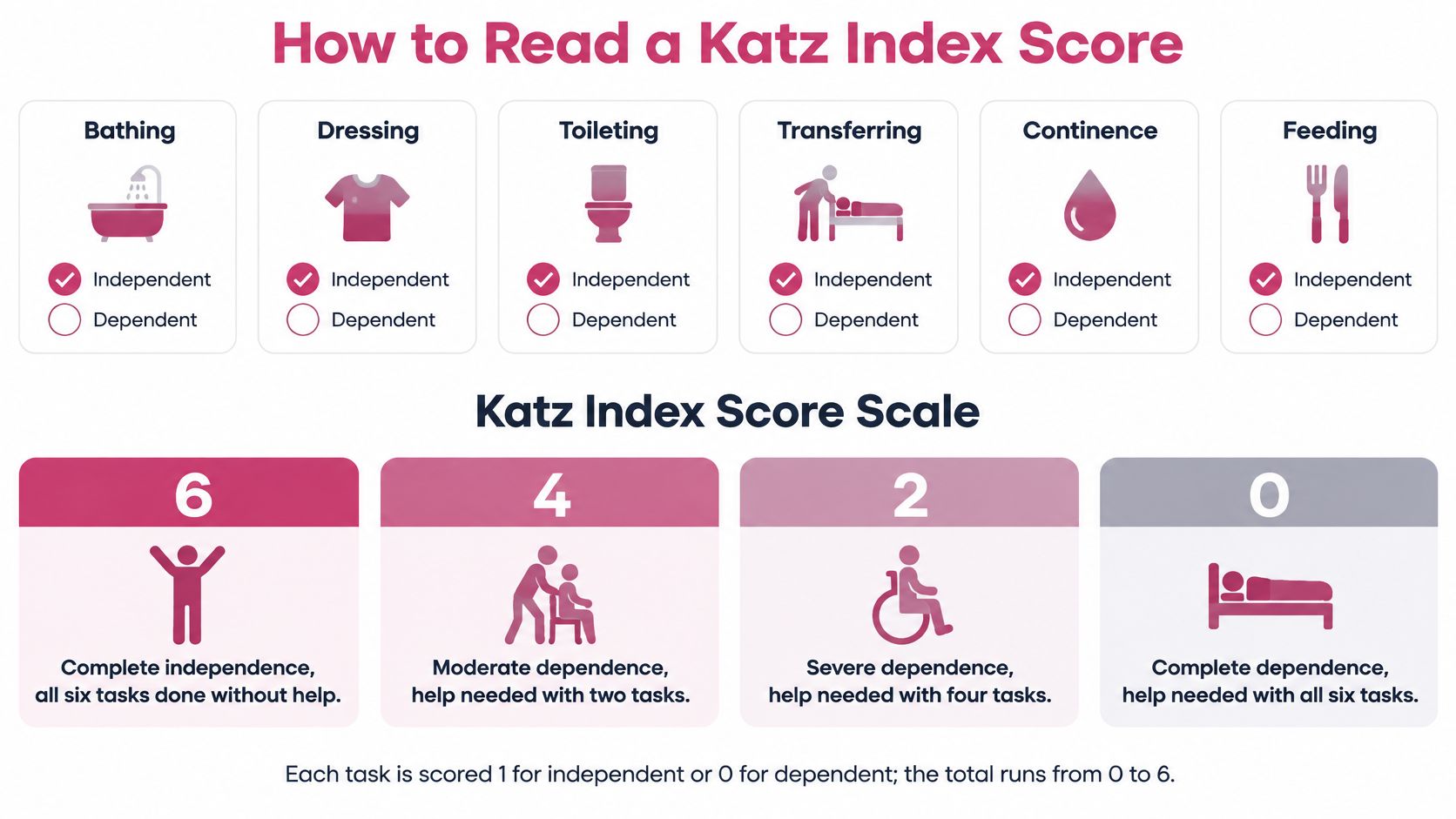
The Katz Index reduces the six tasks to a score. Each task is rated independent or dependent, and the total runs from 0 to 6. A 6 means complete independence, 4 indicates moderate impairment, and 2 or less indicates severe functional impairment, as the Katz Index measure summary from the Shirley Ryan AbilityLab sets out.
| Katz Score | Interpretation |
|---|---|
| 6 | Complete independence in all six basic ADLs |
| 5 | Help needed with one task |
| 4 | Moderate impairment |
| 3 | Help needed with three tasks |
| 2 or less | Severe functional impairment |
Here's where the number stops being enough. The same summary is blunt about the limit: the Katz Index measures basic self-care only and does not cover medication management, shopping, finances, meal preparation, or telephone use. Someone can score 6 and still be unsafe alone, because the tasks that keep a person alive in an apartment, taking the right pill at the right dose, noticing the stove is on, paying the electric bill, sit outside the scale entirely.
That's why a score is a starting point, not a placement decision. A fuller picture combines the standardized score with direct observation, an interview with whoever sees the person most often, cognition and safety screening, and a record of change over time. CMS pairs that assessment with matched supports: grab bars or raised toilet seats for toileting, transfer boards or walkers for mobility, adapted utensils or cups for eating, each tied to a measurable care-plan goal.
The useful question for a family isn't "what diagnosis does she have?" It's "which exact tasks need cueing, supervision, setup, or hands-on help, and can this setting deliver that every day?"
Why Everyday Tasks Slip Before Self-Care Does
A man who showers, dresses, and feeds himself every morning can still be in real danger at home. The tasks that keep a household running tend to break down before self-care does, and none of them appear on the six-item list.
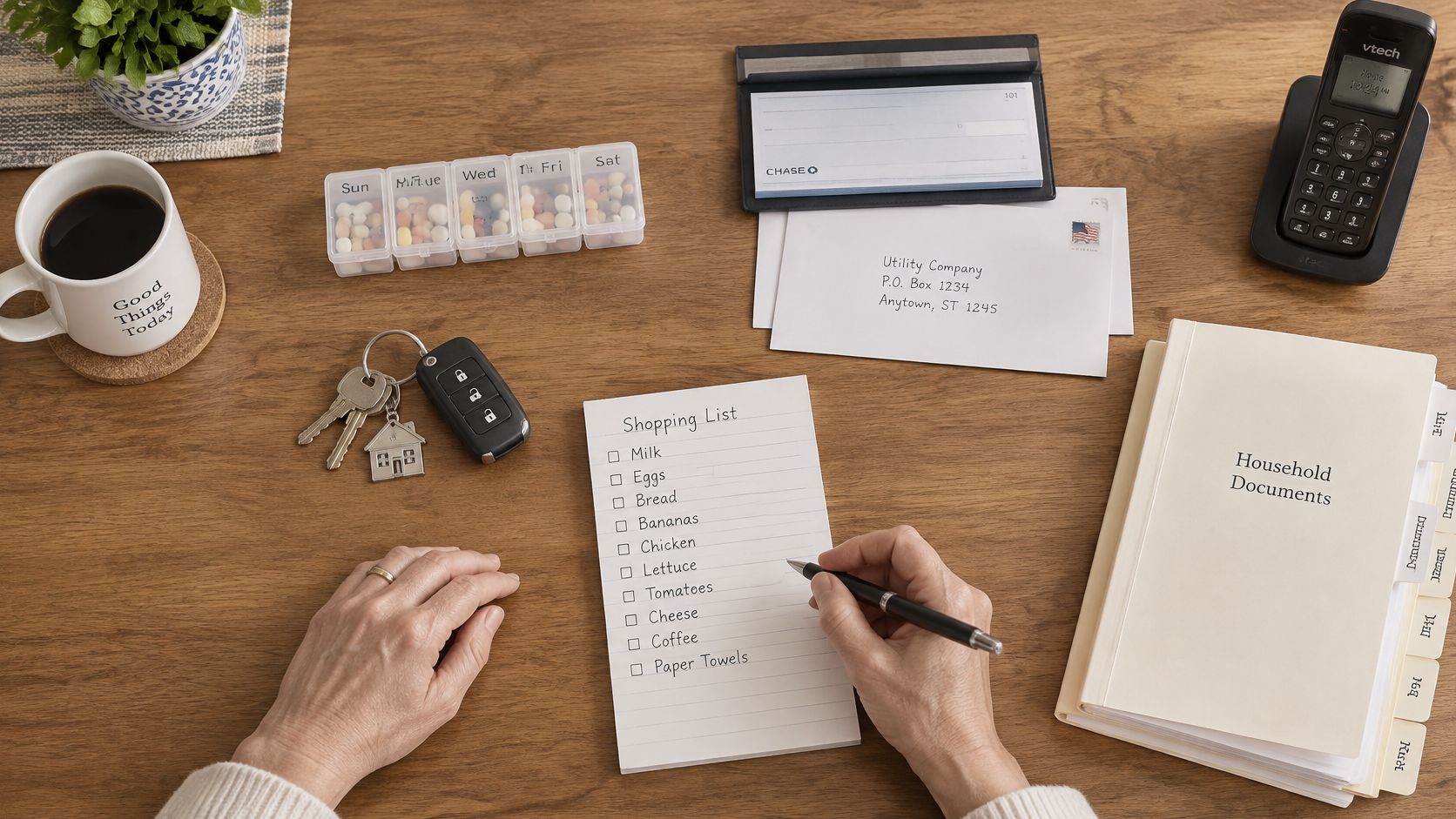
There is a reason for the order. Cooking asks a person to plan a meal, remember ingredients, time several burners, and notice the stove is still on. Dressing is a two-minute routine done in the same order every morning. Tasks that demand planning, sequencing, and judgement give way first. Overlearned physical routines hold on longest.
Longitudinal data from China, published in Scientific Reports, traced the order in which limitations appear, and the sequence undercuts the assumption that a person who bathes and dresses independently has low care needs:
- Early 70s: housekeeping, toileting, money management, and cooking are usually the first to go.
- Late 70s: shopping, bathing, transferring, and dressing follow.
- Early 80s: medication management and continence often become limited.
Read that list again. Money management and cooking tend to decline several years before dressing does. So the family who reports "she's fine, she still showers every day" may be describing a person who hasn't cooked a meal or opened her mail in months.
The signs families notice but dismiss
Watch for unpaid or duplicated bills, missed or doubled doses, spoiled food in the fridge, dents on the car, skipped meals, and mail piling up unopened. Each one can signal that planning, memory, and judgement are slipping.
Separate "done" from "done independently." A person who finishes a task only after a reminder or a spot check needs cueing, and cueing is a form of help. The output looks identical from the outside, which is exactly why families miss it. The same applies to every task on both lists: a clean shirt tells you nothing about whether someone else chose it, laid it out, or fastened the buttons.
Some of these signs also have fixable causes. Joint pain is a common reason someone stops managing meals and housework, and staying active with arthritic knees covers movement strategies that can buy back some function before anyone assumes it's gone for good.
What these combinations suggest is practical, not diagnostic. Medication errors plus unsafe driving point to supervision and pharmacy support. An inability to cook safely alone points to delivered meals or a communal dining room. New wandering on top of a neglected house points to a memory assessment. Report each one to the doctor or care team instead of filing it under "getting older."
What Changes ADL Performance and What Restores It
An ADL score is a snapshot, not a prognosis. Pain, timing, equipment, and rehabilitation move the number in both directions, and a checklist filled out on a bad afternoon can send a family toward a decision they don't need to make yet.
In a 2025 study of 2,992 community-dwelling adults aged 60 to 106, published in Scientific Reports, pain was associated with more limitations across every measured ADL and IADL. Bathing limitations rose by 17.9%, urinary or fecal-control difficulties by 16.1%, and cleaning, shopping, and transportation limitations by roughly 14 to 15%. A aching hip doesn't just hurt. It changes what a person can do, and it changes what an assessor writes down.
The measurement problem makes it worse. Standard post-acute assessments may collect ADL information only at admission and discharge, which means a stretch of home-health care can pass with no record of whether the person improved, plateaued, or slid backward.
The practical split is between current ability and potential ability. Pain control, a course of physical or occupational therapy, assistive equipment, home modifications, and treatment of whatever caused the change can all restore function that looked permanently lost. Equipment alone can flip a rating: if standing from a deep seat is the specific failure, it's worth the time to browse senior lift chair options before concluding that a transfer always requires two people.
Say a woman can't bathe after hip surgery. Four weeks of therapy plus a grab bar and a shower chair often returns that task. An early placement decision, made from a score taken in week one, would have been premature and expensive.
Ask any provider two questions: how often do you reassess, and who records the change? If the answer is "at admission and discharge," the plan may not reflect the person in front of you.
Reassess after a hospitalization, a rehabilitation stay, a medication change, or a pain treatment. Those are the four events most likely to move a score, and each is a reason to redo the list rather than rely on last quarter's version.
Matching ADL Needs to New Jersey Care Settings
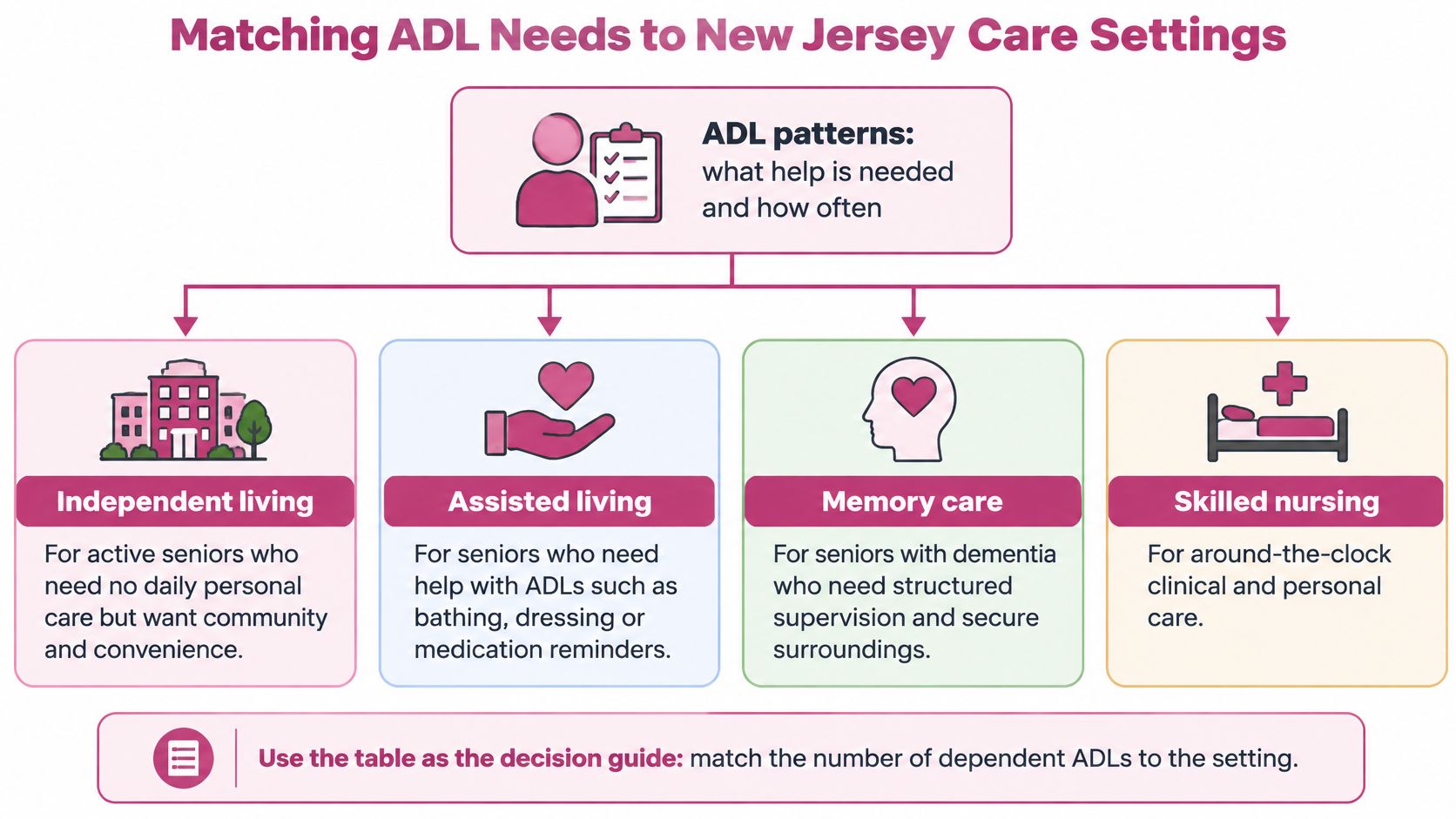
Start with the count, then look past it. The number of ADLs a person needs help with narrows the field of settings faster than any other single measure. In 2022, 62% of U.S. Residential care community residents needed assistance with three or more activities of daily living, while 12% needed no ADL assistance, according to the National Center for Health Statistics.
| ADL Pattern | Setting to Consider | Why It Fits |
|---|---|---|
| Independent in all six ADLs, needs only home upkeep help | Independent living | Community and amenities without daily personal care |
| Help with one or two ADLs, stable over time | Home care | A caregiver visits so the person can stay at home |
| Help with three or more ADLs, every day | Assisted living | Regular personal care plus meals and medication support |
| Cognitive decline drives safety needs, wandering or confusion | Memory care | Secure building and dementia-trained staff |
| Total dependence or 24/7 clinical or rehabilitation needs | Nursing home | Round-the-clock clinical oversight |
Where the count gives way to other factors
The count only sets the starting point. Two people can need help with the same single ADL and land in different settings: a steadying hand at the shower door is a few morning visits from a home aide, while full washing and transfer help every day points toward a setting with staff on-site around the clock. The amount of help each task requires matters as much as the tally.
Cognition moves the decision earlier than the number suggests. A person who is independent in all six tasks but leaves the stove on needs a different building, not a lighter service package. Medication load works the same way, and so does night-time need: someone who is fine all day and confused at 2 a.m. Can't be served by a visiting aide who leaves at five.
At the other end, a person with three dependent ADLs and a clear mind may do well in assisted living for years, because the help needed is predictable and the setting is designed around it. Slipping IADLs such as cooking, medication management, or driving also tell you which direction things are heading, often before the ADL score catches up. Understanding levels of care before you tour keeps the conversation focused on staffing and routines rather than chandeliers and activities calendars.
New Jersey families also have public records worth reading. When we evaluate nearby residences at Life Senior Placement, we review state survey reports, physical safety standards, and operational histories, and that paperwork usually tells you more about a Tuesday afternoon than a brochure does.
Confirm Your ADL Needs Before You Choose a Setting
A score alone tells a provider very little. Two people can both "need help" with bathing and require completely different staffing: one needs a steadying hand at the tub edge, the other needs a full assist and two aides. Write down the version you need before you schedule a single tour.
- Rate each of the six tasks. Walk the table from the first section and write the help level each ADL needs today, plus any IADL that is slipping, such as medication, money, cooking, or driving. Note the evidence, not the impression: doubled doses, unopened mail, a dented bumper.
- Note what changed and when. Compare against the last hospital stay, the last medication change, or the last pain flare. Ask whether therapy, a grab bar, or a pain plan could restore a task before any placement decision gets made.
- Take the list to a provider and test it. Ask whether they can deliver those specific help levels day and night, at a cost and location your family can manage, then ask how often they reassess and who records it.
If you're not sure where the list points, our care quiz helps families narrow down what level of help makes sense, and you can call (862) 398-2006 to talk it through with someone who knows the New Jersey market.
The whole exercise fits on one page: the six tasks, the help level for each, the IADLs that concern you, and the equipment already in the house. Finish it before you tour anything.
Life Senior Placement works with New Jersey families on exactly this problem, matching people to assisted living, memory care, nursing homes, independent living, and home care providers at no cost to the family. The team uses the family's ADL list alongside verified listings to narrow down New Jersey communities and home care providers. Visit Life Senior Placement when you're ready to turn the list into tours.


