
About 14,591 Medicare-certified skilled nursing facilities, with 1,550,110 beds, provide this type of care in the United States (KFF). A skilled nursing facility, or SNF, is a Medicare-certified inpatient setting providing 24/7 medically necessary skilled nursing and rehabilitation, primarily for short-term recovery after hospitalization rather than long-term residence.
Your mother has fractured her hip. The hospital team says she's medically stable enough to leave, but she still needs help walking, medication monitoring, wound observation, and therapy before returning home. Then someone mentions a “SNF,” and suddenly you're expected to understand a system, choose a facility, and figure out what Medicare will pay.
The most important point is easy to miss: “skilled” describes the level of medical care, not a nicer residential setting. A skilled nursing facility may provide long-term nursing home care in the same building, but Medicare's SNF benefit is generally connected to a temporary period of medically necessary rehabilitation or treatment.
This guide explains what happens inside an SNF, which professionals provide care, how a typical stay unfolds, and how SNFs differ from assisted living and acute inpatient rehabilitation. It also addresses the question families often need answered first: will coverage pay only for rehabilitation, or can it pay for a long stay?
What Is a Skilled Nursing Facility
Your parent is leaving the hospital after a hip fracture. They are stable enough to leave, yet still need help walking, medication monitoring, wound observation, and therapy before going home. The discharge team recommends a skilled nursing facility, or SNF. Now your family must understand the setting, choose a facility, and determine whether coverage will support rehabilitation only or a longer stay.
In plain language, an SNF is a Medicare-certified inpatient setting where licensed professionals provide medically necessary nursing care and rehabilitation around the clock. The word “skilled” describes the level of medical care, not a nicer residence.
Each part of that definition matters:
- Medicare-certified means the facility meets federal requirements for participation in Medicare. Certification does not guarantee the same staffing, therapy program, specialty care, or resident experience at every location.
- Inpatient setting means your loved one lives there for a period of time instead of visiting for an outpatient appointment.
- Medically necessary skilled care means treatment calls for the training and judgment of licensed nurses, therapists, or other clinical professionals.
- Rehabilitation can include physical, occupational, or speech therapy to help someone regain function after illness, surgery, or injury.
- Around-the-clock nursing means clinical staff are available to monitor residents and respond to health needs at all times.
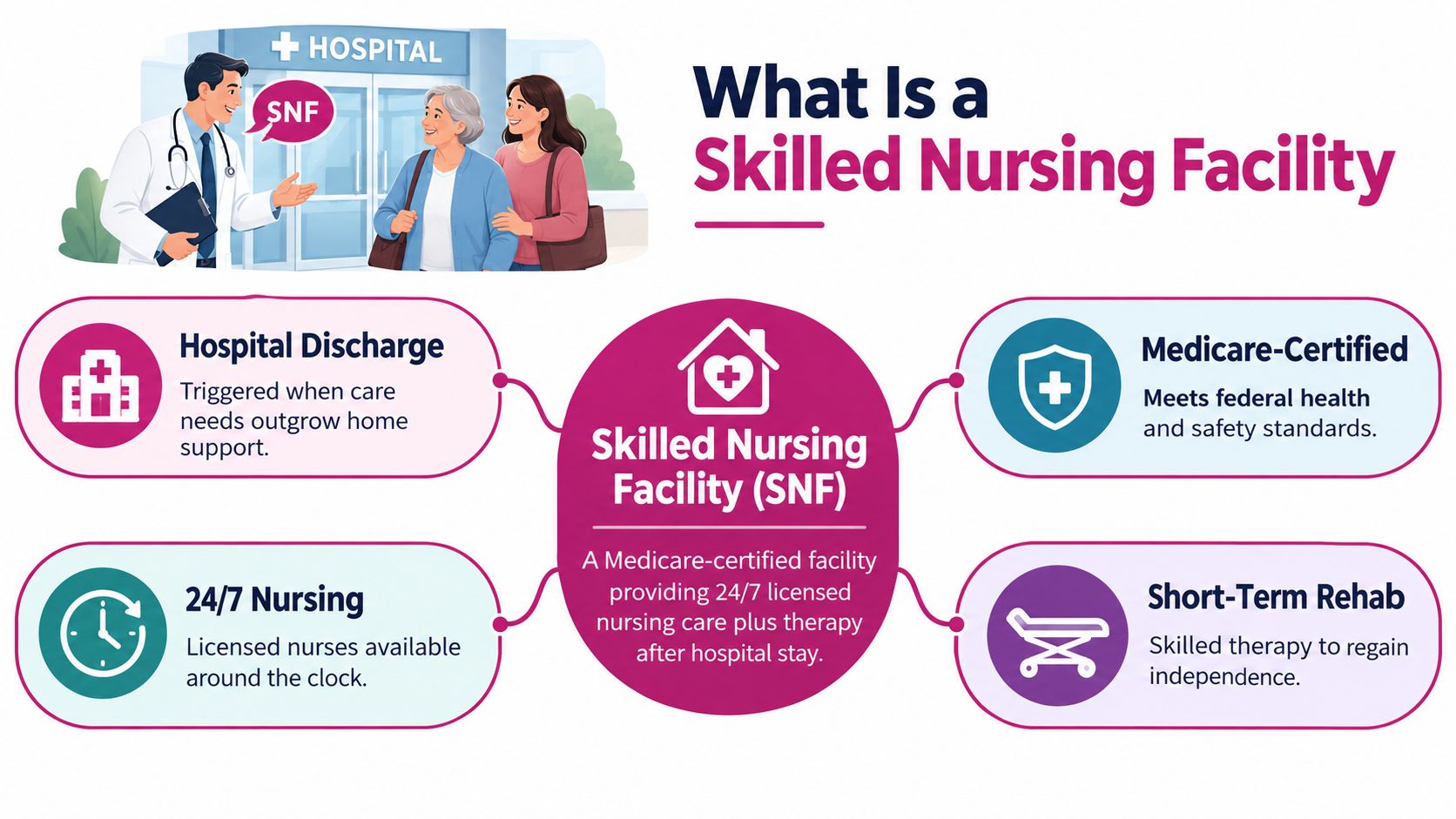
Skilled does not mean more luxurious
“Skilled” is not an upgraded version of assisted living. It refers to clinical complexity, such as therapy after hospitalization, IV treatment, or careful wound management. The term says nothing by itself about private rooms, décor, meals, or amenities.
A SNF may serve as a temporary recovery stop, or the same building may provide nursing home care after rehabilitation ends. More than 1.3 million people receive care in nursing homes or SNFs on any given day, while more than 4 million receive care each year (KFF). Those different uses matter when you ask how long your loved one may stay and what payment will cover.
Start by identifying the care needed now. Then ask how long those services are expected to continue and whether the expected coverage matches a short rehabilitation stay or ongoing nursing care.
The Medical Care That Makes Nursing Care Skilled
After a hospital discharge, a family may hear that a loved one needs a skilled nursing facility and wonder what “skilled” means. The term describes the level of medical care, not a more comfortable residence or a longer stay. Care is considered skilled when it requires the technical knowledge of licensed professionals, is ordered by a physician, and is provided under active clinical oversight (CMS).
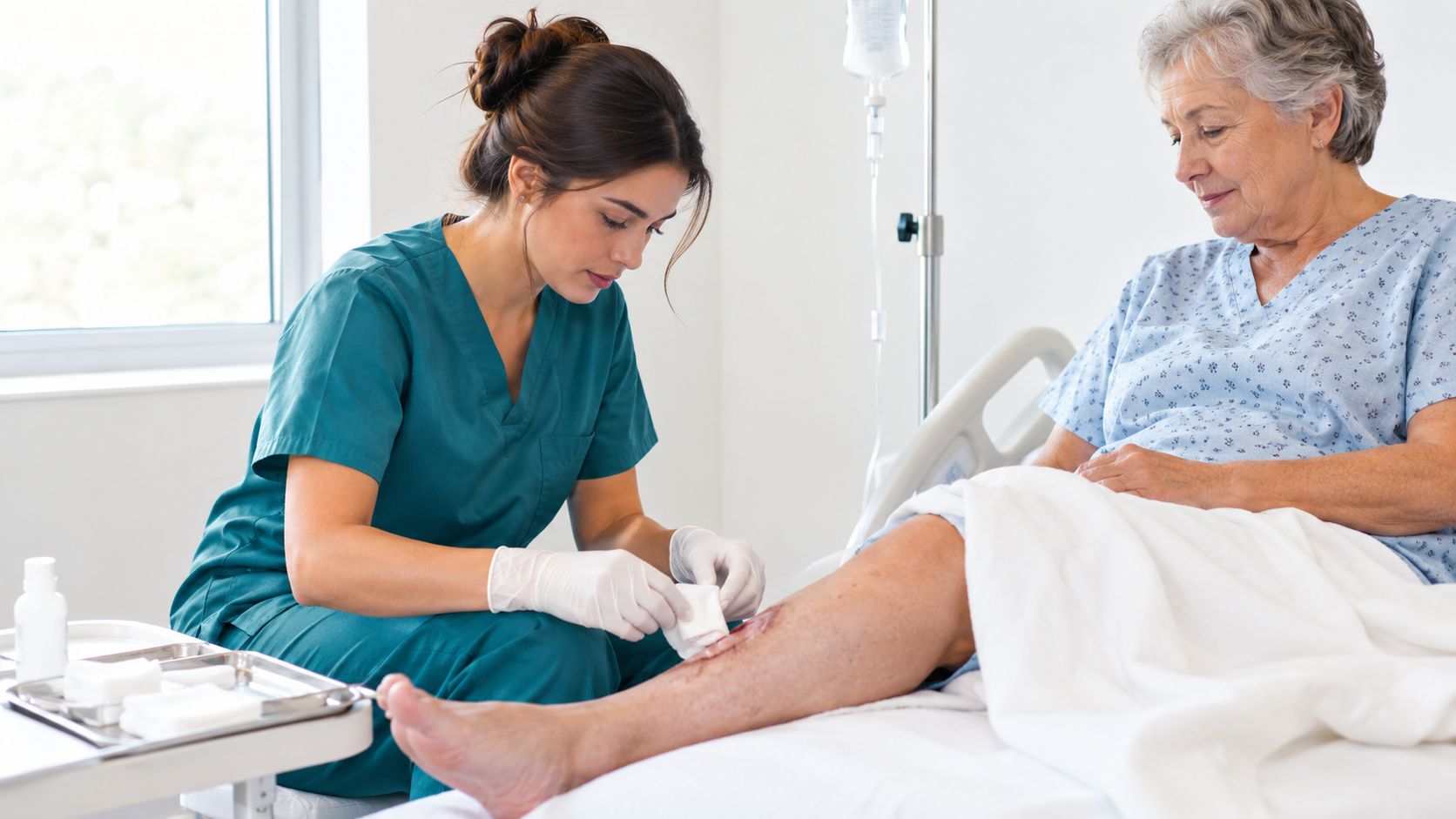
Examples of skilled care
A hospital may discharge someone who needs:
- Wound treatment, including assessment, specialized dressing changes, infection checks, and follow-up with the treatment plan.
- IV therapy, when qualified clinical staff must give and monitor medication or fluids.
- Complex medication management, when a new condition or treatment creates risks that require observation and adjustment.
- Physical and occupational therapy, to rebuild strength, balance, transfers, walking, dressing, or other functional abilities.
- Speech therapy, for communication, cognition, or swallowing problems after a stroke or another medical event.
- Clinical monitoring, when changes in breathing, blood sugar, pain, nutrition, or another complex condition need professional attention.
Help with bathing, dressing, or toileting alone is custodial assistance, rather than skilled care under Medicare's definition. That support can still matter and may be available in a nursing home, assisted living community, or through home care. It does not qualify as skilled care by itself.
The difference becomes clearer in everyday situations. Someone recovering from surgery may need a therapist to assess a safe transfer from bed to chair while a nurse manages a surgical wound. That person needs active clinical treatment. Another person may have completed recovery but need someone nearby each morning to help with a shower. That person primarily needs personal support.
The same facility may provide short-term rehabilitation or ongoing nursing home care after rehabilitation ends. Ask which type of care your loved one needs now, how long it is expected to continue, and whether coverage is designed for rehabilitation or a longer stay.
Practical rule: Ask about an SNF when the need involves medical treatment or structured rehabilitation. Compare lower-acuity options when the need involves ongoing personal assistance without active skilled treatment.
For an accessible explanation of the clinical setting and care process, families can also watch this overview:
Services You Will Find in a Skilled Nursing Facility
An SNF brings several types of care into one inpatient setting. The exact program varies by facility and by each resident's care plan, but the central services usually involve nursing oversight, rehabilitation, medical direction, and daily support.
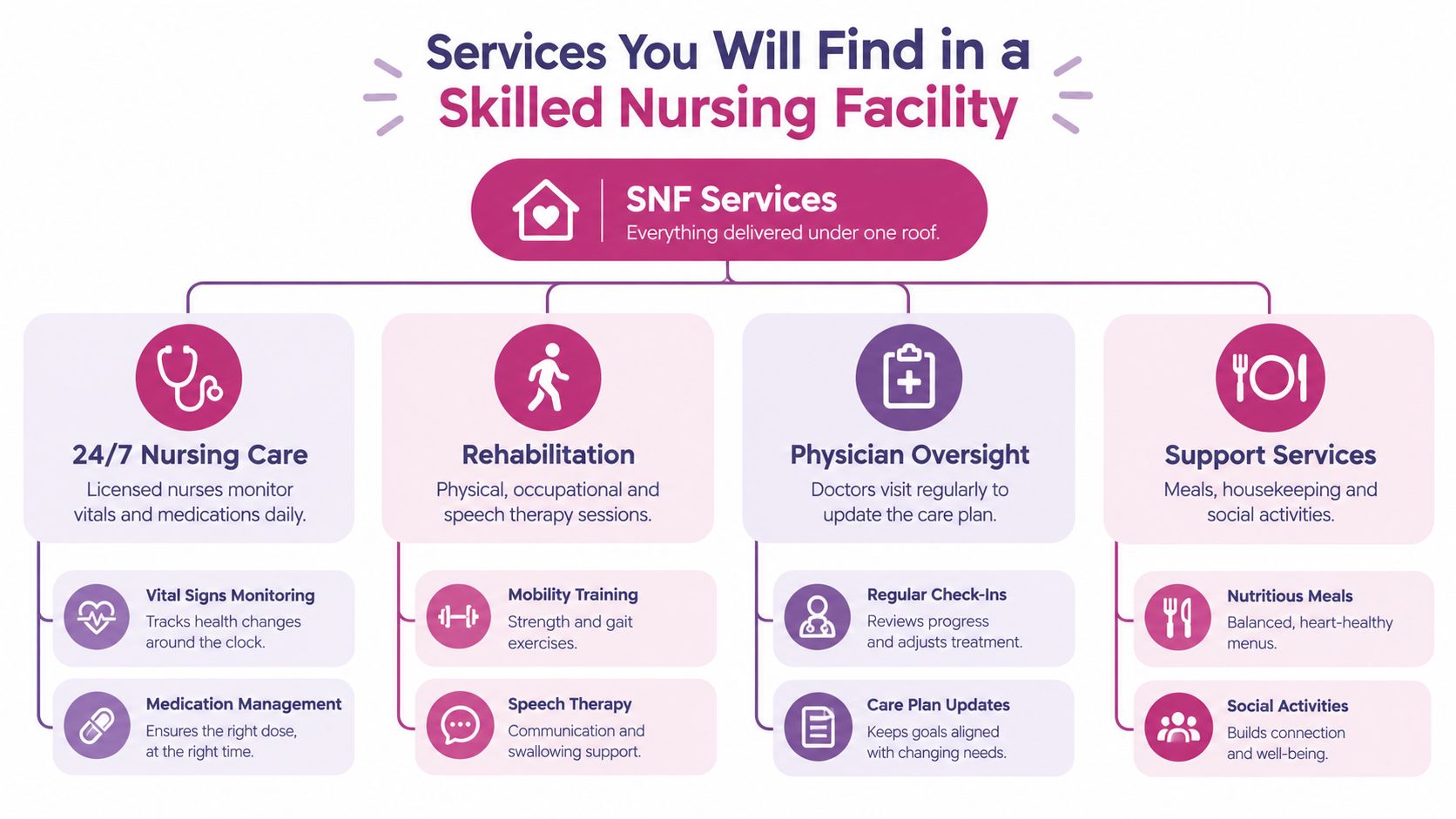
Clinical and rehabilitation services
- Nursing oversight: Registered nurses and licensed practical nurses administer medications, monitor changes, communicate with physicians, and carry out treatment orders.
- Physical therapy: A therapist may work on standing, transfers, balance, gait, strength, and safe use of mobility equipment.
- Occupational therapy: Sessions can focus on dressing, bathing, eating, using adaptive tools, and managing daily tasks safely.
- Speech therapy: A stroke survivor may need help relearning how to communicate or swallow safely.
- Wound care: Nurses may manage pressure injuries, surgical wounds, diabetic wounds, and other complex skin conditions. Families looking for background on treatment options can review this resource on advanced wound care for leg ulcers.
- IV treatment and medication management: A post-surgical patient may need IV antibiotics, while another resident may require close observation during a medication change.
- Physician oversight: Physicians direct the medical plan, review changes, and coordinate with nursing and therapy staff.
What daily life also includes
Residents generally receive meals, housekeeping, assistance with personal care, and opportunities for social interaction. Those services support recovery and comfort, but they aren't what makes the setting “skilled.” The defining feature is the presence of active medical treatment or rehabilitation that requires professional expertise.
A facility's ability to care for a particular resident matters more than its general service list. A family should ask whether the community regularly manages the specific issue involved, such as stroke recovery, complex wounds, respiratory needs, or dementia-related behaviors. For dementia-related placement questions, this guide to skilled nursing facilities for dementia patients can help families identify the issues to discuss with an admissions team.
A Typical Skilled Nursing Stay From Admission to Discharge
After a knee replacement, an older adult may leave the hospital medically stable but still unable to walk safely, manage the incision alone, or complete everyday tasks. A skilled nursing facility can provide the clinical support and rehabilitation needed during this vulnerable transition. “Skilled” describes the level of care, not a more comfortable type of residence.
At admission, a nurse reviews the hospital records, diagnoses, medications, mobility, pain, nutrition, skin condition, and immediate safety risks. Therapists assess movement and daily activities. Together, these findings shape a care plan with practical goals, such as transferring safely, walking with the recommended equipment, and completing personal care with less assistance.
The pace is active, but the timeline depends on the person's condition. Many residents are there for a short rehabilitation period. Some leave sooner, while others need more time because of complications, weakness, or slower progress. Families should ask how the facility expects the stay to develop and which changes could affect the discharge plan.
What the days may look like
Therapy may take place in a gym, the resident's room, or a shared living area. A patient might practice standing, walking, dressing, bathing, or using adaptive equipment. Nurses give medications, monitor symptoms, respond to changes, and reinforce safety instructions.
A care conference or regular team review helps staff adjust the plan as the resident improves or develops new needs. Discharge planning begins early rather than on the final day. Staff may evaluate whether the person can return home safely, whether family help is sufficient, and whether home health, outpatient therapy, equipment, or home modifications will be needed.
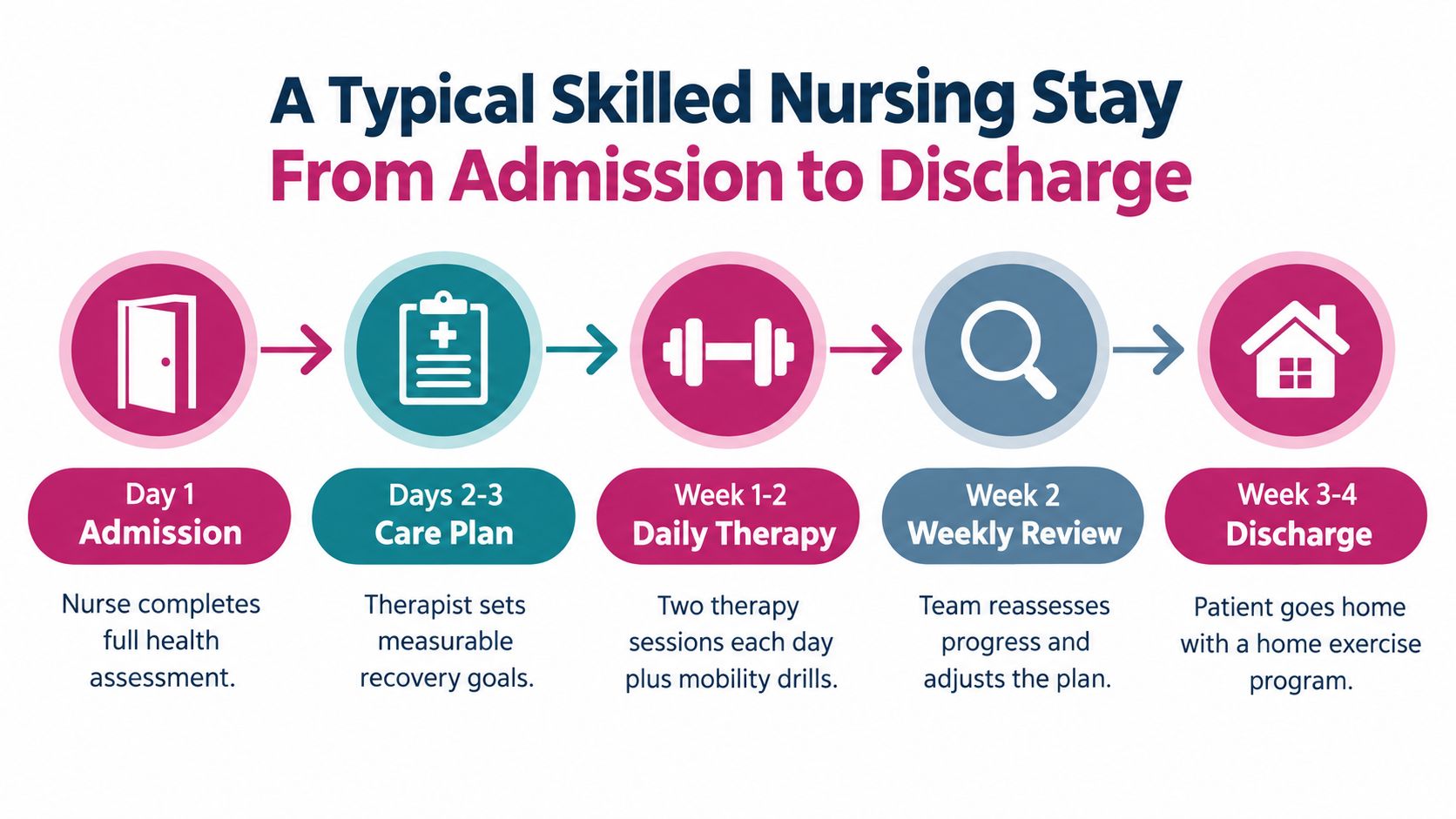
Short stay or longer residence
The same building may also serve residents who are not in a temporary rehabilitation episode. Someone whose clinical needs continue after rehabilitation may remain in long-term nursing home care, with a different payment arrangement and continuing assessments.
Ask two questions before admission: What care does my loved one need today, and what happens when active rehabilitation ends? The answer could be a return home, home-based services, assisted living, or continued nursing home care.
How a Skilled Nursing Facility Differs From Assisted Living and Acute Rehab
An SNF isn't “fancy assisted living,” and it isn't automatically the same as an acute inpatient rehabilitation hospital. These settings can overlap in the people they serve, but they differ in medical intensity, staffing, therapy structure, and payment rules.
| Setting | Level of Care | Staffing | Typical Stay | Best For |
|---|---|---|---|---|
| Skilled nursing facility | Inpatient nursing, medical treatment, and rehabilitation | Nurses, therapists, and physician-directed clinical staff | Often a temporary recovery period, though some buildings also provide long-term nursing care | People needing skilled treatment or rehabilitation after hospitalization |
| Assisted living | Residential support with help for daily activities | Personal care staff, with clinical support varying by community | Ongoing residence | People who need help with daily routines but don't require SNF-level clinical oversight |
| Acute inpatient rehabilitation | Highly intensive inpatient rehabilitation for people able to participate in a demanding program | Rehabilitation specialists and medical staff in an acute rehab model | Short-term rehabilitation | People who need a more intensive rehabilitation program and can tolerate that level of therapy |
Match the setting to the need
Assisted living may fit someone who is medically stable but needs help with meals, medication reminders, bathing, transportation, or household tasks. It offers a residential environment, but its clinical model is different from an SNF.
Acute inpatient rehabilitation may be considered when a patient needs intensive therapy and has the medical stability and endurance to participate. An SNF may be more appropriate when the person still needs substantial nursing management, has lower endurance, or requires a slower rehabilitation pace.
The best choice isn't determined by the most attractive lobby. It starts with the discharge diagnosis, current mobility, nursing needs, therapy tolerance, medication complexity, and expected recovery path. Families arranging care in New Jersey can use a local placement advisor to identify available options across this continuum when hospital deadlines are tight.
For a more detailed comparison of the two rehabilitation models, see this guide to skilled nursing facility versus acute rehab.
The right question isn't “Which setting sounds nicest?” It's “Which setting can safely provide the care this person needs now?”
What Medicare Covers and What It Does Not
Your parent may leave the hospital needing therapy, nursing care, and help with daily tasks. The phrase “skilled nursing facility” identifies the level of care, not the length of the stay or whether Medicare will pay. Medicare Part A generally covers SNF care only under limited conditions, including a qualifying inpatient hospital stay and admission within a short time window after discharge (Medicare).
Before the transfer, ask the hospital discharge team and facility admissions staff to confirm eligibility. Ask which records support the skilled-care requirement, whether the facility participates in Medicare, which services are included, and what your family may owe if coverage changes.
Medicare can cover a qualifying skilled nursing episode for rehabilitation or medical treatment, but it doesn't function as unlimited payment for long-term custodial nursing home care.
Rehab coverage versus long-term care
Suppose your parent enters an SNF after hospitalization to regain strength and mobility. Medicare may cover that qualifying skilled episode under its rules. If the main need later becomes help with bathing, dressing, eating, or supervision instead of active skilled treatment, Medicare generally does not cover that ongoing custodial care.
The person may be able to remain in the facility, but the payment plan and care plan must change. The family may need to discuss private payment, long-term care insurance, Medicaid eligibility, or a move to a setting that fits the person's continuing needs. A social worker or care coordinator can explain what to ask an insurer or benefits specialist.
Availability can change
The timing of the search also matters. MedPAC reported that SNF admissions fell 12% and days fell 8% between 2022 and 2023. Occupancy in October 2024 was still recovering from a pandemic low of 69%. A later update reported admissions fell 4% from 2023 to 2024, while days rose 1%.
Financial pressure can affect which facilities accept new residents. Forty-five percent of SNFs reported a loss or negative margin in 2024, and 23% reported turning away residents more than once a week, citing labor shortages, rising costs, or underfunding (MedPAC). Start contacting facilities promptly, and ask whether each one can provide the required clinical care under the expected payment arrangement.
Finding and Choosing the Right Skilled Nursing Facility
A hospital recommendation is a starting point, not the end of your evaluation. Even when the decision feels urgent, ask for several appropriate options and compare them against your loved one's diagnosis, treatment plan, therapy needs, and expected discharge destination.
Use a practical evaluation checklist
- Verify certification: Confirm that the facility is Medicare-certified and can provide the required level of nursing and rehabilitation care.
- Ask about staffing: Find out which nurses and therapists are available, how physicians participate in care, and how the facility handles nights, weekends, and urgent changes.
- Confirm relevant experience: Ask whether the team regularly treats your loved one's condition, such as stroke recovery, orthopedic rehabilitation, complex wounds, or IV therapy.
- Review therapy access: Ask who provides physical, occupational, and speech therapy, where sessions occur, and how the care team measures progress.
- Inspect cleanliness and safety: Look at resident rooms, bathrooms, common areas, hand hygiene practices, call systems, and fall-prevention procedures.
- Tour before deciding: Notice whether staff answer questions clearly, residents appear attended to, and the environment feels orderly and respectful.
- Clarify the financial plan: Ask what Medicare covers, what happens when coverage ends, which services carry separate charges, and who will contact the family about changes.
Questions to bring on the tour
Ask, “What would the first few days look like for this diagnosis?” Ask who will explain the care plan, how often the family receives updates, and what signs would cause the team to change treatment. Also ask how the facility prepares someone to return home, including medication instructions, equipment, follow-up appointments, and caregiver training.
A no-cost placement service can reduce the number of calls a family must make. Life Senior Placement uses an intake process covering health needs, budget, preferred location, and care goals, then provides matched options from licensed and vetted communities, coordinates tours, and offers advisor support through move-in. Families can review the skilled nursing placement service while confirming every recommendation independently.
The decision should remain grounded in clinical fit. A convenient location matters, but it shouldn't outweigh inadequate staffing, limited therapy, or a poor match for the diagnosis. Write down the discharge requirements, compare facilities against that list, and ask the hospital case manager or social worker to help resolve unanswered questions.
If you're arranging care in New Jersey, you can also call (862) 398-2006 to discuss your loved one's needs, budget, location, and timing with a placement advisor. Getting help early can make it easier to compare appropriate SNFs before the hospital discharge deadline arrives.
Life Senior Placement offers no-cost guidance, matched skilled nursing and rehabilitation options, coordinated tours, and support through move-in for New Jersey families. Visit Life Senior Placement to begin a care search based on your loved one's medical needs, location, and next step after discharge.