
Non medical home care is hands-on help with daily living, companionship, and homemaking delivered in the home by non-clinical aides, and it is not medical care. It's the support behind approximately 3,961,900 home health and personal care aide jobs in 2023, and it works only when you treat it as a coordination plan, not a shopping list of tasks.
Most families don't call me because they read a brochure. They call because Dad came home from the hospital, the discharge papers are on the kitchen counter, and nobody's sure who is getting him safely into the shower tomorrow morning. That gap between medical instructions and daily life is exactly where this service belongs, and it's where families make their most expensive mistakes when they hire hours before they define responsibilities.
What Non Medical Home Care Actually Means
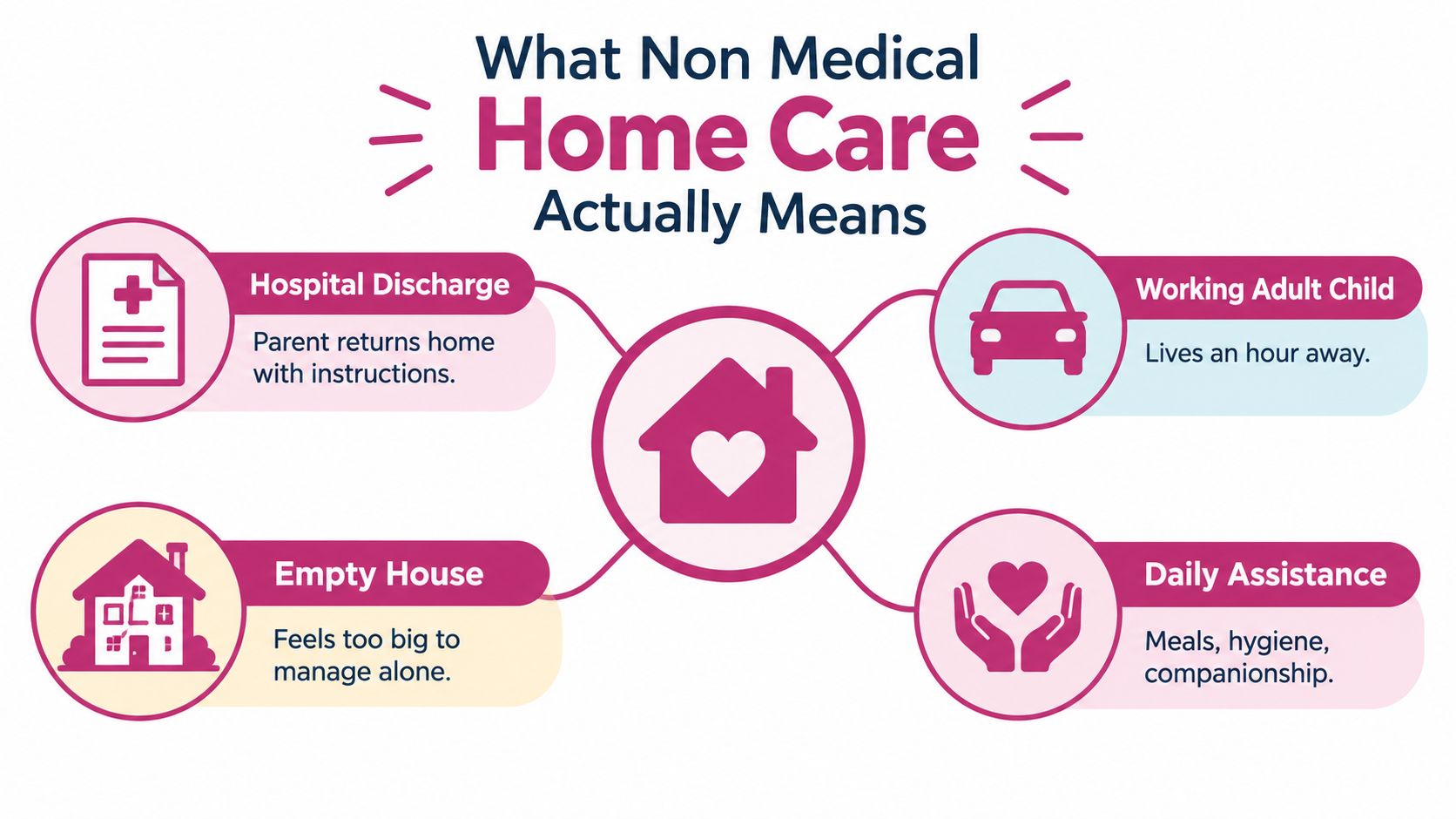
Your mother leaves a New Jersey hospital with printed instructions, a follow-up appointment, and a warning not to fall. You live an hour away, you're working, and her house suddenly has stairs, loose rugs, an empty refrigerator, and a bathroom that wasn't designed for a walker. Non medical home care fills the non-clinical part of that picture.
An aide helps her bathe, dress, move safely from bed to chair, eat a real meal, and keep the house livable. The aide can remind her to take medication she's able to self-administer, drive her to an appointment if transportation is in the plan, and notice that she's more confused today than yesterday. The aide doesn't diagnose that confusion, change a dose, treat a wound, or replace a nurse, therapist, or physician.
Why Coordination Matters More Than the Task List
Don't hire by task list alone. Bathing help on Tuesday doesn't solve who notices weight loss, who calls you after a near fall, who covers a sick aide on Friday, or what threshold triggers a call to the doctor. A good plan names a coordinator, documents daily abilities, and sets escalation rules before the first visit.
My rule for families: If nobody can answer who notices change, who decides what happens next, and who covers a missed visit, you don't have a care plan yet. You have scheduled help.
Demand for this workforce explains why availability can't be assumed. Employment is projected to reach 4,782,400 jobs by 2033, an increase of 820,500 positions or 20.7%, with approximately 718,900 openings per year on average from 2023 through 2033, according to the Bureau of Labor Statistics employment projections for 2023 to 2033. That scale means you should verify staffing depth and continuity, not just accept the first agency that returns your call.
If memory loss is part of your situation, routines and supervision need extra planning from the start. This family guide to dementia care at home is useful background for thinking through structure, safety, and caregiver communication before wandering or missed meals become emergencies.
Non Medical Home Care Versus Home Health Care
Families lose money and time when they confuse these two services. Home health care treats a medical condition. Non medical home care supports daily living. Some households need one, some need both at the same time, and the right answer can change after a hospitalization, a fall, or dementia progression.
Start by asking what problem you're solving this month. If your father needs wound care, injections, skilled nursing assessment, or physical therapy after surgery, that's clinical care delivered by licensed professionals under a physician's order. If he needs help showering, dressing, cooking, doing laundry, and getting to appointments safely, that's non medical care, usually arranged directly by the family without a physician's order.
The comparison below gives you the working distinction I use with New Jersey families.
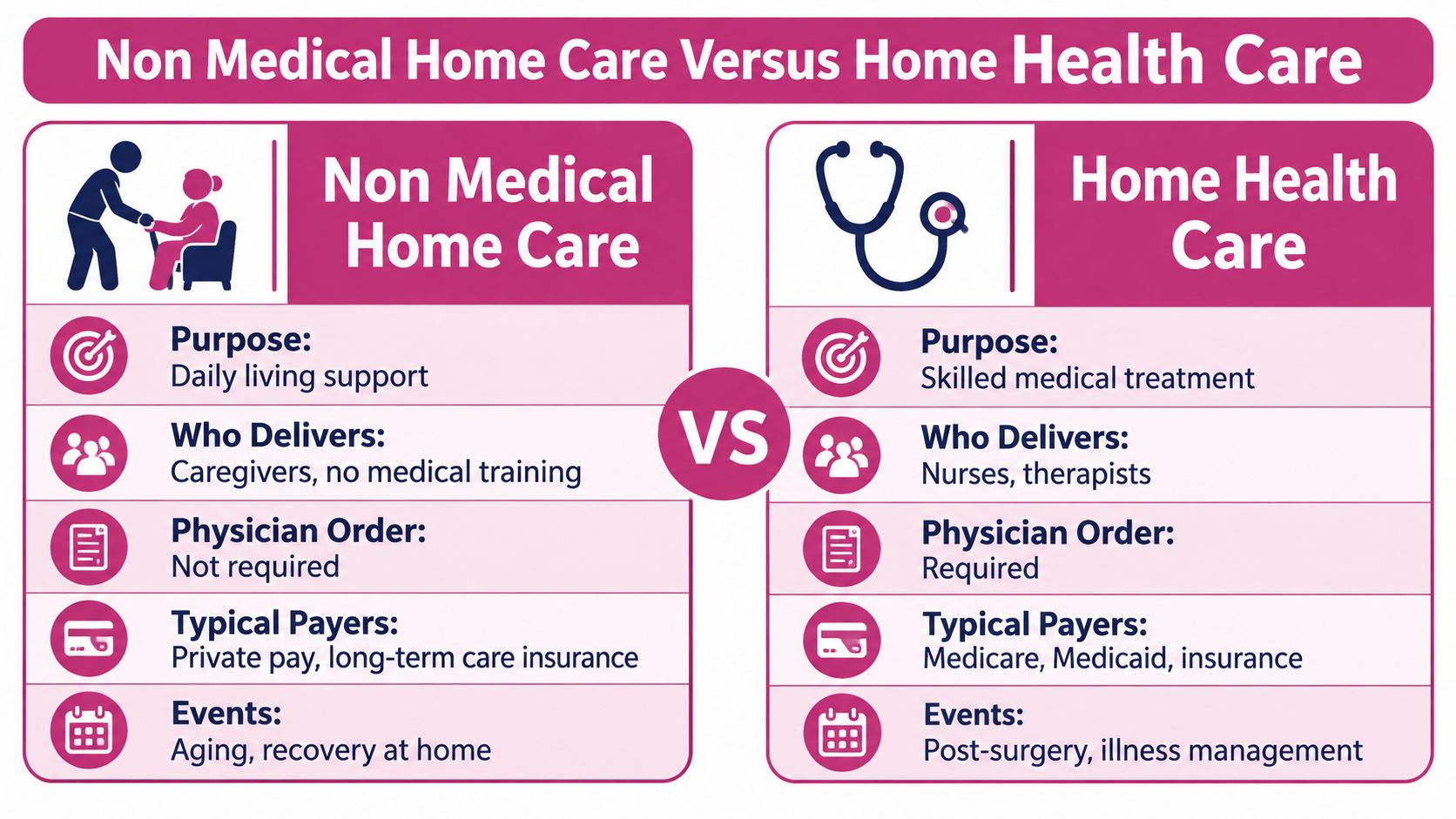
| Dimension | Non Medical Home Care | Home Health Care |
|---|---|---|
| Purpose | Daily living support, safety, companionship, homemaking | Skilled medical treatment and rehabilitation |
| Who delivers it | Personal care aides and home health aides in non-clinical roles | Nurses, therapists, and other licensed clinicians |
| Physician order | Not typically required | Required |
| Typical payers | Private pay, long-term care insurance, some public home and community programs | Medicare, Medicaid, or health insurance when eligibility rules are met |
| Typical triggers | Gradual decline, dementia supervision, recovery support after clinical care ends | Surgery, hospitalization, new diagnosis, wound, or therapy need |
| Duration | Ongoing and adjustable as daily needs change | Usually episodic and tied to a clinical plan |
For a deeper side-by-side explanation before you call providers, read this breakdown of the difference between home care and home health care. Use it to sort out which tasks you're buying before anyone quotes you a schedule.
The Mistake I See Most Often
Don't assume Medicare will pay for the aide hours your parent needs every morning just because a nurse visited after discharge. Clinical eligibility and daily living need are different questions. The reverse mistake happens too, where families private pay for help during a recovery period without first asking whether ordered skilled services should be evaluated separately.
Watch this short explainer if you're still sorting the terminology with siblings who are using the words interchangeably.
Ask one direct question at intake. Which needs are medical, which are daily living, and who is responsible for each? If a provider can't answer cleanly, keep interviewing.
Core Services and What an Aide Really Does
Forget vague phrases like a little help around the house. I want you to picture a Tuesday. The aide arrives, checks how your mother slept, helps her transfer safely out of bed, stays nearby during a shower, helps her dress, makes breakfast, tidies the bathroom, starts laundry, and writes down that she ate poorly and seemed unsteady.
That's the work. It's physical, personal, and observational, and it only works when the care plan describes real routines instead of categories copied from a website.
Personal Care and Mobility
- Bathing and grooming: Shower or sponge bath assistance, hair care, oral hygiene, dressing, and toileting support delivered with privacy and a consistent routine.
- Transfers and walking: Steadying help moving from bed, chair, toilet, or car, plus supervision on stairs and during short walks inside or outside the home.
- Eating support: Meal setup, feeding assistance when appropriate, hydration reminders, and notes when appetite or swallowing concerns appear for clinical follow-up.
Equipment matters here. A shower chair, grab bars, a raised toilet seat, or a properly fitted walker can change whether an aide can help safely. Families building a safer bathroom and bedroom setup can use the DME Superstore home equipment list as a practical inventory to discuss with the agency and any treating therapist.
Companionship and Homemaking
Companionship isn't filler. A good aide provides conversation, reads mail aloud, joins a walk, plays cards, and supervises someone who shouldn't be alone because of fall risk or confusion. For a widow who has stopped answering the phone and started skipping lunch, that presence is often the intervention that keeps the rest of the plan intact.
Homemaking covers meal preparation, light cleaning, laundry, dishes, grocery runs, and keeping walking paths clear. Transportation, when included, means rides to medical visits, errands, religious services, or family events for someone who no longer drives safely. Confirm in writing whether the aide drives her own car, drives the client's car, or only accompanies the client in other transport.
An aide can remind, observe, assist, and report. An aide should not independently administer medication, assess symptoms, change dressings, or decide that a new problem is nothing to worry about.
That boundary protects everyone. It protects your parent from unlicensed clinical judgment, and it protects the aide from being pushed into work outside her role because the family is worried and the doctor's office hasn't called back.
Cost, Payment Sources, and a Realistic Budget
Stop asking only what the hourly rate is. That's the least useful number in the conversation. Your real cost depends on how many hours are needed, which hours family can cover reliably, whether nights are unsafe, what happens after a cancellation, and which payer rules apply.
A parent who needs morning bathing, breakfast, and a safety check has one budget. A parent with dementia who wanders at night, resists showers, and can't be left alone has a completely different one, even if both families use the same agency. Build scenarios, not guesses.
Before you compare quotes, review current local pricing context in this guide to hourly home health aide costs in North Jersey. Then convert that rate into weekly schedules based on real routines, including weekends and the hours nobody in the family wants to discuss.
Build the Budget in Four Passes
- Map the unsafe hours: Mark bathing, toileting, meals, medication reminder times, wandering periods, and nighttime risks across a full week.
- Assign family coverage: Count only help relatives can sustain without missing work, skipping sleep, or resenting the arrangement within a month.
- Price the remaining gap: Get agency quotes for that schedule, plus a higher-hours scenario if a fall, hospitalization, or faster dementia progression occurs.
- Add failure costs: Ask about minimum hours, weekend rates, holiday rates, mileage, replacement coverage, and what you'll pay if you need to increase hours quickly.
The affordability strain is real, not a personal budgeting failure. 28% of U.S. Family caregivers report difficulty finding affordable services, and 44% report at least one negative financial impact from caregiving, including reduced saving, depleted short-term savings, debt, and late or unpaid bills, according to the Caregiving in the US 2025 report on caregivers of adults age 50 plus. That's why I push families to screen every funding source early, before savings are drained by a schedule that was never sustainable.
Screen Every Payment Source
Private pay offers the most control over provider and schedule, but it exposes the family to the full weekly cost. Long-term care insurance may reimburse eligible daily care, so read elimination periods, daily benefit limits, and care setting rules before you assume coverage. Veterans benefits may help some households, but eligibility and documentation take time, so don't build next week's schedule around money that hasn't been approved.
Medicaid-funded home and community-based services can support eligible people at home, but rules vary by state and by program. Don't let anyone promise you a New Jersey outcome based on another state's experience. Get the eligibility screen done early and in writing.
Families also ask whether a relative can be paid. In many cases, yes, but only under specific program rules. In 2025, all responding states allowed some Medicaid beneficiaries to self-direct services, and all states responding to KFF's survey reported paying family caregivers under at least some circumstances, although qualifying conditions vary. Treat that as a screening question, not a guarantee, and confirm tax, training, and documentation requirements before a family member quits hours at work.
When the Care Plan Has to Change
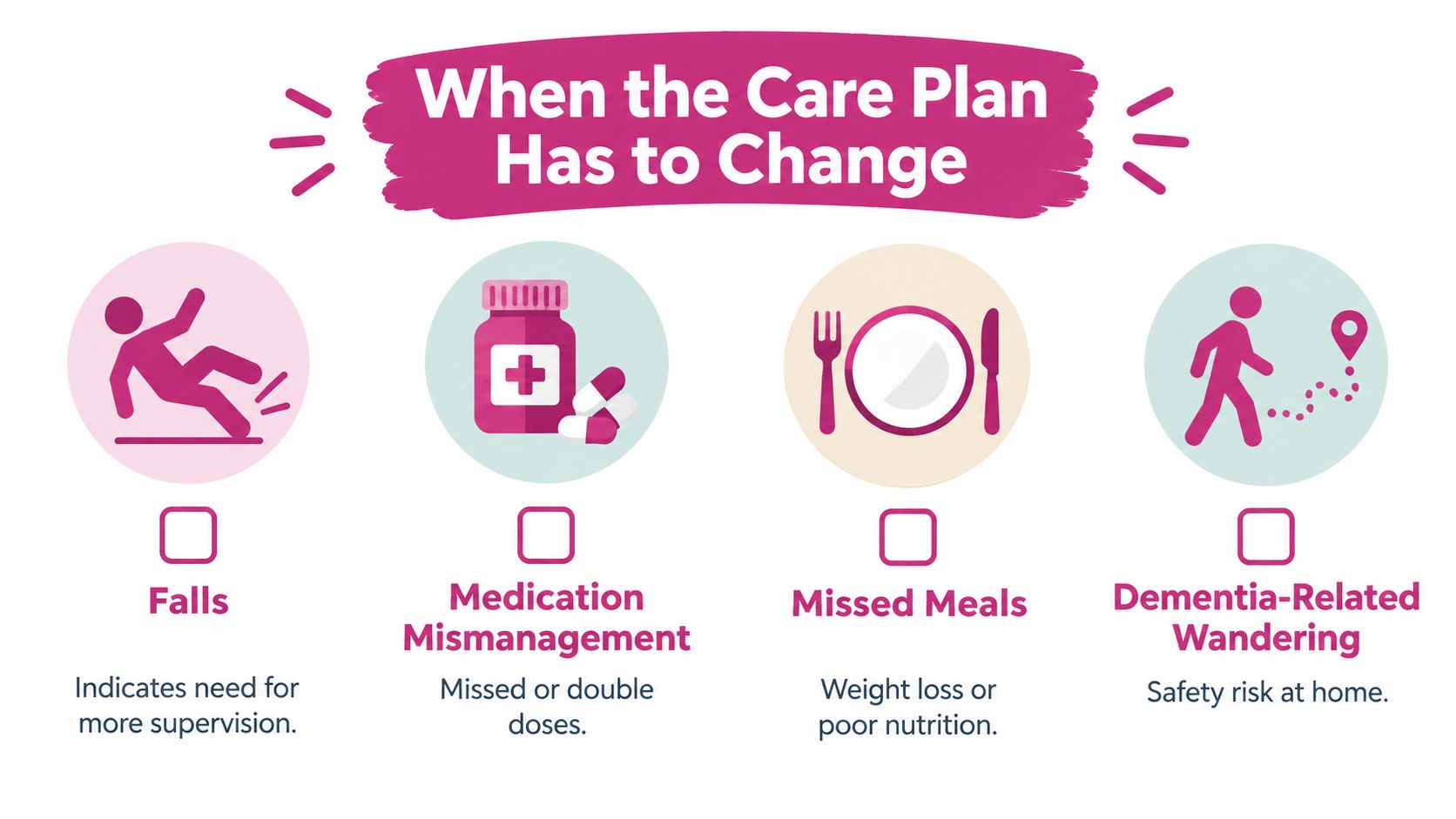
Aging in place is not a permanent decision you make once. It's a conditional plan that holds only while staffing is reliable, the home is accessible, cognition is manageable, family backup exists, and funding lasts. When one of those supports fails, the plan has to change before a crisis makes the decision for you.
Watch for concrete triggers. Repeated falls, missed or doubled medication doses, skipped meals, weight loss, new confusion, unsafe transfers, and dementia-related wandering aren't minor updates for the visit log. They're escalation signals.
Write the Continuity Plan Before You Need It
Your written plan should name backup staffing for missed visits, emergency contacts, fall response steps, transportation alternatives, and the exact changes that trigger a call to a clinician or emergency services. It should also document changing abilities over time, so you're arguing from records instead of memory during a stressful family meeting. If your adult children live far away, put the local decision maker and the after-hours phone chain on the refrigerator and in the agency file.
Structured coordination is not bureaucratic decoration. A systematic review of 35 studies on non-medical home and community care models found that case management improved functional outcomes and medication-management processes, increased use of appropriate community services, and reduced nursing-home admission in randomized evidence. The same review found integrated care results were inconsistent and consumer-directed models improved satisfaction more reliably than clinical outcomes, which is why supervision and documented reassessment matter.
Falls Deserve Their Own Workstream
Don't accept be careful as a fall plan. In a study of older adults receiving home care, 61% of intermediate-risk patients received multifactorial fall-risk assessments, but only 19% received multifactorial interventions, while medication management and osteoporosis-related interventions each reached fewer than 10%, according to research published in PMC on multifactorial fall prevention in home care. Assessment without follow-through doesn't keep anyone off the floor.
Convert each risk into an assigned action. An appropriate clinician reviews medication and orthostatic risk, a therapist addresses balance and lower-extremity strength, vision and hearing get checked, footwear and mobility aids get assessed, and the aide keeps paths clear, reinforces prescribed exercises, and reports near falls. That division of labor is the difference between vigilance and wishful thinking.
Self-directed care gives a household more control over selecting, training, and dismissing caregivers. It also shifts scheduling, supervision, payroll discipline, and contingency planning onto the family. For dementia, post-hospital recovery, or long-distance families, I recommend agency-delivered care unless a local relative has time to manage the operation.
Vetting Providers and Why a Placement Partner Helps
Choosing a service type and choosing a provider are separate jobs. Families get in trouble when they settle the first question, feel relieved, and then hire the first available agency without verifying how it staffs, supervises, and replaces its aides. Don't do that.
The workforce context should make you more demanding, not less. Women represented 87% of U.S. Home health aides and 80% of personal care aides in 2023, the combined occupation employed about 3,689,350 workers with a median annual wage of $33,380, and home health aides are projected to grow from 387,590 workers in 2023 to 526,340 in 2038, a 36% rise, according to the HRSA long-term services and supports workforce projections fact sheet. Direct-care workers are also projected to constitute 66% of the long-term services and support workforce in 2038. Translation for your family is simple. Ask about turnover, training, and backup bench strength.
Verify These Items Directly
- Licensure and screening: Confirm the agency's status, background check process, reference checks, and how aides are matched to dementia, transfer, or language needs.
- Supervision: Ask who visits the home, how care notes are reviewed, how families receive updates, and how quickly a supervisor responds to a reported change.
- Backup coverage: Get the missed visit protocol in writing, including how you're notified and whether a replacement aide receives a proper handoff.
- Scope discipline: Ask what aides are prohibited from doing and how the agency escalates medication problems, falls, or new confusion to licensed professionals.
Medicaid serves approximately 4.5 million people through home and community-based services, states continue using higher payment rates and other measures to respond to worker shortages, and caregiving duties were a reason 12% of working-age Medicaid enrollees could not work in 2023, according to the National Alliance for Caregiving policy brief on caregivers as an invisible workforce. Your family shouldn't become the unplanned backup workforce because an agency oversold its capacity.
A placement partner helps when you need a structured intake, a vetted shortlist, and coordinated comparisons instead of cold calls. Life Senior Placement matches New Jersey families with licensed, vetted home care providers and senior living communities after documenting health needs, budget, lifestyle preferences, and desired location, and you can review how senior placement services structure that matching and touring process.
Putting It Together for Your Family
Make the decision in this order. First confirm which needs are non-medical and which require licensed clinical care. Then map unsafe hours across a full week, screen private pay, insurance, veterans, and Medicaid-funded options, and write down backup and escalation expectations before you interview anyone.
Your Checklist for This Week
- Confirm scope: List bathing, dressing, meals, transfers, supervision, transportation, and any clinical tasks that need separate professionals.
- Price real hours: Build a current schedule and a higher-need scenario instead of budgeting from one hourly quote.
- Plan for failure: Name backup coverage, emergency contacts, fall response, and the changes that trigger reassessment.
- Shortlist carefully: Interview two or three vetted providers and compare supervision, turnover, and replacement protocols.

You're not buying hours. You're building a plan that bends when needs change instead of breaking at the first missed visit, fall, or hospital discharge. Start with scope, fund it clearly, and don't sign until the backup plan is written down.
If you're comparing non medical home care for a parent in New Jersey and want help sorting scope, hours, funding, and vetted local providers, talk with an advisor at Life Senior Placement for no-cost guidance on home care matching and senior living alternatives. Call (862) 398-2006 or email hello@seniorplacement.life to start a structured intake before you sign with any agency.