
A meta-analysis of 90 prospective cohort studies covering more than 2 million adults found that social isolation was associated with a 32% higher all-cause mortality risk, and loneliness with a 14% higher risk, according to JAMA. That figure reframes the whole conversation. A regular visitor stops being a kindness you arrange when the budget allows and becomes part of the same risk management as a blood pressure pill, a grab bar in the shower, or a working smoke alarm.
Companion care for seniors comes down to three questions. What does the visit cover? Will the same caregiver still be walking through the door in March? And how will you know, by week six, whether the plan is helping? Answer those and most of the anxiety around hiring goes away.
What Companion Care Covers and What It Does Not
Companion care is non-medical support built around presence and routine. A companion caregiver holds a conversation, sits through a meal, drives to a doctor's appointment, picks up a prescription, folds laundry, heats soup, and reminds your father that his pills are on the counter. Think of a reliable neighbor who checks in every Tuesday and Thursday and knows which grandchild is graduating, not a nurse who arrives with a dressing tray.
Families often buy the wrong level of service and then blame the caregiver for a gap that was never in scope. The table below does most of the separating.
| Service | Typical tasks | Hands-on personal care | Clinical tasks |
|---|---|---|---|
| Companion care | Conversation, outings, errands, meal prep, reminders | No | No |
| Personal care aide | Bathing, dressing, toileting, transfers | Yes | No |
| Home health aide | Personal care plus vital-sign checks under a nurse's plan | Yes | Limited, under supervision |
| Skilled nursing visit | Wound care, injections, medication administration, therapy | Sometimes | Yes |
Most households end up with a blend. A companion drives your mother to church on Sunday, and a personal care aide handles the shower on Monday and Thursday. The two can come from the same agency, but only when that agency employs aides with the right training. Ask plainly whether the person being sent is trained and authorized to help with bathing and transfers, and treat a vague answer as a no.
If the task involves touching the body or making a clinical judgment, it isn't companion care.
Confusion usually shows up here, in the difference between an aide who takes a temperature because a nurse asked her to and a companion who notices the senior feels warm. One is delegated care under a plan. The other is an observation worth reporting. For a plain-language walkthrough of how training and supervision work on the aide side, read what a home health aide does.
Who Benefits From Companion Care and Why It Matters
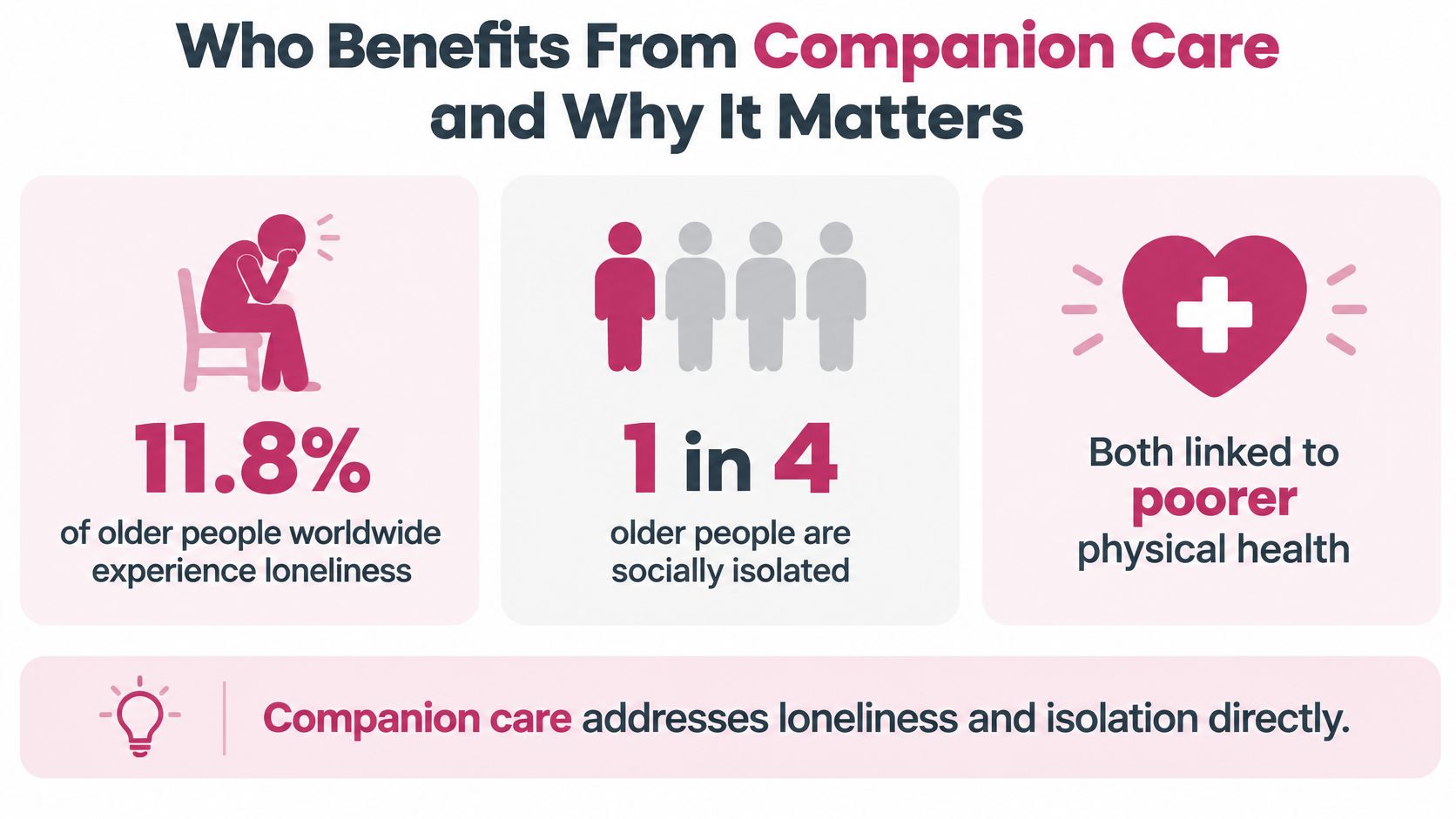
The World Health Organization estimates that approximately 11.8% of older people worldwide experience loneliness, and about one in four older adults are socially isolated. WHO links both to poorer physical and mental health, reduced quality of life and lower longevity. That's the global picture in a single sentence. The local picture is three people you'd recognize.
Three situations where a weekly visit changes the week
A widowed mother who moved to New Jersey to be near her daughter, and whose entire social circle is now that daughter's family. A 74-year-old who handed over the car keys last spring and with them lost the Tuesday card game, the salon appointment and the pharmacy run. A son two hours away who calls every Sunday and spends the rest of the week wondering.
What the visits deliver is more practical than the brochures suggest.
- Company at meals, which matters because a senior who eats alone often stops cooking altogether.
- Escorted outings, to Mass, to the club, to the grocery store, so the week has anchors instead of blank space.
- Early warning, the unopened mail, the fridge with nothing in it, the shirt worn three days running.
- Coverage for you, so a single missed check-in call doesn't spiral into a panic.
- Routine, which for many seniors is the scaffolding that keeps medication and sleep on track.
Sometimes the reason outings stopped is mechanical rather than social. If standing up from a chair has become the obstacle, the 2026 lift chair buying advice from Top Mobility covers the measurements to take before buying one, so the chair fits both the person and the room.
Companionship supports daily life. It doesn't treat disease, and a good provider will say so.
Start here if three things are true. Your parent is physically safe at home, meaning no falls, no wandering, no untreated medical issue. They are alone most days. And they are open to a regular visitor, even a hesitant yes counts.
Companion Care or a Higher Level of Care
Aging in place has a good reputation, and it earns it one household at a time. It isn't automatically the gentlest option, though, especially when the entire plan rests on one 80-year-old spouse or one paid caregiver with a car and a working back.
The caregiving load behind those households is heavier than most adult children realize. In 2025, more than 51 million Americans were caring for someone aged 50 or older, nearly one in five U.S. Adults, according to AARP's family caregiving research. They had been providing care for an average of five years and spent about 26 hours a week on it, up from 22 hours a week in 2020. Nearly one in four also supported an older person with a memory problem or dementia. Companion care exists partly to keep that unpaid workforce standing.

The conversation below usually happens at a kitchen table with a laptop open and three tabs fighting for attention. What it needs is a verdict, situation by situation.
| Situation | Best fit | Why |
|---|---|---|
| Lonely and mobile, needs company and errands | Companion care | No hands-on needs to cover |
| Needs daily bathing or transfers | Personal care aide with companion visits | Body care requires trained hands |
| Memory loss with wandering risk | Memory care or secure assisted living | Secure setting and dementia-trained staff |
| Daily medical tasks or rehabilitation | Skilled nursing or home health | Clinical judgment is required |
| Family caregiver exhausted or home schedule unreliable | Respite or assisted living | A stable schedule removes the single point of failure |
The reliability test: if the home plan collapses when one person gets the flu, it's fragile. Count the people who can cover a Tuesday before you commit to Tuesday visits.
Consider a 78-year-old woman who stayed home for two more years with a companion three mornings a week, someone to walk with her, drive her to the hairdresser, and notice when the mail piled up. It worked, right up until the second fall in a month. She moved to assisted living not because the companionship failed but because the home plan could no longer absorb the risk. That's the honest boundary: companionship buys time and quality of life, not a way around a changing body. If you're weighing the alternatives, this comparison of levels of senior care lays out what each setting provides.
How Companion Care Is Priced and What Changes the Bill
Most companion care is billed hourly, with a minimum shift length set by the agency. Live-in and overnight arrangements usually carry a flat daily or nightly rate instead. That structure explains why two families with the same number of weekly hours can pay very different amounts.
The bigger fork is agency versus independent caregiver. An agency rate carries payroll taxes, liability insurance, background screening and, in theory, backup staff when your regular caregiver is unavailable. An independent caregiver may quote less per hour, but you take on the employer side: taxes, replacement coverage during a vacation, and the liability if something goes wrong in your mother's bathroom.
What moves the bill
- Weekly hours and visit count. Two three-hour visits cost more than one six-hour visit at many agencies, because each visit carries its own travel and scheduling overhead.
- Transportation. Outings add mileage and time, and some agencies bill drive time separately.
- Weekends and holidays. Premium rates are common and should be quoted up front, not discovered later.
- Dementia-related supervision. Higher-skilled, higher-stress work carries a higher rate.
- Add-on personal care. Bathing or transfers turn a companion shift into an aide shift.
- Cancellation terms. Late-notice fees can add real money over a year.
A worked example you can rebuild
Take an illustrative $30 hourly rate for 15 hours a week. Fifteen hours times 52 weeks is 780 hours, or $23,400 a year. Add a 10% reserve for extra shifts, holiday premiums and a heavier month, and the realistic budget is $25,740.
| Scenario | Basis |
|---|---|
| Companion care at illustrative rate | 780 hours a year at $30 an hour, or $23,400 |
| Same plan with 10% reserve | 858 hours a year, or $25,740 |
| Adult day program | Billed per day per attendee; ask for the daily rate and the transport fee |
Ask every provider for a weekly estimate built on identical hours. A quote for 10 hours and a quote for 20 hours can look similar per hour and differ by thousands over a year.
Adult day programs often bill by the day and cover part of the same social need at a lower total cost, while assisted living bundles housing, meals and care into one monthly figure that's easier to compare against a full home-care schedule. On coverage, Medicare generally does not pay for companion care, so ask the agency and the New Jersey Division of Aging Services which costs a Medicaid program or a long-term care policy might cover. For a fuller breakdown of hourly billing, read how much home care costs.
How to Vet a Companion Caregiver in New Jersey
You aren't only choosing a person. You're choosing a schedule that has to hold for months, from an industry that struggles to hold schedules at all. A 2025 federal caregiver fact sheet reports that nearly 75% home-care turnover occurred in 2024, and 62% of provider organizations said they had turned away referrals because of inadequate staffing, according to the ACL Power of Caregivers fact sheet. Continuity is a safety issue, not a scheduling preference.
Before the first phone call
Build a shortlist from sources that aren't paid to fill it. The New Jersey Division of Aging Services and your county Area Agency on Aging both keep provider lists, and your township's senior services office often knows which agencies answer the phone. Ask every agency you call whether it holds a New Jersey state license, and which one.
Seven checks that protect the senior
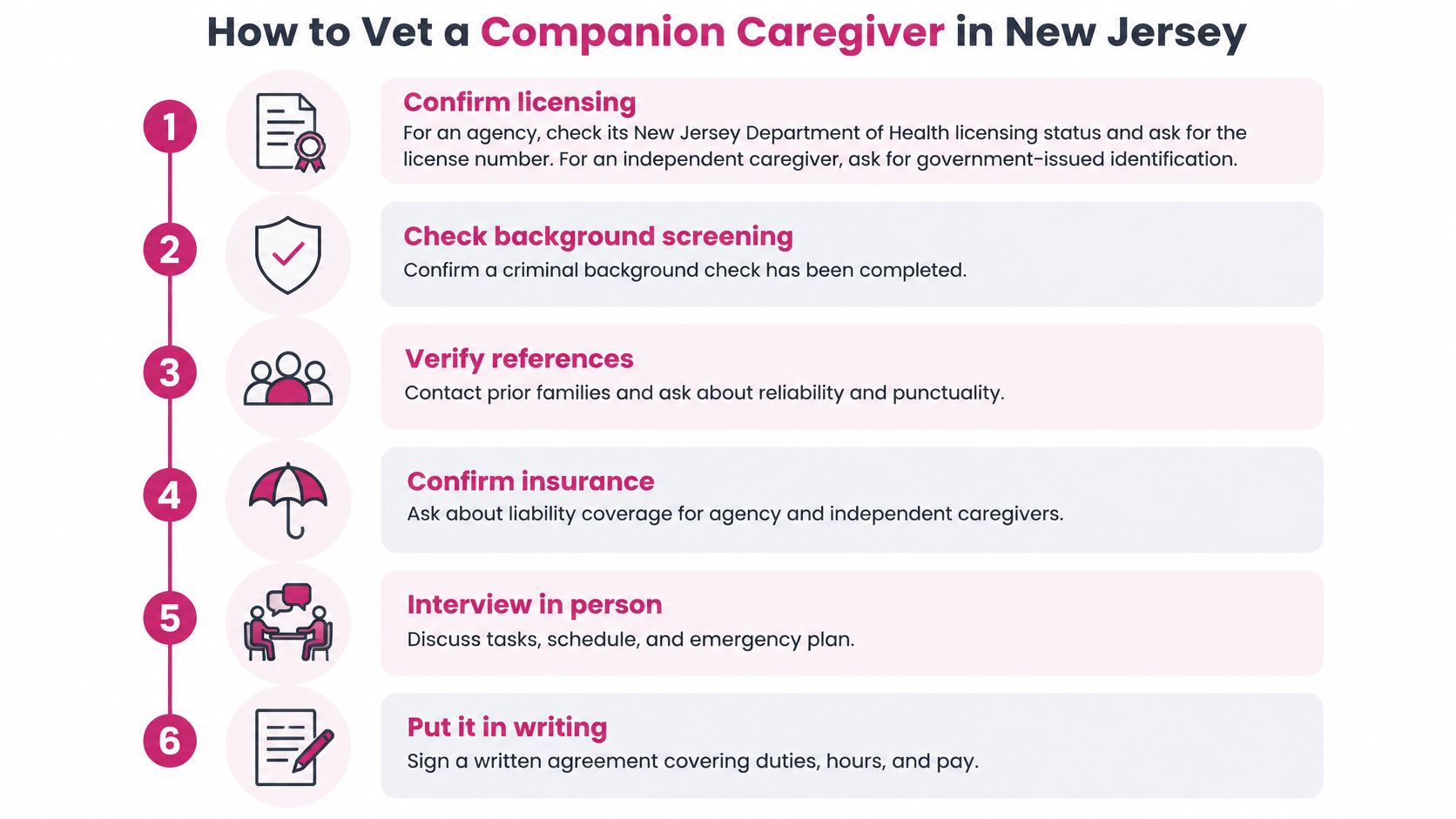
- Confirm licensing. Ask an agency for its New Jersey Department of Health license number and verify the status yourself. For an independent caregiver, ask for government-issued identification and keep a copy.
- Ask how the background check works, not whether one exists. Who runs it, how far back it goes, and whether it's repeated when duties change, for instance when a companion starts driving your parent.
- Call two recent clients. Ask about punctuality, cancellations and what happened on a bad day. Reliability under stress is the whole product.
- Match training to the diagnosis. Dementia-specific training, falls prevention, medication reminders and emergency response should be documented, not described.
- Ask what happens on a sick day. Who covers, how much notice you get, and whether the substitute is briefed on your parent's routine before arriving.
- Let your parent choose the person. A senior who picked the companion will open the door. A senior who was assigned one may not.
- Put it in writing. The service agreement should list tasks, hours, notice periods, and the escalation steps after a fall or a sudden change in behavior.
Some families find it easier to hear these questions than to read them. The video below runs through the same ground, and it's worth watching before you start making calls.
Match the screening to the work
| Caregiver role | Required checks | Ask the provider for |
|---|---|---|
| Companion only (conversation, outings, errands) | Identity check, background check, two recent references | A written list of tasks the caregiver will not perform |
| Personal care aide (bathing, transfers) | Background check, training records, supervision plan | Documented training and care-plan sign-off by a supervisor |
| Companion for a senior with dementia | Background check, dementia-specific training | Escalation plan for wandering, agitation or a missed check-in |
How to Measure Whether Companion Care Is Working
A caregiver can sit in the living room for three hours a week and leave your mother exactly as lonely as before. Hours on a schedule are inputs. Isolation is the outcome, and the outcome is what you need to watch.
There is reason to think the effort pays off when it's done well. Among U.S. Adults aged 50 to 80, reported lack of companionship fell from 41.6% in 2022 to 33.4% in 2024, and frequent isolation fell from 44.4% to 29.2% over the same period, according to JAMA. A national trend is not a plan for one household, though. Your mother is a sample of one, and a simple tracking sheet will tell you more about her than any survey can.
Two measures, not one
Frequency and satisfaction are different outcomes, and you need both. Frequency is the easy one: how many conversations, outings and shared meals happened this week. Satisfaction is the one families skip, and it's the better predictor of whether the visits keep working. Ask your parent directly, in plain words, whether they look forward to the visit and whether the person is good company. A visit your parent dreads still counts as a visit on the calendar. It counts for very little on the sheet.
The weekly tracking sheet
Write a one-page care note on day one and record the baseline before the first shift, because "better" only means something if you wrote down where things started. Then track six things every week.
- Calls your parent initiates, counted separately from calls they receive. Someone who starts reaching out is re-engaging.
- Participation in one preferred activity, named in advance, whether that's a card game, church or a walk to the corner.
- A mood rating from 1 to 5, scored by the caregiver and by you separately. A gap between the two scores is itself worth a conversation.
- Meals eaten, and whether the fridge has food in it.
- Missed appointments, which often signal withdrawal before mood does.
- Sleep changes, reported by your parent rather than inferred.
Set review dates at 30 days and 90 days after the first visit, and put them in the calendar where you'll both see them. At each one, compare the week against the baseline, not against the week before. Gradual drift is hard to spot in small steps and obvious across a month.
If withdrawal, poor appetite or confusion gets worse, call the primary-care provider. Adding a fourth weekly visit doesn't fix a clinical problem.
Adjustments that usually work better than more hours
Change the format before you change the frequency. Unstructured conversation stalls quickly with a quiet senior, while a specific task gives the hour a shape: cooking one recipe together, a card game with real rules, a fixed walking route. Add a small group setting, such as a senior center class or a church committee, so the connection doesn't depend entirely on one paid relationship.
If the caregiver reports flat mood or memory lapses that don't fit your parent's usual pattern, ask the primary-care provider for a cognitive and behavioral review. More companionship is the right answer to loneliness. It is the wrong answer to a new symptom.
Start With a Trial Period and a Written Review Date
Book 30 days, not forever. Before the first visit, write the one-page care note: your parent's goals, the tasks in scope, the weekly hours, and the measures you'll review. Set the review date in writing, agree how the arrangement ends if it isn't working, and confirm the notice period on both sides. A trial with an exit is easier for everyone to say yes to, including a parent who insists nothing is wrong.
If you're still unsure which level of care fits, Life Senior Placement can help you compare local options, and families can call (862) 398-2006 for guidance on assisted living and home care services.
Then do the next concrete thing this week. List three providers, ask each one for the same weekly estimate, and book the caregiver interview before the trial starts.
Life Senior Placement works with New Jersey families who are sorting out exactly this question: whether a parent can stay home with scheduled companionship or needs a setting with more support built in. Advisors review licensed local options with you, compare pricing across home care, assisted living and memory care, and arrange tours at no charge to your family. Start with Life Senior Placement and bring your parent's care note to the first conversation.