You're at the kitchen table with hospital discharge papers, a medication list, and your parent's insistence that everything will be fine at home. You want to respect that wish. You also know someone will have to help with the shower, watch the stairs, and answer if your parent gets up confused at night.
Choosing care starts with those ordinary moments, not a brochure. The useful question isn't which senior setting sounds right. It's who can provide the help your parent needs now, and what happens when those needs change?
Five Levels of Care Compared at a Glance
Level of care means the amount of hands-on help, supervision, and licensed nursing a person needs each day. Those needs help determine which setting fits, although a setting's name doesn't guarantee every service.
Many families begin by helping at home. The Bureau of Labor Statistics reported that 38.2 million people, or 14% of the civilian noninstitutional population age 15 and older, provided unpaid eldercare during 2023 to 2024. When family help isn't enough, the next step is to identify what's missing, rather than assume a move is inevitable.
Compare services, not just names
Read across each row below. The resident column describes the usual fit, the daily-help column describes practical support, and the nursing column separates personal assistance from clinical care.
Five levels of care by who they serve and what they provide
| Setting | Typical resident | Daily help provided | Nursing on site |
|---|---|---|---|
| Independent living | Active seniors who manage daily tasks alone | Meals, housekeeping, activities; no hands-on help included | None as part of the basic model |
| Assisted living | Needs help with daily activities such as bathing or dressing | Hands-on assistance; staff present around the clock | Limited; not continuous skilled nursing |
| Memory care | Dementia requiring supervision and a secure environment | Structured routines, supervision, and behavior support | Limited; confirm nursing coverage and dementia training |
| Skilled nursing | Needs daily licensed nursing or rehabilitation | Around-the-clock nursing, therapy, and personal care | Continuous licensed nursing |
| Home care | Wants to remain home with personal or health assistance | Caregiver hours matched to need; home health adds nurses and therapists | Depends on agency and service type |
The residential options generally progress toward greater support. Home care sits alongside that progression, not above skilled nursing: its intensity depends on the services arranged and the hours it covers in practice.
Also distinguish home care from home health. Companionship and help getting dressed aren't interchangeable with licensed nursing or rehabilitation visits. Ask exactly which service you're arranging.
Starting point: Use this table as a map, not a verdict. Confirm each provider's actual capabilities before treating it as a match.
The CDC's overview of long-term and post-acute care settings distinguishes community-based services, residential care, and clinically intensive facilities. It also includes adult day services, which can help bridge daytime support for someone who continues living at home.
Assess Needs Before Choosing a Setting
Choosing a care setting is a little like buying shoes. The brand on the box tells you what the maker offers, but the foot determines the fit. Settings are labels; needs are the measurement.
Start with what your parent does throughout the day and night. Replace "Mom needs some help" with an observation such as "Mom can dress herself once someone lays out her clothes, but she needs hands-on help entering the shower."
A useful assessment measures the person, rather than starting with a preferred community.

Record what help actually looks like
Ask your parent's clinician, discharge planner, or assessing nurse to help document these areas:
- Activities of daily living: Bathing, dressing, toileting, getting between a bed and chair, and eating. Note whether the person needs reminders, someone nearby, or physical assistance.
- Cognition and behavior: Record confusion, unsafe decisions, wandering, distress, and difficulty following instructions. Include when these occur and what helps.
- Mobility and falls: Describe walking, balance, stairs, equipment, and the assistance needed to stand or transfer.
- Continence: Explain help with bathroom access, clothing, cleanup, and nighttime toileting. Don't reduce this to whether someone uses protective products.
- Medication complexity: Identify who organizes, gives, and monitors medicines, and whether your parent can reliably follow the schedule.
- Nutrition and swallowing: Note meal preparation, assistance eating, appetite changes, and any swallowing concerns requiring clinical evaluation.
- Skilled treatments: List wound care, catheter care, rehabilitation, or other treatments requiring qualified staff.
This approach reflects the breadth of the Minimum Data Set, the structured assessment used in Medicare- and Medicaid-certified nursing homes. It evaluates physical function, cognition, health conditions, continence, nutrition, treatments, medications, and well-being, with findings supporting individualized care planning through CMS's nursing-home assessment process.
Describe the difficult moments as carefully as the good ones. A parent who walks comfortably in the afternoon may still need substantial assistance reaching the bathroom overnight. Both observations belong in the assessment.
A dementia diagnosis doesn't choose the setting
Dementia matters, but it doesn't tell you everything about care intensity. In CDC's 2022 data, Alzheimer's disease or another dementia diagnosis was reported for 44.1% of residential care residents, 41.1% of nursing-home residents, 34.8% of home-health patients, 34.1% of adult-day participants, and 40.4% of hospice patients, according to CDC dementia statistics.
Those settings serve different combinations of supervision, physical assistance, and medical needs. The diagnosis alone can't explain which combination your parent requires.
For an illustrative comparison, consider someone who walks independently but needs redirection away from an exit. Another person with the same diagnosis might require several caregivers for transfers and hands-on toileting overnight. Their care plans shouldn't be interchangeable.
If assisted living appears possible, use these criteria for assisted living to prepare questions for the admission assessment. Ask the provider to evaluate the full picture, including physical needs alongside cognitive changes.
Separate recovery goals from lasting support
Temporary skilled care addresses a clinical or rehabilitation need with measurable goals and a planned review point. For example, a therapist might work toward safe walker use and transfers after surgery. Ask what progress would support discharge, rather than assume the stay has a guaranteed end date.
Lasting support covers ongoing assistance with bathing, dressing, meals, medication, or supervision. A person can improve enough to leave rehabilitation and still need more everyday help than they needed before hospitalization.
CMS quality measures include changes in daily activities and walking, pressure ulcers, catheter use, emergency-department visits, and discharge function. These are facility-level measures, not personal admission cutoffs, as explained in the CMS nursing-home quality measures guide.
For your parent, record the starting ability, desired mobility, transfer method, personal-care assistance, behaviors, treatment needs, therapy requirements, and expected discharge destination.
Put the assessment on paper
Use this worksheet with the care team. The future column is a planning discussion, not a prediction that decline is inevitable.
| Needs today | Needs likely in six months | Who provides them |
|---|---|---|
| Bathing, dressing, eating, and toileting assistance | Could assistance increase or decrease? | Named caregiver or provider |
| Walking, transfers, and fall supervision | What changes would require different equipment or staffing? | Therapist, caregiver, or community team |
| Memory, behavior, and nighttime supervision | What risks should the family watch for? | Person responsible on each shift |
| Medication, nutrition, and swallowing support | What would trigger clinical reassessment? | Responsible clinician or care staff |
| Wounds, catheters, and rehabilitation goals | Which needs may resolve, and which may continue? | Qualified treatment provider |
Don't leave the final column at “family.” Write who has agreed to help and when they're available. An uncovered task is a gap to solve, not evidence that the family hasn't tried hard enough.
Staffing Behind Each Label
A memory-care sign doesn't tell you who will answer when your parent needs help on a Tuesday night. The label describes a service model. Staffing determines whether the provider can deliver it consistently.
Ask how the community would meet your parent's documented needs during an ordinary shift and during a shortage. An attractive apartment can't substitute for someone available to help with a transfer.
Read staffing averages carefully
In its 2025 workforce report, Ziegler reported that 75% of responding operators identified certified nursing assistants as the hardest workers to recruit and retain, 96% reported rising staffing costs during the prior year, and compensation averaged 56.1% of operating budgets; reported nursing hours per resident day averaged 2.05 in assisted living and 3.13 in memory care, according to the Ziegler senior-living workforce report.
Nursing hours per resident day by setting
| Setting | Nursing hours per resident day | What it means for families |
|---|---|---|
| Assisted living | 2.05, reported average | Lower reported intensity; confirm overnight coverage separately |
| Memory care | 3.13, reported average | Higher reported intensity; verify the actual dementia-care staffing |
| Skilled nursing | Not provided in this comparison | Ask for the facility's current staffing report |
| Home care | Not provided in this comparison | Depends on contracted hours and whether skilled visits are included |
These averages aren't a promise of individual attention. They also don't show whether a particular community has enough people available during its busiest toileting or bedtime periods.
Ask about the shift your parent will experience
Bring specific questions rather than asking whether staffing is “good”:
- Vacant shifts: Which shifts are currently unfilled, and who covers them?
- Agency use: How often do temporary staff work here, and how do they learn residents' care plans?
- Overnight nursing: Is a nurse physically present or on call? Who can provide immediate assistance?
- Response time: How do you track call-light response, and what happens when several residents need help?
- Transfers and medications: Who performs assisted transfers and administers medication during shortages?
- Escalation: How do you arrange outside home health or hospice, and which responsibilities remain with your staff?
For local preparation, review New Jersey assisted-living staffing rules and regulations. Then ask the community to explain its own coverage, not merely whether it meets a requirement.
A lower-priced community with dependable coverage may be a better safety match than a premium community that can't reliably staff the care plan.
That's a comparison to investigate, not a conclusion to draw from price alone. Ask for concrete answers and written service commitments.
Signs a Current Setting Is No Longer Enough
The period after discharge deserves close attention. Vizient reports that older adults account for 83.7% of post-acute-care volume, while readmission rates are approximately 20% for patients discharged to post-acute care or home health, compared with 8.8% for those discharged to self-care, in its analysis of inpatient-to-post-acute transitions.
Those figures don't mean that receiving more care causes readmission. They're a reason to take transition planning seriously, not to rank discharge destinations without considering the patient's needs.
Treat changes as reassessment triggers
Needs can change after hospitalization, infection, medication changes, or a fall. Use observable changes to request a fresh assessment, rather than waiting until everyone agrees that the arrangement has failed.
Transition triggers and the setting they point toward
| Indicator | What it suggests | Likely next setting |
|---|---|---|
| Falls or near-falls | Mobility, balance, or supervision needs may have changed | Assisted living with appropriate support; skilled rehabilitation when clinically indicated |
| Night wandering or sundowning | Cognitive symptoms and nighttime supervision need review | Memory care if assessment supports it |
| Missed or wrong medications | The medication plan may exceed current support | Assisted living with appropriate medication services, or skilled nursing if clinical needs warrant |
| Developing incontinence | More hands-on toileting assistance may be needed | Assisted living or nursing care, depending on the full assessment |
| Weight loss or swallowing trouble | Nutrition and clinical needs require evaluation | A setting able to deliver the prescribed support, potentially skilled nursing |
| Wound or catheter needs | Skilled treatment capability must be verified | Skilled nursing or appropriately arranged home-health services |
| Caregiver exhaustion | The existing support arrangement may be unsustainable | Additional home care, assisted living, or memory care as appropriate |
These are directions for evaluation, not automatic placement rules. Wandering doesn't establish why confusion has worsened. A catheter doesn't, by itself, prove someone must leave home. The care team needs to assess the change and determine what services can safely address it.
Decide what must change now
Ask whether the gap involves more supervision, more physical assistance, or clinical treatment. Those are different problems, and adding companionship won't necessarily solve a nursing need.
There's no reliable count of warning signs that automatically determines a move. An individual serious change can justify urgent reassessment; a cluster of smaller changes can show that the existing plan no longer covers daily life.
Reassessment checkpoint: Before leaving the hospital, agree on who will review the plan after arrival, who the family should contact about changes, and what would trigger another placement discussion.
A home-care bridge may provide breathing room while the family evaluates options, provided it covers the actual gap. Don't assume daytime visits solve an overnight problem.
Also ask whether the recommended destination reflects available access rather than the ideal clinical match. If services can't be arranged, bring that limitation back to the discharge team instead of substituting unpaid family help without telling anyone.
How One New Jersey Family Stepped Up Care
This is an illustrative scenario, not a documented client case.
A daughter in Morris County brings her father home after a hip fracture. He wants his familiar bedroom and kitchen, and she wants to give home recovery a fair chance. They arrange daytime home care and expect her to cover the remaining hours.
At first, the plan seems manageable. The caregiver helps him wash and dress, and his daughter prepares meals and handles appointments. Then the nights become difficult: he gets up without waiting for assistance and sometimes seems unsure where he is.
The problem wasn't the daytime plan
After nighttime falls and wandering, the daughter asks his clinician to reassess him. She brings notes about what happened, what assistance he needed, and how little uninterrupted sleep she's getting.
The clinical discussion includes his recovery, cognition, transfers, and nighttime safety. Instead of assuming that every change comes from dementia, the family asks the care team to evaluate what has changed.
They then compare expanded home support with a memory-care community, conditional on an admission assessment confirming that it can meet his physical needs.
| Question | Expanded home support | Memory-care option |
|---|---|---|
| Overnight coverage | Confirm actual shifts and backup coverage | Confirm available staff and their responsibilities |
| Full cost | Obtain a written quote for all needed hours and services | Obtain base charges and assessed care fees |
| Fall response | Establish who can respond and provide assistance | Ask how staff respond and when they seek clinical help |
| Increasing needs | Identify the next service or placement option | Review service limits and discharge criteria |
The daughter doesn't compare an all-inclusive home-care estimate with a community's advertised starting price. She requests written descriptions of the same needs from each option, including nights and personal assistance.
They chose a plan with clear limits
In this illustration, the family chooses memory care after the provider reviews her father's needs. Before agreeing, the daughter asks which nurse covers nights, whether that nurse is on site, and what staff can do while waiting for clinical guidance.
She also asks what would happen if he needed more transfer assistance or developed a skilled-treatment need. The community's answer becomes part of the decision, rather than a conversation postponed until move-in.
The lessons are practical:
- Match the change to the gap: Their pressing problem was nighttime supervision and assistance, not housekeeping.
- Plan the backup early: They identified an alternative before the daughter became unable to continue.
- Confirm the limits: They asked what the new setting could manage and what would require another transition.
The family didn't need a promise that he would never move again. They needed an honest explanation of what the next change would involve.
Confirm the Right Level Before You Tour
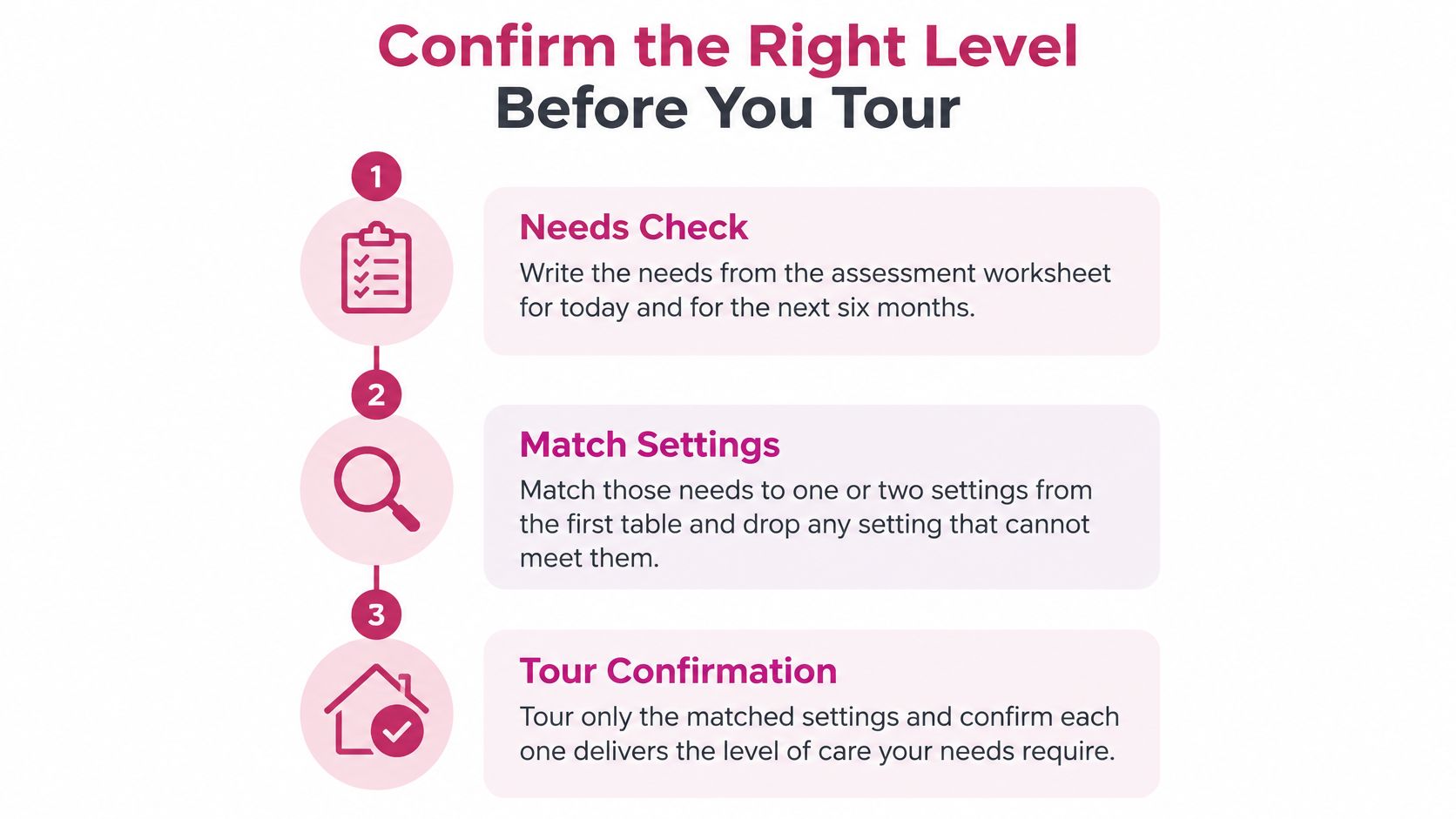
- Write down current and anticipated needs. Bring the completed assessment worksheet, medication list, and relevant discharge instructions. Separate confirmed needs from concerns that still require clinical evaluation.
- Shortlist settings that can meet those needs. Use the comparison table to narrow the search. Ask about the hardest care task first, so you don't spend a visit evaluating somewhere that can't provide it.
- Verify staffing coverage. Ask about vacancies, temporary staff, overnight coverage, and who performs the required hands-on care. Request an explanation specific to your parent.
- Ask what happens if needs rise. Discuss memory-care availability, nursing services, outside providers, and discharge criteria. Get important service limits in writing.
- Confirm the New Jersey license and service type. Check state licensing records against the provider's legal name. Ask the provider to clarify any difference between its marketing description and licensed services.
- Visit outside business hours when possible. Request a weekend-evening tour as well as a scheduled daytime visit. Use these questions to ask assisted living communities to keep comparisons consistent.
- Request the admission assessment and written care plan. Before deciding, confirm who completes them, when you can review them, and whether the provider has accepted every identified care task.
This visual keeps the core decision sequence together.
Start before the decision becomes urgent
Assisted-living occupancy reached 84.3% in the second quarter of 2024, according to the National Investment Center's occupancy report. That historical national figure doesn't establish today's local availability, but it supports asking about openings early rather than assuming a suitable apartment will be waiting.
Keep your worksheet beside you during calls and tours. Your parent's needs should remain the comparison standard, even when a community makes a warm first impression.
For an additional video resource, use the player below.
Life Senior Placement offers New Jersey families no-cost guidance through structured intake, matches to licensed, vetted communities and home-care providers, and coordinated tours with side-by-side comparisons. Visit the website or call (862) 398-2006 with your needs worksheet to discuss options that fit today's care requirements and a backup plan if those requirements change.