
Yes, Medicaid can pay for nursing home care, but only for eligible people who meet state income, asset, and medical-need tests and live in a facility certified as a Medicaid nursing facility. The resident still owes a monthly patient-pay contribution taken from countable income.
Most pages treat that as one yes-or-no. It isn't. A person can pass the financial test, still hand over most of a Social Security check each month, and still have nowhere to go because the preferred home has no open Medicaid bed.
Which check comes first? Eligibility. A tour list built on the private-pay rate wastes weeks if the county later says income, assets, or the level of care don't fit. Patient-pay comes second, because a contribution the household can't live with stops the plan even after approval. The bed comes third, and it has to be confirmed in writing for that specific building.
Say a daughter in Essex County likes a lobby, a staffing board, and a private rate she can cover for two months. None of those facts answers whether her father qualifies, what he will still pay after approval, or whether a certified bed is open.
Yes, Medicaid Covers Nursing Home Care With Conditions
Medicaid does pay for nursing home care in the United States, but only for people who pass state and federal financial and medical tests and live in a facility certified as a Medicaid nursing facility. That is a conditional yes, not an open-ended promise.
Coverage is not automatic, and Medicaid is usually the payer of last resort. Medicare, personal funds, and long-term care insurance are expected to pay what they cover before Medicaid fills the remaining eligible cost of a long stay.
The spending shows why families meet this program on custodial stays that run far past rehab. In 2023, nursing facilities accounted for $68.8 billion, or 83.2%, of the $82.7 billion in institutional Medicaid spending, according to the Medicaid long-term services brief.
| Payer | Covers long-term stays | Who qualifies | Typical role |
|---|---|---|---|
| Medicaid | Yes, when eligible | Income, asset and medical-need tests; facility must be a certified Medicaid nursing facility | Principal public payer for long-term institutional care |
| Medicare | No, generally | Skilled nursing need after a qualifying hospital stay | Up to 100 days of skilled nursing, then coverage usually ends |
| Private pay | Yes | Personal funds or private insurance | Pays the facility's private rate until other sources apply |
The mix-up that burns months is treating Medicare as the long-stay payer. It covers limited skilled nursing after a qualifying hospital stay, not ordinary long-term living.
Run the later checks in order. Confirm eligibility, then the monthly contribution, then an open Medicaid bed at the home you want.
Who Qualifies for Medicaid Nursing Home Coverage
Think of eligibility as four locks on one door. All four have to open. A strong medical chart does not open a file that fails the money test, and a clean bank statement does not place someone in a home the state has not certified.
Federal rules require states to provide nursing-facility services for eligible people age 21 and older who meet that state's nursing-facility level-of-care criteria, as Medicaid's nursing facilities guidance states. The building must be licensed and certified as a Medicaid Nursing Facility. Someone refused ordinary Medicaid may still qualify under special financial rules for people living in institutions, depending on state policy.
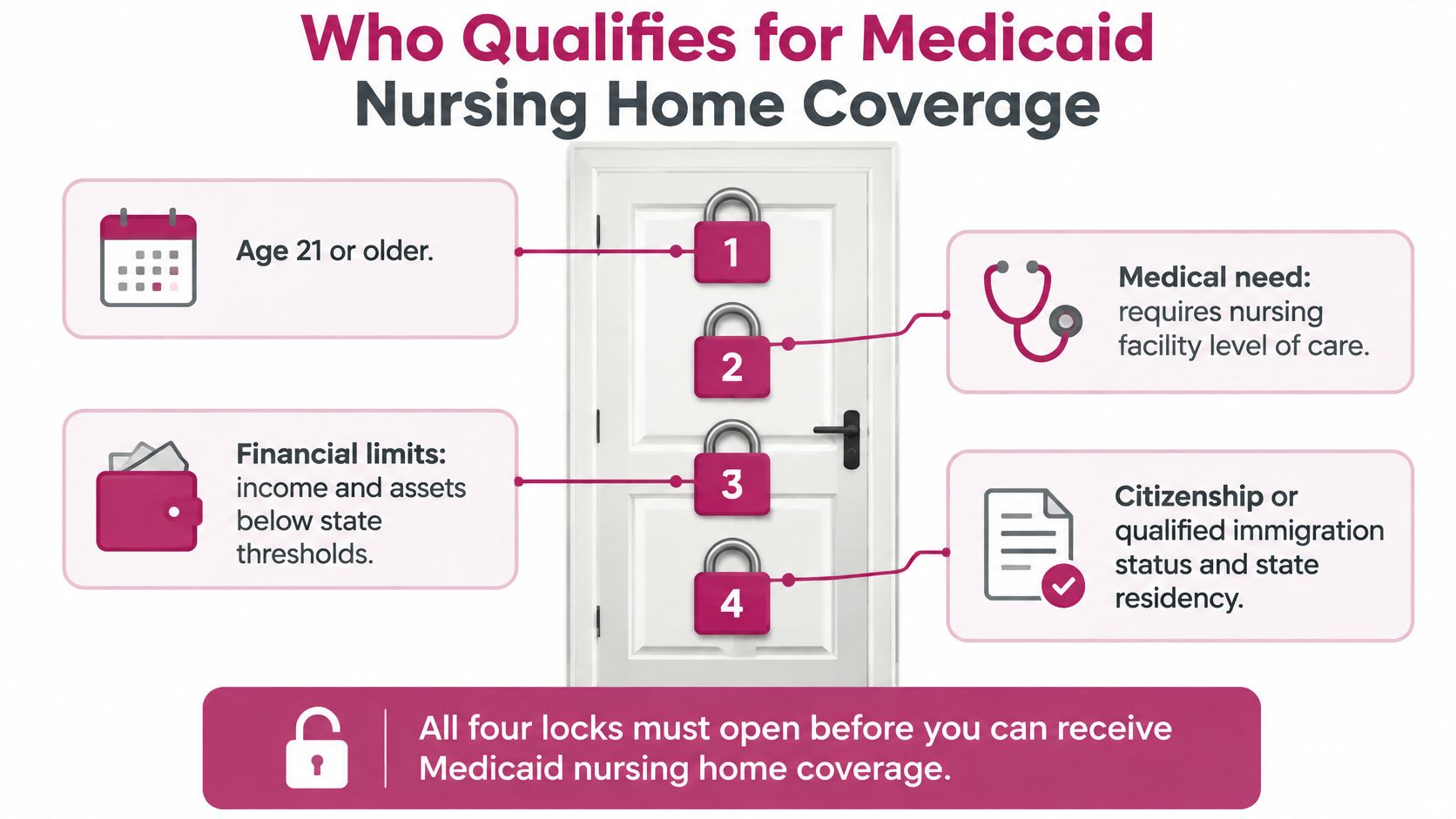
The four locks
Age. Lock one is straightforward. The person must be 21 or older for this nursing-facility benefit. Pediatric institutional rules are a different path.
Medical need. Lock two is clinical, and each state sets its own threshold for needing institutional care. A physician's notes start the file. A state level-of-care review decides it. Needing help with meals is not the same test as needing daily nursing. If you are unsure where a parent sits, compare symptoms against qualifications for nursing home placement before you assume a facility is the right setting.
Finances. Lock three weighs income, countable assets, and state residency for older adults. These are not the income-only rules used for many younger expansion applicants. An applicant turned down once should ask the county whether the institutional rules are a separate door, not a repeat of the same denial.
Facility status. Lock four is about the building, not the person. The home must be licensed and certified by the state as a Medicaid Nursing Facility. A licensed home that only takes private pay fails this lock even when the resident is fully eligible.
Score the case
- Age 21 or older: yes / no
- Nursing-facility level of care, per the state review: yes / no
- Income, assets, and residency inside state rules: yes / no
- Selected home certified as a Medicaid Nursing Facility: yes / no
Any "no" keeps the door shut. Income and asset counting follows state policy, so the county agency, not a facility admissions packet, makes the final call.
A polite "we take Medicaid" at the front desk is not the same as a certified bed with your parent's name moving toward it.
What Medicaid Pays For and What Still Costs Extra
An approval letter settles eligibility. It does not settle the bill. Three questions get blurred together at this stage: whether your parent qualifies, how much of their monthly income goes to the facility as a patient-pay amount, and whether the building itself has an open Medicaid bed. The first is now answered. The second is a separate calculation. The third is the one to check before anything else, because a fully eligible resident still pays privately if the home has no certified bed to offer them.
Once someone is enrolled, the facility cannot bill the resident for core services it must provide or arrange. That bundle is broader than room and board, which is why families are surprised later by the short list of extras.
Required services include nursing and related care, specialized rehabilitative services, medically related social services, prescription-drug services, individualized dietary services, activities, room and bed maintenance, routine personal-hygiene items, and certain dental services. Those are the items that should not appear as add-on charges after approval.
Approval does not make every room upgrade or personal expense free. Private rooms, items beyond the routine list, and some transportation sit outside the bundle in many homes. Families still weighing daily support at home against a facility stay can read aged care guidance from Nursing Assessment Australia for a plain look at what support services usually include before they sign an admission packet.
What the bill still might show
| Item | Medicaid bundle | Ask the facility |
|---|---|---|
| Nursing and related care | Covered | Confirm the staffing standard in writing |
| Prescription drugs | Covered | Confirm which pharmacy the facility uses |
| Room and bed maintenance | Covered | Ask whether a semi-private room is offered at the Medicaid rate |
| Routine personal-hygiene items | Covered | Ask which items count as routine |
| Certain dental services | Covered in part | Ask which dental services are included |
| Private room upgrade | Usually not covered | Ask for the private-pay rate in writing |
| Outside appointments and transport | Often outside the bundle | Confirm who arranges and who pays |
A private room, toiletries beyond the routine list, a favorite shampoo, or a van ride to a specialist can sit outside the bundle. Facilities draw that line differently, so a verbal "that's included" is a weak record.
Practical rule: Get a written list of extras before admission, and ask which items the facility counts as routine.
The monthly patient-pay amount is where the second question comes back in. Even with Medicaid paying the facility's rate, most residents hand over a share of their income each month, and the extras above come out of what is left. If you are still weighing a rehab stay against a longer placement, compare typical charges in a skilled nursing facility cost breakdown so the Medicaid bundle and the private rate are not treated as the same number.
How to Apply for Medicaid Nursing Home Coverage
Paperwork order matters more than speed. A complete file moves. A file missing transfers sits in a county queue while bills stack up.
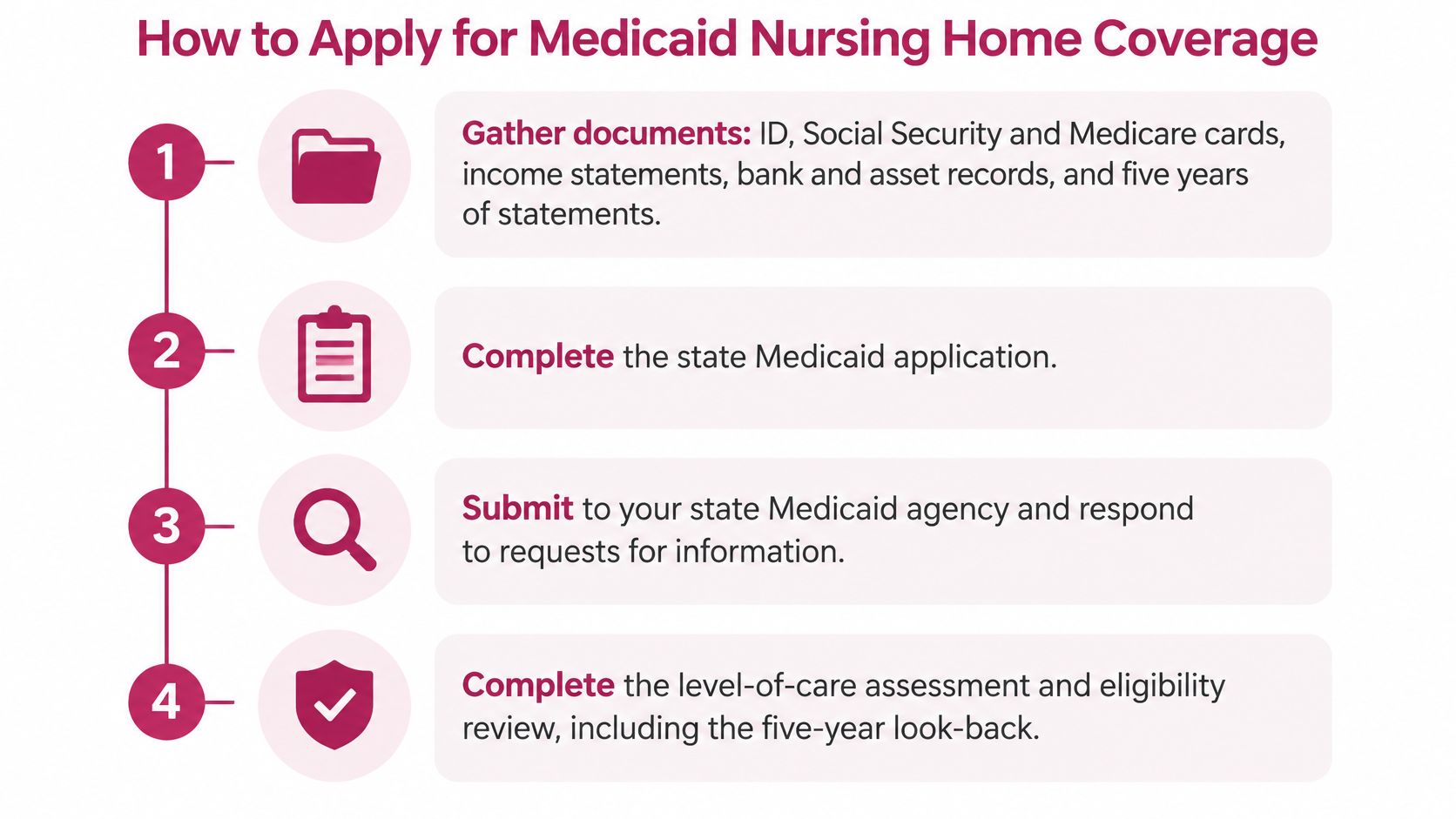
Six steps that keep the file moving
1. Gather the documents before you touch the form. You want photo ID, Social Security and Medicare cards, award letters, pension and income statements, bank and brokerage records, and five years of statements. Federal look-back rules review asset transfers over the past 60 months. Missing pages are the most common reason a worker stops the clock.
2. Request a level-of-care assessment. The clinician has to document why nursing-home care, not a lighter setting, is needed. Ask the hospital or the home who submits that packet and when the state review is scheduled. A diagnosis list without functional detail often comes back for more notes.
3. File with the right office. In New Jersey, nursing-home Medicaid applications go through the county welfare office under the state Department of Human Services. Keep a copy of every page you submit and the date it was received. If managed care will coordinate services after approval, the New Jersey MLTSS guide walks through how that program sits next to the facility stay.
4. Lock the bed in writing while you wait. Ask the facility to confirm that it accepts Medicaid and that a Medicaid bed is open, before the eligibility letter arrives. A pending file is not a reserved bed.
5. Read the decision and the patient-pay notice together. Approval without the contribution figure is only half the answer. Match the notice to the income and deductions you submitted, and question any line that does not match the county's worksheet.
6. If the answer is no, appeal inside the deadline printed on the notice. Ask whether institutional rules were applied, and whether retroactive coverage can reach bills from earlier in the application window. Keep the envelope. The postmark is what the deadline is measured from.
The result you want is three pieces of paper: an approval, a patient-pay figure, and a written bed confirmation.
The slip that stalls files is a gift, a house transfer, or a joint-account change inside that 60-month window that nobody listed. The county will ask for it anyway. Write every transfer down, with dates and amounts, before you file.
A short walk-through of the forms many families face is here:
How the Patient-Pay Amount Is Calculated
Eligibility does not mean the resident keeps the monthly check. After approval, the state sets a patient-pay amount, also called a monthly contribution or applied income. The CMS nursing home beneficiary fact sheet describes that figure as based largely on countable income, with deductions and allowances required by state and federal rules. Medicaid then pays the remaining covered cost to the participating facility.
Older adults are generally reviewed under non-MAGI rules that look at income, assets, residency, and medical need, and those rules differ by state. Medicare is not a stand-in for a long custodial stay. It covers limited skilled episodes under specific conditions, then the long-stay question returns to Medicaid and to this monthly contribution.
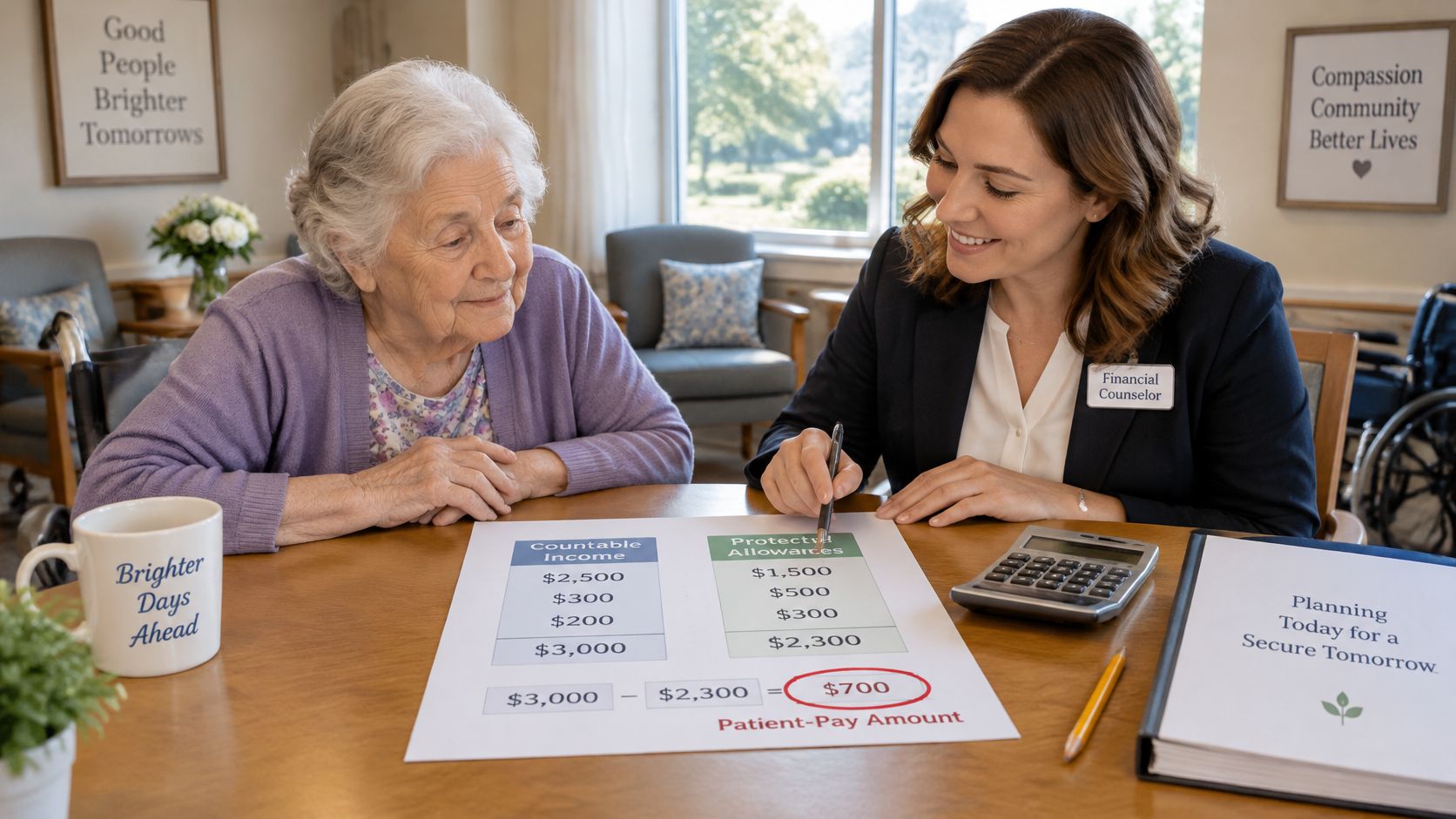
What usually comes off the income
The contribution is typically countable income minus protected amounts. Those protected amounts commonly include:
- A personal-needs allowance so the resident has a small amount for incidentals.
- A community-spouse allowance when a husband or wife still lives at home.
- Certain family allowances when other dependents qualify.
- Qualifying medical expenses, such as health-insurance premiums the state allows.
The state's worksheet controls the dollars, not a national flat rate. The figure also changes when income, deductions, or the level of care changes, so last year's letter is not this year's bill.
A labelled example, not a state notice
Use this only to see the arithmetic. It is not New Jersey's allowance schedule.
- Start with $2,800 of monthly countable income.
- Subtract $150 for health-insurance premiums the state allows.
- Subtract a $50 personal-needs allowance.
- The illustrative patient-pay amount is $2,600. Medicaid would pay the rest of the covered facility bill.
Ask for the patient-pay figure in writing before you choose a home, and check that the leftover income still covers the spouse at home.
Before you commit, you want four answers in hand: the eligibility determination, the expected contribution, confirmation that the home accepts Medicaid and has an open bed, and a list of personal expenses outside the bundle.
Medicare Gaps, Denials and Missed Deadlines
A common assumption is that Medicare will carry the nursing home stay until the family is ready to deal with Medicaid. It will not. Medicare can pay for skilled nursing after a qualifying hospital stay, and it does not generally cover long-term custodial care. Medicaid can pick up from that point only when the financial rules and the state's level-of-care test are met, and only in a licensed, Medicaid-certified nursing facility.
KFF reported that Medicaid paid 44% of U.S. Institutional long-term-care costs in 2023. That share is why a late application is a bill problem rather than a paperwork problem. A person turned down for ordinary Medicaid may still qualify under the separate rules that apply to institutional residents, so a first denial is not the end of the file.
Turn each risk into a dated action
Skilled days running out. Count the days from the qualifying hospital stay on a calendar the week of admission. File the Medicaid application early enough that a decision is in motion before those skilled days end. Waiting for the facility to "let you know" is how families discover the handoff on a Friday.
A pending application. Some homes will admit while the file is open, but charges still accrue if approval is slow. Ask in writing how the facility bills during a pending application and who is responsible if the case is denied.
Retroactive coverage limits. States can limit how far back Medicaid will pay once an application is filed, and those limits differ by program and can change over time. File on the first day of need, and ask the county office whether retroactive coverage can reach bills from before the filing date.
A denial that looks final. Calendar the appeal deadline the day the notice arrives. Keep copies of every submission. Ask specifically whether the institutional financial rules were used, because a denial issued under community rules can be wrong for a nursing home applicant.
The handoff runs in order: skilled rehab under Medicare, then the level-of-care assessment, then the Medicaid file, then the patient-pay notice. Skip a step and the bill does not skip with you. Each step answers a different question. The eligibility determination answers whether the state will pay at all, the patient-pay notice answers what the resident owes each month, and neither one settles whether the chosen building has a Medicaid bed open. Confirm eligibility first, because every figure and facility decision after it depends on that answer.
New Jersey Rules and Facility Checks
New Jersey does not use a single national income chart you can trust from a blog. Long-term care Medicaid rules are set by the Department of Human Services' Division of Medical Assistance and Health Services. Nursing-home applications are filed at the county welfare office. Income limits, allowance figures, and processing steps change, so confirm current numbers with that office before you budget from any example, including the arithmetic above.
Nursing homes are licensed by the state Department of Health. Medicaid certification is a second fact. Confirm both before admission. A current license does not prove the home has a Medicaid bed open this month.
The New Jersey median cost for a nursing home semi-private room is $12,775 a month, which is why a two-month private-pay bridge disappears quickly if the Medicaid file slips.
How to check the building
- Bed count: Ask how many Medicaid beds are open today, not how many the home is certified for.
- Inspection record: Request the latest state inspection report and read the pages on staffing and care complaints.
- Care Compare: Look up the home on Medicare's Care Compare tool and compare staffing and quality ratings with one or two alternatives in the same county.
- Billing during review: Ask what happens to charges if the application is still pending on move-in day.
Questions to ask this week
Which county office has the file? Does this home have an open Medicaid bed, in writing? What is the current personal-needs allowance? Will a pending application change the admission or the daily rate?
Take the answers from the county worker and the admissions office, not from a brochure. If the two answers disagree, the county figure on eligibility and the written bed note from the facility are the ones that protect you.
Confirm Eligibility Before You Choose a Facility
Choose the facility after the Medicaid checks, not before. Shortlisting by private-pay rate feels productive, and it falls apart when eligibility, the contribution, or the bed fails later.
Do the three checks in this order:
- A Medicaid eligibility determination from the county welfare office.
- A written patient-pay estimate you can match to the household budget.
- Written confirmation that the facility accepts Medicaid and has an open Medicaid bed.
We help families sort which payment sources may apply, including private pay, long-term care insurance, veterans benefits, and New Jersey Medicaid for nursing homes, and we can build a shortlist to test against those three checks. Life Senior Placement covers all 21 New Jersey counties. We do not evaluate clinical needs or determine eligibility for insurance or public programs. The county office remains the authority on the decision and on the contribution.
This week, call the county welfare office and request the patient-pay figure, ask two facilities for written confirmation that they accept Medicaid, and confirm the open-bed count with each.
Life Senior Placement helps New Jersey families compare nursing homes against Medicaid eligibility, the monthly contribution, and real bed availability before anyone signs an admission agreement. If you want a shortlist you can verify with the county and with each home, visit Life Senior Placement and start with the payment sources that may cover the stay.


