
A home health aide is a direct-care worker who helps a person with daily personal care in that person's own home, such as bathing, dressing, walking to the bathroom and eating, and does not hold a nursing license. The aide works alongside the nurse, therapist or physician in charge, and what that aide may do on any given morning comes from a written care plan rather than from the title on a name badge.
So why does the same hands-on help cost one family nothing and another family an hourly rate? Because a home health aide is not one job with one payer. It's a role whose edges get redrawn by two documents most families never think to ask for: the service plan that lists the tasks, and the payer that agrees to fund them. Line those two up and the job title stops mattering. Leave them misaligned and you can hire a thoroughly competent aide for tasks nobody will pay a dollar toward.
The scale of this workforce is not in question. The U.S. Bureau of Labor Statistics counted 1,029,460 home health and personal care aides employed in home health care services in May 2024, according to its industry employment data. What is in question, for most families, is the paperwork behind the visit.
What a Home Health Aide Does Each Day
Picture a Tuesday morning visit. The aide arrives at eight, helps the client onto a shower chair, washes her hair, gets her dressed, confirms she takes the pills already set out in her pillbox, fixes breakfast, and writes two lines in the log: she ate half, and she seemed unsteady on the walk to the bathroom. That second line is often the most clinically valuable thing that happens all morning.
The Centers for Medicare & Medicaid Services defines the role precisely. Aides do not hold nursing licenses. They support nurses by helping with bathing, using the toilet, dressing, walking, grooming, feeding and changing bed linens. Hands-on help, yes. A replacement for a registered nurse, licensed practical nurse, therapist or physician, no.
That support-crew picture is the clearest way to hold the role in your head. A physical therapist sets the transfer technique after a hip replacement. A nurse writes the plan and checks the aide's notes. The aide is the person who is there at eight in the morning, doing the technique the way it was taught and reporting back what changed.
Where families get confused is the household work. CMS draws a hard line: a visit consisting only of light housecleaning, meal preparation and trash removal does not meet the Medicare definition of home health aide services. Chores are not personal care, no matter how much they need doing.
The simplest test for any task list: if the task involves hands, water, clothing, food or feet on the floor, it's aide work. If it involves only a mop, a vacuum or a trash bag, it's housekeeping.
| Task | Typical aide role | Needs a nurse or therapist |
|---|---|---|
| Bathing, dressing and grooming | Yes, hands-on help | No, for routine help |
| Toileting and transfers | Yes, with safe-transfer training | Yes, when the technique is unclear |
| Walking and mobility support | Yes, following the service plan | Yes, for a new mobility plan |
| Meal preparation and feeding | Yes | No |
| Light housekeeping only | Not personal care under Medicare | No |
| Vital signs | Sometimes, where state rules and agency policy allow | Yes, where not permitted |
| Medication administration | Limited, under supervision | Yes |
| Clinical assessment and diagnosis | No | Yes |
Read that table against a real morning and the boundaries become obvious. Nobody needs a nursing degree to help someone into a shirt. Somebody does need one to decide that a new wobble on the way to the bathroom means the transfer plan has to change.
How Aides Differ From CNAs and Companion Caregivers
Three titles, three different levels of hands-on care, and a great deal of overlap in daily life.
A home health aide trains according to state rules and agency policy, often entering with a high-school diploma plus a training program and a competency test, and usually works through a certified agency under nurse supervision. A certified nursing assistant completes a state-approved program and a competency exam, which is a portable credential that travels between nursing homes, hospitals and home settings. A companion caregiver provides supervision, conversation, errands and light household help, with little or no hands-on personal care and often minimal state requirements.
| Role | Training usually required | Usual setting | Scope of hands-on care |
|---|---|---|---|
| Home health aide | Varies by state and agency; often a high-school diploma plus training and a competency test | Client's home, usually through a certified agency | Personal care and daily living help under nurse supervision |
| Certified nursing assistant (CNA) | State-approved training program and competency exam | Nursing homes, hospitals and some home settings | Personal care under nurse supervision, in facility or home |
| Companion caregiver | Often minimal or none; rules vary by state | Client's home | Companionship, supervision, errands and light household tasks; little or no personal care |
Think of it as job title versus job description. The title tells you what credential the person holds. The job description, meaning the tasks written into the plan, tells you what will happen in the house. A CNA hired for four hours a week of company and crossword puzzles is functioning as a companion. A companion asked to help with a shower is doing aide work without aide training, which is where injuries and complaints start.
The practical rule is short. If bathing, toileting or transfers are in the picture, ask for an aide or a CNA. If the need is company, supervision and someone to drive to appointments, a companion may be plenty. Families comparing models often find it helps to understand the difference between home care and home health care before they interview anyone, because the two are sold under nearly identical language.
Training, Licensing and Questions to Ask Before Hiring
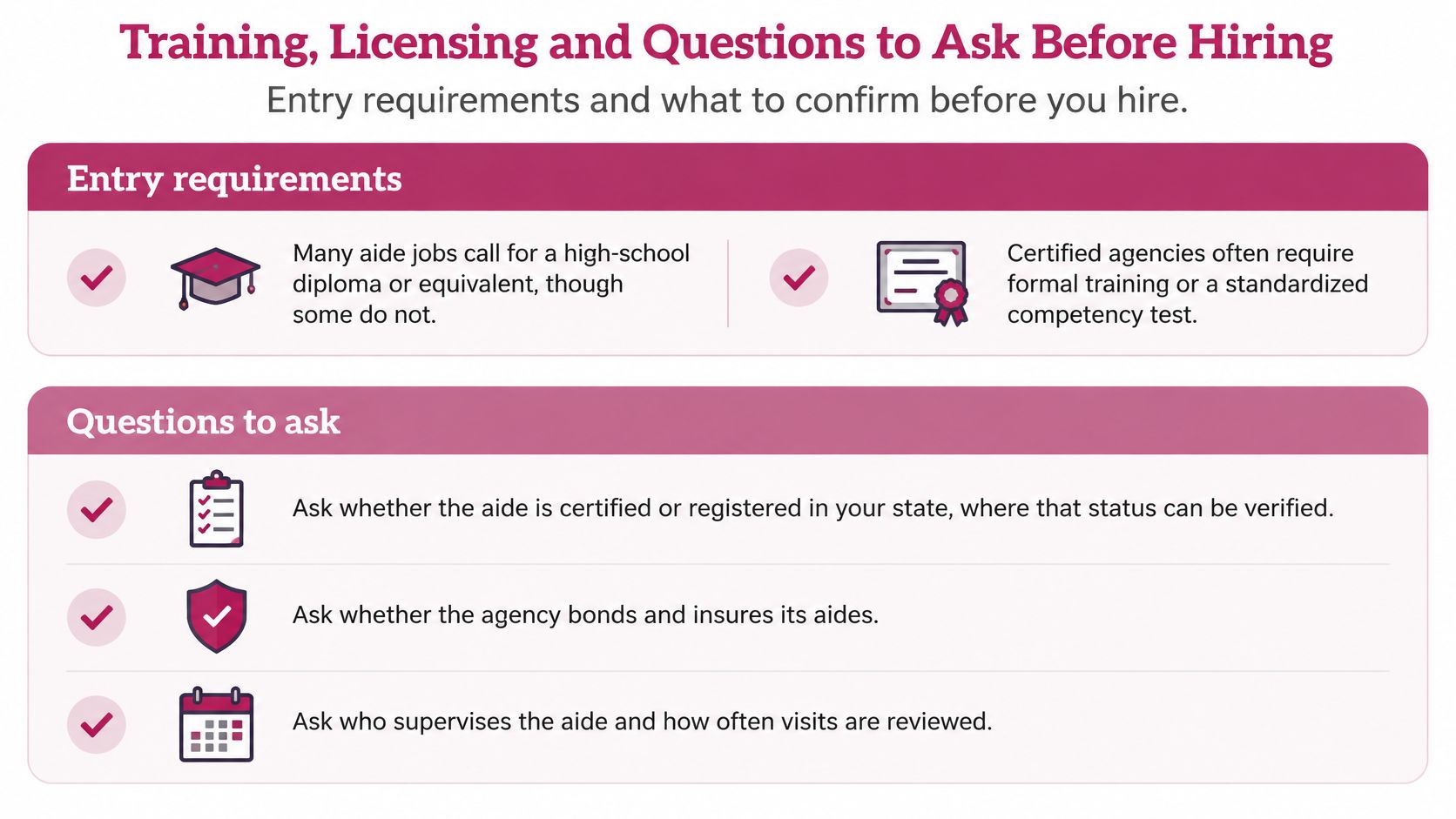
Entry requirements are lower than most families expect, which is exactly why the screening conversation matters. The Bureau of Labor Statistics Occupational Outlook Handbook identifies a high-school diploma or equivalent as typical entry-level preparation, though some jobs don't require one, and notes that certified agencies may require formal training or a standardized competency test.
State rules vary, so the same job title can carry different credential requirements across a state line. The role itself is functional rather than independently clinical. Aides help with activities of daily living, observe the client's condition and document what they delivered. In certified home health or hospice settings they generally work under the direction and supervision of a nurse or another qualified practitioner. Depending on jurisdiction, agency policy and training, an aide may be permitted to take vital signs or assist with medication-related tasks, but not to assess a client or administer medication independently.
That is the line between a credential and a scope. A certificate answers who is qualified. The service plan answers what that qualified person is allowed to touch in your parent's house.
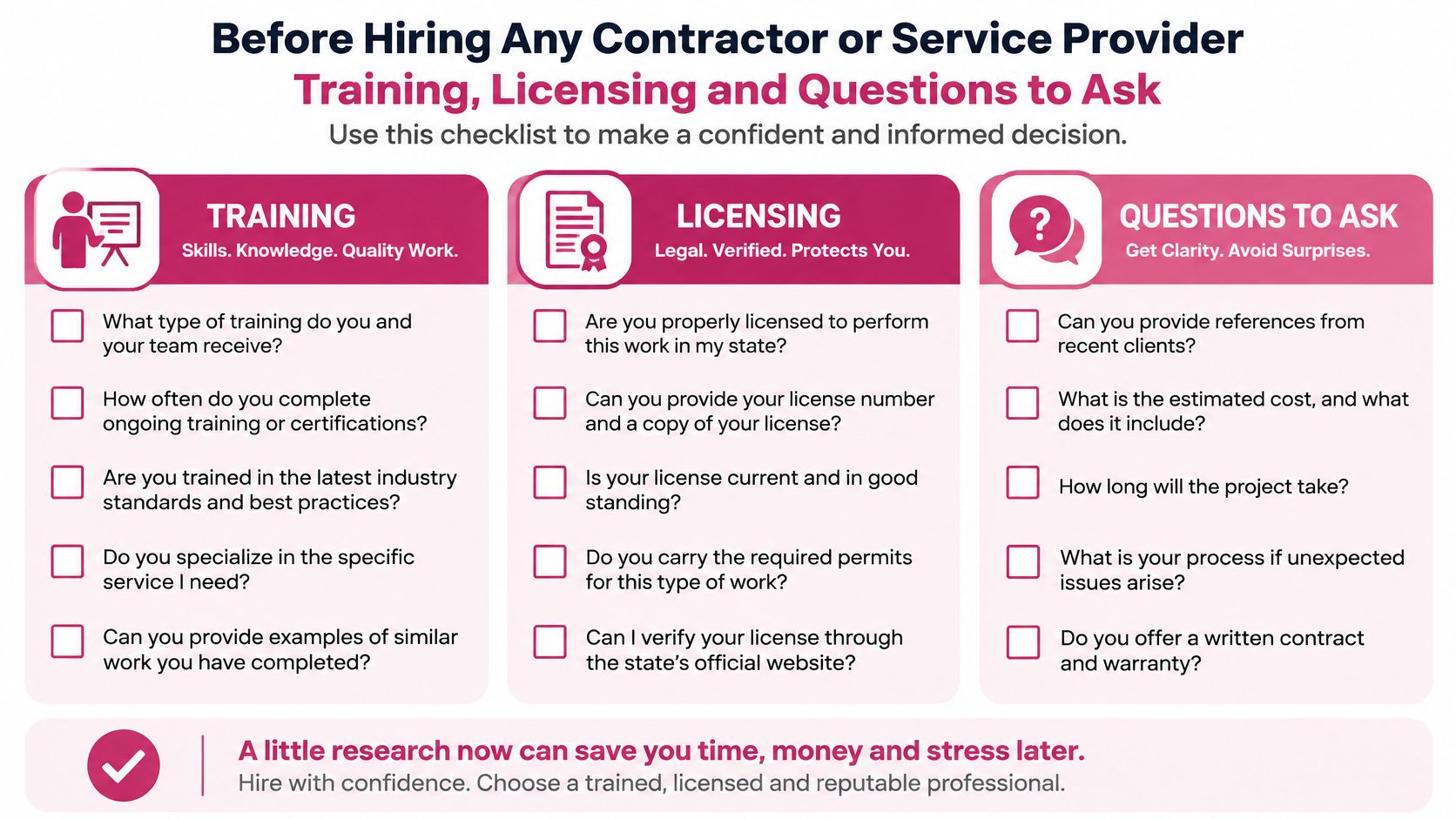
Use these six questions on the first phone call, in this order:
- Licensing and registry status. Is the provider licensed or certified where your state requires it, and is the individual aide listed on the state registry?
- Written tasks. Which specific tasks are authorized in the service plan, and will you see that plan before care starts?
- Supervision. Who supervises the aide, and how often does that nurse visit or review notes?
- Training content. What training did this aide complete, and did it cover safe transfers and infection control?
- Escalation and documentation. How are falls, near misses and changes in condition reported, and who reviews the written record?
- Backup and cost. What happens when the regular aide is sick, and what are the total weekly costs, including any minimum-hours requirement?
Add one more request: confirmation of the background check. Then watch how the agency answers. Vague answers about supervision are a more reliable warning sign than a slightly higher rate.
For a sense of how these questions play out in a real intake conversation, this short walkthrough is useful.
Who Pays for Home Health Aide Care
Who pays for an aide depends on the care plan, not just the job title. Medicare generally does not cover ongoing custodial help on its own. Under Medicare's home health coverage rules, aide services may be covered when the person also receives covered skilled care, such as nursing or therapy, and needs only part-time or intermittent help. Covered assistance can include walking, bathing, grooming, feeding and changing linens. Combined home health services are generally limited to up to eight hours per day and 28 hours per week, subject to eligibility and medical-necessity rules.
For example, someone recovering from knee surgery who has nursing and therapy ordered may qualify for covered aide visits. A neighbor who needs daily supervision and companionship because of dementia may not qualify for Medicare coverage for that help. The tasks, their duration and the payer's rules all matter.
| Payer | What it typically covers | Main limit |
|---|---|---|
| Medicare | Part-time or intermittent aide services alongside covered skilled care such as nursing or therapy | Requires skilled care; combined home health services usually capped at 8 hours a day and 28 hours a week |
| Medicaid | Personal care for eligible low-income people, through state programs or waivers | Eligibility, hours and providers set by each state |
| Private pay | Agreed help, including companionship, supervision and housekeeping | Family pays the full cost; rates and hours are set by agreement |
| Long-term care insurance | Home care benefits defined by the policy | Benefit triggers, daily limits and waiting periods vary by policy |
These payment routes serve different needs. Short-term recovery may involve a certified agency and a doctor's orders. Longer-term daily support may require private payment, a state program or long-term care insurance. A written care plan helps clarify which tasks are needed and how many hours to schedule.
For private-pay care, compare the hourly rate with the total weekly cost. In-home care averages $30 to $38 per hour for licensed non-medical aide assistance, and monthly expenses depend on the number of hours scheduled each week. Check hourly home health aide costs in North Jersey for a local benchmark, not a price that applies everywhere. Ask about minimum hours, missed shifts, backup coverage and the full cost for your planned schedule.
Aides' wages and employer charges are different figures. The Bureau of Labor Statistics reports that home health and personal care aides had a median annual pay of $35,800 in May 2025, with employment projected to grow 18% from 2025 to 2035, according to its Occupational Outlook Handbook. Those figures describe the workforce, not what a family will pay an agency.
Ask directly: “Who is coming on Thursday if our regular aide calls out sick?” A clear answer helps you judge whether the care schedule can hold up in practice.
When Hiring a Home Health Aide Makes Sense
When does scheduled help at home make more sense than asking family to fill every gap? The answer often depends on what the person needs help doing, how long each task takes, and what the written care plan covers.
After a hospital or rehab stay. A hip replacement, stroke or serious fall can make bathing, dressing and moving around harder for a time. A home health aide may help with daily tasks while the person recovers, but skilled medical care is a separate need that may require a clinical provider.
When daily routines start slipping. Perhaps bathing is less frequent, laundry is piling up or the same clothes are worn for several days. These changes can point to difficulty with activities of daily living, the basic personal tasks that often shape a home care plan.
When family caregivers need scheduled relief. An adult child who handles morning and evening visits around a full-time job may need help with specific parts of the day. An aide can take on agreed-upon tasks during scheduled hours.
When getting around the home feels unsafe. A walker catching on a rug or an unsteady bathroom transfer calls for a clear plan. Overexertion, especially from lifting patients, is a major source of injury for direct-care workers, so transfers and lifting should not be improvised.
The plan should spell out transfer ability, equipment in the home, how many people are needed to assist, and any stair or bathroom limits. A nurse or physical therapist may need to establish a safe technique. Practical adjustments, such as a raised toilet seat, shower chair and clear path from bed to bathroom, can also help. If getting out of a deep armchair has become difficult, choosing a lift chair for seniors can help you consider fit, clearance and sizing.
The job title alone does not determine what care will cost or whether a payer will cover it. The written plan matters: the same aide's time may be partly covered, fully private-pay or not covered at all, depending on the tasks listed and how many hours they take. Confirm the plan and payer before scheduling care.
A few scheduled hours may no longer be enough if dementia brings nighttime wandering, falls repeat, or the person needs supervision around the clock. Reassess the care plan after a hospitalization, a medication change or a change in walking ability.
Confirm Your Care Level and Next Steps
Start on paper. Write down the tasks the person needs each day, the weekly hours those tasks add up to, the monthly budget, and the likely payer: Medicare, Medicaid, private pay or long-term care insurance. Then hold that list against the payer table. Skilled and short term points toward a certified agency and Medicare. Daily custodial help points toward private pay or a state program.
Next, gather the medical summary from the doctor or hospital. Ask for nursing or therapy orders, mobility and transfer notes, medication changes, and any memory or night-time concerns documented while the person was still under observation. Whoever assesses your parent at home will want all of it.
At Life Senior Placement, a Life Home Care Manager meets with the family at home or virtually for a free in-home consultation to talk through needs, routines and budget, and every caregiver we introduce is background-checked, with care plans supervised by registered nurses. Bring the task list from the paragraph above to that conversation. It turns a vague worry into a schedule someone can quote.
Five steps, in order:
- Write the daily tasks.
- Set a weekly hour target.
- Note the payer and budget.
- Gather the medical summary.
- Request a shortlist or consultation.
Life Senior Placement helps New Jersey families turn that task list into a shortlist of vetted home care providers and communities, at no cost to you, with an advisor who stays with you from intake through the first week of care. Whether the answer is a few aide hours a week or a move to assisted living or memory care, our team matches your parent's clinical needs, preferences and budget against licensed options and coordinates the tours and comparisons. Visit Life Senior Placement to start with a conversation about what your family needs.


