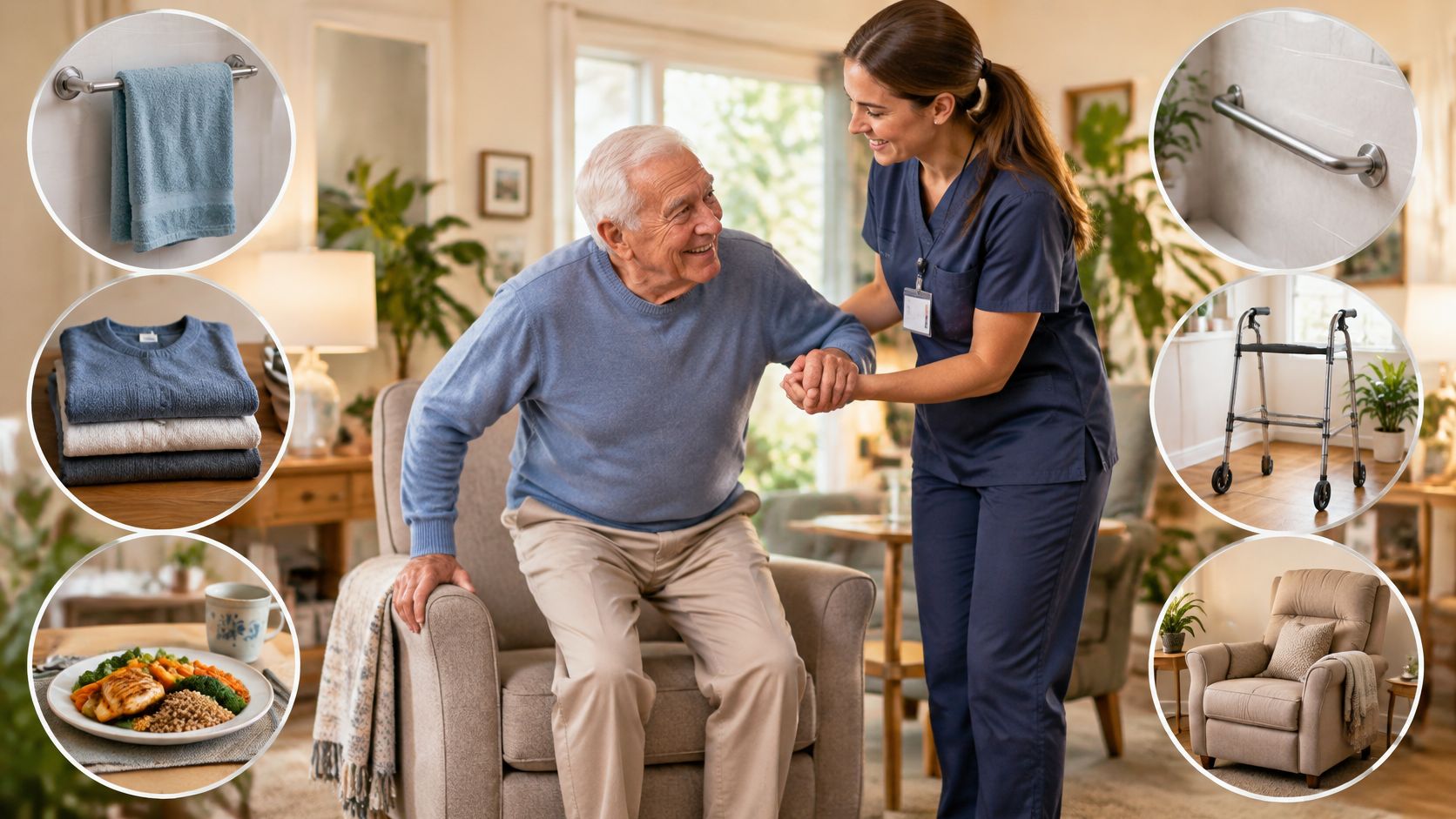
Your parent wants to stay home, but you're already handling meals, medication reminders, and late-night calls. Someone suggests assisted living. Someone else says hiring a caregiver must be cheaper, and suddenly you're comparing prices that don't include the same services.
The useful question isn't which setting costs less. It's which arrangement covers the help your parent needs, including the hours when family can't be there. Comparing assisted living alternatives starts with that schedule, then adds housing costs, safety needs, and a realistic plan for changes.
Assisted Living Alternatives at a Glance
Assisted living alternatives by level of care and typical monthly cost
| Option | Level of care | Typical monthly cost | Setting |
|---|---|---|---|
| Home care | Paid hours for personal care and companionship | Hourly quote multiplied by scheduled care hours | Own home |
| Independent living | Housing and amenities, with care arrangements available if needs change | Our Lodi listings run $3,200 to $5,200 | Community apartment |
| Adult day program | Daytime supervision and activities | Program fee based on attendance; request a transportation-inclusive quote | Day center |
| Assisted living | Daily help with dressing, medication, and meals | $8,710 New Jersey median; our Wall range is $5,500 to $9,200 | Residential community |
| Memory care | Secure setting, dementia-trained staff, structured routines | Individual assessment and residential care quote | Secured residential unit |
| Skilled nursing | Continuous clinical care and rehabilitation | Facility quote based on clinical needs, room, and payment arrangements | Nursing facility |
Read the table as a guide to what you're buying, not a set of interchangeable packages. Independent living mainly replaces household responsibilities. Adult day services cover a portion of the day, while residential care combines housing with an assessed level of support.
The local price ranges are starting points, not offers. Each participating organization sets its own pricing, and a person's assessed needs can change the final amount.
Match the service to the missing help
A person who needs company and dinner preparation has a different problem from someone who can't safely get out of bed alone. Likewise, a scheduled caregiver visit won't solve unpredictable nighttime wandering.
Home care sits near the less-clinical end when it provides companionship and personal assistance, but extensive home support can become a complex arrangement. A familiar address doesn't automatically mean a lower level of need.
Use these questions to narrow the choices:
- Daily assistance: Which tasks require another person, and when must that person be present?
- Overnight safety: Can your parent safely remain alone while others sleep?
- Specialized needs: Does dementia, rehabilitation, or an ongoing medical condition require trained supervision?
At Life Senior Placement, we help families compare assisted living, nursing homes, memory care, independent living, and home care. The starting point is the person's needs, not a preferred building or an advertised room rate.
Staying at Home With Home Care and Modifications
Staying home is a meaningful preference, not something families should dismiss. In AARP's 2024 national survey, 75% of adults age 50 and older wanted to remain in their own homes throughout their lives, and 61% preferred future long-term care at home through a combination of family and paid help.
A familiar room and a trusted caregiver can preserve everyday routines.
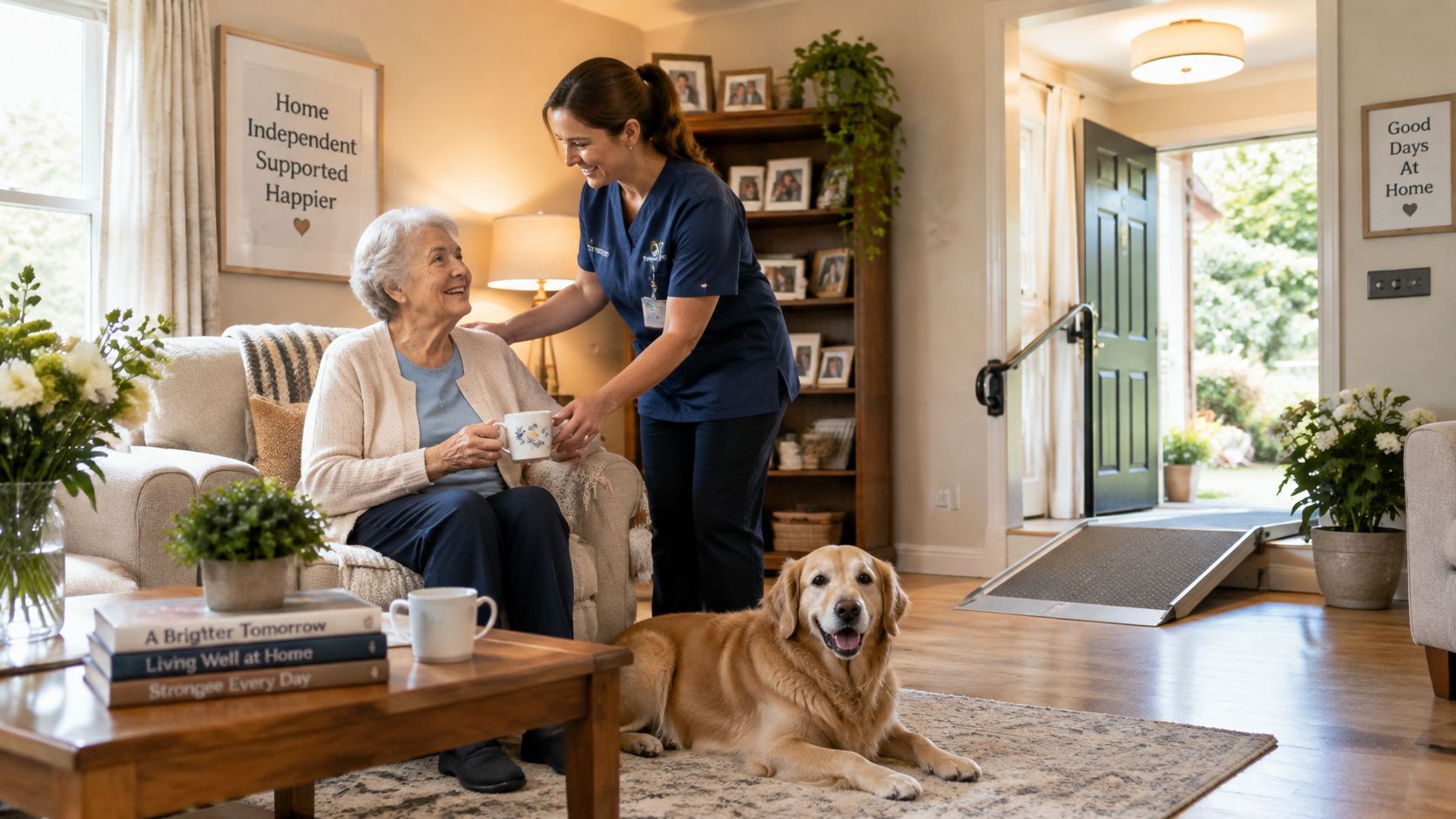
Families can provide all the assistance, hire professionals, or divide responsibilities. A mixed arrangement can give relatives room to remain family members rather than taking every care shift, but it only works when responsibilities are explicit. Write down who handles bathing, meals, appointments, medication support, and unexpected absences.
Walk the routes your parent actually uses
Start outside. Can your parent reach the entrance with their usual mobility aid, manage the threshold, and open the door without losing balance? Then follow the route from the bedroom to the bathroom, including what that route looks like at night.
Check stairs, lighting switches, narrow passages, and places where furniture becomes an improvised handhold. In the bathroom, consider both the person receiving help and the caregiver: can they turn, transfer, and assist without squeezing around fixtures?
Begin with manageable changes, then assess construction work:
- Remove obstacles: Clear loose rugs, cords, and clutter from walking routes.
- Improve visibility: Add accessible lighting along nighttime paths.
- Support transfers: Consider properly installed grab bars and an appropriate shower seat.
- Address structural barriers: Evaluate doorway widening, bathroom alterations, and a step-free entrance.
For a closer look at layout decisions, SouthRay Kitchen & Bath's guide to adapting bathrooms for changing mobility can help you prepare questions for a contractor. Use it alongside an individualized mobility assessment, not instead of one.
This video offers another way to approach the home-care conversation.
Build a schedule before choosing coverage
Our home care options range from a few hours a week to full 24/7 care. Don't assume the largest arrangement is necessary, but don't leave essential tasks assigned to a relative who can't reliably attend.
Say your parent can manage lunch independently but needs help getting dressed and preparing dinner. Separate those care windows from time spent keeping company. Home care is most workable when needs are reasonably stable, core shifts have dependable coverage, and the home can be adapted within the available budget.
When Home Care Costs More Than a Facility
A family that starts with ten paid hours a week rarely stays there. Needs grow, coverage widens, and at some point the hourly math passes the cost of moving. The table below shows where that line sits.
Monthly home care cost by weekly hours at $35 an hour
| Weekly hours | Calculated monthly care cost | Share of NJ assisted living median |
|---|---|---|
| 10 hours | About $1,520 | About 17% |
| 20 hours | About $3,030 | About 35% |
| 40 hours | About $6,060 | About 70% |
| 56 hours | About $8,490 | About 97% |
These are worked estimates using weekly hours × $35 × 4.33 weeks, with the hourly input taken from the Richmond Fed comparison. The percentage column measures each total against the New Jersey assisted living median of $8,710 a month.
Published conversions like this give you a starting grid, not your answer. Use your actual local hourly quote rather than relying on any single published monthly conversion, because agencies price schedules differently.
Find your household's crossover point
The lightest schedule in the table might cover selected meals, bathing visits, or errands. The middle schedules buy more dependable coverage but still leave substantial time for the person to manage alone or receive unpaid help. The longest schedule can approach a residential care budget without paying for housing.
A universal breakeven rule won't help much here. Whether home care becomes more expensive than a facility turns on the local residential quote, paid hours, and household expenses that remain.
Budget rule: Compare a complete month at home with a complete month in a community, not caregiver wages with a room advertisement.
For a local reference, our Wall assisted living range is $5,500 to $9,200 monthly. Baseline rates cover housing, dining, and activities, while tiered fees reflect assistance with medication, bathing, and mobility.
Add what the hourly price leaves out
The hourly figure buys caregiver time only. Your home budget should also include rent or mortgage, utilities, repairs, transportation, and necessary modifications, along with the family member who leaves work early, loses sleep, or gives up paid hours to cover gaps. Unpaid doesn't mean cost-free.
Overnight coverage and split shifts can change the quote, and agency versus direct-hire arrangements need separate comparisons of scheduling responsibility, backup coverage, and employment obligations. Two schedules with the same weekly hours can produce very different monthly totals once those factors enter.
Our guide to how much home care costs can help you organize those questions. Total the required weekly coverage, price the actual schedule, then compare the household total with a written residential quote that includes assessed care fees. If a spouse's health or an adult child's availability changes, rerun the budget rather than assuming family coverage will continue.
Independent Living and Adult Day Programs Explained
Independent living and adult day programs address different needs. Independent living changes where someone lives; an adult day program changes how part of the day is supported. Neither should be mistaken for a complete personal-care plan.
Independent living suits active seniors who want community, amenities, and freedom from home maintenance. Dining, activities, and household services can make daily life easier without requiring someone to accept assistance they don't need.
Housing convenience versus daytime support
Our independent living listings around Lodi run $3,200 to $5,200 monthly. When comparing that price with assisted living, identify which personal-care services are absent rather than assuming you've found the same care for less.
Care may be available if needs change, but the arrangement matters. Establish whether assistance comes through the community or a separate provider, how it's billed, and which needs would require a move. A reassuring statement that care is available isn't the same as a written commitment to provide a particular service.
Our explanation of independent living for seniors can help you distinguish lifestyle services from hands-on support.
Adult day programs provide supervised daytime activities, meals, and, in some programs, health monitoring. Genworth and CareScout's Cost of Care Survey release reports a 2024 national median annual adult day care cost of $26,000, equivalent to about $2,170 monthly.
| Decision point | Independent living | Adult day program |
|---|---|---|
| Main purpose | Community housing and relief from maintenance | Support during scheduled daytime attendance |
| Home arrangement | Person moves into an apartment | Person continues living at home |
| Main gap to resolve | Hands-on care not included in housing | Mornings, evenings, nights, and closed days |
| Practical check | Care contract and move-out criteria | Transportation and attendance schedule |
Consider a combined arrangement
Say a daughter works during the day and her father shouldn't spend that time alone. A day program may provide structure and company, while home care handles getting ready and settling in afterward.
The transportation plan matters as much as the activity calendar. Confirm who helps the person leave home, board the vehicle, and return safely. This middle tier is worth considering when isolation or caregiver availability is the main difficulty, but essential needs outside program hours still require a named caregiver.
Memory Care and Skilled Nursing for Higher Needs
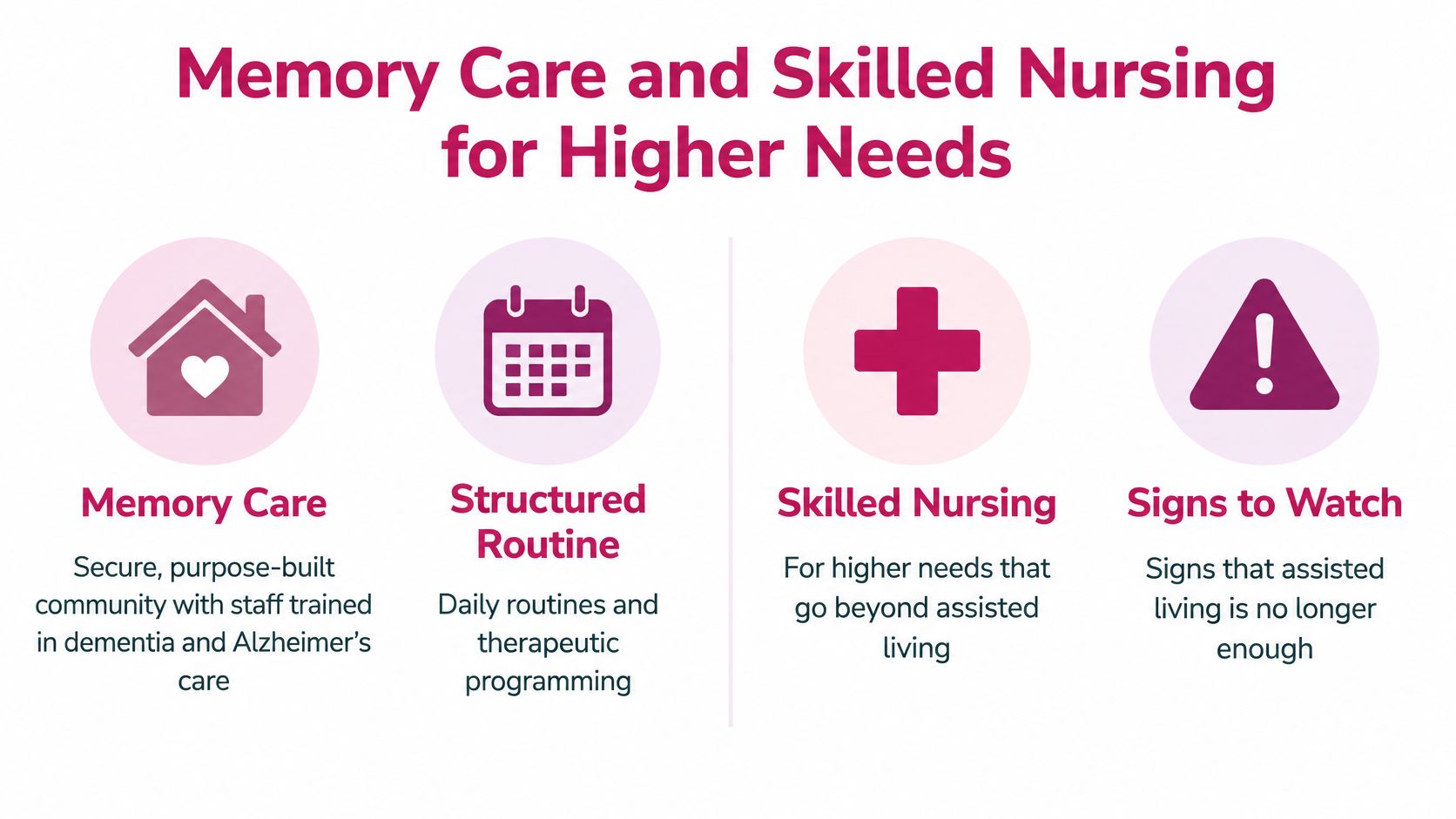
Exit-seeking, distress late in the day, repeated nighttime falls, or a need for constant cueing should trigger a fresh assessment. These aren't automatic placement rules, and sudden changes deserve clinical attention. They are reasons to question whether the current arrangement can still provide safe care.
Memory care offers secure, purpose-built surroundings with staff trained in dementia and Alzheimer's care, structured routines, and therapeutic programming. The aim is to match the environment and staff response to the person's cognitive needs, not just add a locked door.
The comparison below highlights the different purposes of specialized settings.
Dementia support and clinical care aren't interchangeable
A memory care assessment should address wandering, communication, personal-care resistance, sleep patterns, and what helps the person feel settled. Our guide to memory care services explains the kinds of support families should examine.
Skilled nursing is appropriate to investigate when someone needs continuous clinical oversight or rehabilitation beyond ordinary personal care. The CDC's National Post-Acute and Long-Term Care Study overview counted approximately 14,700 U.S. Nursing homes in 2022, reflecting a substantial care pathway for people with higher needs.
A dementia diagnosis alone doesn't tell you which setting is suitable. Someone may need dementia-informed care alongside substantial nursing support, so ask each residence to assess the whole person rather than assigning a setting from the diagnosis.
Separate home health from ongoing supervision
CMS's home health guidance describes Medicare-covered home health as part-time, medically necessary skilled services, such as nursing and therapy, rather than continuous supervision or custodial assistance. A visiting nurse or therapist can address a clinical task without covering the rest of the day.
When comparing higher-needs settings, examine:
- Clinical staffing: Who is present overnight, and who responds to deterioration?
- Rehabilitation capability: Can the team deliver the therapy the person needs?
- Dementia services: How do staff respond to distress and unsafe exit attempts?
- Payment arrangements: Which services and stays are eligible under the person's coverage?
- Changing needs: What would trigger a transfer elsewhere?
If the dominant need is clinical, continuous, or dementia-driven, get assessments and quotes from the relevant specialized settings before committing to a lower-support option.
Checking Quality Before You Commit
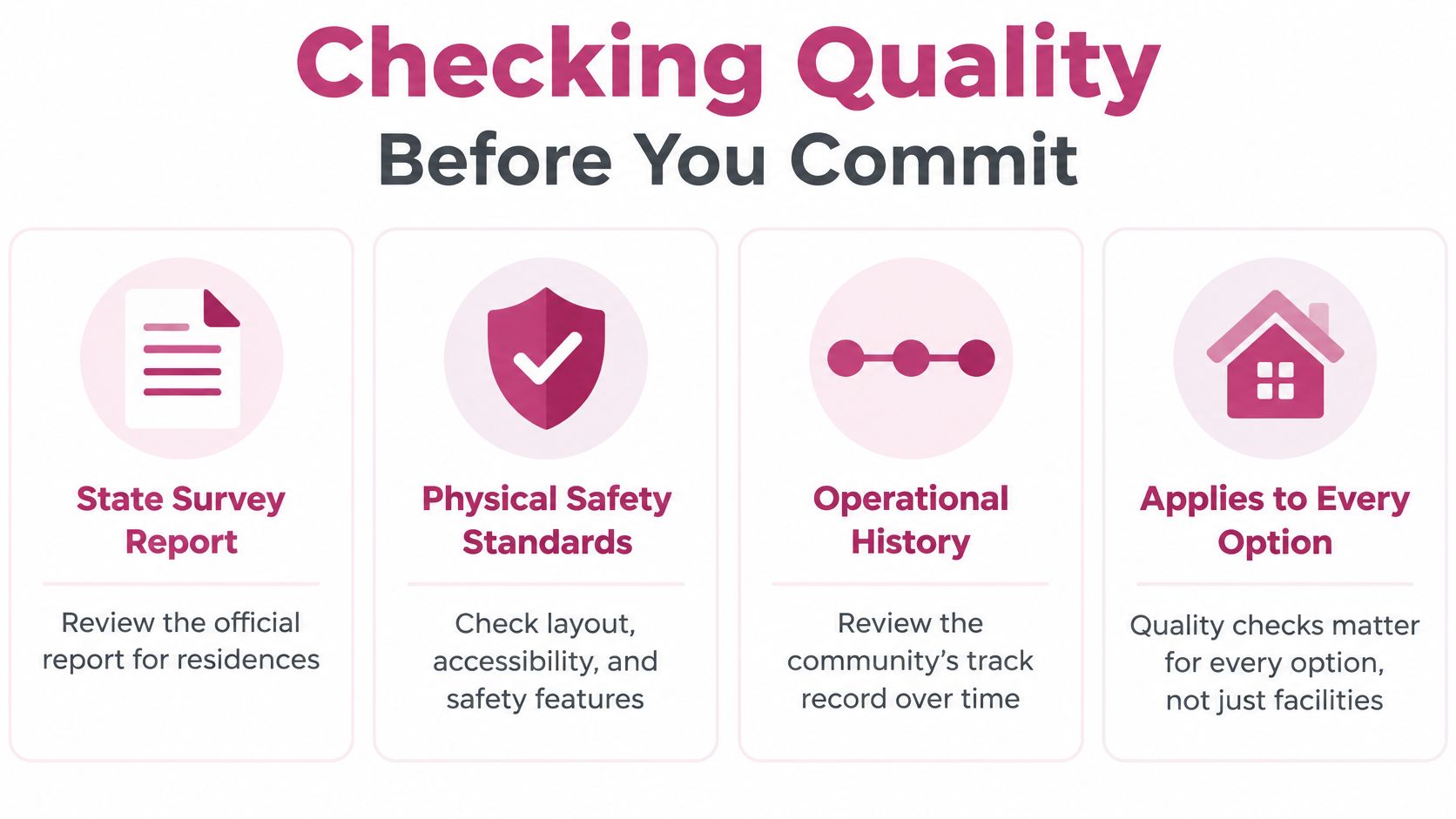
Start with documents you can examine: the residence's state survey reports, corrective actions, and operating history. At Life Senior Placement, we review state survey reports, physical safety standards, and operational histories when evaluating nearby residences, and your own review should work the same way. During a tour, connect those records to what staff can demonstrate.
Say a report identifies a safety problem. Ask what changed, who verified the fix, and how management checks that the correction remains in place months later. A polished lobby will not answer any of that.
Use this checklist to keep the review focused on care and operations.
Test the home plan just as carefully
A 2025 systematic review of home modifications found that 13 of 20 studies, or 65%, reported benefits involving outcomes such as fall prevention, functional independence, or cost savings. That supports thoughtful adaptations, and it still leaves open whether your parent's particular home is safe for their particular needs.
An accessibility assessment should connect the layout to actual tasks. Can your parent transfer onto the toilet using their usual equipment? Can a caregiver assist without lifting unsafely? A bathroom may look accessible while still failing those tests.
For Medicare-certified home-health agencies, look at the applicable risk-adjusted quality measures: functional improvement, serious fall injuries, emergency-department use, hospitalization, preventable readmission, and discharge outcomes. Those measures describe medical home health. A nonmedical companion service is judged differently, so investigate caregiver screening, supervision, backup staffing, and how concerns are handled instead.
A provider's explanation should describe what staff actually do when something goes wrong, not just what the organization hopes to achieve.
Keep building upkeep separate from care quality
Clean, maintained surroundings matter, but they aren't evidence of clinical competence, so use building-condition questions alongside, never in place of, care-quality checks. Guides written for other industries, such as Renue Systems Four Points' discussion of asset protection strategies for hotels, describe how to protect the property itself rather than how to judge the care delivered inside it.
Copy these prompts into your tour notebook:
- Written price: What does the total include, and which services cost extra?
- Care reassessment: Who decides that medication, bathing, or mobility fees increase?
- Staff preparation: How are employees trained to handle falls and dementia-related distress?
- Backup response: What happens when a scheduled caregiver is absent?
- Limits of service: Which changes would mean this provider could no longer meet the person's needs?
- Complaint handling: Who receives concerns, documents them, and follows up with the family?
Record the answers in the provider's own terms. Before signing, resolve vague promises in writing, especially around staffing, care limits, and additional charges.
Confirm Your Choice and Book Tours
You don't have to settle every future possibility before making a sound decision. You do need a workable arrangement for today and a clear response if your parent needs more help.
Turn the comparison into a shortlist
- Write the care schedule. Record assistance needed now and likely changes over the coming year. Include personal care, meals, mobility, supervision, and the gaps relatives can't reliably cover.
- Eliminate mismatched settings. Keep options that can meet both the care requirements and the household budget. Include your parent's preferences about privacy, community, location, and daily routine.
- Obtain complete written prices. Compare assessed care, housing, transportation, move-in costs, and any separately contracted services. We help families understand local costs and compare licensed options at no charge.
- Tour during ordinary activity. Observe how staff assist residents, respond to requests, and communicate with one another. Discuss overnight coverage, dementia training, and the process for increasing support.
- Review records before committing. Check inspection findings, the service agreement, cancellation terms, and the circumstances that could require a move. Keep the care assessment and price breakdown together so everyone is comparing the same arrangement.
Make the decision with your parent
Where possible, let your parent identify what would make an option feel livable: familiar meals, quiet space, nearby friends, or keeping a daily routine. Those preferences belong alongside safety and affordability, not after them.
We provide free, objective guidance and arrange tours at no charge to the family. Call (862) 398-2006 to have real local care options priced. The right choice is the one that meets today's needs with an explicit plan for the next change in care.
Life Senior Placement helps families compare home care, independent living, assisted living, memory care, and nursing homes against their care needs and budget. Visit Life Senior Placement to request no-cost guidance, build a local shortlist, and arrange tours with the questions that matter already in hand.