
Your mother's house is getting too big for one person, the stairs are a nuisance, and the phone calls are starting to sound the same. She's still sharp, still walking, still managing her own medications, but the isolation is creeping in and the lawn, snow, and small repairs are becoming somebody else's problem. That's the moment most New Jersey families start looking at independent living for seniors, and the mistake I see most often is treating it like a lifestyle upgrade instead of a housing and risk decision.
What Independent Living Actually Means Today
Independent living for seniors is housing built for older adults who can still manage their daily life without hands-on care. The promise is simple, no more home maintenance, more social contact, predictable routines, and a safer, easier place to age while staying self-directed. It is not a medical setting, and it should not be sold as one.

What it does and doesn't cover
If a parent needs reminders, supervision, or physical help with bathing, dressing, or medication, independent living is already getting thin. It may still work if the support is light and intermittent, but it's not the honest answer if the family is really shopping for care. A quick primer on the broader housing spectrum can help separate the labels from the reality, and this simple guide to senior living is a useful starting point.
Practical rule: if the question is “Can they live on their own with fewer chores?” independent living belongs in the conversation. If the question is “Who is going to help every day?” you're probably beyond it.
A standalone independent living community is just that, a residential option with services layered in. A continuing care retirement community, or CCRC, changes the equation because it may include access to higher levels of care on the same campus. That matters because you're not only buying an apartment, you're buying a pathway.
The fit test I use with families
I tell families to separate lifestyle need from care need. Lifestyle need means the house is too much, the social circle is shrinking, and upkeep is draining energy. Care need means the person needs regular help to stay safe or clean or medically on track.
If the first list is strong and the second is still light, independent living may be the right move. If the second list is already showing up in daily life, it's time to be honest and compare assisted living instead of forcing the label.
How Independent Living Fits in the Senior Care Continuum
Families get stuck because they compare brochures instead of triggers. I'd rather know what changed, and whether that change is temporary or likely to stick, than hear a tour script about dining rooms and activity calendars. Mobility, cognition, and recovery from a medical event are the true pivot points.
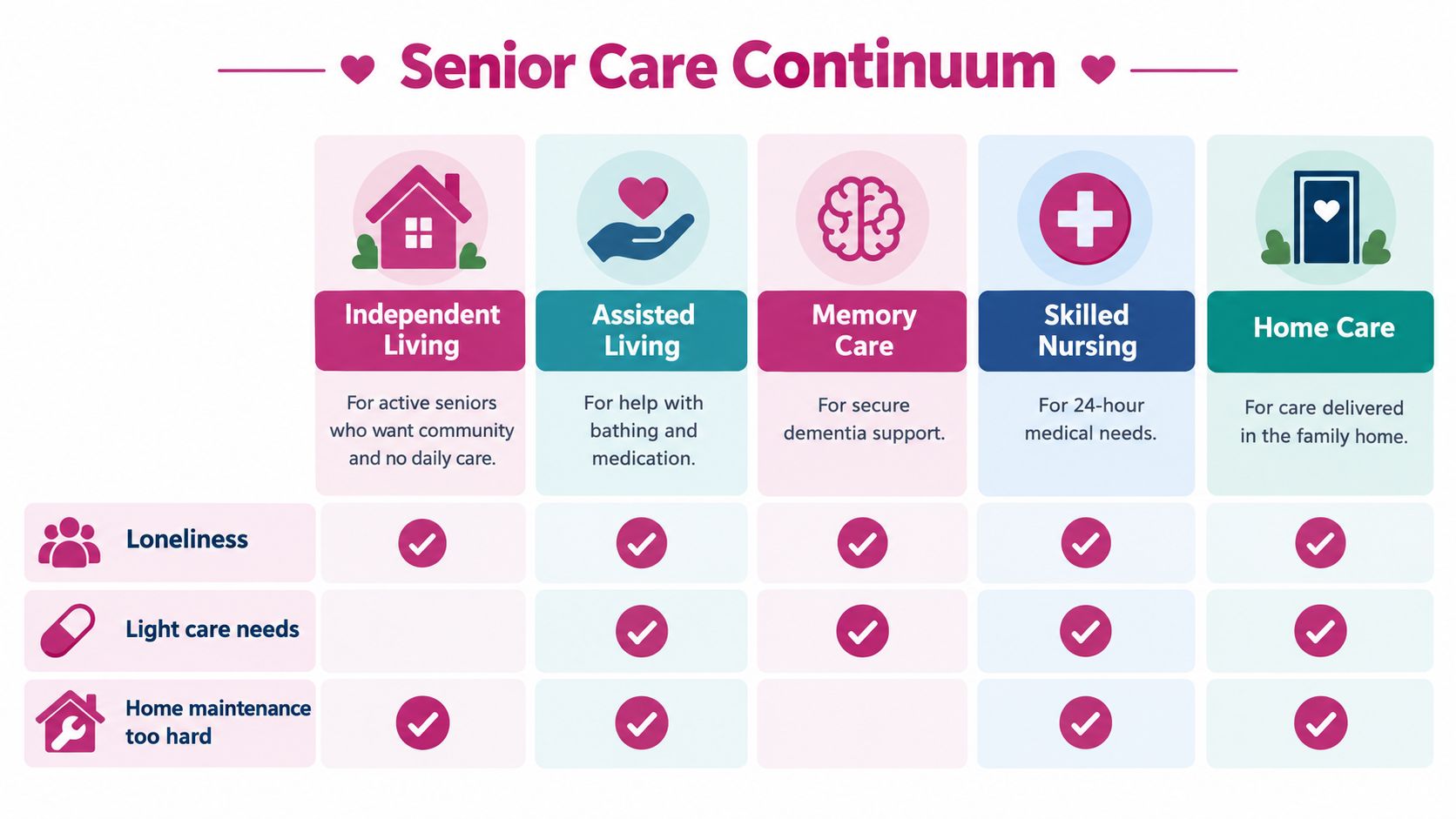
Where each option fits
- Independent living, best for active seniors who want community and no daily care.
- Assisted living, best when help with bathing, dressing, medication, or supervision is needed.
- Memory care, best when dementia requires a secure setting and specialized support.
- Skilled nursing, best for 24-hour medical or rehabilitative needs.
- Home care, best when the person wants to stay home and can afford support in the house.
| Care Level | Best Fit For | Staffing | Common Reason to Move |
|---|---|---|---|
| Independent Living | Active older adults who want a simpler household and social access | Light service staff, not hands-on care | Daily help starts becoming necessary |
| Assisted Living | People who need help with daily tasks | Care staff available for routine support | Needs outgrow what the community can safely provide |
| Memory Care | Residents with dementia or Alzheimer's | Specialized supervision and secured support | Safety and orientation become unreliable |
| Skilled Nursing | People needing medical or rehabilitative oversight | Clinical staff and round-the-clock nursing | Health complexity requires a higher medical level |
| Home Care | People who want to stay in their own home | Caregivers come into the house | The home becomes too hard to manage alone |
The question that matters
The right question isn't “Which place looks nicest?” It's what changed that might not change back. A fall, a new gait problem, cognitive drift, or a hard recovery can turn a workable situation into a fragile one very fast.
Assisted living becomes the more honest fit when a person needs regular physical help or oversight. Independent living still makes sense when the person can manage their own daily routine, but no longer wants to manage the house, the driver's seat, or the social vacuum that sometimes comes with living alone.
Inside a Typical Independent Living Community
A good independent living community runs on routine, not glamour. Think of a resident who wakes up, grabs coffee, checks the dining schedule, signs up for a shuttle, and knows the snow will be handled before the sidewalk becomes a problem. That's the product, not the lobby.
What a week can feel like
Breakfast may be optional, lunch may be the social anchor, and dinner may be the meal that keeps a resident from skipping food when cooking feels like a chore. Transportation usually needs sign-up, which matters more than most brochures admit, because convenience disappears fast if a resident can't get to the doctor, pharmacy, or grocery store on the schedule that exists. Maintenance staff handle the unit problems, but the resident still has to manage timing, guest policies, and pet rules.
A secure building also needs more than a locked front door. Families should ask how the community handles a fall in a unit, what happens if someone needs help overnight, and whether staff can respond quickly without pretending the building is a medical site. For a useful outside reference on physical property protection, how PeakFriend Security protects properties is worth reading before you tour any senior building.
What actually matters in daily life
Residents don't move for square footage. They move for fewer burdens and more reliable days.
That's why fitness classes, libraries, and lifelong-learning events matter only if the resident will use them. A packed calendar is not the same thing as a livable week. Meal flexibility, transportation reliability, and staff responsiveness are the pieces that decide whether the community feels supportive or just expensive.
If you're touring, ask a simple question, “What does a normal Tuesday look like here?” The answer tells you more than the brochure ever will.
What Independent Living Really Costs in New Jersey
Families need to get ruthless about math. Independent living can look cheaper than staying home until you stack rent, meals, utilities, housekeeping, transportation, fees for a second occupant, and possible entrance or deposit structures. The question that matters is not what looks affordable on day one, it's what the three-year bill will feel like if the resident stays healthy, then slips into needing more support.
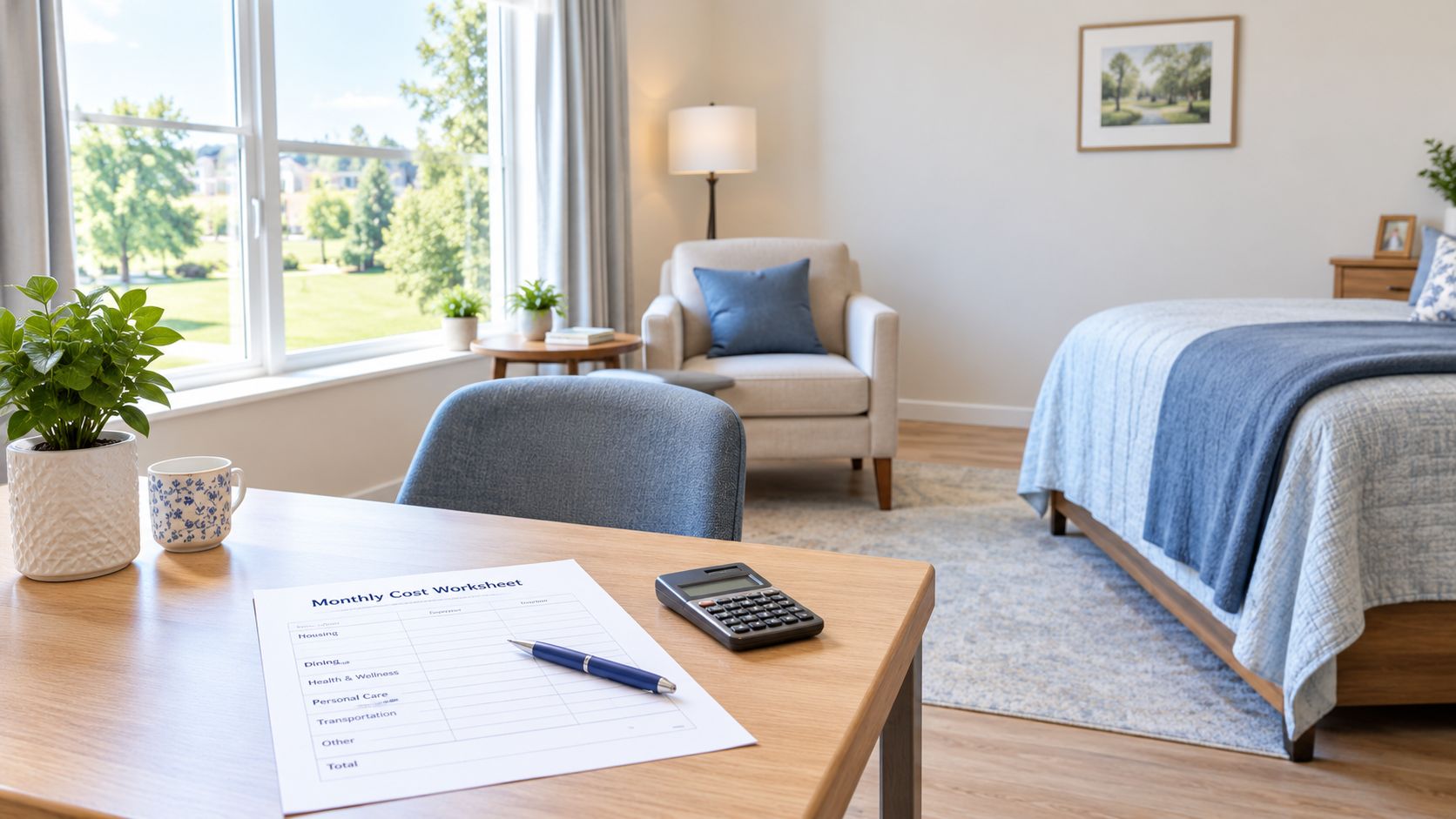
The cost stack people forget
The common mistake is focusing on the monthly fee and ignoring the entry structure. Some communities use an entrance fee, some use a deposit, and the refundability terms can be a make-or-break detail. A contract that sounds friendly can still lock up capital or shift costs later if the person's needs change.
Practical rule: never compare communities without asking what happens if the resident needs a higher level of care mid-stay.
New Jersey families also need to think about rent increases over time, because a move that looks manageable in year one can stretch hard by year three. The monthly budget should be tested against the full expected stay, not the first invoice. That's the only way to compare it accurately with staying put and bringing in home care.
Compare before you commit
The right comparison is independent living versus aging in place with paid help, not independent living versus a fantasy version of staying home. A house with stairs, upkeep, and long drives can chew through cash and energy in ways families underestimate. On the other hand, a mortgage-free home with good access and light support can be cheaper than a move.
That's why I like a simple worksheet: housing, meals, transportation, housekeeping, future care, and the likely length of stay. Independent and assisted living comparisons near you can help frame the local market, but your family still needs its own break-even math.
The blunt truth is this, independent living is not automatically cheaper or more expensive. It's a trade, and the winning side depends on the house you already own, the support you'll need later, and how long the move is likely to last.
Safety and Social Life Beyond the Brochure
A shiny lobby doesn't prevent a fall, and a busy activity calendar doesn't guarantee someone stops feeling lonely. Families need to inspect independent living communities like a risk manager, not like a weekend shopper. That means looking at the unit, the building flow, and the way people connect.
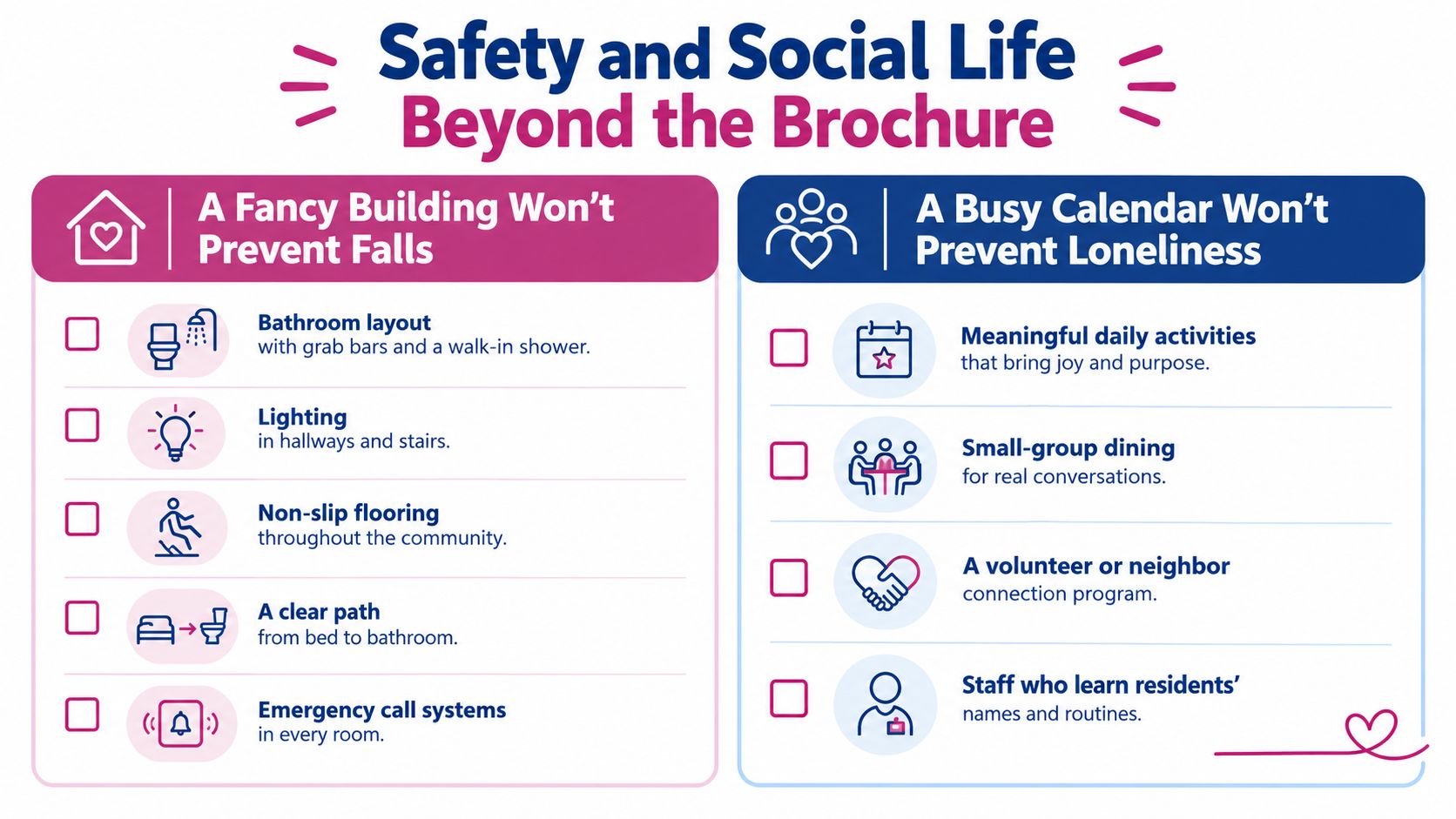
What to inspect in the unit
Bathrooms deserve the closest look. Check grab-bar placement, shower access, toilet transfer space, slip resistance, and whether the route from bed to bathroom is completely clear. Thresholds, lighting, reachability, and room layout matter more than countertops and paint.
A hazard-heavy bathroom is not a minor issue. Environmental risks are tied to falls, and bathroom falls are especially serious because they can lead to hospitalization. If a resident uses a walker, cane, or other mobility aid, that inspection becomes even more important.
What to ask about social design
A calendar full of events doesn't tell you whether a resident will participate. The better question is whether the community creates repeated, accessible interaction for the people who live there. Some residents need small groups, not big mixers. Others need transportation to outside groups because they'll never feel at home sitting in one room every afternoon.
- Ask about participation, not just the number of activities.
- Ask who attends, because a club that nobody in your parent's age or interest group uses won't help.
- Ask how they welcome new residents, especially during the first 90 days.
- Ask how they notice withdrawal, missed meals, or a resident who starts disappearing.
Practical rule: if staff can't explain how they turn activity into relationships, the social program is probably decoration.
A community can look social and still leave people isolated. That's especially true for introverts, residents with hearing limitations, or people who don't enjoy organized groups. The right place makes connection easy without forcing performance.
Choosing and Moving Into the Right Community
Start with three required checks before you tour anything: budget ceiling, care triggers, and location. If the monthly number already strains the family, glossy finishes do not matter. If the person already needs hands-on help, independent living is the wrong level of care.
How to tour like a decision-maker
Bring a printed checklist and use it in every building. Ask about staff turnover, transportation radius, emergency response time, and whether assisted living sits on the same campus if needs rise later. Read the residency agreement for refundability, transfer rights, and discharge clauses before you sign.
A placement advisor can make this easier by handling intake, narrowing options, and coordinating tours instead of letting the family chase listings all week. One New Jersey option that does this is Life Senior Placement's senior placement services, which works across independent living, assisted living, memory care, nursing homes, and home care.
The first 30 to 90 days matter
Move-in is the start of the test. Watch whether the resident eats, joins anything, learns the transportation system, and settles into the rhythm without getting more withdrawn.
If a community says a person can stay forever, ask how it decides when a resident needs assisted living or another level. The answer should be concrete. You want a community that plans transitions openly instead of pretending every need can be absorbed in place.
Making the Right Call for Your Family
A family usually gets this right by looking at three numbers: the monthly rent, the cost of fixing the house, and the cost of help at home. If maintenance is the main drain and the person is lonely, independent living deserves a hard look. If daily help is already part of the routine, assisted living fits better. If the home still works and the care gap is small, aging in place with targeted home care can be the cheaper choice.
Do not let a parent's “I'm fine” end the conversation. Falls, missed medications, and a hospital discharge change the math fast. Once any of those show up, set a 90-day recheck. Waiting for a crisis usually costs more and limits options.
Best practice: treat the first move as a bridge, not a final verdict.
Independent living should reduce friction without pretending care needs disappear. In New Jersey, that means comparing the full monthly bill, the risk of another fall at home, and the social setup inside the community against the price of staying put.
If you want a sharper read on whether independent living, assisted living, or home care makes the most sense in New Jersey, Life Senior Placement can help narrow the field, compare real communities, and organize tours around budget, care needs, and location. They work across the full senior care continuum, so you are not forced into one category before the facts are clear.