
Move a parent toward assisted living when they need regular daily help that family or scheduled home care can't reliably cover, and the warning signs repeat over several weeks. Don't wait for a crisis, but don't treat age or an isolated mistake as a reason to move.
You may already be checking the pill organizer after work, bringing groceries on weekends, and sleeping with your phone nearby. The difficult question isn't whether you love your parent enough to keep helping. It's whether the arrangement still works when you're unavailable, your parent has a difficult night, or the usual caregiver calls out.
Warning Signs and Clinical Triggers That Justify Review
Say a daughter finds untouched pills in her mother's organizer, hears about a fall on the stairs, and opens an almost-empty refrigerator. Each problem has an explanation. Taken together, though, they raise a more useful question: Can her mother consistently get through the day safely with the help currently available?
That question should guide the decision. Don't judge the home plan by what everyone intends to do. Judge it by what happens.
The National Institute on Aging's guide to recognizing when an older adult needs help identifies problems with meals, hygiene, medications, mobility, and home management, alongside falls, confusion, weight changes, and isolation. These are reasons to investigate, not automatic instructions to relocate.
Warning signs and when to act
Use this table to identify the gap and choose the next action. These aren't diagnostic cutoffs, and dangerous events don't need to repeat before you respond.
| Sign | What it looks like | Act when |
|---|---|---|
| Repeated falls | Falls or near-misses on stairs, in the bathroom, or getting up from a chair | Any fall occurs alongside worsening balance or mobility |
| Missed medications | Pills skipped, doubled, or left untouched | Errors recur, or any error could cause immediate harm |
| Unpaid bills and missed appointments | Late notices, missed medical visits, spoiled food | A pattern develops across several weeks |
| Poor nutrition or weight loss | Empty refrigerator, unexplained weight loss | Meals are regularly missed or unexplained weight loss appears |
| Bathing or hygiene decline | Unwashed clothing, neglected grooming, unsafe showers | Your parent fears bathing alone or needs hands-on help |
| Confusion or wandering | Getting lost on familiar routes or leaving home unsafely | Any wandering or unsafe stove use occurs |
| Social withdrawal | Stops answering calls, pursuing hobbies, or going out | Isolation appears alongside difficulty managing daily life |
| Caregiver strain | Exhausted relatives, canceled visits, overnight gaps | Essential coverage can't be maintained reliably |
Don't turn this into a score that your parent must fail. A parent who wanders outside unsafely needs attention even if meals, bills, and hygiene remain well managed. Conversely, missed appointments and household clutter may call for added support rather than a move.
Document patterns without delaying urgent care
Keep a shared notebook or spreadsheet with the date, what happened, who was present, and the consequence. Write “evening pills still in organizer at breakfast,” rather than “Mom is getting worse.” Record what help was scheduled and whether it arrived.
For nonurgent concerns, observations over several weeks are more useful than an argument about a single bad day. Look for connections: does your parent skip meals when no one visits, avoid showers without assistance, or become confused after dark?
Practical rule: Observe ordinary problems long enough to understand the pattern. Respond to immediate danger immediately.
A father who falls repeatedly but gets up afterward still needs a professional assessment. A mother who falls and can no longer walk safely needs prompt medical evaluation before the family starts comparing apartments. Sudden confusion, suspected serious injury, or acute illness belongs in a medical assessment, not a placement checklist.
Repeated hospitalizations, uncontrolled symptoms, and complex medical treatments also require a clinical review. Assisted living isn't a substitute for determining why someone's function has changed.
Check whether the home itself can support the plan
Ask whether your parent can rise from the toilet, get out of a chair, use mobility aids, and summon help. The AARP discussion of when to consider assisted living supports evaluating safety alongside the family's ability to sustain care.
Furniture deserves attention too. Meliusly's guide to senior-friendly furniture offers a starting point for reviewing seating and household arrangements, but easier-to-use furniture can't replace someone who must physically assist with transfers.
Bring your observations to a clinician and request an assessment of cognition, gait, medications, daily-living abilities, and fall risk. The outcome should identify both treatable problems and the help your parent needs now.
Care Levels Matched to Daily Help Needs
Activities of daily living, often called ADLs, are basic personal tasks: bathing, dressing, eating, toileting, continence, and transfers, such as moving from bed to a chair. Extended activities of daily living, or IADLs, include cooking, managing medications and finances, shopping, transportation, and housekeeping.
The distinction matters because someone who needs groceries delivered has a different care requirement from someone who can't safely get out of bed. Choose the setting around the assistance required, not the building's appearance.
Falls make those functional questions especially important. The CDC's older-adult falls data report that more than 14 million U.S. Adults aged 65 and older report falling each year, with approximately 4.5 million emergency-department visits annually because of older-adult falls.
Care settings matched to daily help needs
| Care setting | Typical help included | Best fit |
|---|---|---|
| Home care | Scheduled help with bathing, meals, medication reminders, and companionship | Predictable support needs, with the parent otherwise safe between visits |
| Independent living | Housing, dining, activities, and emergency-response arrangements; outside care may be added | Active seniors who don't need routine hands-on personal care |
| Assisted living | Daily personal assistance, meals, medication support, and supervision | Regular ADL and IADL support without continuous skilled treatment |
| Memory care | A secured environment, structured routines, and dementia-trained staff | Dementia-related confusion, wandering, or unsafe behavior requiring specialized support |
| Nursing home | Continuous clinical oversight, skilled nursing, and rehabilitation | Complex medical treatment or rehabilitation that a residential personal-care setting can't provide |
These are starting categories, not guarantees about an individual community. Confirm its admission criteria, available services, and limits before accepting a placement.
Assisted living sits between scheduled support and a more medically intensive setting. It can preserve independence while making personal help available, but it isn't the right answer when the main need is ongoing skilled treatment. Dementia likewise requires a specific assessment rather than an assumption that standard assisted living will manage every behavior.
Use our guide to levels of care to clarify the differences before touring.
For a practical self-check, make a worksheet listing each ADL and IADL. Add columns for who helps, when help is needed, and what happens if that person is unavailable. Test the arrangement against a bad week, not the easiest day your parent has had recently.
Caregiver Capacity and When Family Help Runs Out
Your parent's needs and your family's dependable availability must be assessed together. A home plan isn't adequate just because someone usually finds a way to cover it.
In the 2025 caregiving report from AARP and the National Alliance for Caregiving, caregivers supporting adults aged 50 and older averaged 26 hours of care per week, and 44% provided high-intensity care. That's a substantial responsibility to fit around employment, children, sleep, and your own health.

Count dependable help, not promises
Write down the hours relatives can commit to, including travel and coordination. A sibling who can occasionally stop by isn't the same as a caregiver assigned to a medication routine or bedtime transfer.
Ask these questions together:
- Weekly coverage: Which essential tasks have a named person responsible for them?
- Overnight needs: Who responds when your parent needs help getting to the bathroom or becomes disoriented?
- Medical tasks: Is anyone doing something they haven't been trained to perform safely?
- Backup help: Who takes over when the usual caregiver cancels?
- Caregiver illness: What happens if the main caregiver suddenly can't provide care?
If the answers rely on the same exhausted person, the arrangement needs reinforcement or replacement. Medication mistakes, missed meals, unsafe wandering, and uncovered nights are evidence that the current system isn't dependable.
Your capacity is part of the care plan. It isn't a measure of how much you care.
Don't dismiss persistent exhaustion, irritability, or loss of interest as the unavoidable price of being a good daughter or son. Uptown Psychology's explanation of how burnout differs from depression can help you describe what you're experiencing, but it doesn't replace an individual mental-health assessment.
You don't have to become ill before asking for a different arrangement. If dependable outside help can't close the gaps, start evaluating a structured setting.
Assisted Living Costs Compared With Care at Home
A home-care quote can look manageable when it covers only a few scheduled visits. Compare the full cost of keeping the current care plan dependable with the cost of the support your parent needs.
The 2024 national median annual cost of assisted living was $70,800, a 10% year-over-year increase, according to Genworth and CareScout's Cost of Care Survey. Use this figure as national context, not as a quote for a New Jersey community.
Home care costs rise as the weekly coverage gap grows. The 2025 Aging and Health Technology Watch market overview describes home care commonly filling a 20 to 27-hour weekly gap and notes that annualized costs can approach assisted-living costs. Treat that range as context, not a universal break-even point. Local rates and the hours your family needs determine the comparison.
Cost items to model before choosing a setting
| Cost item | What to include | Common mistake |
|---|---|---|
| Home care hours | Weekly coverage gap multiplied by the quoted hourly rate | Assuming the gap stays unchanged |
| Assisted living fee | Base monthly fee plus assessed care-level charges | Forgetting added charges for transfers or specialized support |
| Transportation and home changes | Rides, grab bars, ramps, and bathroom modifications | Ignoring one-time expenses |
| Lost caregiver work time | Unpaid leave, reduced hours, and family time spent coordinating care | Treating unpaid help as having no cost |
| Overnight and respite coverage | Nighttime assistance and relief shifts | Budgeting only for daytime visits |
| Rising care needs | A higher-support scenario over the coming year | Planning only for today's needs |
Include any home modifications in the home-care estimate. Aureli Construction's aging in place guide can help you identify changes to consider, but compare their costs with the recurring expenses of care.
Build a full-year comparison. Separate one-time expenses from recurring costs, include household costs that continue at home, and check which expenses the community's fee replaces.
Set a point to reassess if home-care costs approach the total for assisted living at the needed care level. Compare like with like: the care your parent requires, not a low starting bill or a base rate that may exclude added support.
How Families Pay for Assisted Living
Don't assume Medicare will pay for an assisted living apartment or ongoing custodial personal care. Separate coverage for medical services from payment for housing and everyday assistance, and verify the funding plan before signing a contract.
Start with dependable income and available assets. Then investigate benefits without counting unapproved payments as money already available.
Match the funding source to its limits
- Private funds: List income, savings, pensions, and annuity payments. Distinguish readily available money from assets that require a sale, withdrawal decision, or tax advice.
- Long-term care insurance: Request a benefits review using the actual policy. Confirm covered settings, benefit limits, eligibility requirements, the elimination period, and the claims documentation.
- Medicaid programs: Ask the state program and the community whether applicable services are covered, whether your parent qualifies, and whether the community participates. Don't assume assistance with care also pays the full housing bill.
- Veterans benefits: Eligible veterans and surviving spouses should investigate whether Aid and Attendance could supplement pension benefits. Confirm eligibility rather than treating military service alone as approval.
- Home equity: A home sale may release funds, but the timing matters. Get independent advice before using a reverse mortgage, especially when the borrower is moving out.
Our guide to paying for assisted living without draining savings can help organize the questions you bring to insurers, benefits counselors, and financial advisers.
Budget safeguard: A benefit application is not an approved payment. Keep a workable plan for the period before funds arrive.
Request an itemized written price sheet from each community. It should distinguish the housing charge, personal-care fees, medication services, move-in charges, and costs that increase with assessed needs.
Then compare the payment sources with both today's bill and a higher-care scenario. A funding plan that works only while your parent's needs remain unchanged is too fragile.
Emotional Factors and Talking With Your Parent
A parent's determination to stay home isn't irrational, and it isn't permission to ignore unsafe conditions. Home may represent privacy, identity, familiar routines, and control over decisions.
The University of Michigan's long-term-care preferences findings report that 52% of adults aged 50 and older preferred future long-term care at home from family or friends, while 61% said they wouldn't let family make long-term-care decisions for them. Respecting autonomy means involving your parent early, not presenting a finished decision after a frightening event.

Make the conversation about workable choices
Avoid opening with a verdict about where your parent must live. Start with a specific problem and ask what arrangement they would accept to solve it.
- Begin with staying home safely: Ask which help would make bathing, meals, or evenings manageable. Be clear about the support you can and can't personally provide.
- Invite comparison rather than commitment: Offer to tour communities so your parent can judge the rooms, meals, routines, and atmosphere.
- Explore a temporary stay: If an appropriate respite option is available, discuss whether experiencing the setting would answer questions that a tour can't.
A preference needs a budget, reliable helpers, and a backup plan. Agree in advance on the events that would reopen the discussion, such as uncovered overnight needs or an inability to transfer safely despite added support.
You may feel grief even when the decision is sensible. Your parent may feel angry even when you involve them respectfully. Neither reaction proves the plan is wrong.
Don't promise that nothing will change. Promise that you'll keep listening, stay involved, and judge the arrangement by whether your parent receives dependable care while retaining meaningful choices.
How to Plan the Move From First Concern to Move-In
If your parent's needs are becoming harder to meet at home, use a clear plan to test whether the next arrangement will work. When circumstances allow, plan in weeks rather than days. A medical event may shorten the timeline, so ask the treating team to help shape a safe discharge plan instead of choosing a residence solely because it has an opening.
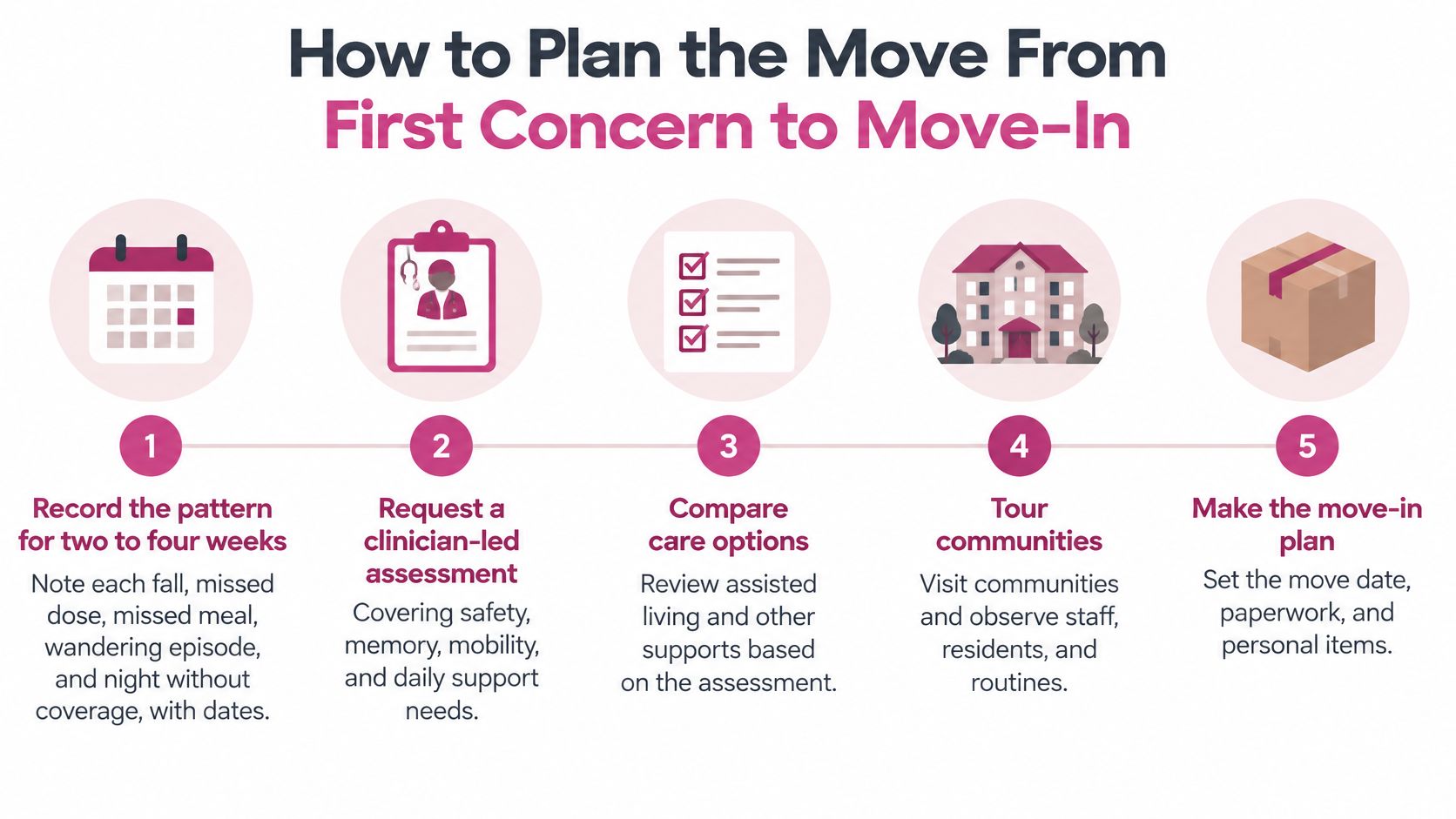
Turn the assessment into a practical move plan
- Gather the information. Bring dated observations, a current medication list, recent discharge paperwork, and the caregiver schedule. Record your parent's priorities, including location, privacy, pets, and familiar routines.
- Ask for a clinician-led assessment. Request clear guidance about personal assistance, supervision, mobility, and medical treatment. Share the recommendations with prospective communities so each can assess the same needs.
- Compare workable arrangements. Get actual quotes for a supported home plan and suitable residential options. Rule out any arrangement that leaves daily needs uncovered, even if its initial price looks attractive.
- Check the provider's records. Ask prospective communities what licensure information, inspection findings, safety procedures, and operating records they can provide. Use the answers to identify questions that need follow-up.
- Tour with specific questions. Ask who is available overnight, how residents summon help, who handles medications, and how staff provide assistance during busy periods. Describe your parent's hardest daily routine and ask staff how they would manage it.
- Confirm costs and care limits. Before signing, get written answers about care-level pricing and what happens if your parent needs more help. Agree on an early care-plan review and a later reassessment after ordinary routines are established.
- Prepare the handoff. Transfer medication information through the appropriate clinical process, label belongings, and bring familiar items without overcrowding the room. Set a family contact plan and identify the staff member to reach with concerns.
Use this checklist for moving into assisted living to organize paperwork, belongings, and move-day responsibilities.
After the move, check whether staff understand your parent's routines, daily assistance is being provided, and your parent knows how to ask for help. The plan is working only if those needs are met consistently.
Book a Free Placement Review Before You Decide
Check the recurring warning signs. Confirm which level of care can meet your parent's needs. Set a reassessment date so the decision remains accountable to how well the arrangement works.
A neutral review can help your family compare choices before urgency narrows them. We provide free, objective guidance to help New Jersey families evaluate local options and choose care settings, so families don't pay for the review itself. Participating communities pay us a placement fee.
Take practical action this week
- Write down the pattern: Bring concrete observations rather than a general description of decline.
- Schedule the assessment: Ask your parent's clinician to clarify functional, cognitive, and medical needs.
- Arrange a placement review: Call (862) 398-2006 to discuss local assisted living and home care services.
If you're unsure where to start, our care quiz helps narrow down which level of help makes sense. Treat it as preparation for a conversation, not a clinical diagnosis.
You don't have to decide everything during the first call. Start with the gaps that need solving, involve your parent, and revisit the arrangement on the reassessment date.
Life Senior Placement offers free, objective guidance to help you compare your parent's needs, preferences, and budget with local care options. Visit Life Senior Placement to explore the next step, or call with your care notes ready so we can help you evaluate whether assisted living or a stronger home plan makes sense.