
Boxes are half-packed, a medication list is sitting in one doctor's portal and a different version in another, and the residency agreement arrived by email yesterday, still unread. If that's your kitchen table right now, you're not behind. You're at the normal starting point for a move into assisted living, and normal does not have to mean chaotic.
A good checklist for moving into assisted living does more than tell you what to pack. It puts decisions in the right order, so you assess care before you tour, read the contract before you sign, and plan the room before you hire movers. Work in that sequence and you avoid the mistakes that cost families the most, including surprise fees, a care level that does not fit, missing legal documents, and a miserable first week.
The ten tasks below run from before you choose a community through the first month after move-in. Do them in order, write down answers instead of trusting memory, and keep one binder or shared folder where everything lives. That's the whole system. I recommend you start today with task one, because every later choice depends on it being honest.
1. Complete a Level-of-Care Assessment
Don't tour first and assess later. Document what help is needed with activities of daily living, including bathing, dressing, toileting, transferring, eating, and medication management, plus gait, balance, recent falls, and any dementia related behaviors. Assisted living fits people who need that daily support but don't need 24-hour skilled nursing.
Fall risk belongs on page one of that assessment. The CDC falls data and research page reports that more than 14 million U.S. Adults aged 65 and older, more than 1 in 4, report falling each year. Ask the physician to note transfer ability, mobility equipment, footwear needs, and medicines that raise fall risk, then bring those notes to every tour.
Say a parent has recovered from a hip fracture but still needs hands-on help getting from bed to chair. That single fact narrows your search to communities with staff available around the clock, grab bars, and reliable nighttime response, and it rules out prettier buildings that cannot do transfers safely.

Ask each community how it reassesses residents and what triggers a move to a higher level of care. Our advisors can help document health needs in a structured intake before tours begin, so you're comparing communities against written needs, not sales language.
2. Map the Full Cost of Care and Funding Options
Base rent is the least useful number on a tour. One community can quote a low rent and then add steep tiered fees for medication help, bathing, and mobility support, while a higher rent bundles those services and costs less overall for the same resident. I always tell families to compare the total monthly bill for your parent's actual care plan, not the starting price.
Get the full picture in writing before you fall in love with a dining room. The Genworth and CareScout Cost of Care Survey release put the national median annual cost of assisted living at $70,800 in 2024, a 10% increase from 2023. At that pace, a plan that barely works this year may not work in year three.
What to Request in Writing
- Complete fee schedule: Move-in, community, care level, medication, incontinence, transportation, and ancillary charges.
- Rate history: How and when rates increased in the past three years, and what notice you'll get.
- Funding check: Whether a veteran may qualify for VA Aid and Attendance, and what happens if private funds run out.
Talk with an elder law attorney or financial planner before transferring assets. Guidance on safeguarding savings from nursing home bills is a useful starting point for that conversation, but it should not replace advice specific to your family's situation.
3. Verify Licensure and Review Inspection Records
A warm tour does not tell you whether a community corrects problems. Inspection reports do. In New Jersey, assisted living residences must be licensed by the state, and you should confirm the license number with the state before you tour, not after you've signed something.
Systems vary, so verify for yourself. A U.S. Government Accountability Office report on assisted living oversight found that states differ in inspection frequency, inspection content, and enforcement mechanisms. Read the most recent report, check whether corrective actions remain open, and ask the long-term care ombudsman about complaint patterns.
Consider a daughter comparing two otherwise similar communities. She notices repeated medication documentation issues in one inspection history and clean follow-ups in the other. That documented pattern, not lobby decor, makes the decision for her.
Practical rule: If a community cannot explain an inspection finding and what changed afterward, treat the finding as unresolved.
Learning how to read a New Jersey assisted living inspection report helps you separate minor paperwork lapses from repeated safety issues. We review state survey reports, physical safety standards, and operational histories when evaluating nearby residences, and our listings are reviewed against state licensing records before they're published.
4. Tour Communities with a Structured Comparison Checklist
Tour the same way at every community, or memory will blend them together. Use one sheet with the same fields for each visit, covering licensed capacity, current availability, overnight staffing, emergency response, medication administration, dementia security, dining, cleanliness, and fees for escalating services. Score what you see, not what you're told.
Scheduled tours show a community at its best. Visit once without an appointment and once during a meal or in the evening, when staffing is thinner and routines are under pressure. A family that returned at lunchtime noticed residents waiting a long time to be served, something they hadn't seen on the polished morning tour, and asked harder questions about dining staff.
What to Observe in Person
- Staff interactions: Do aides address residents by name and respond without rushing?
- Available unit: Ask to see a unit that's open, not only the model apartment.
- Resident engagement: Talk with residents and visiting families when they're willing.
The short video below is worth watching before your first visit, so you know what to watch for.
We coordinate tours and side-by-side comparisons as part of our guidance process. That structure keeps you from choosing on first impression alone.
5. Review the Residency Agreement Carefully
Read the agreement as if the tour never happened. Verbal promises about holding a room during a hospital stay, capping a fee, or providing a service don't protect you unless they're in the contract, an addendum, or the care plan. Get a copy several days before signing and give yourself time to be annoyed by the fine print.
Monthly price is only part of the risk. The Congressional Research Service overview of long-term care costs cited a 2025 median annual cost of about $74,000 for a private one-bedroom assisted-living unit, up 5% year over year. At that level, clauses on care recalculation, nonrefundable community fees, and billing during hospitalization matter as much as rent.
Ask what is excluded, how care charges change after reassessment, what notice is required for increases, and whether there's a cap. Clarify discharge and transfer rules too. One family learned that when needs exceeded the community's capability, the process required a formal assessment and a transition period, which gave them time to plan instead of scrambling.
Have an elder law attorney or trusted advisor review the document. Our guide to five clauses to check in New Jersey residency agreements gives you a focused starting list, and you should confirm every verbal promise in writing before you sign.
6. Plan Room Layout and Downsizing
Measure first, pack second. Assisted living apartments are smaller than most family homes, and furniture that fits on paper can still block a walker, a bathroom door, or an aide helping with a transfer. Ask for a floor plan, photos, and a list of what's provided and what's prohibited, such as space heaters or candles.
Sketch the layout and test it with painter's tape on the floor at home. Keep pathways wide, daily items between waist and shoulder height, and lighting where your parent reads and dresses. A favorite recliner, a small dresser, and framed family photos often do more for comfort than a full bedroom set squeezed into the unit.

Work room by room with keep, donate, and discard piles, and photograph sentimental items you cannot bring. For the house that's being emptied, Clear It Services' clearance checklist can help you organize what stays, goes, or gets stored.
Keep documents and valuables in one designated, secure place. Photograph valuable items before moving day so ownership and condition are documented if anything goes missing.
7. Organize Health Records, Medications, and Legal Documents
Intake goes well when the nurse is not chasing three offices for one medication list. Build a single binder and a digital copy with the current medication list, allergies, diagnoses, recent discharge papers, physician and pharmacy contacts, insurance cards, photo ID, health care proxy, power of attorney, and advance directive. Request records at least two weeks before the move, because offices rarely move at family speed.
Treat medication management as a safety control you can verify. A 2024 Texas Health and Human Services assisted living quality study of 517 assisted-living facilities found that 97.7% of facilities that administered medications reported staff training on medication-error prevention. Ask anyway who administers medications, how allergies and high-risk drugs are flagged, how errors are reported, and how the pharmacy coordinates refills.
A complete binder can turn a long, repetitive intake into one focused conversation, because staff can copy what they need and spend their time on your parent instead of paperwork.
Confirm that the proxy and advance directive are on file with the community, not only in your folder. Ask which physician forms and assessments the community requires for admission, and get names and fax numbers or portal instructions confirmed in advance.
8. Schedule and Coordinate the Move
Move at your parent's best time of day, not the movers' most convenient slot. Midmorning often works well, after morning medications and breakfast, with enough daylight left to set up the bed, lighting, and chair before dinner. If mornings are slow or sundowning is an issue, build the schedule around that reality instead.
Assign one family member as the single point of contact for the community, movers, and siblings. That person carries the timeline, confirms elevator or loading rules, deposits, insurance requirements, and parking, and answers the phone so three people don't give three different instructions.

Pack a First-Day Bag by Hand
- Medications and toiletries: Keep them with you, never in a moving box.
- Clothing and comfort items: One change of clothes, sleepwear, glasses, hearing aids, chargers.
- Paperwork: IDs, insurance cards, and the community's contact sheet.
Let movers handle furniture while family stays with the resident in a common area or dining room. Set up the bed and bathroom first. Decor can wait until tomorrow, but safe sleep, toileting, and a working call system can't.
9. Update Financial, Insurance, and Government Records
Administrative loose ends cause quiet damage. A missed premium, a benefit letter sent to an empty house, or a pharmacy mailing refills to the old address can undo an otherwise good move. Build one master list before the move and work it for a month afterward, checking off each institution as confirmation arrives.
Your list will likely include Social Security, Medicare, pension administrators, banks, credit cards, insurers, pharmacies, physicians, utilities, subscription services, and the postal service for mail forwarding. Designate one trusted person to monitor mail at both addresses during the overlap, since forwarded mail is slower and some senders do not forward at all.
Say a family lists twenty-two institutions to notify and completes them within a month. That sounds tedious, and it is, but it's far easier than reinstatement paperwork after a policy lapses. Break it into five calls a day and log the representative's name and date.
Confirm whether a Medicare Advantage or supplemental plan has network restrictions tied to the new location or providers. If a home sale, trust, or asset transfer is involved, coordinate timing with an elder law attorney or financial advisor before you close accounts or change titles.
10. Plan the Transition and First 30 Days
Move-in day is the middle of this process, not the end. Adjustment commonly takes weeks, and a resident who looks calm may still be eating less, sleeping poorly, skipping activities, or waiting too long for help. Plan to measure how the care plan is working, not only whether the room looks settled.
A useful cadence is formal check-ins at about 72 hours, 2 weeks, 30 days, and 90 days, covering falls, medication changes, sleep, appetite, toileting, bathing help, missed activities, loneliness, and staff response. Guidance from U.S. News on easing the transition to assisted living frames early support around routine and connection, and your check-ins turn that support into specific questions staff can act on.
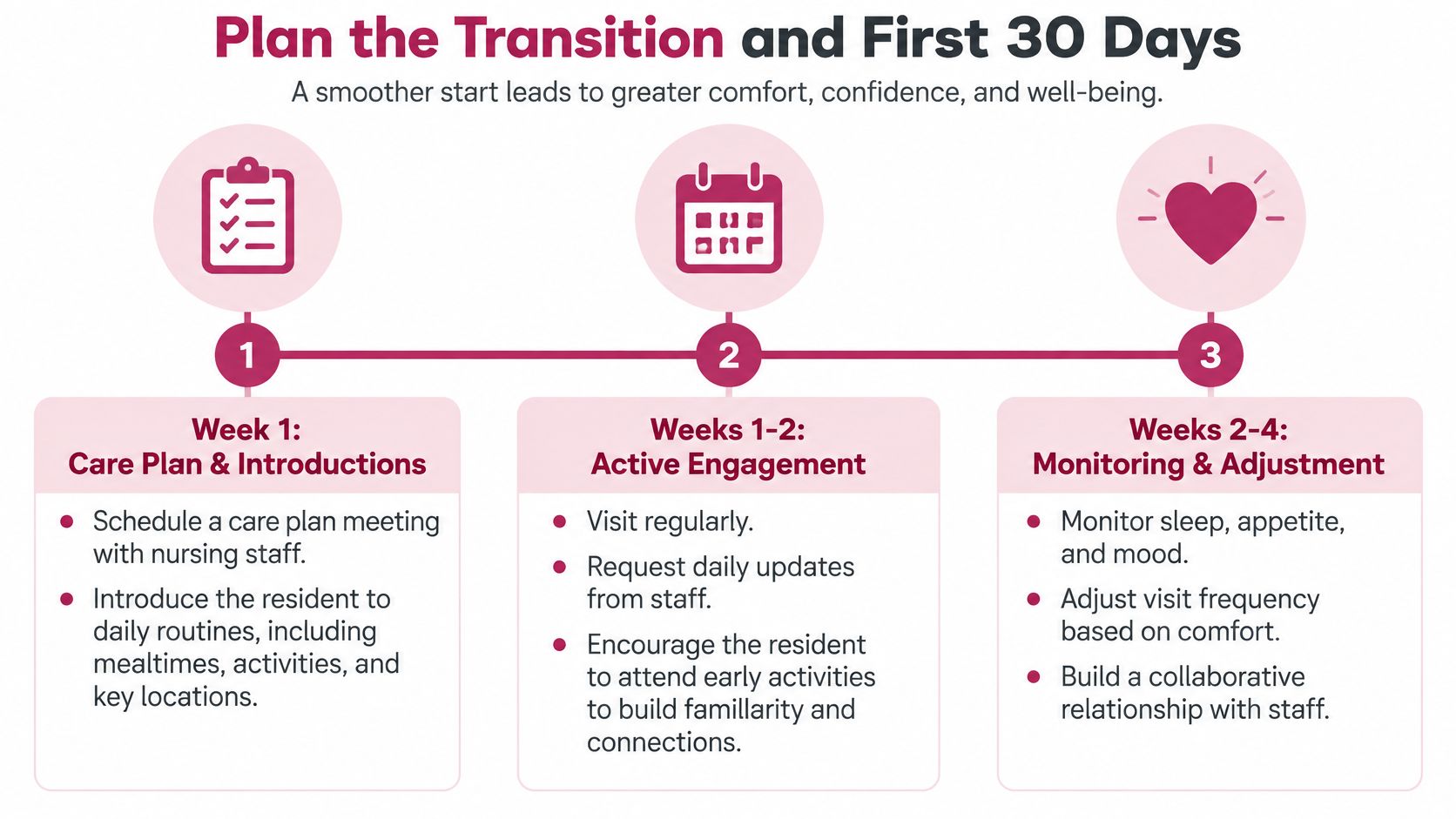
One family caught a medication timing issue at the first care plan meeting, and staff corrected it within days. Sleep and the morning routine improved because someone asked early, in a scheduled meeting, instead of hoping it would resolve.
Visit regularly in the first two weeks, then adjust frequency to your parent's comfort. Encourage one or two meals or activities early, without forcing a full social calendar. For practical detail, read our guide to the first thirty days in New Jersey assisted living, and document who can revise services and how quickly you'll be notified of changes.
Assisted Living Move Checklist at a Glance
| Checklist Item | When to Do It | Primary Goal | Key Resource or Contact |
|---|---|---|---|
| Complete a Level-of-Care Assessment | Before choosing a community | Match care needs to an appropriate setting | Primary care physician |
| Map the Full Cost of Care and Funding Options | Before selecting a community or committing financially | Build a sustainable plan for care costs | Community billing staff; financial planner or elder law attorney |
| Verify Licensure and Review Inspection Records | Before committing to a community | Confirm licensing, safety, and compliance | New Jersey Department of Health |
| Tour Communities with a Structured Comparison Checklist | While comparing communities | Evaluate daily conditions and compare options | Community staff and residents |
| Review the Residency Agreement Carefully | Before signing | Understand services, fees, and resident policies | Elder law attorney or trusted advisor |
| Plan Room Layout and Downsizing | Before move-in | Create a safe, comfortable apartment setup | Community staff; senior move manager |
| Organize Health Records, Medications, and Legal Documents | Before move-in | Support safe, continuous care and clear decision-making | Medical providers; community admission staff |
| Schedule and Coordinate the Move | Before move-in | Reduce stress and coordinate moving logistics | Community staff; senior-experienced movers |
| Update Financial, Insurance, and Government Records | Before and shortly after the move | Prevent benefit interruptions and billing errors | Social Security Administration; Medicare; financial institutions |
| Plan the Transition and First 30 Days | Beginning at move-in and throughout the first month | Support adjustment and identify care concerns early | Community care staff; family caregivers |
Cross Off the Last Box With Help When You Need It
A checklist only helps if you use it in order. Assess care needs first, because that assessment tells you which communities can safely say yes and which services you'll pay for. Map the full cost next, in writing, so a low base rent does not hide care fees that change the decision. Then verify licensure, read inspection history, and tour with the same comparison sheet every time.
After that, slow down for the residency agreement. The contract governs fee increases, care changes, refunds, hospitalization, discharge, and transfer, long after the tour team has moved on to the next family. Confirm verbal promises in writing, ask what triggers reassessment, and make sure the agreement still works if your parent needs more help in six months. That one step prevents many avoidable second moves.
The practical work comes next, and it's manageable when it's sequenced. Plan the room from a floor plan, downsize around safe pathways and familiar pieces, and keep valuables documented. Organize health records, medications, and legal documents into one binder staff can use on day one. Coordinate movers around your parent's energy and medication schedule, pack a first-day bag by hand, and give one person authority to answer questions.
Don't stop at move-in. Update financial, insurance, and government records over the following month, and treat the first 30 days as a monitored transition with scheduled check-ins on sleep, appetite, medications, falls, participation, and staff response. Small problems are normal at first. Unreported problems are the ones that grow, so write concerns down, raise them early, and confirm what changed afterward.
If coordinating tours, comparing communities, or sorting out costs feels like too much on top of everything else, you don't have to do it alone. We provide free, objective guidance to New Jersey families, help match care needs, preferences, and budgets with licensed, vetted communities, arrange tours, and support you through move-in. Families can call us at (862) 398-2006 for guidance, use our care quiz to narrow down what level of help makes sense, and compare verified options before committing.
Start with the assessment today. Write down the help that's needed now, the help that's likely next, and the questions you still cannot answer. That page becomes your tour sheet, your contract checklist, and your first care plan conversation, and it's the step everything else depends on.
If you're working through this checklist and want a shortlist that fits your parent's care needs, budget, and preferred New Jersey location, we can verify licensed options, arrange tours, and help you compare total costs side by side at no charge to your family. Visit Life Senior Placement to start your intake or take the care quiz before your first tour.