
Coverage and clinical fit, not therapy intensity alone, should drive the choice. Medicare requires inpatient hospital status for SNF coverage, while IRF admission requires the patient to tolerate three hours of therapy daily.
A family in New Jersey may face this decision within hours of a stroke, hip fracture, or major surgery. The hospital case manager says the patient can go to a skilled nursing facility or acute rehabilitation, but those options aren't interchangeable. One may offer a stronger path back home, while the other may be the only setting covered under the patient's actual discharge status.
The right question is not “Which facility has more therapy?” Ask three practical questions instead: Can the patient tolerate intensive treatment? Which setting can safely manage the medical needs? What will Medicare or another payer cover?
| Decision factor | Acute rehabilitation, or IRF | Skilled nursing facility, or SNF |
|---|---|---|
| Main purpose | Intensive recovery for patients able to participate in a demanding program | Skilled nursing and rehabilitation in a broader post-acute setting |
| Therapy expectation | Patient must tolerate three hours of intense rehabilitation services per day | Therapy may be included, but the setting accommodates lower tolerance and broader care needs |
| Medical profile | Patients needing hospital-based rehabilitation and close medical oversight | Patients needing skilled nursing, recovery support, or rehabilitation without IRF-level intensity |
| Coverage issue | Admission depends heavily on clinical qualification and available authorization | Medicare coverage depends on a qualifying inpatient hospital stay and other requirements |
| Typical family concern | Can the patient keep up with the program? | Will coverage apply, and can the patient receive enough therapy? |
The Real Discharge Decision Families Face
The phone rings after a New Jersey hospital stay. Your mother has had a stroke, or your father has undergone surgery for a hip fracture. The team says discharge is approaching and offers two destinations: an acute rehabilitation hospital or a skilled nursing facility. The family is tired, the terminology is confusing, and the decision feels urgent because beds and authorizations can change quickly.
The diagnosis alone doesn't settle the question. A patient with a stroke may qualify for either setting, depending on strength, alertness, medical stability, and ability to participate. A patient recovering from surgery may need intensive mobility training, or may instead need wound care, pain management, nursing supervision, and a slower rehabilitation pace.
Practical rule: Choose the highest level of rehabilitation the patient can safely and consistently use, but verify payment eligibility before agreeing to the transfer.
Three questions that prevent an expensive mistake
Can the patient tolerate intensive therapy? An IRF is designed for someone who can participate in a demanding daily program. If fatigue, confusion, weakness, uncontrolled symptoms, or medical instability prevent reliable participation, the setting may be a poor clinical match even if the patient needs substantial rehabilitation.
Which setting matches the medical complexity? Acute rehabilitation combines intensive therapy with hospital-based medical oversight. An SNF provides skilled nursing and may provide physical, occupational, or speech therapy, but its role is broader. It can suit someone whose primary need is nursing care, monitoring, recovery from illness, or gradual functional improvement.
What will the family owe? Medicare rules can change the answer before clinical preferences do. Observation status, rather than inpatient hospital status, can create a serious barrier to SNF coverage. Families should ask the hospital to explain the formal status in writing and confirm the payer's requirements.
For a New Jersey-specific overview of the transition, families can review this hospital discharge to NJ rehab guide. The goal isn't to select the most impressive building. It's to secure a clinically appropriate bed with a payment path the family understands.
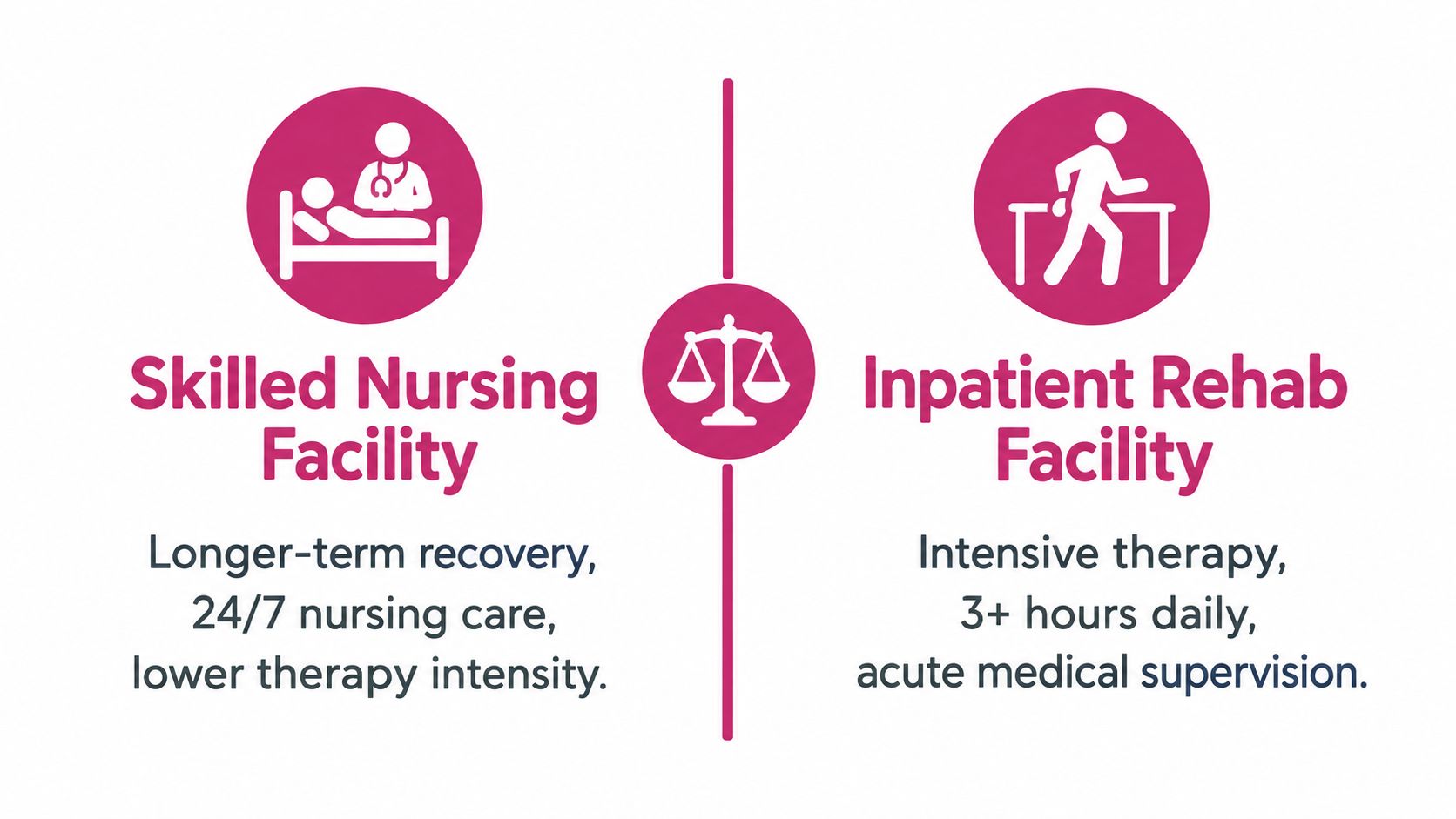
How Skilled Nursing Facilities Differ from Acute Rehab
An inpatient rehabilitation facility is a free-standing rehabilitation hospital or a rehabilitation unit within a hospital. Medicare describes IRF patients as people who can tolerate three hours of intense rehabilitation services per day, which makes therapy participation a central admission issue. The setting is built around coordinated recovery, with rehabilitation physicians, nurses, therapists, and other clinicians working toward measurable functional goals. Medicare's description of inpatient rehabilitation care explains the hospital-based nature of this option.
A skilled nursing facility serves a wider post-acute population. It provides skilled nursing care and may include rehabilitation, but not every SNF patient is prepared for an IRF schedule. The patient may need medication management, wound care, assistance with daily activities, infection monitoring, or recovery after a procedure while gradually rebuilding endurance.
The environment changes the recovery plan
IRF care usually treats therapy as the center of the day. The team expects active participation and adjusts the program as the patient gains mobility, self-care ability, communication, or swallowing function. The medical team remains involved because patients may still have complex needs after hospitalization.
SNF care is more flexible. A patient can receive rehabilitation while also receiving substantial nursing support, and the plan can accommodate slower progress or a larger need for assistance. That flexibility matters for people who aren't medically ready for home but can't sustain an acute rehabilitation schedule.
Both settings can be part of the Medicare post-acute system, but Medicare coverage doesn't make them clinically identical. A facility may advertise rehabilitation while offering a level of therapy that differs considerably from an IRF program. Ask for the expected therapy schedule, the disciplines involved, the physician coverage, and the facility's plan if the patient can't participate as expected.
Families and case managers also need to understand the administrative side. A facility's billing team translates clinical services into payer requirements, so a practical practice guide for rehab billing can help clarify why documentation, authorizations, and medical necessity matter during placement.
This video offers another visual explanation of the distinction:
Therapy Intensity, Length of Stay, and Recovery Outcomes
The clinical case for IRF care is strongest when a patient has meaningful recovery potential and can use intensive therapy. A JAMA Network Open study comparing inpatient rehabilitation and SNF care found greater improvement in mobility and self-care among patients receiving inpatient rehabilitation, even after adjustment for patient and facility characteristics.
That finding doesn't mean every patient should go to an IRF. A treatment setting can produce stronger outcomes for the patients it can safely admit, while an SNF remains the better fit for someone who needs more nursing support or cannot sustain the required workload.
The numbers families should understand
Length of stay is often longer in SNFs than in IRFs. One comparison reported an average of 24.7 days in SNFs versus 13.0 days in IRFs, while another reported 25.5 days versus 10.7 days, respectively. Those figures come from the comparative analysis summarized in the cited research, and they show a pattern of shorter, more concentrated IRF stays rather than a promise that every patient will follow the same timeline.
The same analysis reported lower SNF costs in one dataset, $10,001 compared with $11,984 for IRF care. Cost comparisons don't determine a family's bill by themselves because benefit status, coinsurance, supplemental coverage, authorization, and length of stay all matter. Still, they illustrate why families should compare both clinical value and payment exposure.
| Metric | Inpatient Rehab, IRF | Skilled Nursing, SNF |
|---|---|---|
| Mobility and self-care | Associated with greater improvement in the cited adjusted comparison | Improvement may occur in a less intensive setting, depending on patient needs and participation |
| Average length of stay | 13.0 days in one comparison and 10.7 days in another | 24.7 days in one comparison and 25.5 days in another, as summarized in the comparative evidence |
| Cost in one dataset | $11,984 | $10,001, in the same analysis |
| Downstream recovery | Matched analyses associate IRF care with more days at home and lower mortality | SNF rehabilitation can support recovery when intensive participation isn't realistic |
| Best interpretation | Concentrated therapy for an appropriate candidate | Flexible skilled care and rehabilitation for a broader post-acute population |
Recovery isn't measured only at discharge
A congressional evidence review found that, in matched comparisons, IRF rehabilitation was associated with lower mortality, fewer emergency-room visits, and more days at home than SNF rehabilitation. One multi-condition analysis reported an 8% lower two-year mortality rate and 5% fewer ER visits per year for IRF rehabilitation. More recent comparative research in the same congressional evidence review found that redirecting patients from IRF to SNF did not materially change readmissions but increased 90-day mortality by 6.5 percentage points after stroke and 5.8 points after hip fracture.
The practical lesson is clear. Families shouldn't judge a setting only by whether the patient returns to the hospital quickly. Survival, functional improvement, and the ability to return to the community matter just as much.
Medicare Payment Rules and Eligibility Barriers
The most common placement mistake is treating IRF and SNF as two versions of the same covered benefit. They aren't. Medicare Part A can cover medically necessary care in both settings, but the eligibility pathway and payment rules differ.
SNF coverage generally requires a qualifying inpatient hospital stay and entry into the SNF within the applicable discharge window, generally 30 days. Medicare's coverage publication for skilled nursing facility care explains the conditions families should verify. A patient who spent time in the hospital under observation may still have received extensive care, but observation status can prevent Medicare SNF coverage from applying.
The payment questions to ask before transfer
Medicare says SNF coverage can last up to 100 days in a benefit period when the requirements are met. In 2026, the first 20 days are covered, while days 21 through 100 carry daily coinsurance. The family must confirm the current benefit status and exact financial responsibility with Medicare, the plan, and the facility's admissions department.
IRF admission is driven by clinical qualification, physician oversight, rehabilitation needs, and the ability to participate in the intensive program. Don't assume that a diagnosis automatically creates eligibility. Ask the hospital team to identify the reason the patient qualifies and ask the IRF what happens if the patient's endurance falls below the program's expectations.
The family should request answers to these questions before accepting a bed:
- Hospital status: Was the patient formally admitted as an inpatient, or was the stay classified as observation?
- Benefit status: How much SNF coverage remains in the current benefit period?
- Coinsurance: What amount begins after the covered period changes?
- Authorization: Has the insurer approved the recommended setting and length of stay?
- Fallback plan: If the IRF cannot accept the patient, which SNF options can provide appropriate care?
These rules also explain why families researching whether Medicare helps pay for assisted living need to distinguish post-acute medical coverage from residential senior care. Assisted living isn't a substitute for IRF or SNF rehabilitation when a patient needs skilled post-hospital care.
Market conditions add another layer. MedPAC reported that the share of hospital discharges going to IRFs increased steadily since 2019 and reached 5.3% in 2024, while fee-for-service SNF admissions rose 1.7% to about 1.58 million in 2025, the first annual increase since 2022. Those trends don't mean one option has replaced the other. Availability still depends on geography, payer mix, staffing, and the patient's authorization.
How to Match Patient Needs to the Right Setting
The safest decision framework has three gates. A patient should pass the clinical gate, the medical gate, and the payment gate before the family commits to a destination.
Start with therapy tolerance. Ask the therapist or physician, “Can this patient participate in three hours of daily rehabilitation, with rest breaks as needed, and do so consistently?” Don't rely on a hopeful answer based on one unusually good session. The team should consider alertness, endurance, pain, cognition, motivation, and the patient's ability to follow instructions.
Next, examine medical complexity. A patient who needs intensive medical supervision alongside rehabilitation may be better suited to an IRF. Someone who needs skilled nursing, medication management, wound care, assistance with daily activities, and gradual therapy may fit an SNF more naturally.
Finally, confirm payment. Ask, “Does the patient's discharge status satisfy SNF requirements?” and “Has the payer reviewed the IRF admission?” A clinically sound plan can fail if the family discovers after transfer that Medicare coverage doesn't apply.
A working decision matrix
| Patient situation | Setting to investigate first | Reason |
|---|---|---|
| Stroke with alertness, endurance, and clear participation in therapy | IRF | The patient may be able to use intensive mobility, speech, and self-care rehabilitation |
| Hip fracture after surgery with strong rehabilitation potential | IRF | Concentrated therapy may support faster functional progress when medically appropriate |
| Significant nursing needs with limited endurance | SNF | The broader setting can combine skilled care with a more gradual rehabilitation plan |
| Ongoing wound, medication, or post-surgical monitoring | SNF or IRF, based on acuity | The discharge team must match the medical workload to available oversight |
| Unclear inpatient versus observation status | Pause and verify coverage | Payment eligibility may determine which option is realistic |
Families comparing broader support models can also consult this home care vs nursing home UK guide for a general discussion of supervised care versus support at home. For dementia-related placement questions, review skilled nursing facility options for dementia patients, while remembering that post-stroke or post-surgical rehabilitation requires a separate clinical assessment.
What Families Should Do Before Choosing a Facility
A facility's claim that it “has rehab” does not establish clinical fit or payment eligibility. Before accepting a bed, ask the hospital case manager for the recommended level of care, the patient's formal hospital status, current therapy notes, and the clinical reason each proposed facility can meet the patient's needs. Request several options. The first available bed may be the wrong setting or create avoidable payment risk.
Build a placement file
Keep these details together:
- Clinical needs: Diagnosis, surgery or hospital event, mobility, cognition, medications, wounds, dietary needs, equipment, and the nursing tasks required each day.
- Therapy profile: Physical, occupational, and speech therapy abilities, including how long the patient can participate before fatigue or confusion limits progress.
- Coverage facts: Medicare or insurance plan, authorization status, inpatient versus observation classification, benefit information, and expected coinsurance. Confirm these details before transfer.
- Family priorities: Preferred New Jersey location, visiting needs, language, room preferences, transportation limits, and the likely discharge destination.
The file should show whether the patient can tolerate the proposed therapy program, what care the receiving team must provide, and what payment rules may apply. Ask facilities how often each therapy discipline evaluates patients, who directs the rehabilitation plan, what nursing services are available, and how staff respond if the patient's condition changes.
Compare facilities before accepting a bed
Call admissions departments and request written answers about bed availability, payer acceptance, therapy schedules, physician coverage, nursing support, and discharge planning. Tour if time allows. Check cleanliness, staff interaction, accessibility, therapy space, call-bell response, dining arrangements, and whether residents appear engaged and supervised.
A placement advisor can organize health needs, budget, location, and lifestyle preferences, then provide a shortlist of licensed providers and coordinate tours. Life Senior Placement provides New Jersey guidance for families comparing nursing homes, rehabilitation-related care, assisted living, memory care, and home care through its placement service.
Confirm the handoff before discharge day. Ask who will send the medication list, therapy records, physician orders, insurance authorization, and personal belongings. Confirm transportation and paperwork requirements. A complete handoff helps the receiving team begin care safely and prevents avoidable delays.
When Acute Rehab Is Worth the Effort and When SNF Makes Sense
Acute rehab is worth pursuing when the patient has meaningful recovery potential, can tolerate the required program, and needs concentrated therapy after a stroke, hip fracture, or similar event. In that situation, the evidence linking IRF care with stronger mobility, self-care, and downstream outcomes deserves serious weight.
SNF care makes more sense when nursing needs dominate, endurance is limited, medical monitoring is substantial, or the patient needs a slower rehabilitation pace. It can also be the practical choice when the patient's hospital status or payer rules prevent Medicare SNF coverage from applying, although the family should then ask about other payment options before transfer.
Consider two patients after hip fracture. One is alert, medically stable, and participating actively in therapy. The other is fatigued, confused, dependent on extensive nursing assistance, and unable to sustain intensive sessions. The first should be evaluated for IRF placement. The second may need SNF care, even though both patients share the same diagnosis.
The post-acute market isn't moving in only one direction. MedPAC reported rising IRF discharge share and a recent increase in fee-for-service SNF admissions, with regional differences affecting access. Families should focus less on which setting sounds superior and more on clinical fit, therapy tolerance, discharge status, and total payment risk.
Life Senior Placement helps New Jersey families compare skilled nursing and rehabilitation-related options, review verified listings, and coordinate tours around clinical needs, budget, and location. Visit Life Senior Placement to request guidance before accepting a post-hospital bed.


