
You're in the discharge room, and the hospital team is pushing for a decision before lunch. Your mother, 85, has mid-stage Alzheimer's, a recent hip fracture, and another round of UTI-related delirium. The social worker is talking through a rehab-focused skilled nursing facility for dementia patients, a memory care community, and the possibility of piecing together home health, while you're trying to figure out which option is safe, realistic, and not a waste of money.
That's the right pressure point to focus on: not the label on the building, but stage, recovery goal, and behavioral complexity. Families get into trouble when they choose by vibe instead of by need, or when they assume memory care is always gentler and SNF is always harsher. The truth is simpler and more useful, if you're willing to look at the actual clinical picture.
When Families Start Asking About Skilled Nursing for Dementia
The call usually comes after something scary. A fall, a hospitalization, a medication mix-up, or a week of confusion that never fully clears. By the time the discharge planner starts naming facilities, the family is already exhausted and the decision feels bigger than it should.
That's exactly why the question needs to be sharpened fast. If your parent needs therapy after a hospital stay, has unstable behaviors, or needs hands-on nursing the home can't realistically provide, an SNF may be the right move. If the main issue is wandering risk and supervision, memory care might fit better. If the person still has a stable routine and a strong caregiver at home, home health or assisted living may be the better first step.
What makes this decision harder
Dementia rarely arrives as one neat problem. It changes mobility, judgment, continence, swallowing, sleep, and behavior at different speeds, which means the care setting has to match the whole pattern, not just the diagnosis. A facility that sounds more comfortable on paper can still be the wrong fit if it can't handle wound care, post-fracture rehab, or medication complexity.
Families also get pushed by urgency. Hospital teams need beds filled, work schedules don't pause, and no one has the energy to tour five places after a sleepless week. That's why this decision has to be made with a clear frame, not with guilt or marketing language.
Practical rule: if the problem is mostly supervision, look at memory care. If the problem is medical recovery or complex nursing, look at SNF.
What a Skilled Nursing Facility Actually Does
A skilled nursing facility is a licensed clinical setting, not just a place with aides and meals. It has 24-hour nursing, physician oversight, and therapy services, and it can manage things that ordinary residential settings usually can't, including IV antibiotics, wound care, and physical therapy after hospitalization. The Alzheimer's Association's 2026 facts and figures report notes that SNFs also provide transitional services for older adults who are not ready to return home after a hospital stay, which is why these facilities matter so much in dementia care (Alzheimer's Association facts and figures report summary).
That's also why SNF is different from assisted living and memory care. Assisted living is primarily residential support, not a clinical license. Memory care is designed for safety, structure, and dementia support, but it usually doesn't offer the same level of medical intervention or Medicare-funded rehab.
| Feature | Skilled Nursing Facility | Memory Care | Assisted Living |
|---|---|---|---|
| Main purpose | Clinical recovery and nursing oversight | Safety and dementia support | Help with daily living |
| Nursing intensity | 24-hour nursing | Limited clinical capacity | Basic care support |
| Rehab services | Common | Limited | Limited |
| Medicare rehab | Often available after a hospital stay | Usually not the core model | Usually not the core model |
| Best fit | Medical complexity, recovery, unstable needs | Supervision, wandering risk, cognitive support | Lower-acuity daily support |
Why the lines blur in real life
Marketing pages often make the categories sound cleaner than they are. Some SNFs run dementia units, and some memory care communities accept residents with more medical need than their license seems built for. Families should not trust the brochure alone. They should ask what the building does on a hard day, not what it looks like on a quiet tour.
The funding picture matters too. SNF stays can involve Medicare for post-acute care, Medicaid for long-term custodial care when eligible, and private pay for the gap. That means the same room can function like a rehab bed, a long-term nursing bed, or a transition point depending on why the person came in.
If you want a plain-English bridge between these categories, a useful explainer is this guide on what skilled nursing covers versus assisted living in New Jersey.
Specialized Dementia Care Inside an SNF
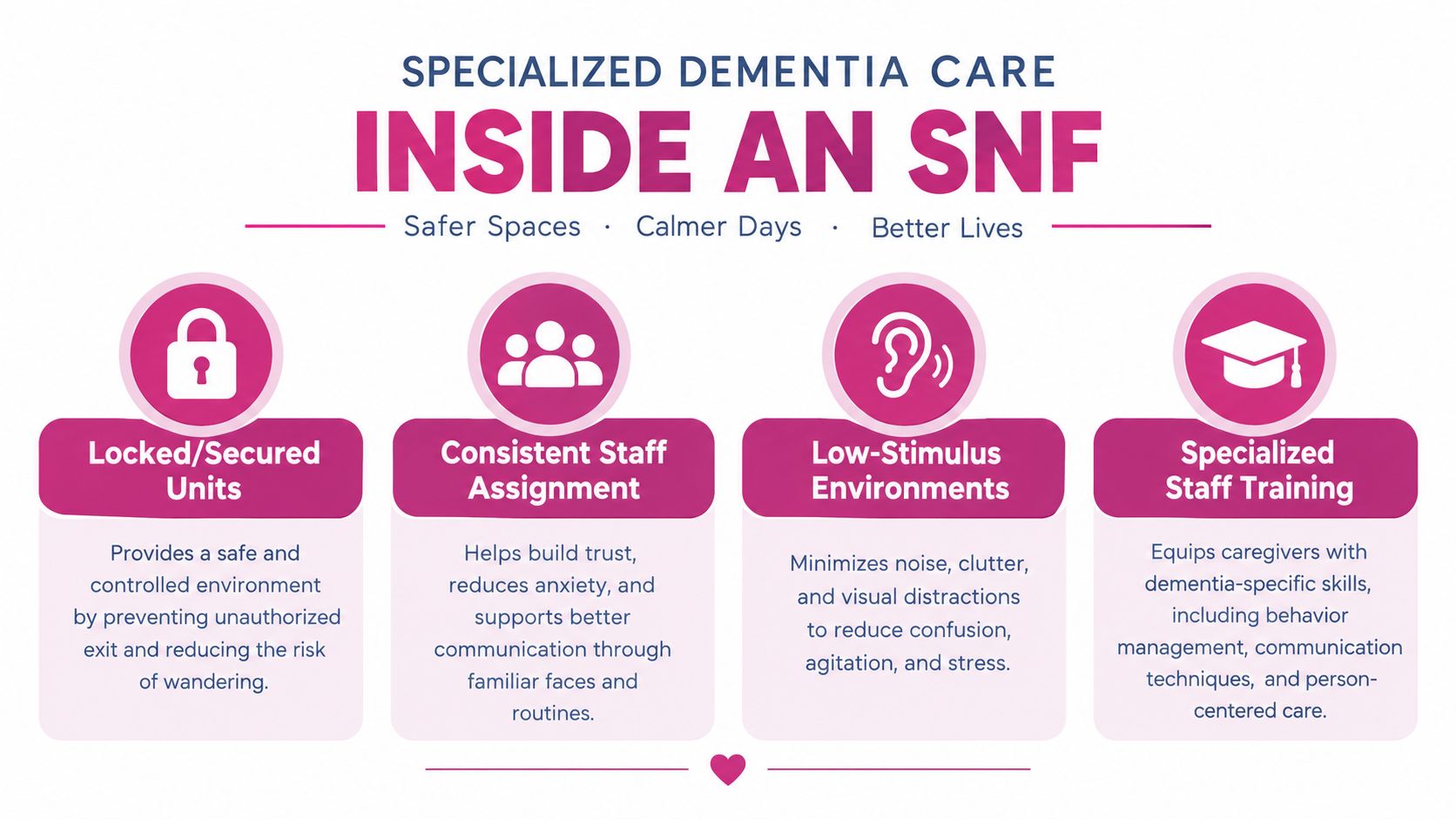
A dementia-capable SNF is not just a nursing home with a memory care sign on one hallway. The difference shows up in how the unit is built, how the staff is assigned, and how often the team has to improvise under pressure. Facilities with a very high concentration of residents with dementia tend to function better because the staff sees the same behaviors over and over again and gets good at handling them. NIH-supported analysis found that facilities where 90% or more of residents had dementia had significantly higher skilled-nursing hours per resident than lower-concentration facilities, and 35% of those high-dementia facilities had special dementia care units versus 20% in facilities with 60% to 90% dementia prevalence (NIH/NIA analysis).
What to look for on the unit
You want a secured or locked unit if wandering is a real risk. You want consistent staff assignment so your parent doesn't start from zero with a new face every shift. You want a unit that handles agitation with routines and redirection first, not with medication as the default response. And you want activities that are adapted for cognitive loss, not just scheduled as busywork.
Staffing mix matters too. A large U.S. Study found that nursing homes with a high proportion of cognitively impaired residents were 41% less likely to have a high staffing rating or high RN staffing rating than homes with fewer cognitively impaired residents, which is a blunt reminder that dementia-heavy buildings are often stretched thinner unless leadership invests in the right team (staffing and quality study). That's why you should ask directly about RN coverage, CNA coverage, and whether the same aides work the same hall consistently.
A dementia unit works best when the staff knows the resident's habits before the crisis starts.
For families looking at both clinical and nonclinical supports, some also ask about complementary approaches. If you're comparing care models, resources on integrative dementia therapies can help you think through supportive routines, though they do not replace skilled nursing when medical care is a true need.
Video walkthrough of dementia-capable care features
The Post-Acute Path After a Hospital Stay
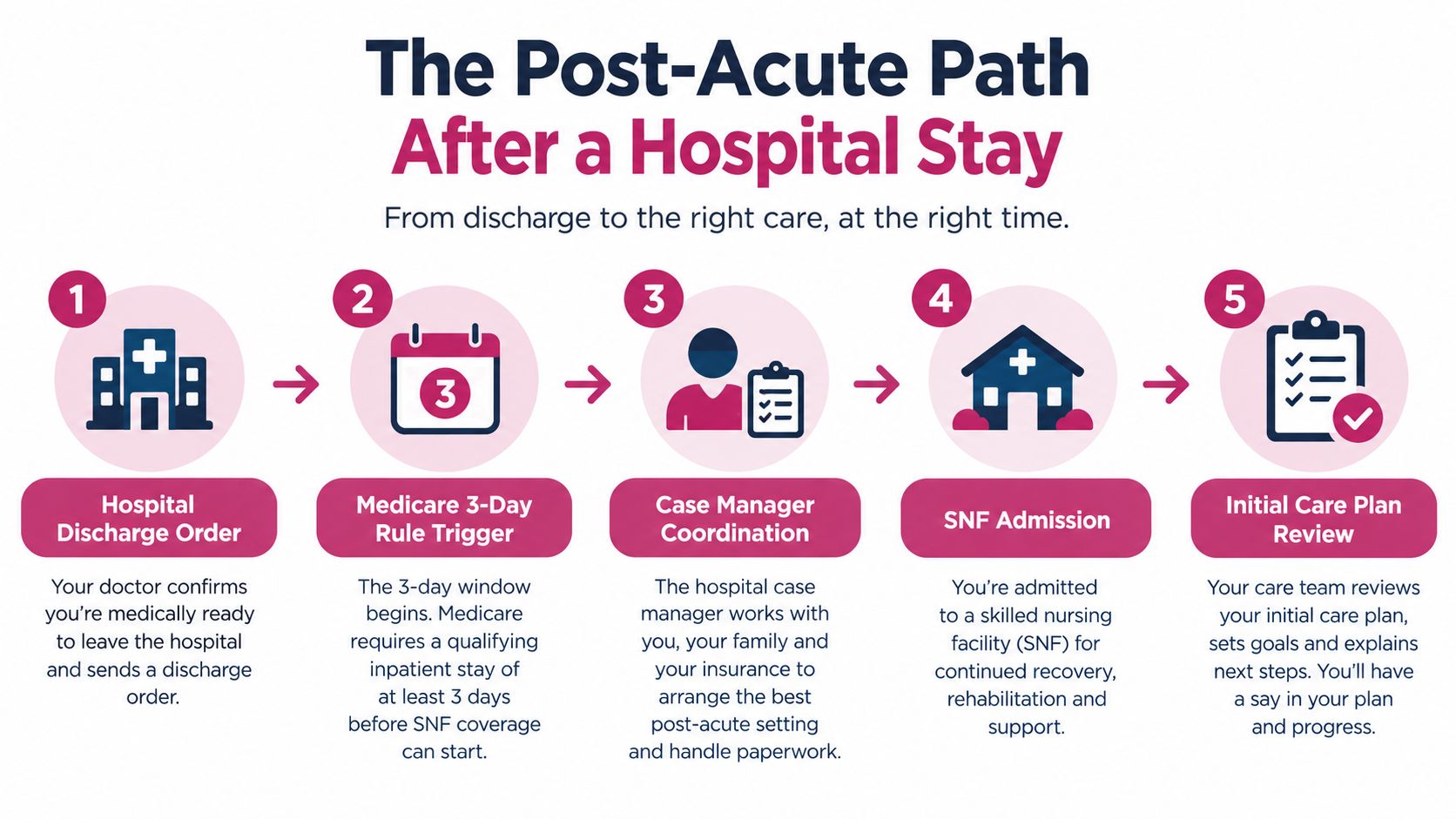
A lot of families think the SNF decision happens after discharge. In practice, it starts while the hospital team is still writing the plan. The case manager identifies facilities, the discharge order gets written, and then the clock starts on medication reconciliation, therapy evaluation, and family orientation. If the transfer is rushed or poorly documented, the receiving team has to reconstruct the situation instead of treating it.
That matters even more after falls, infections, or delirium. These are the exact moments when a person with dementia can look too unstable for home but not sick enough to stay in the hospital. SNFs fill that gap, which is why they are such a common part of post-acute care for dementia.
What happens in the first days
The first 72 hours usually set the tone. The team reviews medications, checks mobility, evaluates swallowing or feeding needs if there's concern, and decides whether therapy goals are realistic. Families should use that early period to ask how the facility handles behavior changes, toileting assistance, nighttime supervision, and discharge planning.
The discharge window is also when families should ask whether the stay is short-term rehab or likely to convert to long-term custodial care. That's not a minor distinction. It affects expectations, finances, and the amount of coordination needed after the first rehab push is over. If you want a New Jersey-specific bridge for the discharge process, this rehab discharge guide is worth reviewing before the transfer happens.
A simple read on the trajectory
- Short rehab stay: The person is recovering from a fall, surgery, or infection and can still participate in therapy.
- Extended SNF stay: Medical recovery is happening, but cognition or behavior makes discharge back home unsafe.
- Long-term custodial care: Therapy has plateaued, but the person still needs daily nursing and supervision.
The key point is blunt. The post-acute window is often the first real test of whether an SNF is dementia-capable or just medically licensed.
When SNF Is the Right Call and When It Is Not
The cleanest way to decide is to stop asking which setting sounds nicest and start asking which one can absorb the person's current needs. Early or stable dementia with a reliable caregiver usually points toward home support or assisted living. Moderate to advanced dementia with wandering, repeated delirium, feeding problems, or complex wound and infection care usually points toward SNF.
That doesn't mean every person with dementia belongs in a nursing facility. It means the setting has to match the level of support the family can no longer provide safely. A memory care community can be the right answer when the main issue is structure and supervision, but it is the wrong answer when the resident needs frequent skilled intervention.
| Dementia Stage & Profile | Best-Fit Setting | Why This Setting |
|---|---|---|
| Mild dementia, stable routine, family caregiver at home | Home health or assisted living | Support is needed, but not full-time nursing |
| Mild to moderate dementia, wandering risk, low medical complexity | Memory care | Security and routine matter more than clinical intensity |
| Moderate to advanced dementia, frequent infections, feeding or wound issues | Skilled nursing facility | Nursing, therapy, and medical oversight are central |
| Post-hospital recovery after fall, surgery, or acute illness | Skilled nursing facility | Rehab and transitional care are the main need |
A family should also respect the stage-specific reality. Some older adults with dementia can do well in non-SNF settings after hospitalization, but that is a fit question, not a slogan. The decision should be driven by recovery goal, behavior, and caregiver capacity, not by the word “facility” itself (post-acute fit discussion).
The hard part is that the line between memory care within an SNF and standalone memory care can be blurry in practice. That's why facility tours have to focus on actual capability, not branding.
How to Evaluate and Tour a Dementia SNF
Start with the unit, not the decor. A dementia SNF has to keep a confused, frail resident safe, respond fast when behavior changes, and keep the family out of constant crisis mode. The tour should test staffing, continuity, and how the team handles a shift in condition.
Four questions that tell you a lot
- Staffing ratios: Ask for RN and CNA hours per resident per day on the dementia unit, not the building-wide average. One hallway can be well covered while the rest of the building is thin.
- Turnover patterns: Ask who will be working that hall next week. Dementia care depends on repetition, and high turnover usually shows up in resident behavior.
- Training depth: Ask how staff handle agitation, refusal of bathing, feeding problems, and nighttime wakefulness. "Dementia-trained" means little unless they can explain the routines.
- Family communication: Find out how the facility reports changes, who answers calls, and what happens after a fall or medication change.
Visit at different times of day if you can. Lunch shows you pacing, cueing, and whether residents are being rushed. Early evening shows you how the unit handles sundowning and shift-change pressure.
Watch the hall, not just the brochure. If residents look disoriented and staff are constantly redirecting without a plan, the unit is probably underbuilt for dementia.
Look for the concentration of dementia residents in the building. A higher concentration usually means the staff sees these behaviors every day, which is the underused quality signal families should check.
If you need help comparing options, Life Senior Placement can match New Jersey families with nursing homes, memory care, assisted living, and home care based on the person's needs and location. Use the help, but tour with your own checklist in hand.
The Transition Risk Most Families Miss
The biggest danger in a hospital-to-SNF move is not always the facility. It's the paperwork. A multi-site study found that 21.5% of people with documented dementia had the diagnosis omitted in the discharge summary, while omission rates were 81.9% for power-of-attorney documentation, 88.0% for POAHC activation, and 70.4% for code status (transition documentation study). When those details go missing, the SNF team loses the person's behavioral baseline, decision-maker, and emergency preferences in one shot.
That creates avoidable chaos. Medication plans get reset. Staff don't know who can consent. Families get told something “wasn't on the paperwork” when they thought it was obvious. A 2025 systematic review of 67 studies also pointed to persistent gaps in dementia care transitions, which means this is a systems problem, not a rare mistake.
What to verify before the patient leaves the hospital
- Full discharge summary: Make sure the dementia diagnosis and current cognitive status are included clearly.
- Decision-maker paperwork: Confirm who holds healthcare POA and that the receiving team has the document.
- Code-status forms: Verify that POLST or DNR paperwork travels with the patient if it applies.
- Medication review timing: Ask for a review with the SNF team within the first 72 hours.
- Routine notes: Share sleep habits, triggers, communication style, and bathing resistance before the transfer.
The single most important step is the handoff call between the hospital case manager and the SNF intake nurse. That call should not be a formality. It should be a full transfer of the person's baseline, risks, and decision structure.
Making the Decision and Planning Ahead
Families make this call faster when they stop arguing about labels and start looking at the actual case. Dementia stage, behavioral complexity, recovery goal, and family capacity are the four factors that matter. If a person is still rehabbing after a hospital stay, an SNF may be the right setting. If the main problem is safe supervision with no skilled need, another level of care may fit better. If behaviors are severe, a facility with more dementia experience and tighter structure usually beats a generic rehab floor.
The quality signal families miss most is dementia concentration. Ask how many residents on the unit live with dementia, how often staff handle wandering or resistance to care, and whether the team sees these issues every day. A building that concentrates those residents usually has better routines, better redirects, and fewer surprises at 2 a.m. That matters more than glossy brochures.
Money has to be handled before the crisis, not after. Medicare and Medicaid work differently, and the line between a short post-acute SNF stay and long-term custodial placement changes who pays and for how long. Families who think long term should also review this nursing home asset protection guide while they are still making placement decisions.
A practical timeline
- Six months out: Update POA documents, write down code-status wishes, and start visiting facilities.
- Three months out: Compare options by dementia concentration, staffing patterns, and discharge planning.
- At the first crisis: Bring in the hospital case manager early and demand the full transfer packet.
- After admission: Confirm the care plan, medication review, and how family updates will be handled.
FAQ
How should families handle insurance and care coordination?
Start with the coverage rules before admission. Ask the SNF what it expects Medicare to cover, what triggers a change in payment source, and who handles communication with the hospital, therapist, and family once the person arrives.
What visitation rules should families ask about?
Ask whether visits are flexible, whether there are restricted hours, and how the unit handles late-day confusion or agitation. Facilities that care for many dementia residents should be able to explain when a visit helps and when it makes the evening harder.
What staffing questions matter most in a dementia SNF?
Ask who is on the unit overnight, how often nurses are present, and whether aides stay on the same hall or float across units. Consistent staffing usually gives families a better read on how the building handles behaviors and routine care.
How do I know if the unit is built for dementia, not just rehab?
Look at the residents. If the unit has a clear concentration of people with dementia, staff usually have more practice with redirection, bathing resistance, wandering, and communication problems. That is the practical difference families should check.
Can a person move from SNF to another setting later?
Yes, and that is common when the clinical picture changes. A rehab stay can end, a long-term need can become clear, or the family may decide a different setting fits better once behavior, mobility, and supervision needs are better understood.
If you are choosing between SNF, memory care, or home care in New Jersey, make the decision by stage and care need, not by the label on the door. Get a placement advisor to compare the actual facilities, the staffing, and the discharge path, then visit Life Senior Placement for a shortlist built around your parent's care needs.


