
In 2025, the national median for assisted living was $6,200 per month, while a semi-private nursing-home room averaged $9,581 per month. Those published rates are starting points, not reliable estimates of what your family will spend after care tiers, medications, and other fees are added.
A New Jersey family usually starts with a practical question: “Can we afford this community?” The answer depends on more than the brochure's monthly rate. You need to know what care your family member needs now, what may change, and which expenses the community bills separately.
Why the Sticker Price Rarely Matches the Final Bill
Two New Jersey assisted living communities advertise similar apartments, meals, and activities. After assessing the resident's care needs and adding each community's care fees, their monthly quotes differ by more than $1,800. That is an illustrative example, not a market benchmark. The lesson is practical: compare the full cost of the same care plan, not two starting rates.
Start with the national reference points
CareScout's 2025 national medians were $6,200 per month for assisted living, $35 per hour for home care, and $9,581 per month for a semi-private nursing-home room or $10,798 for a private room (CareScout's 2025 Cost of Care Survey). Use these figures to compare broad care settings. They are not a quote for a specific provider, and they do not show how that provider prices personal care.
Memory care rates also vary by community and by the services a resident needs. Ask what the monthly quote includes, which services cost extra, and how the community assigns care tiers. Get the answers in writing before comparing options.
Room and board is only part of the bill. KFF reported that assisted living room and board averaged $64,200 a year in 2023, with support services potentially adding to the cost (KFF's analysis of long-term-care affordability). That distinction matters: a listed room rate may leave out the help that shapes a resident's monthly out-of-pocket cost.
Ask a better question
Ask, “What will this resident's care plan cost here, and which charges could change?” A resident who needs help with bathing, dressing, medication, or mobility may be billed differently from a neighbor in the same building. The base rate does not settle the budget.
Practical rule: Request a written quote based on the resident's assessed needs, not the advertised starting rate.
Have each community price the same care needs. Ask it to list excluded services, explain how added support affects the monthly bill, and identify any fees that could change as needs increase. Then compare those written estimates, not the brochure prices.
The Four Levels of Care Explained
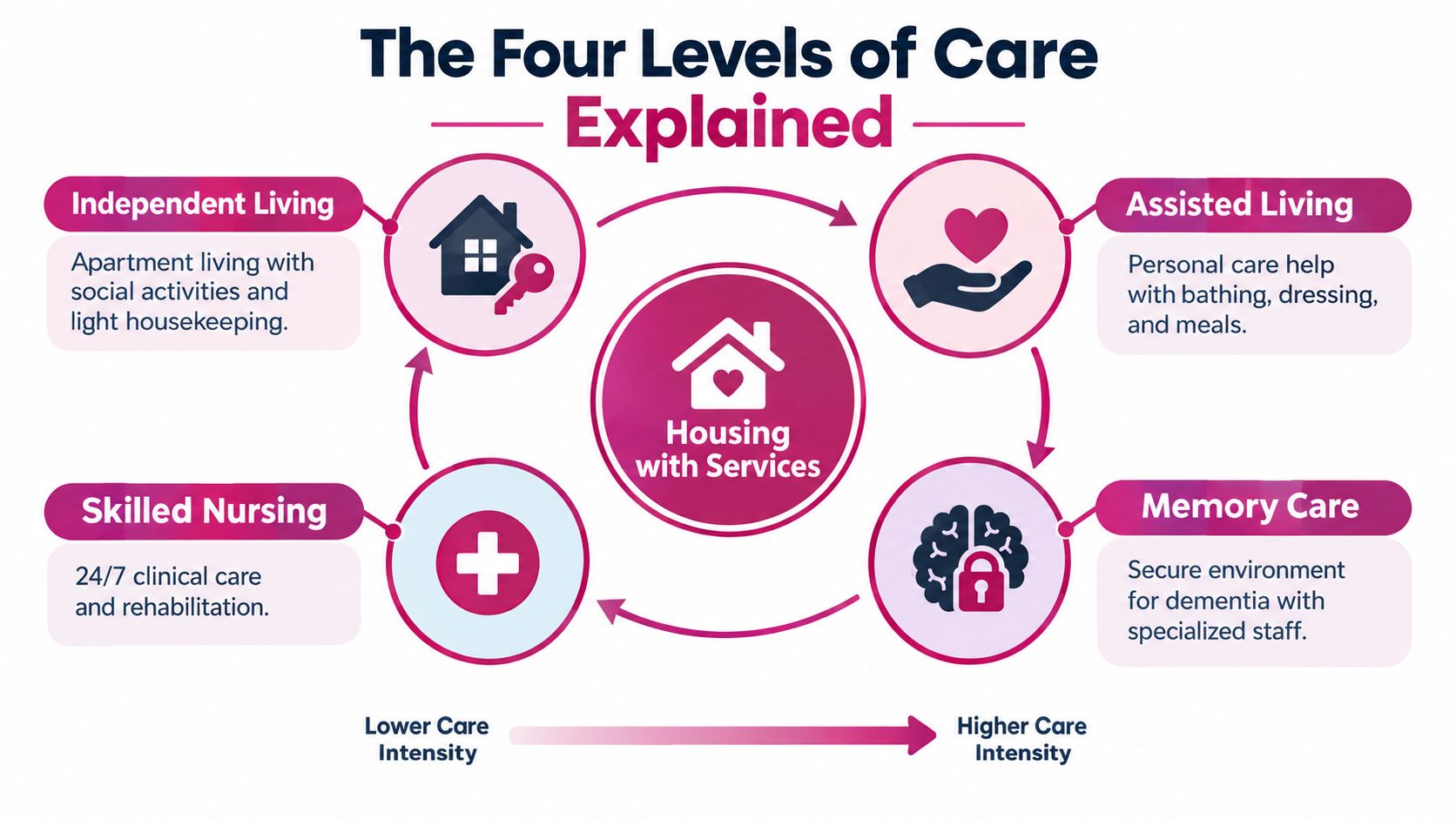
Think of senior living as a vehicle with different trim levels. The basic model gets you housing and convenience. Higher levels add more help, safety measures, or clinical care. The right choice isn't the most elaborate option; it's the least intensive setting that can safely meet the person's needs.
Match the setting to the need
Independent living suits someone who can manage daily activities but wants less home maintenance and more community amenities. The resident typically lives in a private apartment, with services such as meals, housekeeping, or social activities depending on the community. It isn't designed to provide hands-on personal care.
Assisted living adds regular help with daily tasks, such as bathing, dressing, and meals. Families often start looking after a fall, a pattern of missed medications, or difficulty maintaining a safe routine at home. Care is usually individualized, and the cost can rise when the resident needs more support.
Memory care is designed for people living with dementia who need a more structured, secure environment and staff familiar with dementia-related needs. A diagnosis alone doesn't automatically determine the setting. Look at the person's safety, supervision needs, and ability to manage everyday life in a less specialized environment.
Skilled nursing provides a more clinical setting for people who need substantial ongoing medical oversight or rehabilitation. A hospitalization may prompt an assessment, but the right placement depends on the person's current clinical needs and the recommendations of their care team.
Plan for transitions, not just today
A family choosing a setting should consider the current need and the next likely transition. Ask whether the community can support changes in care, what would trigger a move, and whether the resident would need to transfer elsewhere if needs exceed what staff can provide.
Don't pay for a higher care level because it sounds more secure. But don't choose a lower one that can't meet the person's needs. Compare staffing and services against the specific tasks the resident needs help with, then confirm how the community reassesses care and updates its charges.
Comparing Settings Side by Side
A monthly rate only helps if it covers the services the resident needs. Use this comparison to narrow your choices, then request an itemized quote from each provider. Staffing, bundled services, and reasons for a move vary by community, so confirm them directly.
Senior Living Settings Compared
| Setting | Typical monthly cost | Included services | Staffing | Common trigger to move |
|---|---|---|---|---|
| Independent living | No comparable median provided here | Housing and community amenities; services vary | Confirm what staff are available and when | Daily tasks or safety needs begin requiring hands-on help |
| Assisted living | $6,200 national median in 2025 | Housing, meals, and personal-care support vary by community | Ask who provides care and what support is available overnight | Care needs exceed what the community can safely provide |
| Memory care | No comparable median provided here | Secure setting and dementia-focused support vary by community | Ask about dementia training, supervision, and overnight coverage | Clinical needs exceed the unit's capability |
| Skilled nursing | $9,581 semi-private; $10,798 private national monthly medians in 2025 | Clinical and rehabilitative services depend on the resident's plan | Confirm the clinical coverage relevant to the resident's needs | Ongoing clinical care or rehabilitation is needed |
The national figures above use the 2025 medians introduced earlier. Independent living and memory care have no comparable median listed here, so don't estimate their prices from another setting's rate. Ask providers for current pricing and a clear list of what each quote includes.
Three decision forks families commonly face
Memory care or assisted living? Memory care may fit better when dementia creates safety or supervision needs that an assisted living community cannot meet. Compare the actual support, not just the price. Ask how staff handle the resident's routines and specific behaviors, and confirm what supervision is available.
Home care or assisted living? Home care can suit someone who wants to remain at home and has reliable support. An hourly home-care rate and an assisted living rate cover different things. Use this comparison of independent living and assisted living in New Jersey to understand how housing and support can differ. Then include housing, meals, upkeep, and family caregiving in your own budget comparison.
Assisted living or skilled nursing? Let clinical needs determine the setting. If a complex medication regimen or medical condition calls for ongoing clinical oversight, ask the care team whether assisted living can safely provide it. Admissions staff can explain a community's services, while a clinician can assess whether those services suit the resident.
Before touring, shortlist one or two settings that match the resident's current needs. Compare itemized costs, the services included, and when staff are available. Choose the option that provides the required support without paying for a care package the resident does not need.
Why New Jersey Families Pay More Than the National Average
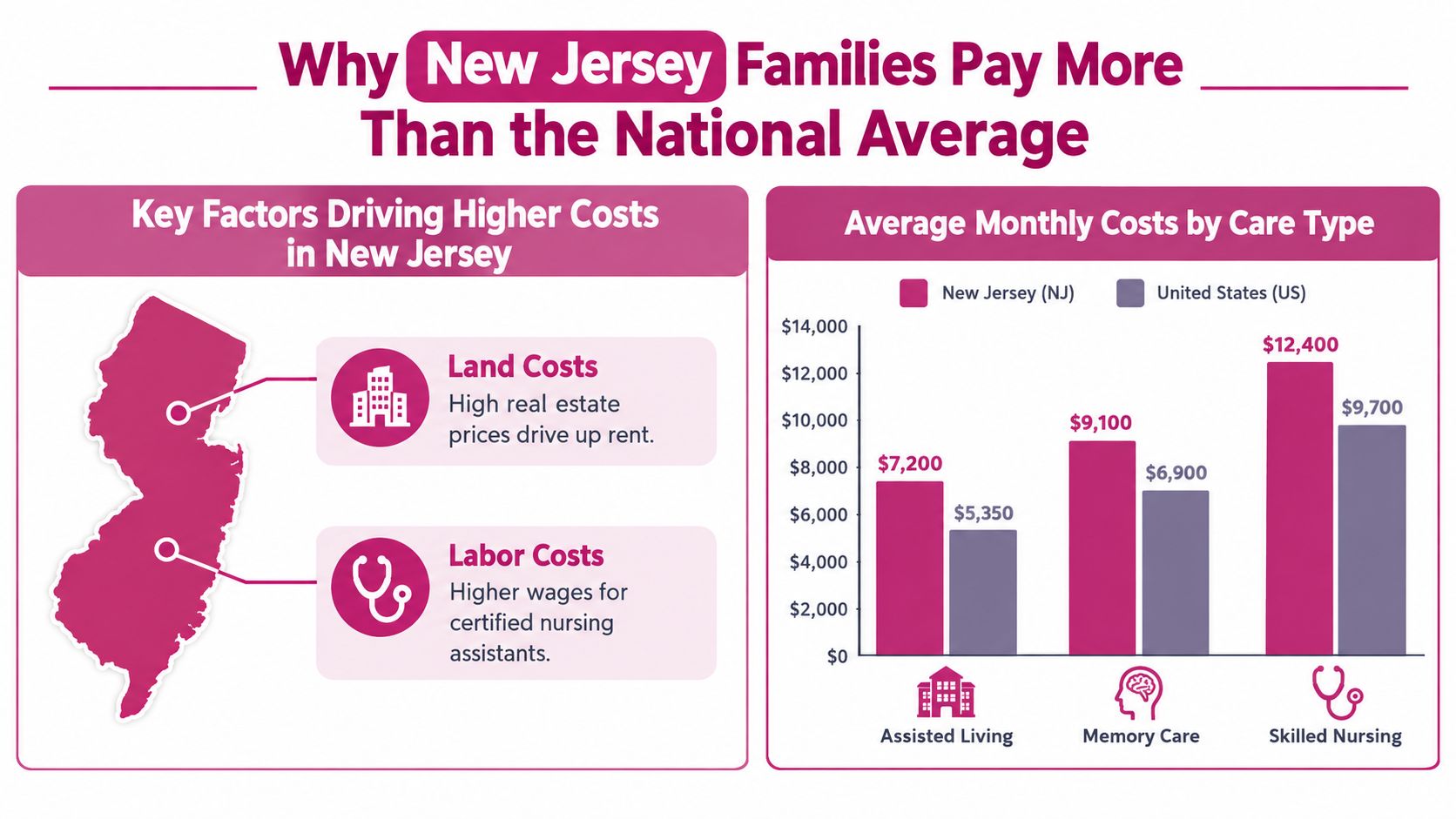
A New Jersey quote can look high beside a national figure because the two may describe different markets, apartments, and care packages. National medians offer context, not a promise that local providers will charge the same amount. A family should compare a quote with nearby options serving similar needs, not with a generic figure from another state.
Read local quotes as local quotes
Housing and labor costs affect what providers must charge to operate. The community's location, apartment type, care model, and available services also shape the price. A family comparing a New Jersey community with a national median may be comparing unlike packages, especially if one quote includes more care or a different housing arrangement.
Costs can also vary within the state. A community in a higher-cost area may quote more than one elsewhere, but don't assume the county alone explains the difference. Ask providers to itemize housing, care, and additional services, then compare communities with similar offerings. A New Jersey assisted living cost comparison by ZIP code can help you start a local search, but a provider's written quote is what belongs in your budget.
Sanity-check the quote
Don't accept a single price as proof that a community is expensive or a bargain. Ask what room type the quote assumes, what care level it reflects, which services are included, and whether a move to a higher care tier would change the monthly bill. If a provider won't explain how it builds the price, you don't have enough information to compare it fairly.
When two local quotes differ, compare the care plans line by line. One might include more support in its base rate, while another may bill each service separately. Focus on the resident's likely total outlay, not the provider's preferred headline number.
Inside the Monthly Bill
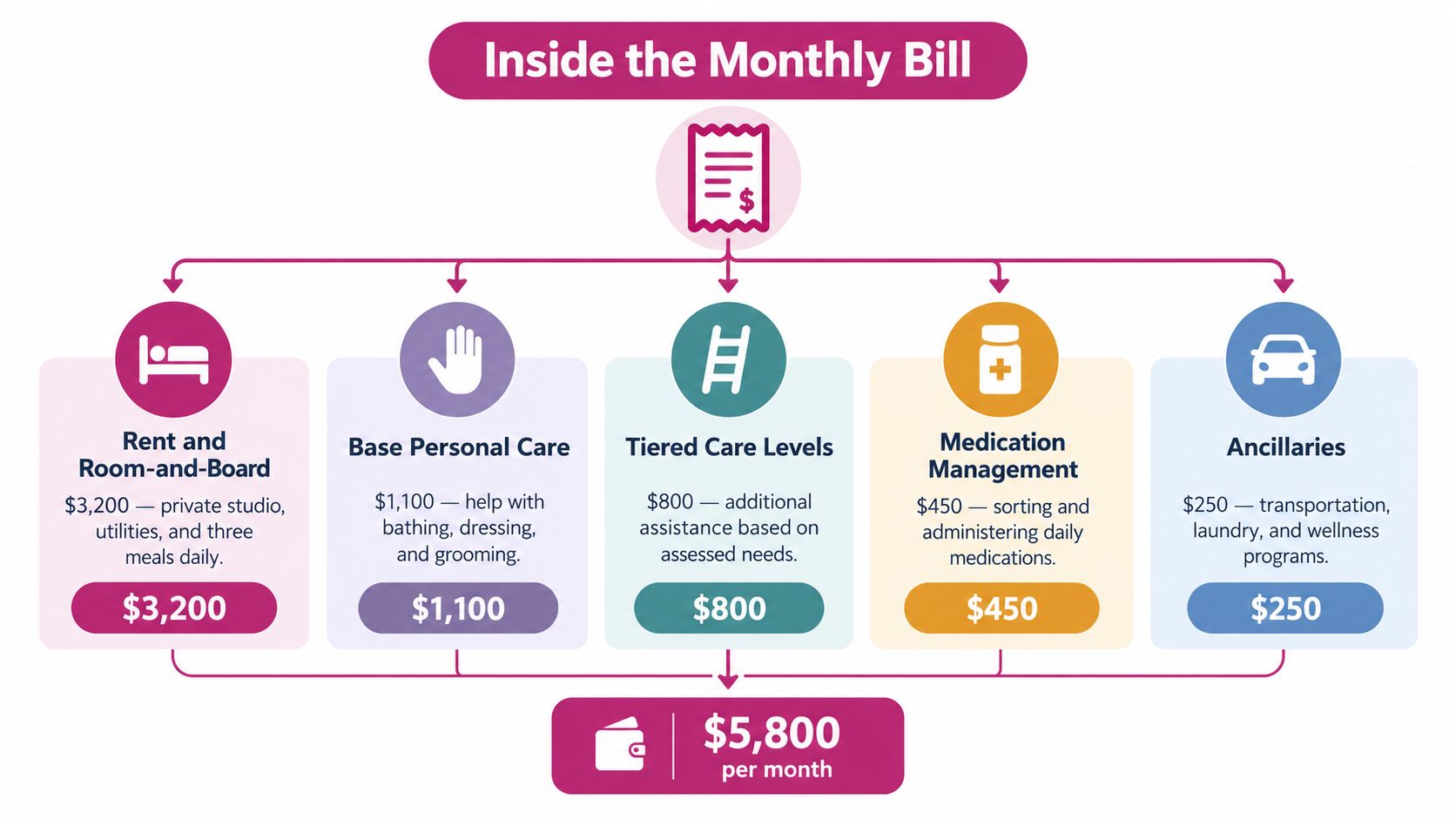
An assisted living statement is easier to evaluate when you separate housing from care. A bill may combine a room, meals, personal assistance, medication support, and optional services. Ask the community to identify each charge and explain which ones can change as the resident's needs change.
Audit the quote line by line
A useful quote separates these categories:
- Rent and room and board: Ask whether utilities, meals, housekeeping, and maintenance are included, and whether the quoted room type is the one your family wants.
- Base personal care: Confirm which everyday tasks are covered, such as help with bathing, dressing, or grooming.
- Care tiers: Ask what assessment determines the tier, who conducts it, and what changes the resident's level.
- Medication management: Check whether reminders, organizing medications, and administration are priced differently.
- Ancillary charges: Ask about transportation, incontinence supplies, laundry, guest meals, and other services your family expects to use.
The five figures displayed in the infographic are an illustrative sample, not a verified price schedule or a typical bill. Don't use them to estimate what a particular New Jersey community will charge. Request a personalized, itemized estimate instead.
Ask what Medicaid changes, and what it doesn't
New Jersey's 2025 Medicaid standards list an assisted-living room-and-board amount of $973.40 per month and a maintenance-needs allowance of $143.65. Those amounts illustrate why families need to distinguish between room and board and covered care when discussing benefits. They don't establish that a resident qualifies or show the full amount a particular family will owe. Eligibility and payment details depend on the program and the individual case.
Before relying on Medicaid in a budget, ask the facility and a qualified benefits adviser which charges remain the resident's responsibility, how the program handles the resident's income, and what happens during any private-pay period. Write down the answers and the date they apply.
Don't compare one community's room rate with another community's all-in estimate. Compare the same room, care needs, and add-on services in both quotes.
Financing Options That Actually Work in 2026
A monthly rate is only useful if it fits the household budget after care charges, insurance payments, and a spouse's expenses are counted. Build a funding plan around the itemized quote, and verify each source before relying on it. Most families need to combine several sources.
Build a funding stack
Private pay can draw on savings, retirement income, or proceeds from selling a home. Calculate what remains after taxes, household bills, and the ongoing costs of a spouse staying at home. If the budget only works by spending down savings faster than planned, review the care setting and payment strategy before signing.
Long-term care insurance can help if the policy covers the setting and services the resident needs. Check the benefit amount, elimination period, inflation protection, covered care settings, and lifetime benefit cap. Confirm which records the insurer requires and when the waiting period starts. Do not assume every community charge will be reimbursed.
Veterans benefits may apply to eligible veterans or surviving spouses. Check current eligibility rules and gather the required records before counting a possible award as income. The application and outcome depend on the individual's circumstances.
Home equity or a life settlement may be worth discussing with a financial or legal professional. These choices can affect a spouse, heirs, taxes, and future options, and they may be difficult to reverse. Get advice on the terms before committing.
Medicaid may help eligible individuals pay for covered long-term services under program rules. It does not promise to cover every room, board, or personal expense. Ask a qualified New Jersey benefits adviser to review eligibility and identify any costs the resident must still pay.
Put the resident's and spouse's expenses in the same cash-flow plan. A worksheet or tool to track recurring spending costs can help reveal whether the monthly bill is sustainable for both households. For additional funding approaches, read this guide to paying for assisted living without draining savings.
Be realistic about the affordability gap
KFF's analysis compared a median annual income of about $36,000 for Medicare beneficiaries with a median annual cost of $116,800 for a private nursing-home room. That contrast shows why families should compare available funds with the actual quote, rather than assume income alone will cover care. It does not predict what a particular family will pay or establish eligibility for a benefit.
Map confirmed funds against the itemized estimate, verify benefits before including them in the budget, and leave room for costs to change. Life Senior Placement offers no-cost guidance and provider matching for New Jersey families comparing care settings and budgets. Consider that help alongside advice from a benefits adviser, financial professional, or elder-law attorney.
Five Cost Myths That Drain Family Budgets
Myth: Medicare covers long-term care. KFF's long-term-care analysis explains that Medicare generally does not cover ongoing long-term care. Correction: Confirm covered services before putting Medicare dollars against an assisted living or custodial-care bill. Treat unconfirmed benefits as unavailable.
Myth: The cheapest community is always the cheapest option. A low room-and-board rate can leave care and medication support outside the quote. Correction: Choose the affordable total for the resident's care plan, including required extras, rather than the lowest advertised rate.
Myth: All-inclusive means every expense is included. The package name proves nothing. Providers set their own exclusions. Correction: Get those exclusions in writing, particularly ancillary fees and charges triggered by a higher care tier.
Myth: Waiting a few months will save money. Delay guarantees neither a lower price nor unchanged care needs. Correction: Price suitable options now and agree on a review point with the family and care team before a change in needs narrows your choices.
Myth: The price stays stable after admission. Genworth and CareScout's 2024 survey release reported year-over-year increases of 10% for assisted living, 7% for semi-private nursing-home rooms, and 9% for private rooms. These figures are not a forecast for an individual community. Correction: Ask separately about routine rate increases and care reassessments. Choose a community whose total bill leaves room for changes, rather than one that uses every available dollar at move-in.
Your 30 60 90 Day Action Plan
First 30 days: Gather financial statements, insurance policies, veterans' records if relevant, and a current medication list. Request itemized estimates from a few communities and compare the same room type and care needs.
Days 31 to 60: Tour the strongest matches. Ask who sets care tiers, what services cost extra, how medication support works, and what happens if needs increase. Start applications for benefits that may apply, and track what's submitted.
Days 61 to 90: Choose the setting that fits the resident's needs and the household's budget. Confirm move-in costs, the services in the agreement, and a future affordability review.
Take these questions to each tour:
- What does the monthly rate include and exclude?
- How do you assess and price care needs?
- What can trigger a higher care tier?
- Are medication support and transportation included?
- How do you handle changing needs?
- Which charges may be billed separately?
- What are the move-in and payment terms?
- What financial or benefit documents should we provide?
Finish by writing a one-page monthly budget with income, housing, care, medications, ancillary charges, and any likely benefits. That worksheet is more useful than a brochure when your family has to make a decision.
If you're weighing a New Jersey community against the monthly budget, Life Senior Placement offers no-cost guidance, vetted provider matches, and support with comparing options and arranging tours. Share the resident's care needs, preferred area, and budget, then ask an advisor to help you build a shortlist you can verify with itemized quotes.