
You're home from the hospital with a stack of discharge papers, a follow-up appointment on the calendar, and a tired parent who still needs help getting dressed before breakfast. The paperwork mentions home care, home health, and maybe even a visiting nurse, and it's easy to hear all of that as one big blur. It isn't one service. It's two different kinds of help, and the difference matters the minute you start making calls.
The cleanest way to sort it out is simple. Home care helps a person stay safe with daily life at home. Home health care treats a medical problem at home under a clinician's order. Families often need both in the same house, sometimes at the same time, because a person can need help bathing every morning and still need wound care or therapy a few times a week. That split is the heart of the difference between home care and home health care.
Why Two Services Exist and Why Families Confuse Them
A New Jersey discharge planner may hand an adult child a short list after a hospital stay. The labels can include “home care,” “home health,” and “skilled nurse.” On paper, they look like neighboring choices. At the kitchen table, with a parent still recovering, the difference affects who comes to the house, what that person can do, and how the family pays.

Two services, two jobs
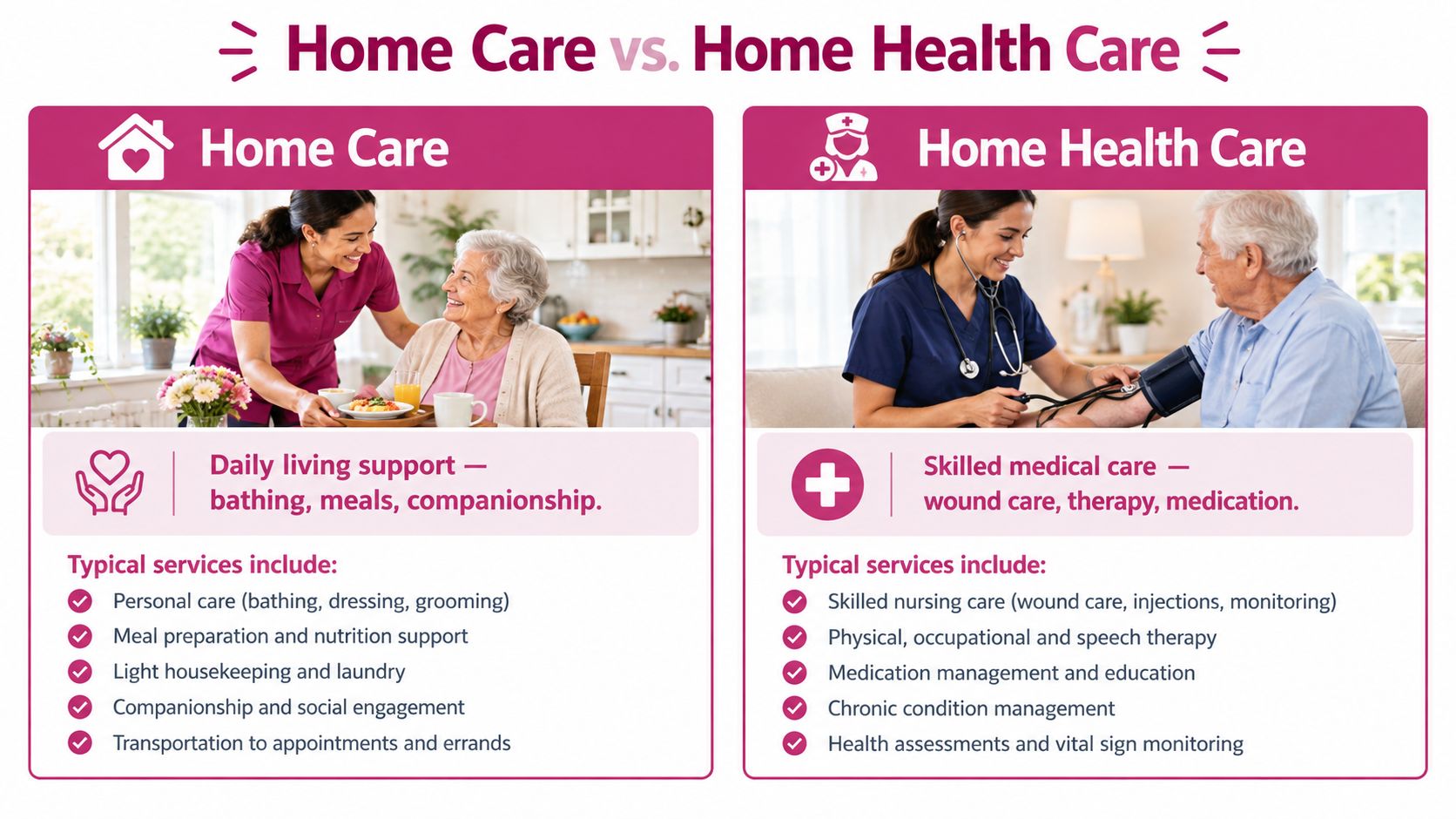
Home care supports the routines that make daily life safer. An aide may help with bathing, dressing, toileting, mobility, meals, companionship, errands, or light housekeeping. The goal is practical support at home, not treatment of a medical condition (Medicare and home health care).
Home health care addresses a medical need under a clinician's direction. Medicare describes services for illness, injury, disability, or recovery, including skilled nursing, physical therapy, occupational therapy, speech-language pathology, and medical social services. The visit is tied to treatment, monitoring, or rehabilitation rather than the ordinary work of keeping a household running.
The difference becomes clearer through a typical morning. A home care aide might help your mother get out of bed, prepare breakfast, keep her steady while she walks, and make sure she has eaten. A home health clinician might assess a wound, monitor recovery after surgery, or work on mobility after a fall. One supports the day. The other provides skilled care for a health problem.
Both services happen in the same setting, so families often combine the labels. A parent may need personal assistance every morning and receive clinical visits at separate times. The services can work alongside each other, yet they are ordered, staffed, and paid for differently.
For a plain-language overview of what New Jersey home care agencies provide, see the home care page at Life Senior Placement.
Practical rule: if the task helps someone get through the day safely, look at home care. If it is connected to a diagnosis, recovery plan, or skilled medical need, look at home health.
Why the distinction stuck
Medicare's home health benefit covers medically necessary care, not open-ended custodial assistance. That boundary explains why bathing help generally belongs to home care while wound management belongs to home health. The address is the same, but eligibility and payment depend on the service's purpose (Medicare and home health care).
For another plain-English comparison of the same practical split outside the United States, see Australia home care options.
Defining Each Service in Plain Language
A parent may need help before breakfast and skilled treatment later that day. Following each visit's purpose makes the difference between home care and home health care easier to see.
What home care looks like at 7 a.m.
A home care aide might arrive before breakfast, help with a shower, lay out a robe and shoes, make coffee, and remind Mom about her morning pills. Later, the aide could prepare lunch, change bed linens, or drive her to a haircut. These tasks support daily safety and independence rather than treat a medical condition. They fit the home care model, which is distinct from the skilled services described in Home health services.
The practical question is simple: can the person remain safely at home with help for ordinary routines? New Jersey families should also ask how an agency trains its aides. A provider may describe personal care assistance under the state's applicable standards, so families can compare preparation and supervision instead of relying only on a job title. For a plain-language look at what local agencies may provide, see the New Jersey home care services guide.
What home health looks like after surgery
After surgery, a registered nurse might change a wound dressing, monitor a serious illness, or give an injection. A physical therapist could work on mobility goals after surgery or a fall. These visits are organized around a clinical need and an ordered plan, rather than a repeating household routine.
Home care answers, “Who helps my mom get through the day safely?” Home health answers, “Who treats her medical condition right now?” One person may need both, particularly during the transition home after a hospital stay. The Australia home care options comparison offers another plain-language explanation of the same service boundary.
| Home care | Home health care |
|---|---|
| Bathing, dressing, meal preparation, companionship | Skilled nursing, therapy, wound care |
| Supports daily living | Addresses a diagnosed health issue |
| Often ongoing | Often time-limited and goal-focused |
The choice does not have to be permanent. A family may arrange home health during recovery, then continue home care for the daily tasks that remain after clinical visits end.
If you are comparing local arrangements, the hourly home health aide costs North Jersey guide can help clarify whether you are seeking hourly daily support or a scheduled skilled visit.
Providers, Credentials, and What Each Visit Looks Like
At the kitchen table, a family may hear “caregiver,” “aide,” and “nurse” used for different jobs. The title matters because each role brings a different level of training, authority, and purpose into the home.
Who walks in the door
A home care visit is usually provided by a personal care aide, home health aide, or companion. Training requirements vary by state and agency. The work centers on daily support, such as bathing, dressing, meal preparation, light housekeeping, medication reminders, transportation, and companionship. The aide helps a person complete the day safely, but does not diagnose a condition or provide skilled treatment.
A home health care visit involves licensed clinicians, including a registered nurse, physical therapist, occupational therapist, speech-language pathologist, or medical social worker. Their work follows a clinical plan and addresses a defined need, such as wound healing, strength, mobility, or follow-up after discharge (Medicare and home health care).
| Service | Typical provider | Credential | Oversight | Visit pattern |
|---|---|---|---|---|
| Home care | Personal care aide, home health aide, companion | Varies by state and agency | Agency or care manager | Often scheduled daily or weekly |
| Home health care | Nurse, therapist, social worker | State license and clinical qualifications | Clinical team and plan of care | Intermittent, goal-based visits |
What happens during the visit
Home care follows the person's routine. The caregiver may help with a shower, prepare breakfast, tidy the kitchen, provide a ride, or offer reminders. The value is consistency: someone is present to support ordinary tasks and notice when the day is becoming harder.
Home health starts with a clinical question. Is a wound improving? Can the person transfer from bed to chair more safely? Are exercises being completed correctly? Has a symptom changed enough to report? The clinician assesses progress, provides treatment or therapy, and records findings tied to the care goal.
A useful filter is simple:
If the person needs help with a shower, meal, ride, or daily supervision, home care may fit. If the person needs licensed judgment about a wound, therapy program, or significant symptom change, home health may fit.
Discharge planners often hand families a shortlist, and the provider's title can prevent a costly mismatch. A caregiver may be right for daily supervision but unable to perform a medical task. A nurse may address the treatment plan while visiting only at intervals, leaving the family to arrange separate help with lunch, clothing, or household routines. Families in North Jersey comparing hourly support can use this hourly home health aide costs guide to clarify whether they need recurring assistance or scheduled skilled visits.
How Payment and Insurance Treat Each Service
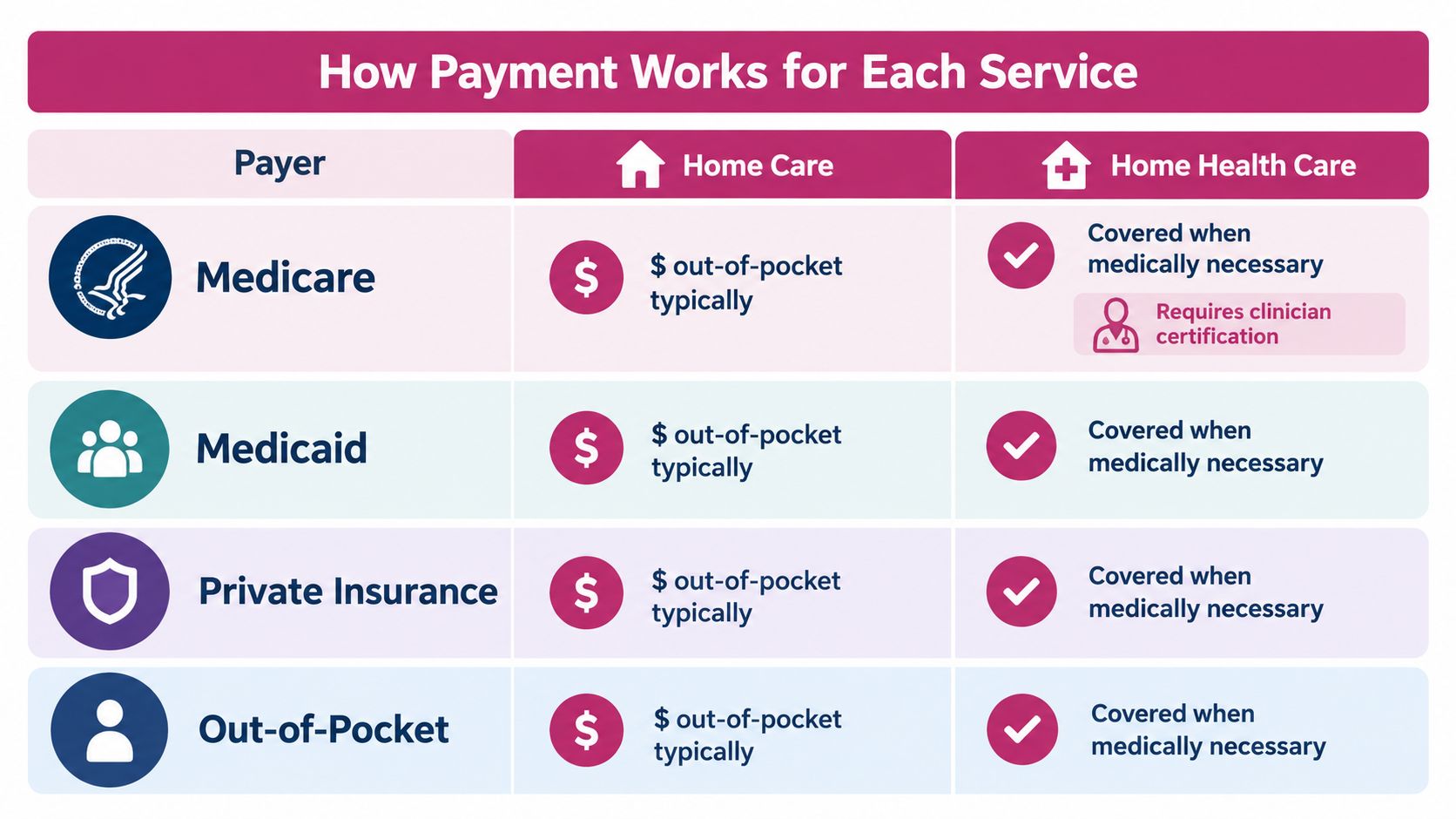
Here is the surprise for many families: Medicare generally does not pay for custodial home care when that is the only service needed.
Medicare draws the line at skilled need
Medicare covers home health when a clinician certifies that the person needs part-time or intermittent skilled care and meets the program's homebound and eligibility rules. It can cover wound care, injections, intravenous or nutrition therapy, monitoring serious illness, and physical, occupational, or speech therapy when medically necessary, as described in the Medicare and home health care publication.
Medicare generally does not pay for custodial home care when that is the only service needed, as explained in Home health services. A parent may need help every day, but if the need is bathing, meals, supervision, or companionship, Medicare is usually not the payer.
Medicaid, private pay, and insurance fill the gap
Medicaid can help eligible New Jersey seniors access home and community-based services, including personal care support through state programs. Long-term care insurance may reimburse both kinds of service once a policy's triggers are met. Private pay is still the default for ongoing home care when the need is nonmedical and open-ended.
The practical rule is straightforward. Short-term skilled care tends to be covered. Long-term daily care tends to be paid privately or through Medicaid. That is why families sometimes hear, “Yes, you qualify for home health,” and still have to figure out how to pay for a caregiver the other 20 hours of support each week.
If you are comparing agencies and want a checklist of what to ask before you hire, the what to check when hiring home care guide is a useful reminder that the first question is not always price. It is scope, supervision, and backup.
The Workforce Reality Behind Aging in Place
A family can choose the right service on paper and still get stuck on a very old problem, there may not be enough workers to fill the schedule.
Availability is part of the decision
In 2025, every state responding to a KFF survey reported shortages in Medicaid home- and community-based-services workers, with shortages affecting direct-support professionals in 48 states, nursing staff in 47 states, personal-care attendants in 46 states, and home-health aides in 41 states (KFF survey on Medicaid home care worker shortages). That doesn't just affect policy debates. It affects whether a provider can staff the shifts your parent needs.
Families feel this in ordinary ways. A provider may accept the referral and still struggle to cover weekends, overnights, language matching, or a same-day replacement when a caregiver calls out. A plan that looks stable in the hospital often gets shaky once it hits real life at home.
What to ask before you sign
Ask the agency who covers call-outs, how quickly backup shifts are filled, and whether the same worker will come regularly. If your parent needs help in a language other than English, ask that directly. If safety depends on a weekend routine or overnight supervision, say so before you agree to anything.
Don't buy a promise of “we can cover it” without a backup plan in writing or in clear conversation. Reliability matters as much as clinical fit, especially after discharge when the family is already stretched thin.
This shortage also complicates the boundary between home care and home health. A person may only qualify for short, intermittent clinical visits, but still need ongoing help with meals, bathing, medication reminders, or supervision in the hours between visits. That gap is where families get burned if they assume one service will solve everything.
Matching the Service to the Senior in Front of You
The right answer usually shows up in the daily routine, not in the diagnosis alone.
Look at the tasks, not just the labels
If your parent needs help with activities of daily living, the fit leans toward home care. That includes bathing, dressing, toileting, transferring, continence support, and eating. If the bigger struggle is complex daily tasks, like medications, finances, transportation, meal prep, or housekeeping, home care still usually fits better because those are support tasks, not skilled medical treatment.
If you're seeing wandering, missed appointments, sundowning, or unsafe judgment, that's a signal to think about supervision and routine support, not only medical follow-up. If the need is new oxygen, a recent fall, a wound, or a new diagnosis, home health may be needed, often alongside home care.
A quick sorting guide:
- Bathing and dressing: home care
- Meal prep and housekeeping: home care
- Medication setup and reminders: usually home care, unless a clinical task is required
- Wound care or therapy: home health
- Dementia supervision: home care, sometimes with added clinical support
- Recovery after surgery or hospitalization: often home health first, then home care to keep the household stable
Use the weekend test
Ask yourself what would break first if you stepped away for two days. If the concern is personal safety, meals, or getting the house through the day, home care is likely the anchor. If the concern is healing, wound monitoring, or a rehab goal, home health belongs in the plan. Many families end up arranging both because the parent is medically stable but still not functionally safe.
New Jersey Decisions and How Local Placement Support Helps
In New Jersey, the hard part is often not defining the service. It is figuring out who can start care quickly, who is allowed to provide it, and what the discharge plan requires.
Local rules and local help
Home care agencies in New Jersey operate under state oversight, while home health agencies follow state licensure rules and federal Medicare conditions when they are providing covered skilled services. County Area Agencies on Aging can also help families sort options and point them toward local resources. That matters when a discharge planner hands you a shortlist and expects a fast answer.
The senior placement services overview is useful when the situation is not a clean home-care-only case, because many families also need to compare home care with assisted living, memory care, or skilled nursing once safety at home starts to slip.
A practical next step for NJ families
If you would rather not screen the shortlist alone, a New Jersey placement advisor can check licensing, scope, and fit for you at no cost. Life Senior Placement works this way for families in East Hanover and across the state, helping them compare assisted living, memory care, skilled nursing, independent living, and home care without turning the search into a second full-time job.
Start with the need, then check the schedule, the payer, and the backup plan. If the mix still feels tangled, a placement advisor can help you sort the clinical from the nonclinical and choose the next step before the discharge paperwork piles up on the counter.
If you need help turning a confusing discharge list into a real plan, Life Senior Placement can walk you through the difference between home care and home health care and match the next step to your family's needs. Visit Life Senior Placement to get no-cost guidance, compare options, and talk through what fits your parent's situation in New Jersey.


