
The national median for assisted living is around $6,313 per month, but costs vary dramatically by location, ranging from about $1,126 to $9,711 depending on the ZIP code. In New Jersey, the community that looks affordable on a statewide comparison can still be far beyond a family's budget once local rent, apartment size, and care fees are added.
That range comes from a 2024 analysis of 782 U.S. Cities, which found the lowest monthly rent in Lake Mary, Florida, and the highest in Princeton, New Jersey. The national median in that analysis was $4,567 per month, so Princeton was more than twice the median while Lake Mary was about 75% below it. The difference between those two markets exceeds $103,000 per year before memory care, higher-acuity support, or entrance fees are considered. McKnight's Senior Living details the ZIP-level pricing analysis.
After helping New Jersey families compare communities, I've found that “What does assisted living cost?” is rarely the right first question. The useful question is, “What will this specific resident pay in this specific ZIP code, for this floor plan, with this care assessment?” That distinction keeps a national average from creating a local budgeting mistake.
Understanding Assisted Living Pricing Variability
A family searching near Princeton may receive a dramatically different quote from a community in a nearby town, even when both offer meals, transportation, housekeeping, activities, and help with daily routines. The difference usually reflects more than the building itself. Local real estate, staffing expenses, demand, apartment inventory, and the resident's care profile all influence the monthly rate.
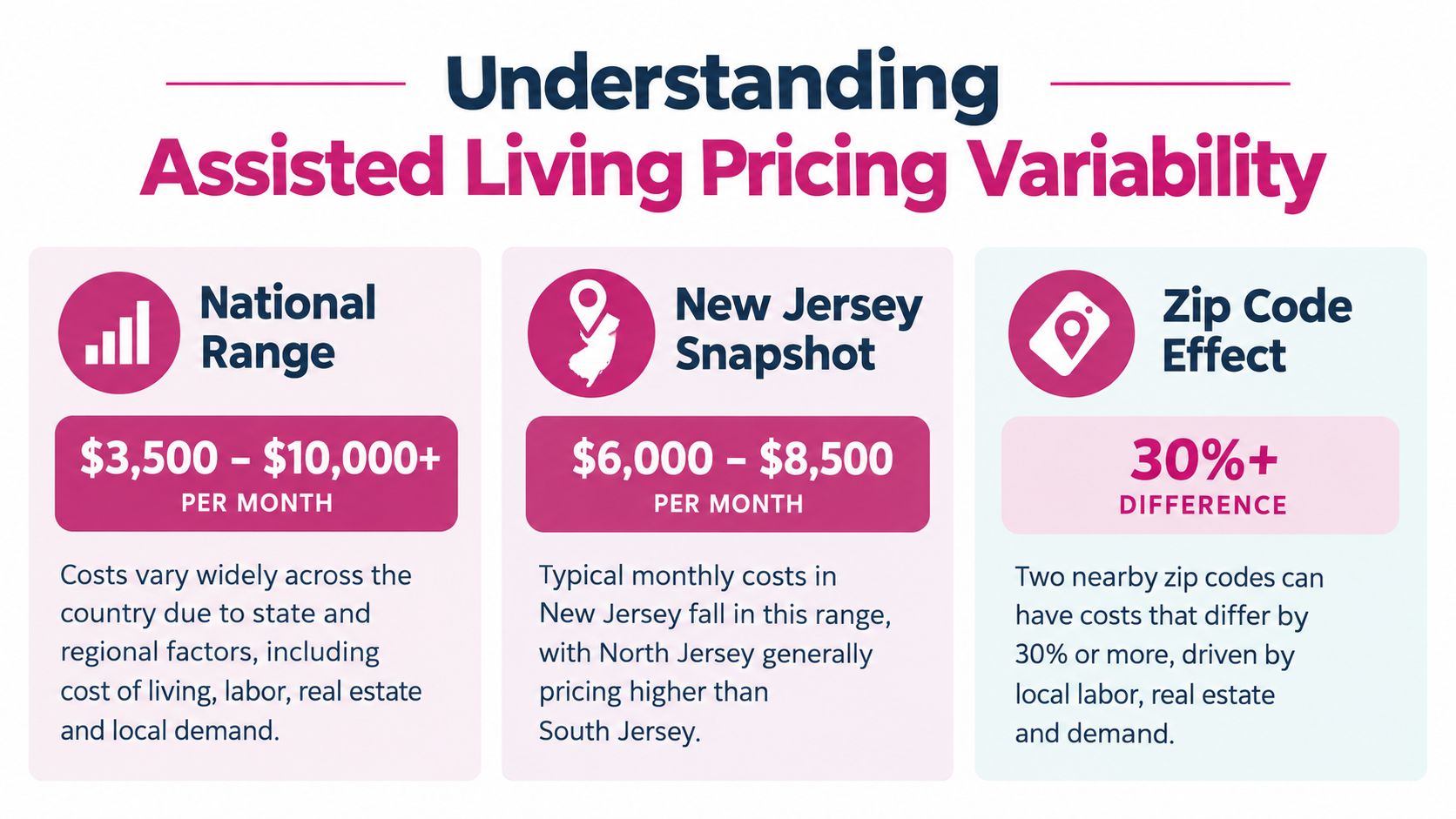
The 2024 pricing analysis used real-time move-in data and adjusted estimates according to ZIP code, community size, and local cost of living. That matters because a national median smooths away the very differences families need to understand. A ZIP code is not just a search filter. It's a financial variable.
Why New Jersey comparisons can mislead
New Jersey families often begin with a town name, then compare communities as if every option serves the same market. A higher-cost North Jersey location may carry a different staffing and property burden than a community in a less expensive part of South Jersey. Even within one county, proximity to major employment centers, hospitals, highways, and affluent residential areas can affect pricing.
A directory such as this assisted living cost guide can help establish a starting point, but online ranges shouldn't replace a written quote. Ask each community to separate the base apartment rate from care, medication support, transportation, and one-time charges.
Practical rule: Use the ZIP code to build the shortlist, then use the resident's care assessment and floor plan to build the budget.
The most affordable ZIP code isn't automatically the right choice. A cheaper community may be farther from family, offer fewer apartment choices, or use a pricing model that rises quickly as needs change. A higher quote can sometimes include more services, but families should verify that value in writing rather than assuming a premium guarantees better care.
National and New Jersey Cost Trends for 2026
Assisted living budgeting has become harder because national benchmarks are moving upward while local markets continue to vary. Genworth-based reporting placed the U.S. Annual median at $64,200 in 2023, or $5,350 per month. A 2026 update estimated the annual median at $75,756, or $6,313 per month, which implies roughly a 17% increase across that period. Investopedia's assisted living cost overview explains the ZIP-level nature of local comparisons.
That change affects how New Jersey families should plan. A quote that appears manageable today may not remain manageable if the family has budgeted only against an older national figure. New Jersey also has markets where housing, labor, and competition for appropriate senior housing create pressure above broad national benchmarks. A statewide comparison gives context, but it doesn't predict the quote from a specific community.
What the trend means for a move
Families should separate three decisions that often get blended together:
- Location: Which ZIP codes are close enough for family visits and medical care?
- Care setting: Does the resident need assisted living, memory care, or a more clinical environment?
- Financial runway: How will the household respond if the monthly bill rises or the resident moves to a higher service tier?
The trend also changes the timing of a search. Waiting until a hospital discharge or a lease deadline can leave families choosing from limited availability. Starting earlier allows an advisor or family member to compare pricing models, ask about waitlists, and identify alternatives without treating the first available apartment as the only option.
For a more focused local reference, review assisted living costs in New Jersey, then request current rates directly from communities. Published figures are useful for orientation, but the decision should rely on a current proposal that identifies the apartment, included services, care assumptions, and conditions that could change the bill.
How Apartment Size Impacts Your Monthly Bill
ZIP code averages conceal one of the largest practical pricing differences, the apartment itself. A studio, one-bedroom, and two-bedroom unit can sit in the same community while producing very different monthly obligations. Families who search only for a ZIP-level median may underestimate the cost if a parent needs a separate bedroom, additional living space, or room for a spouse.
Recent reporting found that larger assisted living floor plans can push monthly costs above $7,000 in higher-cost markets, while national medians in the available datasets range from approximately $5,419 to $6,200. A Place for Mom's reporting on record assisted living costs and family budgets illustrates why the advertised median doesn't necessarily describe the apartment a family needs.
The floor plan question families overlook
Ask for the price of the exact unit type before comparing communities. “Starting at” usually describes the least expensive available configuration, not necessarily the unit that matches the resident's preferences or safety needs.
A practical comparison should record:
| Pricing detail | Why it matters |
|---|---|
| Apartment type | A larger floor plan can raise the base monthly rate before care is added. |
| Availability | The least expensive layout may not be available when the resident needs to move. |
| Included utilities and services | Two similar-looking quotes may include different housing or service components. |
| Second occupant rules | A couple may face a separate charge or individual care assessment. |
Privacy can also become a care issue. A resident who needs family support, mobility equipment, or a live-in spouse may not be able to use the smallest available layout comfortably. Conversely, paying for unused space can drain resources that might be better reserved for future care.
Compare the bill, not the brochure
Request a written estimate for the specific apartment, then ask what happens after the initial care assessment. The base rate may remain unchanged while care charges, medication support, or other services alter the final bill. Compare the total monthly estimate across communities, not only the square footage or amenity list.
A family may choose a smaller apartment in a more convenient ZIP code, or a larger unit farther away, depending on priorities. The right decision depends on the resident's needs, the family's ability to visit, and how much flexibility the budget has if care requirements change.
Asking Prices versus Move-In Rates: What Families Actually Pay
The first quote you receive is often not the final monthly bill. A posted rate usually describes a base asking price, while the move-in proposal reflects the selected apartment, care assessment, community fees, concessions, and timing.
A 2026 industry review reported that in-place assisted living rates rose 5.3% in June 2026, while initial move-in rates rose 6.4%. It also reported that the discount between asking and initial rates widened to 9.4%. The review placed the national median at about $6,200 per month, with state-level figures ranging from roughly $4,369 in Mississippi to $12,096 in Hawaii. The 2026 assisted living market review explains the difference between asking, initial, and in-place rates.
Ask the sales director for a written move-in worksheet, not a verbal estimate. It should show:
- Base rent: The apartment charge before resident-specific care.
- Care fees: Charges for assistance, medication, mobility, or supervision.
- Community fees: One-time charges or deposits tied to moving in.
- Concessions: Discounts, waived fees, or temporary incentives, along with their expiration dates.
- Future adjustments: Events that could trigger a reassessment or rate change.
For a New Jersey family comparing communities, this worksheet exposes differences that a phone quote can hide. One residence may advertise a lower base rate but bill medication support and additional services separately. Another may start higher while including more support, making the final bill easier to predict.
Ask whether the quoted rate is an in-place rate for current residents or an initial rate offered to a new resident. A vacant apartment, a particular move-in date, or the fee structure may give a community room to adjust the proposal, but the family must ask directly. A temporary discount belongs in the short-term budget, not the permanent one.
Ask for this in writing: “Show us the regular monthly rate, every current concession, the expiration date of each concession, and the estimated bill after care fees.”
A lower asking price can lose its advantage when services are added individually. An all-inclusive structure may cost more at first but offer steadier monthly planning. A tiered structure can suit a resident with stable needs, provided the family understands how reassessment changes the bill.
Calculating True Local Costs with Housing Benchmarks
Assisted living combines housing and care, so a housing benchmark cannot produce an assisted living price by itself. It can, however, help families separate local real estate pressure from the cost of staffing, supervision, meals, and support.
HUD Fair Market Rent for a two-bedroom apartment provides a useful local reference. A ZIP-level comparison using HUD Fair Market Rent and assisted living pricing illustrates how widely assisted living prices can vary, with published examples ranging from about $2,910 per month in Sioux Falls to $6,319 in San Francisco.
Use the comparison this way:
- Begin with the community's estimated monthly total, including the resident's expected care and service charges.
- Compare it with the HUD benchmark for a similar apartment size in the same area.
- Treat the difference as a planning signal, not a care fee. Assisted living also covers meals, staffing, building operations, activities, transportation, and shared spaces.
A community's full estimate may sit far above local rent for practical reasons. A larger apartment, extensive common areas, overnight staffing, or included transportation can all affect the gap. The comparison becomes useful when families ask:
- How much of the price reflects local housing conditions?
- Which services are included, and which are billed separately?
- Is the apartment larger or more specialized than the unit used for another quote?
- Could a nearby ZIP offer similar access and care at a more sustainable total cost?
The benchmark is a screening tool, not a verdict on value. A larger difference may reflect substantial care infrastructure that protects safety and reduces the need for separate services. A smaller difference does not prove that a community is affordable or appropriate for the resident.
Use the figures to make the quote more specific. Ask the sales director to identify the costs behind the monthly total, then weigh each one against the resident's safety, dignity, daily support, and long-term budget.
Navigating New Jersey Communities by Zip Code
Start with a realistic search radius around the preferred ZIP code. If family visits, a hospital system, or a physician's office matters, mark those locations before calling communities. A ZIP code search should narrow the field, not prevent you from considering a nearby town with better availability or a more suitable care model.
Use directories and local housing information together. For families evaluating whether a location is workable, New Jersey housing market insights for lenders can provide useful context about local property conditions, but it won't answer whether a community can safely manage a resident's care.
A focused search sequence
- Define the resident profile: Record mobility, medication, bathing, toileting, memory, and nighttime support needs.
- Set the location boundary: Choose preferred ZIP codes, acceptable nearby areas, and travel limits for regular visits.
- Call for current availability: Ask about the exact floor plan and whether the quoted price applies to an available unit.
- Request the fee sheet: Get base rent, care levels, one-time charges, and likely add-ons before touring.
- Tour with a checklist: Observe staffing presence, cleanliness, resident engagement, dining, emergency procedures, and apartment access.
- Verify the fit: Confirm that the community accepts the resident's clinical needs and can respond if those needs increase.
HUD Fair Market Rent can serve as a reference while you compare local housing pressure, but don't use it to rank care quality. A community should be evaluated on both affordability and its ability to support the resident safely.
Families often make better decisions when they compare a small number of well-matched communities rather than touring every building in a county. Three strong options with written pricing and confirmed care fit are more useful than a long list of unverified names.
Before choosing, ask who will remain your point of contact after the tour. A clear process matters, especially when the search follows a hospitalization or a rapid change in health.
The Role of Professional Placement Advisors
A placement advisor can cut down the calls, tours, and bad-fit referrals a family has to manage. The useful advisor does more than send a list of buildings. They start with the resident's care needs, budget, location preferences, timing, and household concerns, then narrow the field to communities that can work.
A first conversation should also answer a harder question: is assisted living the right setting, or should the family be looking at memory care, skilled nursing, independent living, or home care? That call matters before anyone focuses on ZIP code or advertised rent.
Good support shows up in the details. A practical advisor should screen current care needs and likely changes, match communities to the resident's New Jersey area, explain what the base rate includes, arrange tours around family schedules and urgent timelines, and review written proposals before any lease or residency agreement is signed.
Families should ask how the advisor is paid and whether the service costs them anything. A recommendation should be tied to fit, availability, and budget, not to an unclear incentive.
A placement service can save time, but it does not replace a tour, a clinical assessment, or a careful read of the residency agreement. The family still needs to inspect the community and decide whether the setting feels right for the resident.
For families who want a clearer explanation of the process, senior placement services offer a useful framework for intake, matching, touring, and move-in planning. The strongest result is a documented comparison, not pressure to choose fast.
Final Budgeting Checklist for Senior Care
A reliable assisted living budget starts with the resident, then works outward to the ZIP code. Begin by writing down current monthly income, available savings, housing obligations, insurance, and any expected proceeds from a home sale. Families should also identify who can manage bills and communicate with the community if the resident's condition changes.
Use this checklist before selecting a community:
- Confirm the ZIP strategy: Compare the preferred area with nearby ZIP codes that preserve family access and medical convenience.
- Price the exact apartment: Request the rate for the available studio, one-bedroom, or two-bedroom unit, not only the community's starting price.
- Separate fixed and variable charges: Mark base rent, care fees, medication support, transportation, utilities, meals, and personal services.
- Ask about reassessment: Find out when care needs are reviewed and what events could move the resident into another pricing tier.
- Document concessions: Record each discount, waived fee, expiration date, and condition tied to the offer.
- Include one-time costs: Ask about community, administrative, deposit, and move-in charges before comparing totals.
- Plan for higher support: Build a scenario for memory care, higher-acuity assistance, or a change in mobility.
- Review payment resources: Check long-term care insurance, veterans' benefits, Medicaid-related programs, and private funds with qualified professionals.
- Read the agreement: Confirm refund rules, notice periods, annual increases, discharge terms, and what happens if the family can no longer pay.
A community should provide a clear explanation of what the family pays at move-in and what could change later. If the sales presentation and the written proposal don't match, pause the process until someone reconciles the difference.
The most useful budget has at least two versions, the expected monthly bill and a higher-care scenario. That approach doesn't predict the future, but it prevents a family from treating the lowest possible quote as the only realistic outcome.
Moving Forward with Confidence
Searching for assisted living costs by ZIP code is valuable because location shapes the starting point, but the ZIP code alone won't determine the final bill. The apartment, care assessment, pricing model, move-in timing, and future support needs all matter. Families who compare those elements together make more grounded decisions than families who rely on a national median.
New Jersey's market rewards preparation. Gather the resident's care information, identify preferred and acceptable ZIP codes, request current written proposals, and compare the full monthly cost. Use housing benchmarks to understand the local environment, but judge each community on safety, staffing, services, and whether the setting can accommodate changing needs.
You don't have to solve every question during the first phone call. A careful shortlist, a structured tour, and direct answers about fees can turn a stressful search into a manageable decision. The right community is one your loved one can live in safely and one your family can sustain financially.
If a community cannot explain its pricing clearly, keep looking. If the care fit is uncertain, request a clinical review before committing. And if the search feels too fragmented, bring in a placement advisor who can organize the process without taking the decision away from your family.
Life Senior Placement offers no-cost guidance, verified New Jersey senior care listings, community matching, tour coordination, and move-in support for families comparing assisted living and memory care by ZIP code. Visit Life Senior Placement to request a focused search based on your loved one's care needs, budget, and preferred location.