Your parent is coming home from the hospital, but you're not sure home is still safe. One community says assisted living will work; another recommends memory care. Meanwhile, you're trying to compare prices, answer work emails, and understand what the discharge team needs from you.
Senior care advisors help turn that uncertainty into a care decision. Their value isn't the size of their directory. It's whether they can explain which settings fit, test how reliably care is delivered, and help you understand what the arrangement could cost as needs change.
What a Senior Care Advisor Does and Which Care Level Fits
A senior care advisor translates a senior's health needs, safety concerns, budget, and preferred location into practical options. Think of a travel agent for the care system, comparing different destinations against the same requirements. The advisor should advocate for the family's priorities rather than steer everyone toward a particular community.
The choices extend well beyond nursing homes. AARP's overview of long-term services and supports estimates that 14 million U.S. Adults needed these services in 2018, including 7.9 million people aged 65 and older, and approximately 90% of those needing support lived in community settings rather than nursing homes.
Care levels an advisor compares
| Care level | What it covers | Who it usually fits | First question an advisor asks |
|---|---|---|---|
| Independent living | Housing, meals and amenities with no hands-on daily help | Active seniors who want less home upkeep | Can you manage medications, stairs and bathing alone? |
| Assisted living | Housing plus help with bathing, dressing and medication | Seniors who need some daily support but value independence | Which daily tasks now need hands-on help? |
| Memory care | Secured setting and dementia-specific programs | People with Alzheimer's or other dementia who wander or need cueing | Is there wandering, confusion or safety risk, especially at night? |
| Skilled nursing home | 24-hour nursing and rehabilitation | Post-acute or complex medical needs | Does the person need daily clinical care or therapy? |
| Home care | Caregivers in the senior's home for personal care and companionship | Seniors who want to stay home and need part-time or live-in support | How many hours a day, and are overnight hours needed? |
These aren't interchangeable housing categories. Our guide to levels of care can help you distinguish personal assistance from clinical care. A diagnosis alone doesn't settle the choice; what the person can safely do matters too.
The responsibilities fit together like this.
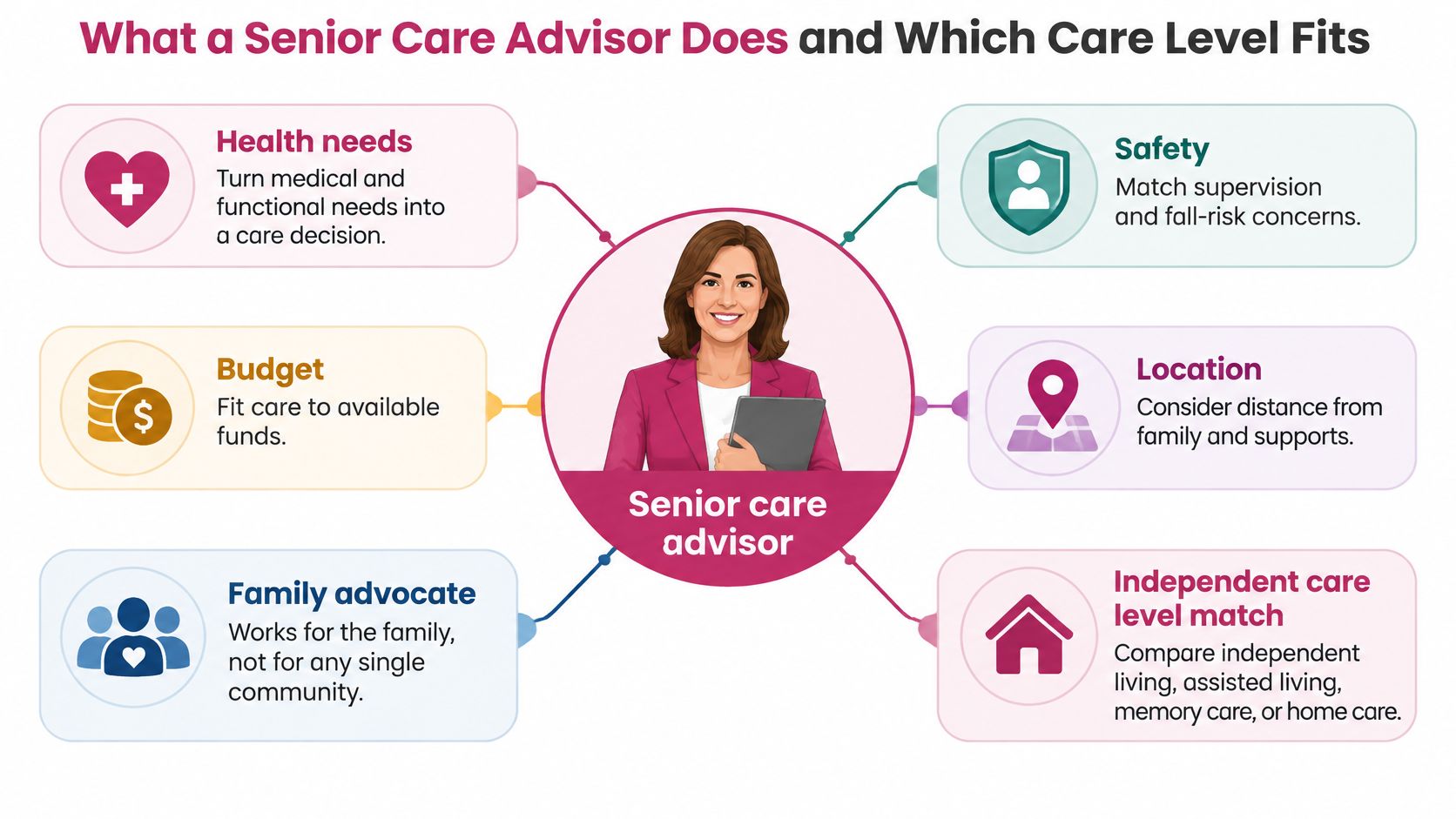
At Life Senior Placement, we provide free, objective guidance and function exclusively as an information and connection service. We don't replace the clinician who determines medical needs or the provider responsible for delivering care.
For families also organizing appointments and paperwork, Approved Lux Personal Assistant's resource on delegating care logistics to an assistant offers a separate coordination perspective. Before calling an advisor, write down the daily tasks your relative can't manage without help.
Who Benefits From an Advisor and When to Call One
An adult child living far away, a hospital case manager facing discharge, a spouse managing alone, and a senior planning ahead may all need an advisor. Their situations differ, but each needs a manageable decision rather than an unfiltered list of addresses.
The workload behind those decisions is substantial. The 2025 AARP and National Alliance for Caregiving report found that 51 million Americans provided care to someone aged 50 or older, spending approximately 26 hours a week on caregiving.
An advisor can take responsibility for organizing the search while the family concentrates on the person. Useful outcomes include a care-level explanation in ordinary language, an availability-checked shortlist, coordinated tours, and clear questions for providers. None of those outcomes should be confused with a guaranteed placement or a promise that every preferred community will accept the applicant.
A practical self-test
Consider calling if any of these describe your situation:
- A decision is approaching. You need an actionable plan, not another evening of browsing.
- Daily functioning has changed. Falls, missed medications, nighttime confusion, or difficulty transferring have made the existing arrangement uncertain.
- You're managing remotely. You can't easily visit providers or check what their descriptions mean in practice.
- Family members disagree. You need shared criteria that separate essential care from personal preferences.
Practical rule: Ask for help when you can no longer explain why the current arrangement is safe and workable.
An advisor may add little when you already know a suitable respite provider and only need to confirm an opening. Likewise, an urgent medical problem requires clinical attention, not a placement search. If someone is suddenly confused, injured, or unsafe, contact the appropriate healthcare professional or emergency service first.
Before the initial conversation, agree on who will speak for the family and how the senior will participate. Bring their preferences, including what they don't want. An efficient search still needs to respect the person whose home and routine may change.
How an Advisor Places a Senior, Step by Step
Placement should begin with requirements, not photographs. The National Institute on Aging's facility-selection guide recommends identifying current and anticipated needs before comparing services, costs, availability, licensing, and contract terms.
Turn needs into a workable search
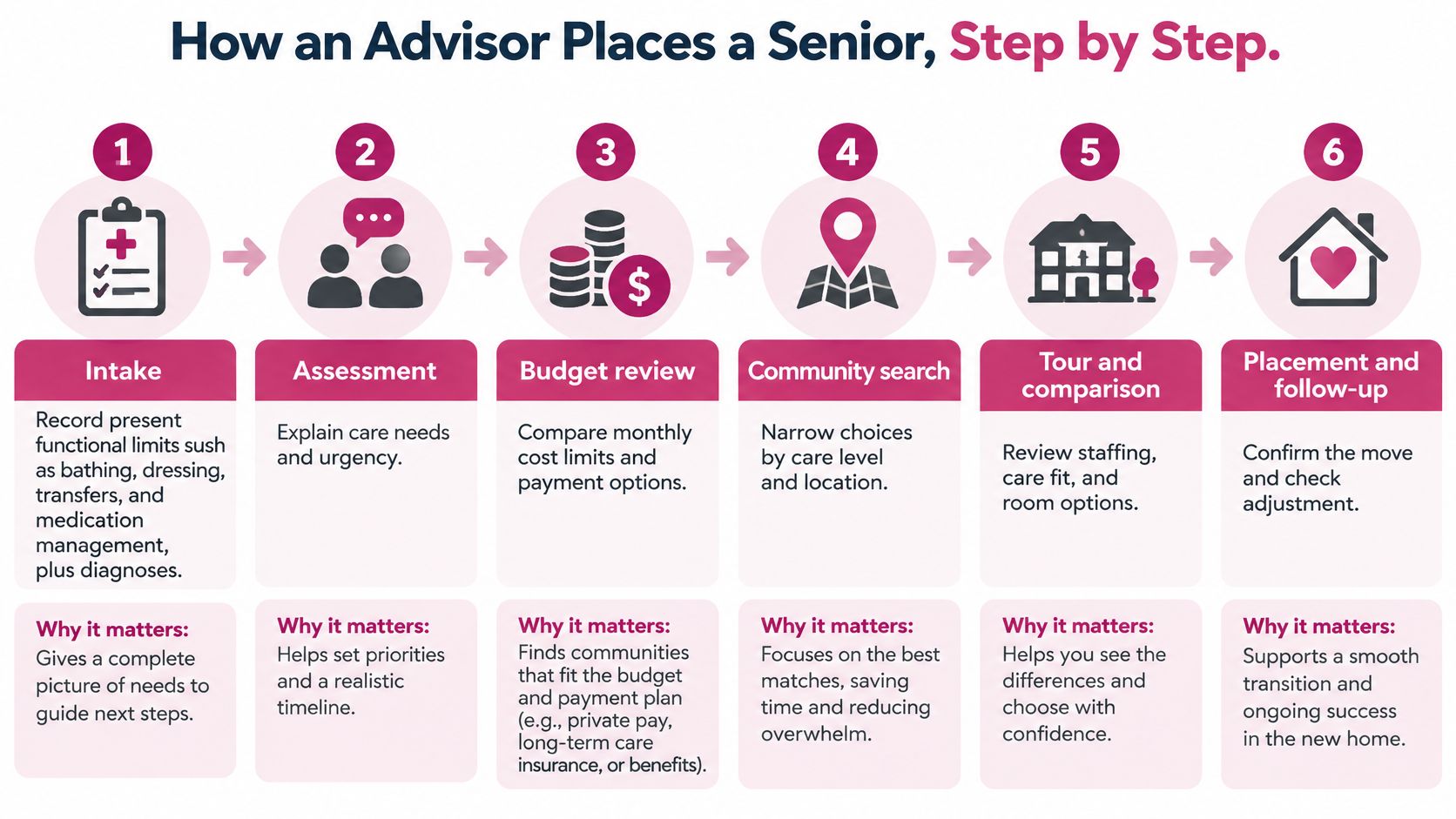
- Record the intake in concrete terms. Document bathing, dressing, toileting, transfers, walking, and medication management, alongside diagnoses, memory concerns, behavioral needs, and rehabilitation requirements. Include payer sources, available budget, preferred area, and urgency. “Needs some help” isn't enough; explain whether someone must provide reminders, hands-on assistance, or lifting support.
- Set exclusions before collecting options. Remove settings that can't meet essential needs. If wandering requires a secured environment, an unsecured setting shouldn't remain on the list because its dining room is attractive. When clinical needs are unclear, obtain clarification from the treating team rather than asking the advisor to diagnose them.
- Rank suitable candidates and confirm availability. Use written criteria such as care capability, affordability, location, and the senior's priorities. Confirm whether an opening matches the required room and service type, whether an assessment is needed, and what a waitlist means. A general statement that a community has availability isn't an admission offer.
The overall workflow should remain understandable to everyone involved.
Validate the match before signing
- Tour with the same checklist. Compare assistance with daily tasks, room accessibility, dining support, activities, and staff interactions. Where practical, visit during different routines, such as a meal and an evening period. Ask the senior what feels comfortable or restrictive, not just whether the building looks pleasant.
- Speak with the person responsible for care. The nursing lead or administrator should explain whether the provider can meet the documented needs and what would trigger reassessment or discharge. Verify licensing, review service limitations, and obtain the proposed agreement. Record unanswered questions rather than treating a reassuring conversation as confirmation.
- Confirm admission details and organize the handoff. Review the deposit, cancellation terms, move-in date, medication arrangements, equipment, and transportation before signing. Make sure the receiving provider has the information it needs and knows who can authorize decisions. Agree on whom the family should contact if the transition doesn't go smoothly.
Our advisors review verified communities near Wall, compare pricing, arrange tours, and match care needs. Those tasks support the decision; the receiving provider must still determine whether it can safely admit the person.
Don't start with an available bed and work backward to justify it. Start with the person's requirements and test the bed against them.
A common mistake is waiting until discharge day to begin. Tell the hospital team early if you don't yet have a workable destination, and ask what assessments or documents the receiving provider will need.
What Advisor-Led Placement Costs Over 12 to 36 Months
2025 national median costs by care option
| Care option | 2025 national median | Billing basis | Ask before signing |
|---|---|---|---|
| Assisted living | $5,419 per month | Monthly rent plus care fees | Which care tiers and medications are extra? |
| Memory care | $6,690 per month | Monthly rent plus care fees | Are secured-unit and dementia programs included in the base rate? |
| Home care | $34 per hour | Hourly rate | What are the minimum hours, overnight rate and agency fees? |
The 2025 national medians above are reported in Senior Housing News's affordability coverage; they're planning benchmarks, not New Jersey quotes or all-inclusive offers.
Build the total, not just the rent
Ask for an itemized proposal showing base housing charges, the assessed care tier, medication management, incontinence support, transportation, deposits, and other mandatory fees. Request the written policy for rate increases and reassessments. Our senior living cost guide helps organize those categories.
Build a spreadsheet across the planning horizons in this heading. For each period, add recurring charges and one-time costs, subtract reliable income, and show the amount drawn from savings. Keep increases and additional care costs visible as assumptions rather than burying them in a total.
Care costs and advisor compensation are separate questions. A family needs to understand the provider's bill even when there's no charge for placement guidance. Identify the payer for each proposed setting, and don't assume a health insurance card establishes long-term care coverage.
Test a change in needs
Ask the advisor to help compare these scenarios:
- Current care. Use the provider's assessed rate, not its advertised starting price.
- Expected progression. Price the additional assistance the clinical team considers plausible.
- A difficult transition. Obtain quotes for memory care, nursing care, or expanded home support if the original setting becomes unsuitable.
For New Jersey families considering Medicaid, participation alone doesn't establish that a particular room or service will be funded. Ask about admission requirements, covered services, availability, and what happens if private funds decline. Obtain current eligibility guidance from the responsible program or a qualified benefits professional.
Budget safeguard: A financially workable placement needs an answer to what happens next, not merely what you can afford at move-in.
Also ask whether increased needs could require relocation. A higher care bill and an unexpected move are different risks, and the family should plan for both.
Verifying Care Quality Beyond Tours and Ratings
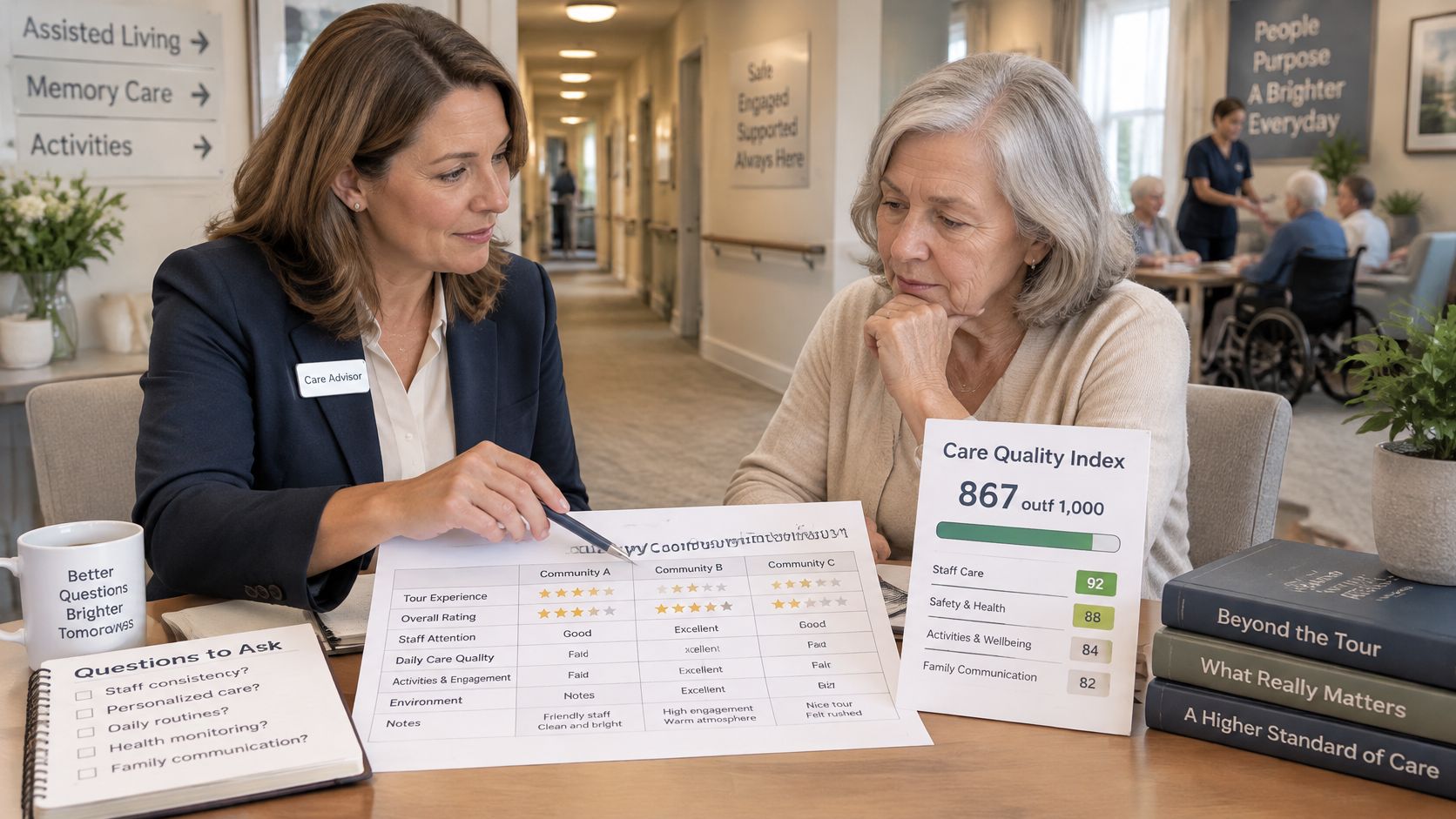
A welcoming tour and strong satisfaction scores are useful signals, but they don't establish reliable care at night or during staff absences. The 2025 J.D. Power study, as reported by ConsumerAffairs, recorded satisfaction of 867 on a 1,000-point scale among assisted-living and memory-care decision-makers.
That finding doesn't tell you who will help your parent after an overnight fall. High satisfaction can coexist with fragile operations, so an advisor should test the provider's ability to deliver the specific assistance your relative needs.
A written comparison makes those questions easier to discuss.
Request evidence of everyday performance
Ask for available aggregate information without requesting identifiable resident records:
- Staffing by shift. Current schedules and historical coverage, separating licensed nurses from other care staff.
- Coverage under pressure. How absences are filled, use of temporary staff, and weekend or overnight differences.
- Response and safety trends. Available call-bell response information, falls, and hospital transfers, with explanations of how each measure is defined.
- Workforce continuity. Turnover patterns, orientation, and dementia-specific training.
- Accountability. Complaint history and the procedure for escalating a concern or changing a care plan.
Request a historical period that includes ordinary weekends and nights, not just the tour date. If the provider doesn't track a requested measure, ask what alternative evidence it uses to supervise care. A smaller provider may document performance differently, but the explanation should still be concrete.
Read ratings by domain
For nursing homes, CMS's Five-Star consumer guide separates health inspections, staffing, and quality measures. Examine the relevant components rather than treating the overall rating as a verdict; this nursing-home framework isn't an assisted-living rating system.
Inspection findings also need interpretation. Our guide to reading a New Jersey assisted living inspection report can help families distinguish an isolated finding from an unresolved care concern.
Finally, compare the paperwork with what you observed. If staff describe reliable overnight assistance, ask who provides it and how requests are prioritized. Missing shift-level information isn't proof of unsafe care, but it is a finding that deserves a documented explanation before committing.
How to Choose a Senior Care Advisor
Start with local knowledge, compensation transparency, and the breadth of the search. A useful advisor can explain which nearby providers fit your requirements and which were excluded. Knowing a community's name isn't the same as knowing its admission limitations.
Our local advisors cover Bergen County, and we have advisors who know South Jersey. When defining your search area, name the towns that would let relatives visit regularly, along with any location constraints that are nonnegotiable.
Five questions for judging a senior care advisor
| Question to ask | Good answer | Red flag |
|---|---|---|
| Who pays you, and how? | Clear, written explanation of how the advisor is compensated | Vague answer or refusal to explain |
| How do you verify licensing? | Checks state licensing and inspection records directly | Relies only on the community's own listing |
| How many options will I see? | A ranked shortlist tied to written criteria | One or two options with no stated reasons |
| Will you show me the full cost picture? | Fee schedule covering base rent, extras, deposits and annual increases | Quotes only the base monthly rate |
| What happens after move-in? | Follow-up on care changes and transitions | Contact ends at signing |
Look for clear boundaries
Ask whether the search includes suitable providers outside the advisor's participating network. If it doesn't, you need to know that before interpreting the shortlist as a complete view of local options. Compensation disclosure helps you understand the arrangement; it doesn't remove the need to judge the recommendations.
A consistent point of contact is useful, but clarify what follow-up includes. An advisor can help organize a transition without becoming the resident's medical provider, legal representative, or ongoing care manager.
Pressure to sign, unexplained omissions, and refusal to provide written information should pause the process. Put the table's questions to competing advisors and compare their answers alongside a sample recommendation. Choose the person who makes the reasoning inspectable, not the person who sounds most certain.
Three Placement Stories and What Advisors Changed
The following are illustrative composites, not accounts of actual clients. Each shows how an advisor's method can change a decision without promising a particular outcome.
These situations involve different kinds of placement support.

Recovery after a hospital stay
Say a hospital case manager is arranging discharge for someone recovering from hip surgery. The family starts by asking for somewhere close to home, but the advisor first confirms the required rehabilitation and transfer assistance with the clinical team.
Providers unable to meet those requirements are excluded before availability is compared. The family then chooses among clinically suitable openings rather than assuming any vacant room will work.
Dementia care from a distance
An adult child living elsewhere is comparing assisted living with memory support against a secured memory-care setting for a father with dementia. During intake, the family describes nighttime confusion that wasn't mentioned in the original inquiry.
The advisor requests details about evening coverage and arranges a visit during that routine. In this scenario, the family chooses the provider that can explain who responds overnight and how staff manage the father's particular safety needs.
This video offers another way to approach the placement conversation.
Independence with a contingency plan
A couple wants less home maintenance but doesn't currently need personal assistance. Their advisor helps them compare independent living while checking whether outside home care could be introduced later.
Rather than promising they'll never move again, the couple documents decision triggers, such as assistance needs exceeding what can safely be delivered in the apartment. They also identify who will reassess the arrangement.
The changes are practical: an exclusion list prevented an unsuitable recovery placement, an operational question clarified dementia care, and a transition plan preserved choices before a crisis.
Book a Free Advisor Call Before the Next Decision
Prepare a short intake note before calling:
- Health and medication information. List diagnoses, current medications, mobility limitations, and equipment.
- Daily support and safety. Describe hands-on help, memory concerns, behaviors, and nighttime needs.
- Practical boundaries. Record the budget range, preferred county, and move-in timeline.
Call Life Senior Placement at (862) 398-2006 to speak with an experienced local senior care advisor, including an advisor who knows Warren County. You can also email hello@seniorplacement.life and explain which areas you're considering.
Our service is free for families, and participating communities pay us a placement fee. Request a reasoned shortlist, the provider's itemized charges, and written answers to the care-reliability questions before arranging tours.
Bring the senior into the conversation wherever possible, and name the concerns you still need resolved. The decision should rest on evidence collected, not on the first tour.
Life Senior Placement helps families compare New Jersey care settings, understand their options, and coordinate tours around individual needs. Visit Life Senior Placement to start a conversation about a suitable shortlist and the questions that need answering before you choose.