
Your mother is medically ready to leave the hospital, but nobody can tell you where she can go. The discharge planner says she needs a nursing home. Medicare may or may not pay. One facility asks for therapy notes, another asks about Medicaid, and a third says it has no staffing for her transfer needs.
This confusion is common because qualifications for nursing home placement aren't one checkbox. Three separate gates must open: the person must have an appropriate clinical or functional need, a payer must cover the proposed care, and a specific facility must be able and willing to accept that person now.
When a Nursing Home Becomes the Next Step
A hospital recommendation is only the beginning. Suppose your father has recovered from pneumonia but still needs wound care, assistance transferring from bed to chair, medication supervision, and daily physical therapy. His doctor may recommend skilled nursing, yet the recommendation doesn't automatically create Medicare coverage or reserve a bed.
The hospital team answers the clinical question: What care does he need after discharge? A financial eligibility worker or insurance specialist answers the payer question: Which program, policy, or benefit can cover that care? A facility admissions team answers the operational question: Can we safely provide it with our staff, equipment, and current census?
Those answers often diverge. A person can need long-term nursing support but fail Medicare's short-term skilled-care rules. Someone else may meet a state's Medicaid level-of-care standard but be rejected by facilities that can't staff the required care or accept the payer.
The practical rule: “Needs a nursing home” is a care recommendation, not proof of coverage or acceptance.
Start by assigning each question to the right professional:
- Ask the physician or therapist: What skilled services are ordered, how often are they needed, and what functional limitations remain?
- Ask the hospital case manager: Was the hospitalization formally inpatient, what records will be sent, and which facilities have confirmed interest?
- Ask the payer specialist: Does Medicare, Medicaid, or another insurer cover this type and duration of care?
- Ask the placement advisor or admissions director: Which facilities can meet the person's needs and accept the payer at the expected discharge time?
Families handling complex transitions may also benefit from understanding how a legal assistant case management role organizes records, communication, and follow-up across multiple parties. That kind of coordination matters because placement delays usually come from missing details, not from a single unanswered question.
The rest of the decision becomes much easier when you keep the three gates separate: clinical qualification, payer qualification, and real-time facility acceptance.
What Clinical and Functional Qualification Actually Means
Diagnosis alone doesn't qualify someone for placement. A facility needs evidence of what the person must receive every day and what the person can no longer do safely.
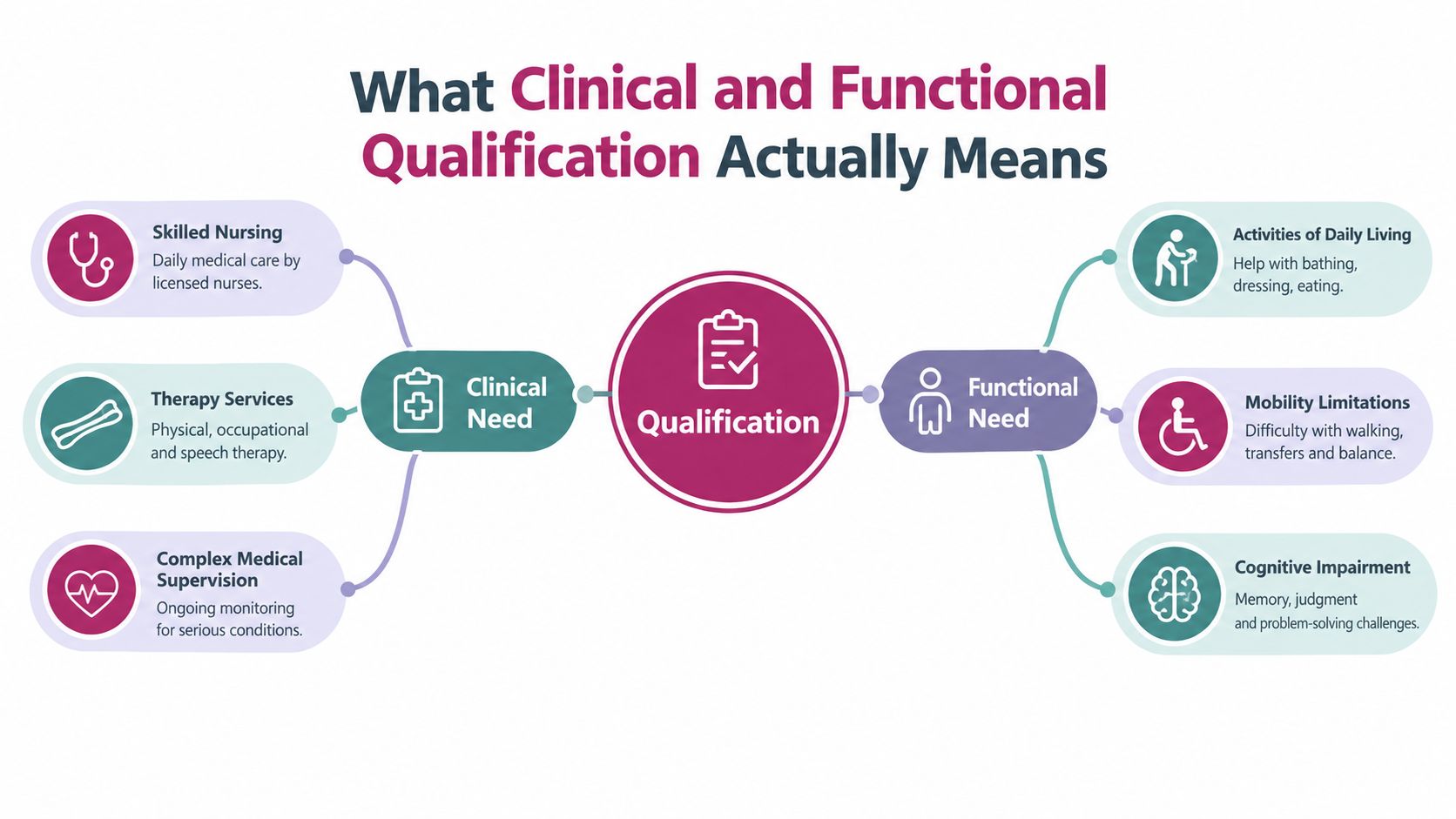
Clinical need usually involves skilled nursing, therapy, or ongoing medical supervision. Examples include intravenous medication, wound treatment, physical therapy, occupational therapy, medication management, and monitoring for a complex condition. The service must be appropriate for qualified professionals, not merely convenient for the family.
Functional need describes the assistance required with ordinary activities. Assessment teams commonly examine bathing, dressing, eating, toileting, transferring, and mobility. They may also document cognition, behavior, continence, fall risk, and the level of supervision needed throughout the day.
Separate the two rails
A person may need extensive help with dressing and toileting but not require daily skilled services. That profile may fit assisted living, personal care, or home support more closely than a Medicare skilled nursing benefit.
Another person may walk independently but need daily IV treatment, complex wound care, or intensive therapy after hospitalization. That person can have a strong skilled-care case even without broad assistance with activities of daily living.
Ask the care team for concrete descriptions rather than broad labels:
- Can the person stand, pivot, and transfer safely?
- Can the person follow therapy instructions?
- Who administers medications, and what monitoring is required?
- How frequently must nurses change dressings or assess a wound?
- Does the person need therapy to improve, maintain, or prevent deterioration?
- Are memory loss, agitation, wandering, or psychiatric symptoms affecting safety?
For long-term placement, Medicaid uses state-defined nursing-facility level-of-care criteria. The assessment typically considers substantial help with daily activities, nursing supervision, medication management, rehabilitation, or monitoring of complex conditions. The exact threshold varies by state, so a diagnosis or physician letter by itself isn't enough.
Families comparing clinical support models can also review this guide for Sydney families seeking RN support. Although local rules differ, the useful principle is universal: document the actual nursing tasks, supervision, and functional assistance rather than relying on a diagnosis name.
Medicare's Skilled Nursing Facility Rules
Medicare Part A is mainly a post-acute skilled-care benefit, not a general payment source for long-term custodial nursing-home residence. The central question is whether the beneficiary meets Medicare's hospital, timing, certification, and daily-skilled-service requirements.
A typical qualifying pathway requires:
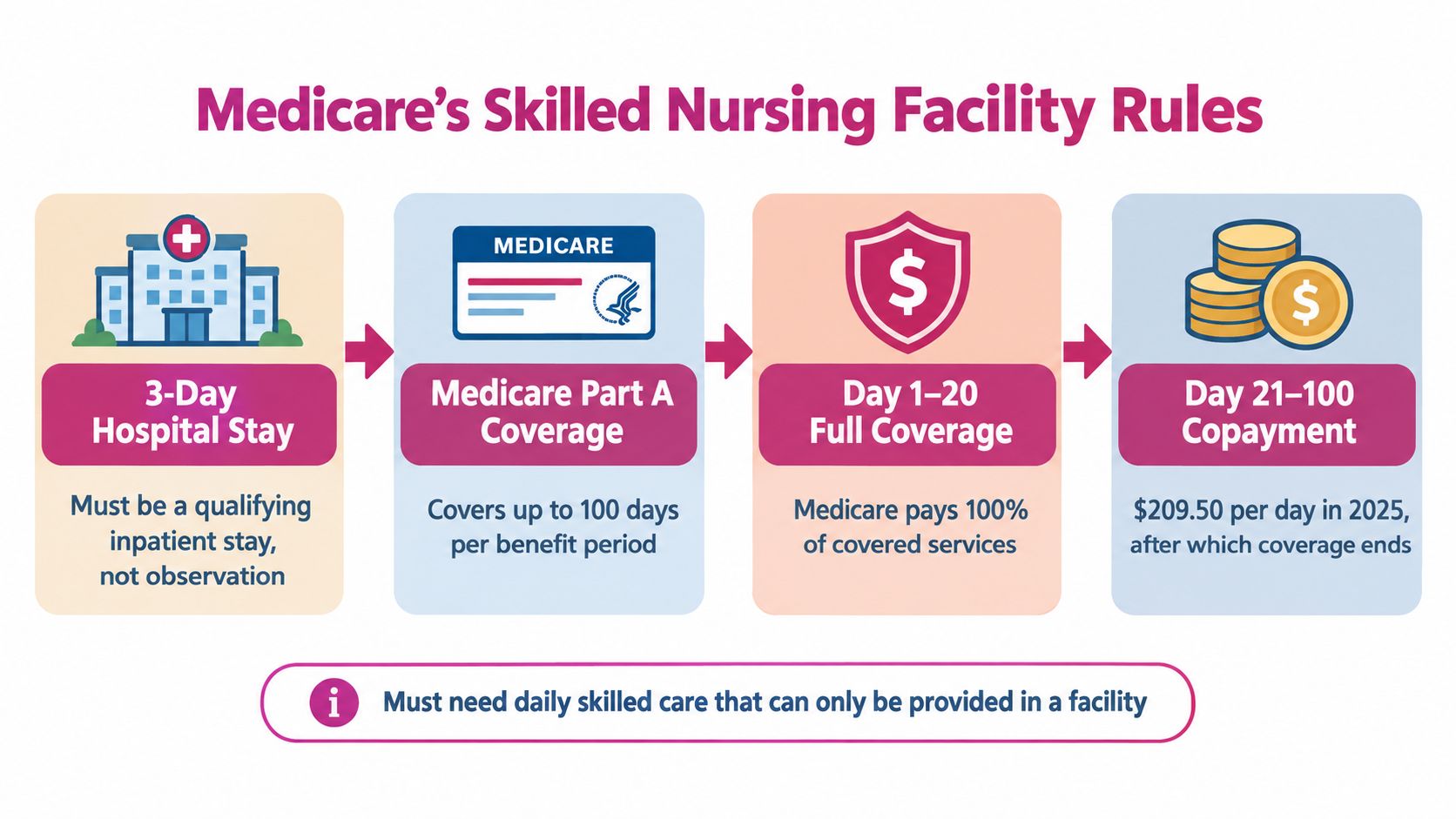
- A medically necessary inpatient hospital stay lasting at least three consecutive days. The admission day counts, but the discharge day doesn't.
- Formal inpatient status. Emergency-department time and hospital observation time don't count toward the inpatient threshold.
- Transfer to a Medicare-certified skilled nursing facility within approximately 30 days after discharge.
- Certification by a physician or other qualified provider that the person needs daily skilled nursing or therapy.
- A reasonable and necessary skilled service connected to the condition treated during the hospitalization or a new condition arising during skilled nursing treatment.
Medicare's official skilled nursing facility coverage guidance identifies services such as IV medication or fluids, skilled wound care, physical therapy, occupational therapy, and treatment intended to improve, maintain, or prevent deterioration.
The status trap families miss
A family may hear that a loved one was in the hospital for three nights and assume the Medicare requirement is satisfied. That assumption can be wrong if the hospital classified some or all of the time as observation.
Ask the case manager to verify the formal admission status in the hospital record. Don't rely on the number of nights spent in a bed, the number of meals served, or what appears on a discharge whiteboard.
Part A can cover up to 100 days of SNF care during each benefit period, subject to Medicare's rules and cost-sharing. That coverage remains tied to skilled-care eligibility. Once the person needs only custodial assistance, Medicare generally isn't the payer.
Ask this before choosing a facility: “What exact daily skilled service is ordered, and where is that service documented?”
Approved accountable-care arrangements may waive the three-day rule in some circumstances, so the case manager should check whether an exception applies. For a plain-language explanation of the difference between post-acute rehabilitation and custodial placement, review what a skilled nursing facility provides.
Medicaid Long-Term Care Eligibility and Financial Qualification
Medicaid is often the more relevant pathway when a person needs months or years of nursing-home care. It doesn't use one national placement test. Each state establishes nursing-facility level-of-care criteria within federal requirements, and each state separately determines financial eligibility.
The clinical assessment asks whether institutional care is medically necessary. It may consider substantial assistance with bathing, dressing, eating, toileting, transferring, or mobility, along with nursing supervision, medication management, rehabilitation, and complex medical monitoring.
The financial review asks a different set of questions. The applicant generally must meet state income and asset rules, provide financial records, and satisfy any applicable transfer or look-back requirements. The facility must also meet Medicaid certification requirements and agree to accept the person's coverage.
These are separate decisions. A person can meet the clinical standard but fail the financial test. A person can qualify financially but need a facility that doesn't participate in the relevant Medicaid program.
| Dimension | Medicare SNF, Part A | Medicaid Long-Term Care |
|---|---|---|
| Primary purpose | Short-term post-acute skilled nursing or rehabilitation | Long-term institutional care when state clinical and financial rules are met |
| Clinical gateway | Qualifying inpatient hospitalization and daily skilled services | State-defined nursing-facility level of care |
| Financial gateway | Medicare Part A eligibility and benefit rules | State income and asset eligibility rules |
| Duration | Up to 100 covered SNF days per benefit period, subject to coverage rules | May support ongoing care while eligibility and program requirements continue |
| Facility issue | Facility must be Medicare-certified | Facility must meet applicable Medicaid certification and acceptance requirements |
| Common failure point | Observation status, missing inpatient stay, or no daily skilled need | Failing financial rules, incomplete records, or no participating bed |
Start the financial review early. Waiting until Medicare coverage is nearly exhausted can leave the family trying to assemble bank statements, income records, legal documents, and facility choices under pressure.
For administrative tasks such as confirming benefits, collecting policy details, and checking payer participation, families can compare insurance verification providers before deciding how much of the process to handle internally. An elder-law attorney or Medicaid specialist should address complicated asset transfers, trusts, spousal issues, and estate planning.
Why a Qualified Applicant Can Still Get Turned Away
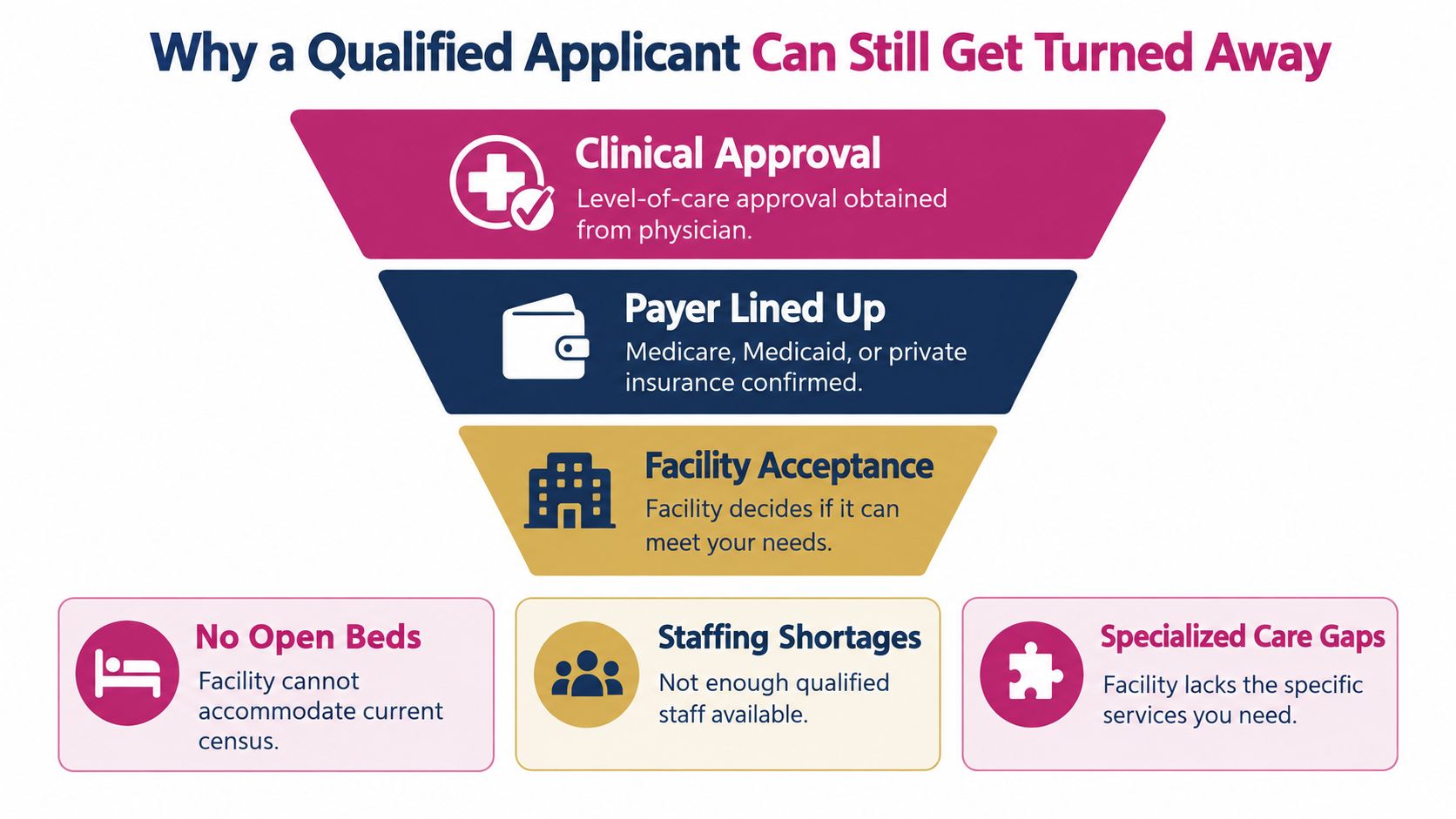
Clinical approval doesn't force a facility to accept someone. A nursing home must decide whether it can staff the case, provide the required specialty care, manage the person's risks, and work with the payer.
The operational barrier is substantial. A 2025 Pennsylvania workforce survey found that 25% of nursing-home providers couldn't use more than 10% of their licensed beds because of staffing shortages. Respondents reported 2,443 hospital referrals declined during a 90-day period, and 42% were limiting or denying admissions because they couldn't hire enough workers. The survey is available in the Pennsylvania Health Care Association workforce report.
Minnesota's 2025 long-term-care survey also reported about 12,500 vacancies and identified staffing limitations and inability to meet an individual's needs as continuing discharge barriers. These figures don't mean every facility is full. They show why a licensed bed isn't necessarily an available bed for a particular person.
Match the profile to today's capacity
A facility may decline a person who needs dialysis coordination, complex wound care, bariatric equipment, behavioral supervision, isolation precautions, or two-person transfers. Another facility may accept the same person because it has the staff and equipment available.
The right question after clinical approval isn't “Which nursing homes are nearby?” Ask:
Who can safely take this person, for this payer, with these care needs, at the expected discharge time?
A placement search should record the reason for every rejection. “No bed” means something different from “can't staff transfers,” “doesn't provide dialysis,” or “won't accept the payer.” Those distinctions determine which facilities should be contacted next.
For New Jersey families, payer rules add another layer. A practical overview of what New Jersey Medicaid covers for nursing homes can help frame the conversation, but the admissions director still needs the person's current clinical packet before making a decision.
Documentation That Helps a Facility Say Yes
Admissions teams don't want a vague statement that someone is “weak after surgery.” They need enough information to determine whether the facility can safely deliver care from the first shift.
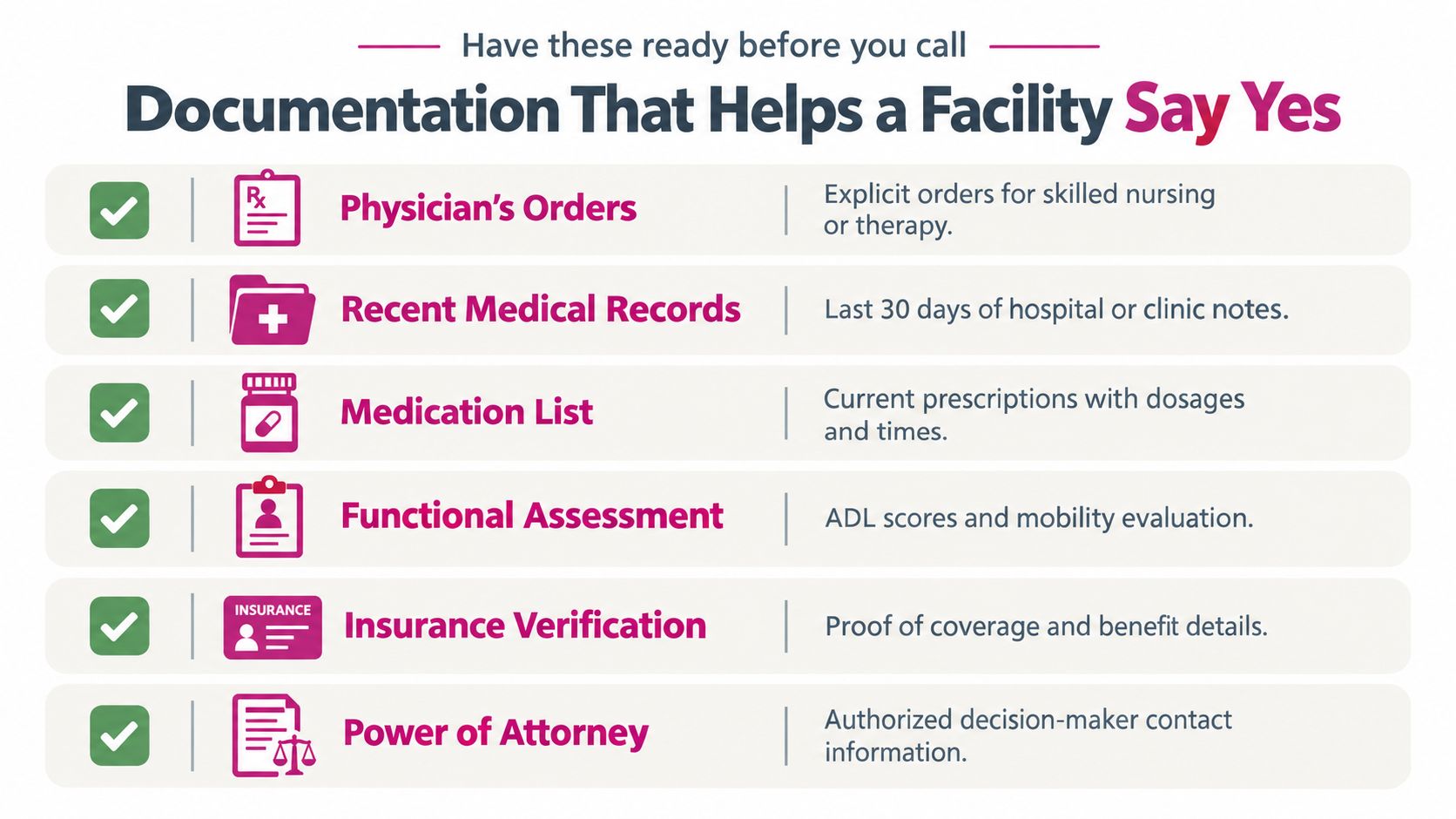
Build one organized packet and send the same version to every facility. Include:
- Discharge summary: Diagnosis, hospital course, current condition, precautions, follow-up appointments, and expected discharge date.
- Orders and treatment schedule: Nursing treatments, therapy orders, wound instructions, IV medications, oxygen requirements, diet, and monitoring needs.
- Medication list: Every current medication, dosage, route, timing, and recent change.
- Functional status: Bed mobility, transfers, walking distance, assistive devices, continence, eating ability, and help required with bathing and dressing.
- Behavioral and cognitive information: Dementia symptoms, confusion, aggression, wandering, psychiatric history, communication limitations, and successful de-escalation approaches.
- Specialty-care details: Wounds, dialysis, feeding tubes, tracheostomy care, infection precautions, isolation status, or other services that affect staffing.
- Payer information: Medicare status, Medicaid application or approval, private insurance details, authorization requirements, and responsible contact.
- Therapy goals: What physical, occupational, or speech therapy is intended to improve, maintain, or prevent.
- Decision-maker information: Health-care proxy, power of attorney, family contacts, and who can sign admission documents.
Use plain language in the cover note. Write, “Requires two-person assist for transfers and wound dressing changes each morning,” not “needs significant support.” Specific details let an admissions nurse make a faster decision and reduce repeated calls to the hospital.
Ask the facility to confirm three things in writing: whether it can meet the care requirements, whether it accepts the payer, and whether it can take the person on the proposed date. A verbal “we'll review it” isn't an acceptance.
A Practical Path Through the Placement Process
Once the medical team has described the care need, move through the placement process in a deliberate order.
First, confirm the pathway. Ask whether this is Medicare-covered skilled care, Medicaid long-term care, private payment, or another insurance arrangement. Verify the inpatient status, the skilled orders, the level-of-care assessment, and any authorization requirement.
Next, define the search. Set the acceptable geography, required care level, specialty services, payer, room preference, and transportation needs. A short list based on actual acceptance criteria is more useful than a long directory of facilities that can't take the case.
Then send complete packets. Give each admissions team the discharge summary, medication list, functional assessment, treatment schedule, behavioral information, payer details, and expected discharge date. Ask targeted questions instead of asking whether the facility has “availability.”
Tour the facilities that pass the initial clinical and payer review. Look at staffing interaction, cleanliness, call-bell response, therapy space, wound-care processes, meal support, and how staff explain changes in condition. Take notes immediately, because facilities can blur together during a stressful week.
A placement advisor can coordinate intake, compare licensed options, arrange tours, and help keep the hospital, family, and facility aligned. New Jersey families can review how nursing home placement services fit into that workflow, while a hospital social worker remains essential for discharge documentation and payer coordination.
Use the next day productively:
- Gather records and orders.
- Confirm the payer pathway.
- Contact facilities that match the clinical profile.
- Track responses and rejection reasons.
- Tour viable options.
- Confirm acceptance, paperwork, transportation, and move-in timing.
Don't wait for one facility to answer before contacting appropriate alternatives. A safe discharge plan needs a primary option and a backup.
Putting It All Together for Families and Case Managers
The qualifications for nursing home placement are best understood as three gates:
- Clinical gate: The person needs skilled services, substantial functional assistance, or a state-defined nursing-facility level of care.
- Payer gate: Medicare, Medicaid, private insurance, or personal funds can cover the proposed care under the applicable rules.
- Acceptance gate: A specific facility can provide the care, staff the case, accept the payer, and offer a bed when needed.
A diagnosis doesn't open all three gates. Neither does a physician's recommendation, a Medicaid approval, or a facility directory listing.
Keep these documents ready:
- Current discharge summary and physician orders
- Medication and treatment schedule
- Mobility, transfer, and ADL details
- Cognitive and behavioral information
- Wound, dialysis, therapy, and infection-care requirements
- Insurance, Medicaid, and responsible-party information
- Expected discharge date and transportation plan
Families should ask for help when the medical needs are complex, the payer status is uncertain, the person may need Medicaid, or facilities are declining the referral. The goal isn't to find any nursing home. It's to find a licensed facility that can safely accept this person's actual profile, under the correct payer, at the time care is needed.
Life Senior Placement helps New Jersey families organize clinical, functional, payer, and preference information, identify appropriate licensed options, and coordinate tours and move-in decisions. Visit Life Senior Placement to request guidance for a nursing home, skilled nursing, assisted living, memory care, or home care search.