The call usually comes fast.
A hospital case manager says your parent is medically ready for discharge. Rehab is recommended. The family group text lights up. One sibling wants the closest nursing home. Another wants the highest-rated one. You're still trying to understand whether this is a short recovery stay or the start of long-term care.
That's where nursing home placement services become useful. They exist because families rarely have the time, local knowledge, or clinical vocabulary to sort through facilities while a discharge clock is ticking. In the United States, more than 1.3 million people receive care in a nursing home or skilled nursing facility on any given day, and more than 4 million people use these services each year according to AHCA/NCAL nursing home facts. The same source notes that 64% of admissions are short-stay residents with an average length of stay of about 25 days, which helps explain why many families first encounter nursing home placement during a sudden post-hospital decision rather than a long-planned move.
For many families, this feels less like choosing a new residence and more like solving an urgent travel problem. You need the right destination, but you also need a seat on the plane today. A facility can look strong on paper and still not be able to accept your loved one now.
That urgency gets even harder when relatives are scattered. If your family is coordinating from different states after a health crisis, practical guides on related logistics can help reduce overload. One example is this explanation of navigating a distant death, which shows how quickly care decisions can become transportation, paperwork, and communication decisions too.
Introduction When a Nursing Home Decision Cannot Wait
Families often picture nursing homes as permanent placements. That still happens, but the situation is broader now. Many placements are short-term rehab stays after surgery, illness, or a fall. Others begin as rehab and later become longer-term because recovery doesn't restore the person's prior level of independence.
A placement advisor helps calm that confusion by turning one overwhelming question into several smaller ones:
- What care is needed right now
- Which facilities are licensed and appropriate for that need
- Which of those facilities can accept the person now
- What payment source applies
- What has to happen before move-in
The first good placement decision usually isn't “Which building do we like most?” It's “Which facilities can safely meet this person's needs today?”
That's why a strong placement process doesn't start with a glossy brochure. It starts with facts. Is the person weight-bearing? Are they confused at night? Do they need IV antibiotics, wound care, dialysis transport, or daily therapy? Can they participate in rehab? Those answers narrow the field quickly.
The reassuring part is that families don't have to figure this out alone. In New Jersey, advisor-guided placement help is available at no cost to families through services that work with participating communities. The value isn't just convenience. It's having someone who can translate a stressful discharge into a manageable sequence of decisions.
What Nursing Home Placement Services Actually Do
Think of a placement advisor as a local care concierge, not a directory. A directory gives you names. A concierge helps you sort, compare, and act.
That difference matters because nursing home searches usually break down in the same place. Families can find lists online, but they can't always tell which options match the person's medical needs, budget, preferred location, and timing. A useful placement service narrows the field before you waste hours calling the wrong places.
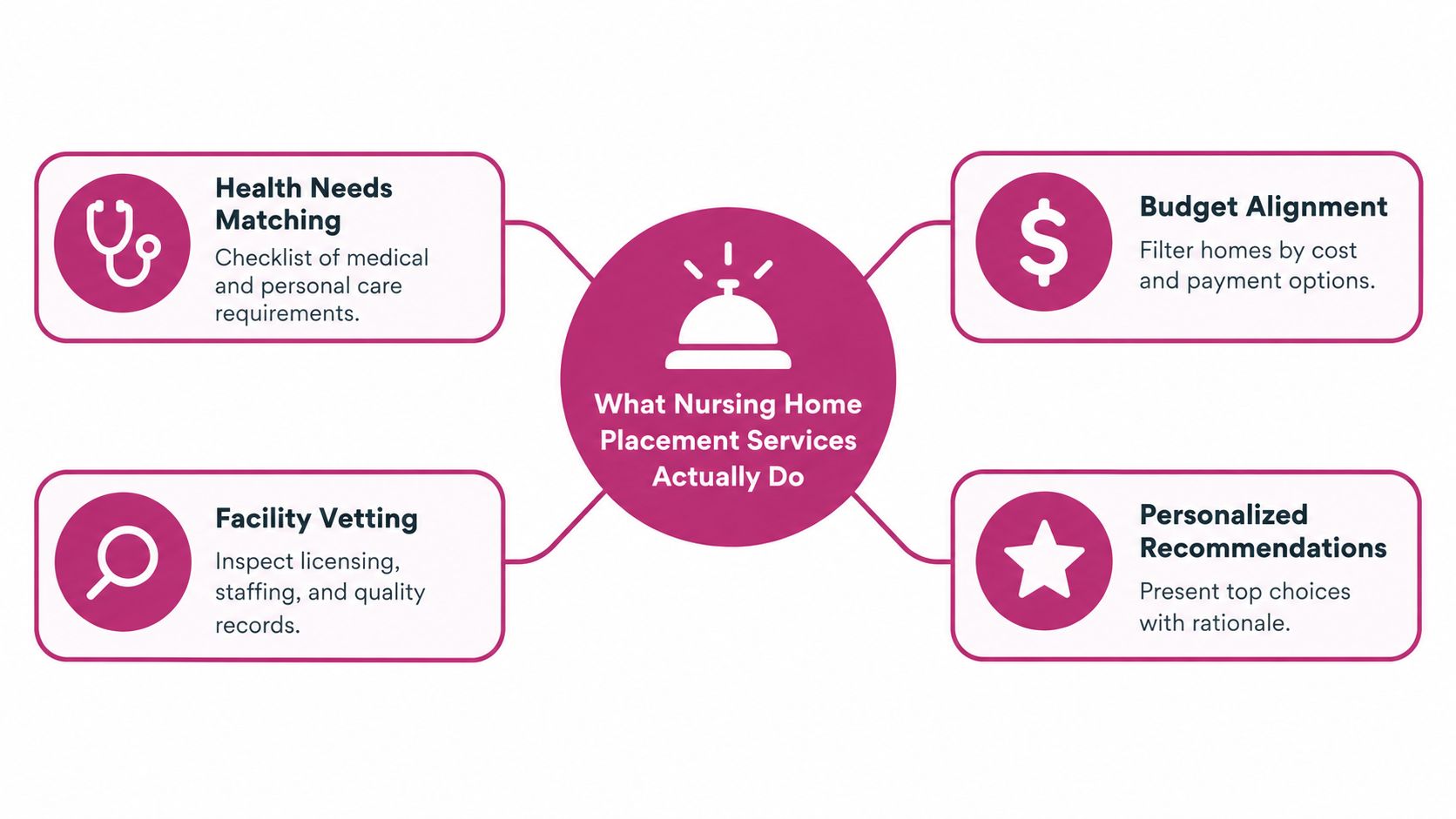
The four jobs families usually need most
A professional placement service often helps in four practical ways:
- Clinical matching: The advisor learns what care the person needs, then removes facilities that can't safely provide it.
- Location filtering: The family may want something near home, near the hospital, or near a specific town or ZIP code.
- Payment screening: Medicare, private pay, long-term care insurance, and Medicaid each shape the search differently.
- Decision support: The advisor helps compare final options, set up tours, and keep the move from stalling.
Some services also support the full senior care continuum, not only nursing homes. That matters because the right answer isn't always institutional care. A family that starts a search for nursing care may learn that assisted living, memory care, or home care is a better match. For a broader view of how advisors work across settings, this overview of senior placement services in New Jersey gives helpful context.
What placement services are not
They aren't hospital discharge planners, though they often coordinate closely with them. They also aren't the same as a facility's in-house admissions team. Admissions staff work for one building. A placement advisor usually helps compare several.
Life Senior Placement is one example of this model in New Jersey. The service offers no-cost guidance to families, works across settings including nursing homes and home care, and uses a dedicated advisor approach with verified listings and support through touring and move-in.
Practical rule: If someone only shows you one option, you're not getting placement guidance. You're getting a sales conversation.
That doesn't mean admissions staff are unhelpful. They're often essential. It just means their job is to explain their building. A placement advisor's job is to help the family choose among appropriate options.
Inside the Intake and Assessment Process
A good placement search starts with a careful intake. This is the part families sometimes underestimate because it can feel repetitive. Why does everyone need the same information again?
Because the details determine whether a facility can accept the resident safely.
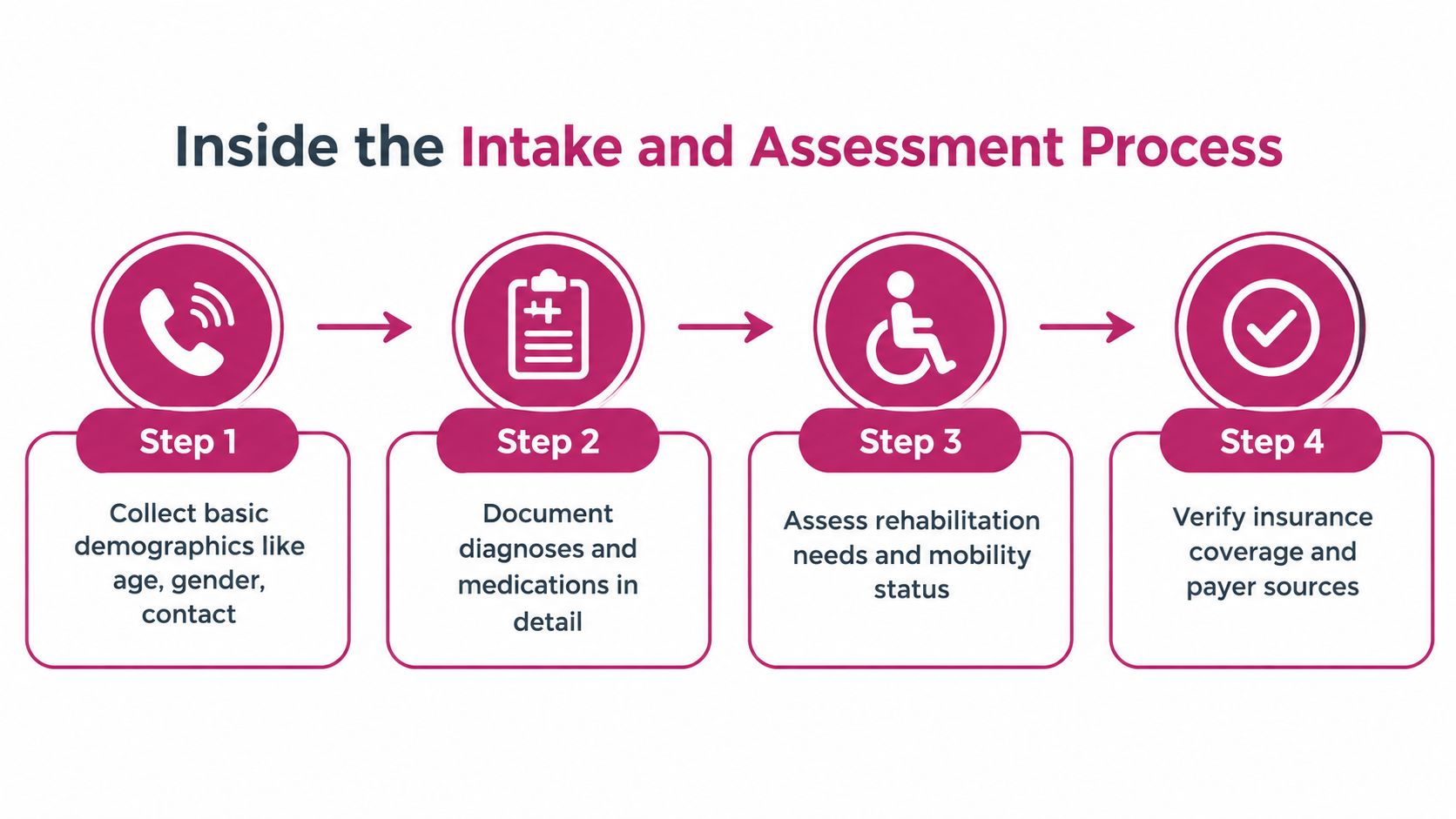
What an advisor needs to know
The intake usually begins with basic facts, then moves into clinical and financial detail.
- Identity and contact details: Name, age, current location, family decision-maker, and best callback number.
- Medical picture: Diagnoses, recent hospitalization, surgery, wound needs, oxygen use, infection precautions, and medication list.
- Functional status: Can the person walk, transfer, feed themselves, or participate in therapy?
- Cognition and behavior: Dementia, confusion, wandering risk, nighttime agitation, or communication barriers.
- Payment and coverage: Medicare status, Medicaid application status, long-term care insurance, or private-pay limits.
- Personal preferences: Language, location, room preference, religious or cultural needs, and proximity to family.
A family may think location is the top issue, but clinical fit usually comes first. If a person needs extensive rehab, bariatric support, or a specific medication routine, many buildings will screen them out quickly. That's not a quality judgment. It's a capability question.
Match the person's needs to the building's licensed capability first. Preferences come after safety and acceptance.
Why each intake detail changes the shortlist
Small details can have big placement consequences. A person who can tolerate and benefit from therapy may fit a short-term rehab unit. A person with advanced confusion and little rehab potential may need a very different environment. Someone who needs dialysis transportation or special wound care may have fewer realistic options.
The advisor's job is to translate this into a usable shortlist. In practice, that often means filtering by city, ZIP code, or preferred community area, then directly verifying whether the provider can accept the case. Families often assume online listings are enough. They usually aren't. A listing can tell you a facility exists. It can't tell you whether that facility can take your mother this weekend.
The three-step flow families actually experience
Many placement services use a simple rhythm:
- Intake
The advisor collects the care, budget, and location details.
- Matched options
The advisor identifies licensed, vetted communities that appear to fit.
- Touring and decision support
The family reviews the best choices, asks questions, and moves toward admission.
The process works best when the family gathers paperwork early. A discharge summary, medication list, insurance cards, therapy notes, and power of attorney documents can save time. Think of intake like packing for a flight. If the essentials are ready, boarding goes more smoothly.
How Advisors Determine the Right Level of Care and Fit
At this stage, families are usually asking one hard question in two different ways. What setting gives our parent the right care, and which place can take them soon enough?
Those are related questions, but they are not identical. A facility can look strong on paper and still have no clinically appropriate bed open today. Another may have availability, but not the staff, therapy program, or specialty support that the person needs. An advisor weighs both at the same time. The job is part quality review, part real-time bed search.
A nursing home placement also serves different goals. One person needs a short rehab stay after surgery, a fall, or a hospital admission. Another needs long-term nursing support because daily life at home has become too medically complex or too unsafe, even with family help. In some cases, home care can buy time and delay placement. In others, it only delays an unavoidable move and creates more rushed decisions later.
CMS separates nursing home quality into different lenses, including short-stay, long-stay, staffing, and health-inspection measures, and the framework includes items such as short-stay rehospitalization, outpatient emergency department use, discharge function score, and pressure-injury changes according to CMS nursing home quality measures.
Short-stay and long-stay are different decisions
A short-stay rehab search works a lot like choosing the right recovery unit after a setback. The main question is whether the facility can help the person regain strength, mobility, and daily function with enough nursing support to avoid another hospital trip.
A long-stay search asks different questions. Can this building manage ongoing medication needs, transfers, continence care, cognitive decline, behavior changes, or progressive illness month after month? Does the staffing pattern support stable daily care, not just a brief recovery period?
That distinction changes the shortlist fast.
A person with good rehab potential may do well in a stronger post-acute setting, even if it is not the closest building to home. A person with advanced dementia, repeated falls, or limited tolerance for therapy may need a facility with steadier long-term nursing support instead of a rehab-focused unit.
What advisors compare in practice
| Evaluation Criteria | Why It Matters for Placement |
|---|---|
| Short-stay performance | Helps show how well a facility handles post-acute recovery and transition planning |
| Long-stay measures | Helps identify whether ongoing care quality is stable for residents who remain longer |
| Staffing levels | More nursing time per resident can affect daily oversight and responsiveness |
| Staff turnover | Frequent turnover can disrupt consistency and communication |
| Health inspections | Survey findings help families see compliance history and operational discipline |
| Discharge function score | Useful when the goal is to regain function after illness or surgery |
| Rehospitalization and ED use | Helps families judge whether residents often bounce back to the hospital |
| Five-Star rating | Gives a quick summary signal, with 5-star homes labeled much above average and 1-star homes labeled much below average in the CMS value-based purchasing measures overview |
Practical reading of quality signals
Families often focus on the overall star rating because it is simple. Advisors use it as a starting point, not a final answer.
A star score works like a dashboard light. It tells you where to look more closely. It does not tell you, by itself, whether a facility is the right match for a person who needs wound care, daily therapy, behavior support, or close medication monitoring.
That is why advisors read across the measures. If the goal is short-term rehab, recovery-related items such as discharge function and return-to-hospital patterns matter more. If the goal is long-term residence, staffing stability, inspection history, and consistency of ongoing care carry more weight. CMS also gives attention to measures such as nursing hours per resident day, staff turnover, and discharge function score in the same CMS overview.
In plain terms, families are not only choosing a building. They are choosing the setting with the best chance of meeting the resident's needs, while also finding a bed that is open, appropriate, and available in time.
Coordinating With Hospitals to Expedite Transitions
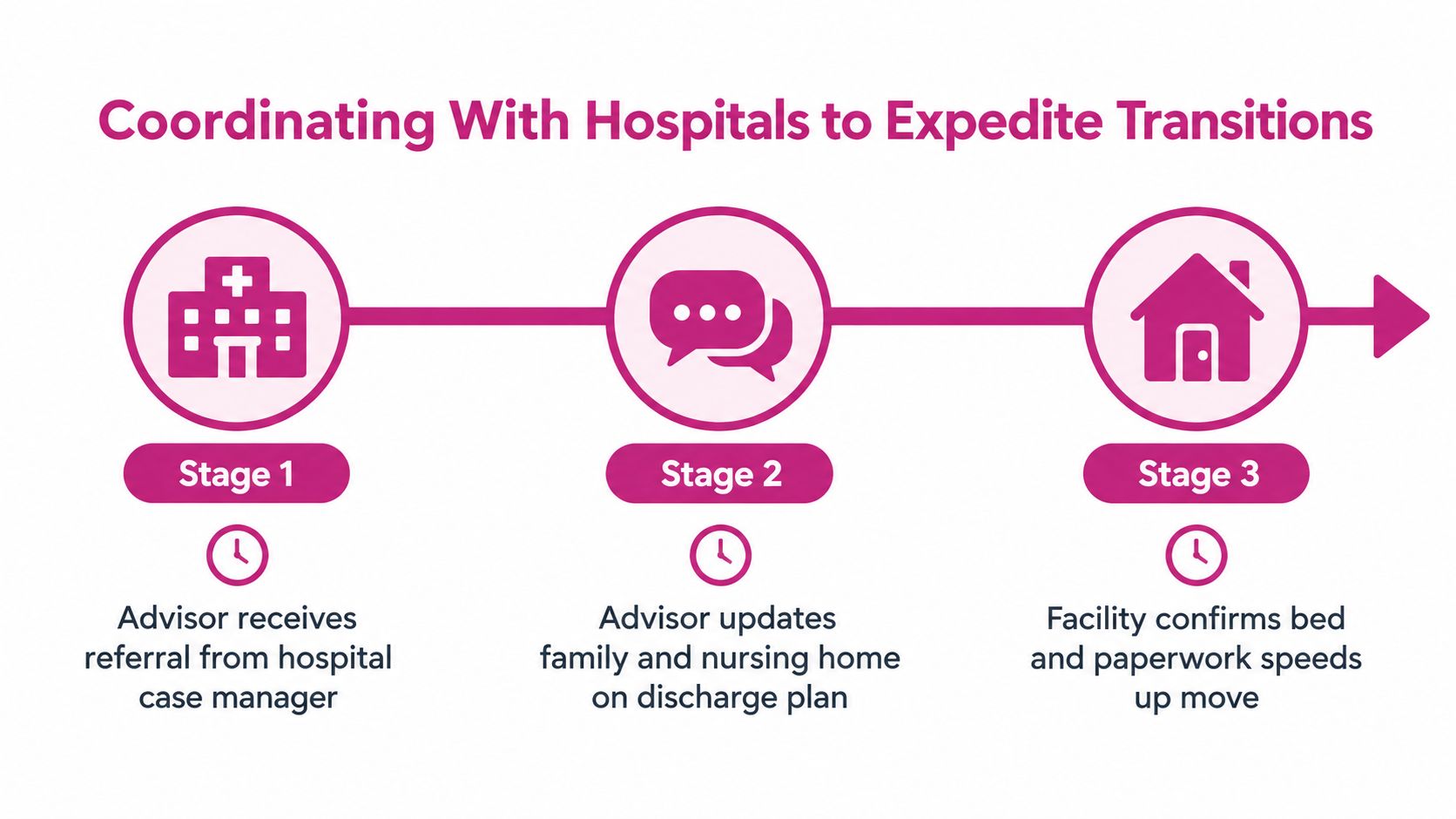
The placement work families see is only part of the job. A large part happens between phone calls, faxes, portal messages, and follow-ups with hospital teams and nursing home admissions departments.
That coordination matters because a discharge can stall for reasons families never hear clearly. A facility may need updated therapy notes. Another may want medication clarification. A third may have an appropriate unit but no weekend admissions coverage.
Best and available are different questions
That's the central truth of time-sensitive placement. The strongest fit on paper isn't always open right now.
Recent industry reporting cited in a placement-focused review found that staffing shortages caused 25% of single-site communities and 18% of multi-site communities to limit admissions in a July 2025 survey, and separate survey evidence described roughly 12,500 statewide vacancies while noting that staffing, weekend coverage, and the ability to meet a prospective resident's needs affect referral acceptance, according to this discussion of unmet needs and nursing home placement. For families, that means access has become a moving target.
What advisors do to keep discharge moving
An advisor often becomes the bridge between three groups who all have partial information:
- Hospital team: They know the medical status and discharge timeline.
- Family: They know preferences, decision-makers, and practical constraints.
- Facility admissions staff: They know current bed status, staffing, and clinical acceptance rules.
The advisor keeps these pieces aligned by confirming:
- Clinical acceptance: Can the facility safely manage the person's current needs?
- Authorization status: Is the payer source in order, and is any approval still pending?
- Admission timing: Can the facility take the resident today, tomorrow, or only after additional review?
- Rehab start logistics: If therapy is the goal, how quickly can that begin after arrival?
A delayed handoff often starts with one missing detail. The fix is usually better communication, not a better internet search.
Hospital social workers and case managers are central to this process, and families sometimes benefit from understanding that role more clearly. For readers curious about how hospital-based social work is trained in another system, this explanation of UK hospital social work qualifications gives useful perspective on the discharge-planning side of care coordination. Families dealing with a New Jersey discharge may also find this guide to hospital discharge to rehab in New Jersey helpful when they're trying to understand what should happen before transfer.
What Working With a Placement Advisor Looks Like in Practice
The easiest way to understand placement help is to look at two common situations.

Scenario one after surgery
A father has a hospital stay after a hip fracture repair. The surgeon wants rehab. The family assumes any nursing home with therapy will do, but the advisor starts narrower.
First come the functional questions. Can he transfer with assistance? Can he follow therapy directions? Is pain controlled? Then come the logistics. Which facilities are near family, accept the payer source, and can start the admission process fast enough to avoid discharge delay?
The advisor presents a shortlist, explains the tradeoffs, and helps the family compare the options side by side. One may be closer to home. Another may look stronger for rehab. A third may have the earliest bed. The family makes a decision with current information instead of calling ten buildings blindly.
Scenario two when home support is breaking down
An older adult with memory loss has been living at home, but the problem isn't always “needs nursing home now.” Sometimes the hidden problem is that home support has become too thin.
That question matters because research on home- and community-based services found that 19% of recipients entered a nursing home over 24 months, and every 5-hour increase in monthly attendant care was associated with a 5% lower risk of nursing-home placement in the clinical research summarized within MedPAC's March 2025 chapter on skilled nursing facility services. Recent dementia care reporting also described unmet needs across daily living help, treatment support, socialization, caregiver support, resource access, personal preferences, and home modifications, with barriers such as awareness, affordability, availability, and cultural fit pushing families toward placement sooner than necessary in this summary of gaps in dementia care.
That's the contrarian side of good placement guidance. Sometimes the right move is not to rush into a facility search. It's to ask whether stronger home care, better respite, or different support services could delay institutional placement safely.
Advisor-guided search versus going alone
Searching alone often means:
- Calling outdated listings
- Retelling the same clinical story repeatedly
- Learning too late that a building can't accept the case
- Comparing amenities before confirming clinical fit
Working with an advisor usually means:
- Starting with a vetted network
- Using current information on likely acceptance
- Getting help with tours and comparisons
- Keeping one point of contact through decision and move-in
The main benefit isn't magic. It's reducing wasted motion during a stressful week.
Choosing Support and Taking the Next Step With Confidence
If you're facing this decision now, the next step is simpler than it feels. Start by gathering the core facts. Recent hospital records, medication lists, insurance information, functional status, and your preferred location will shape the search more than any brochure will.
Then ask two questions in the right order. First, what setting can safely meet the person's needs right now? Second, among those appropriate options, which ones are available and workable for the family?
A short checklist for families
- Gather the essentials: Keep discharge paperwork, medication lists, insurance cards, and legal decision-making documents in one folder.
- Clarify the goal: Is this expected to be rehab, long-term care, or an evaluation because home isn't working anymore?
- Ask about payment early: Coverage affects timing and options. Families sorting through public coverage questions may want a plain-language guide to what New Jersey Medicaid covers for nursing homes.
- Protect communication: During a crisis, families are more vulnerable to confusion and bad information. Tools such as a senior friendly scam blocker can help reduce unwanted calls and noise while you manage decisions.
- Use advisor support when speed matters: A guided search can help when hospital discharge, rehab timing, and bed availability are all moving at once.
You don't need to know every rule before making the first call. You just need a clear starting point and someone who can help separate urgent from important. That's often the difference between a frantic search and a manageable one.
Life Senior Placement helps New Jersey families sort through nursing home and senior care options when timing, clinical fit, and availability all matter at once. If you need no-cost guidance, verified local listings, and advisor support through matching, touring, and move-in, visit Life Senior Placement.