
The advice most families get is simple, and it is often wrong. If your parent has dementia, people say, choose memory care. If they just left the hospital, choose a nursing home for rehab and plan to bring them home. That shortcut treats the label as the decision. It is not.
A locked memory-care wing is not automatically safer, and it is not automatically nonmedical. A nursing home is not only a rehabilitation stop on the way home. Families who pick the building that sounds gentler, or the one a discharge planner named first, often find the mismatch after move-in. Wandering is still unmanaged, or skilled needs show up that the residence cannot meet.
Memory care vs nursing home is a match between the dominant risk and what the license, the staff, and the building can do. Supervision and routine are one problem. Daily skilled treatment is another. Start there, then check competence and who pays. The screen below is the one to use before anyone falls in love with a lobby.
Memory Care vs Nursing Home at a Glance
Memory care is not a lighter nursing home. A nursing home is not a hallway between the hospital and home. Families lose months when they treat those labels as a ladder of seriousness.
Memory care is a residential model for adults living with Alzheimer's disease or another dementia. The day is built around a secured or monitored setting, routines, cueing, meals, medication management, and help with activities of daily living. The program may hold an assisted-living license, or it may sit as a unit inside a nursing home.
A nursing home is the skilled setting. Residents have 24-hour nursing access and supervised personal or skilled care when medical, physical, or cognitive needs are substantial. Rehabilitation lives in that building for many short stays. So do long stays that never were about therapy.
How the two models split
| Criterion | Memory care | Nursing home |
|---|---|---|
| Primary purpose | Dementia-focused residential support and supervision | 24-hour skilled nursing, personal care, and rehabilitation |
| Best fit | Wandering, missed medication, or unsafe independence with stable medical needs | Complex medical needs, wounds, oxygen, daily skilled treatments, or rehab goals |
| Clinical model | Medication management and help with daily activities; not continuous skilled nursing | Licensed nurses around the clock and supervised skilled care |
| Dementia design | Secured or monitored space, routines, cueing, and cognitive programming | Dementia unit possible but not guaranteed by the nursing-home label |
| Staffing emphasis | Dementia-trained caregivers and closer supervision | RN, LPN, and CNA clinical staffing plus therapy when ordered |
| Typical stay | Ongoing residence | Short-stay rehab after a hospital stay, or long-stay custodial care |
| Payment posture | Mostly private pay; Medicare generally does not cover room and board | Medicare may cover eligible short-term skilled care, not long-term custodial living |
Two rows decide more tours than the rest.
Clinical model. Memory care manages medications and daily activities. It does not provide continuous skilled nursing. A nursing home staffs licensed nurses around the clock and supervises skilled care. If a nurse must assess and treat every day, the residential license is the wrong building.
Dementia design. Memory care assumes a secured or monitored space, routines, cueing, and cognitive programming. A nursing home might run a dementia unit. The nursing-home name does not promise one, and a memory-care name does not prove the clinical depth is there.
Placement rule: Choose memory care when the dominant risk is wandering, missed doses, or unsafe independence and the person is medically stable. Choose a nursing home when daily skilled treatments, wounds, oxygen, complex medications, or measurable rehab goals drive the move.
Some nursing homes contain dementia units, so the name on the door only starts the classification. The two models also do not cost the same thing.
What Memory Care and Nursing Homes Cost
The room label does not settle the price, and a higher bill does not automatically mean better care. Compare what each monthly rate covers, then price the level of support the person needs.
Monthly cost benchmarks for planning
| Benchmark | Monthly figure | What the figure represents |
|---|---|---|
| US memory care median | $6,160 | 2024 national median |
| US nursing home semi-private | $9,277 | 2024 national median |
| US nursing home private room | $10,646 | 2024 national median |
| Federal guide semi-private example | About $8,200 ($276 a day) | Older federal senior-care guide average |
The linked 2024 senior-care cost figures list these national medians. An older federal senior-care guide gives a different semi-private nursing-home average: about $276 per day, or $8,200 per month. These figures reflect different sources and methods, so use them as planning benchmarks, not quotes. For a closer look at what memory-care bills may include, see this memory care cost breakdown.
What the monthly figure is buying
Memory-care pricing reflects secure design, closer supervision, and cognitive programming. Nursing-home pricing includes round-the-clock medical supervision and may include rehabilitation. The rates pay for different services, so compare the written inclusions rather than the headline amounts.
In New Jersey, the median cost for a nursing-home semi-private room is $12,775 a month. Memory care is estimated at $9,000 to $13,000 a month based on New Jersey placements, not survey data. Each participating organization sets its own pricing, so a published range is not a quote.
Ask whether the quoted monthly total includes:
- Room type: Private rooms generally cost more than shared rooms.
- Transfers: Confirm whether the rate covers a two-person assist.
- Behavior support: Ask how added supervision is priced.
- Supplies: Check whether incontinence products are included.
- Care services: Separate skilled therapy from help with dressing and other daily tasks.
Get a written total for the same care needs from two memory-care communities and two nursing homes. A policy may help cover costs if its daily benefit, elimination period, and dementia coverage fit the bill. Compare the policy's terms and long term care insurance premiums with the written care estimate before relying on it as the funding plan.
When Nursing Care and Medicare Decide It
Care level and the payer are different questions. Mixing them is how families accept a bed that cannot do the clinical work, or turn down a nursing home because they think the stay must be permanent.
A nursing home, as a skilled nursing facility, is built for licensed nurses day and night. That means complex medication management, wound care, IV treatment, oxygen dependence, disease monitoring, or post-acute rehabilitation with goals you can measure. Memory care usually covers medication reminders or administration, cueing, and personal care. It fits when cognitive impairment creates wandering or a supervision risk and that daily skilled load is not there.
Medicare's nursing home coverage can pay for qualifying medical or rehabilitation services in a nursing facility. It does not pay for long-term custodial room, board, or dementia supervision in a memory-care residence. "Medicare will cover the nursing home" is not a plan for a year of living there. Coverage ends when the skilled need ends.
Write the intake before you tour
The family and the hospital case manager should put the same facts on one page:
- Recent hospitalization: Dates, and whether the stay was inpatient.
- Orders: Physical, occupational, or speech therapy, plus the goal.
- Clinical tasks: Wounds, IVs, oxygen, and how often each is done.
- Movement: How many people a transfer takes, and recent falls.
- Behavior: Wandering, sundowning, aggression, and what has already been tried.
- Nurse time: How often a licensed nurse must assess or treat, not only pass medications.
A short rehab stay and a long custodial stay are not the same admission. Many residents remain after therapy ends because they need ongoing nursing, not because a course of treatment is still open. Don't tour as if every nursing-home bed is a gym with a discharge date.
If daily skilled treatments or measurable rehab goals are on that page, ask about clinical capacity and whether the skilled benefit applies. If the page shows secure supervision without those treatments, memory care stays in play even when a physician is involved.
Medicaid may pay for an eligible long-term nursing-home stay once clinical and financial tests are met. Help with memory care through Medicaid waivers changes by state, and it rarely mirrors a full nursing-home benefit. Confirm the payment path for that license before you commit. Our guide to nursing home placement qualifications shows how that screen looks in practice.
Verify Dementia Skill and Staffing Before You Choose
A keypad on the door is not a quality score. Staff inside a memory-care unit can be thin, poorly supported, and slower to learn from incidents than staff on a standard long-term unit. A nursing home can be a years-long home for people with advanced dementia, not a rehab lobby. Verify both.
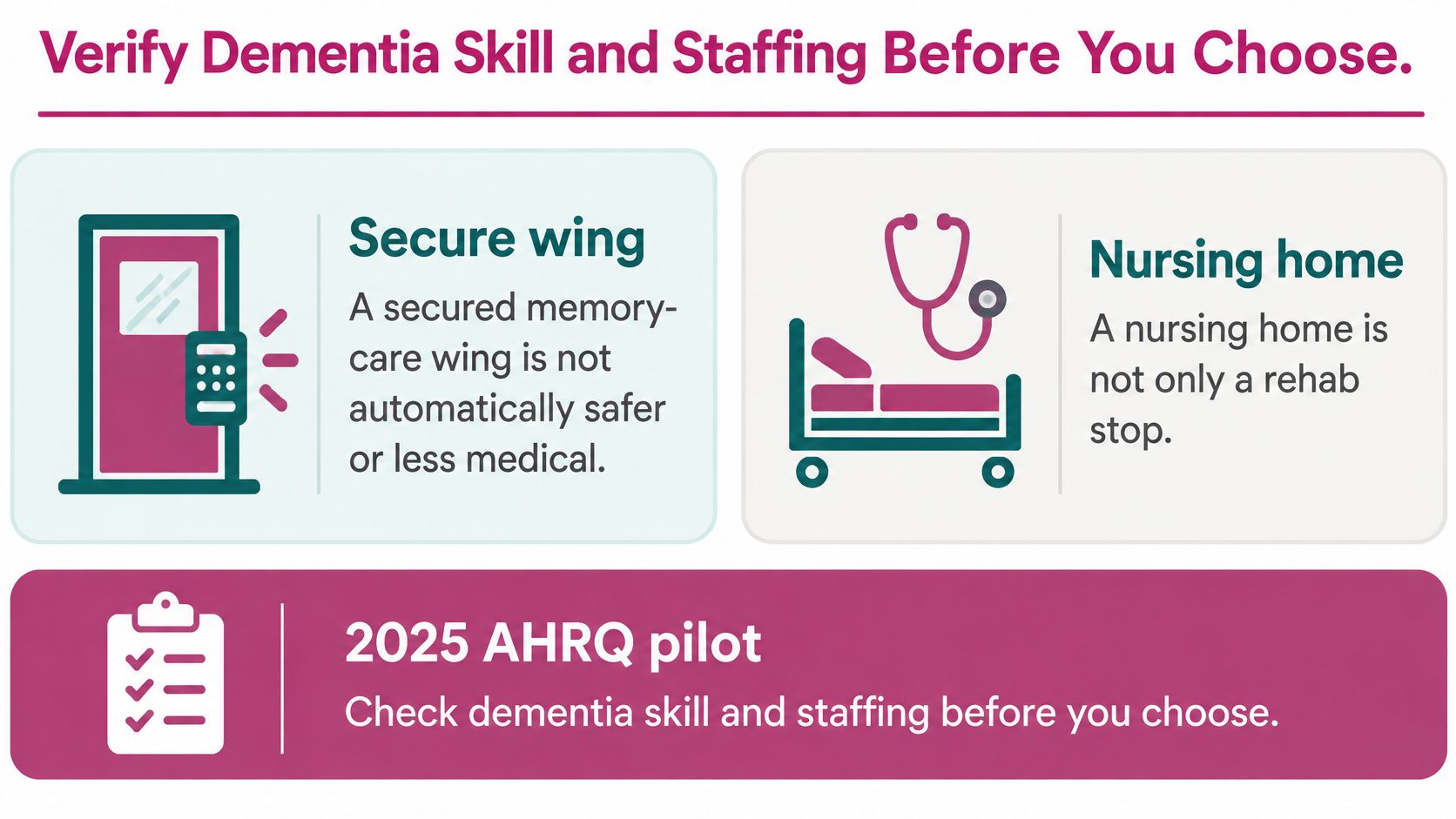
A 2025 AHRQ pilot of the Nursing Home Survey on Patient Safety Culture found staffing was the lowest-scoring area. Only 48% of staff said they had enough people to handle the workload. Staff in memory-care units reported worse safety-culture perceptions than staff in other units on half the measures, including an 11-percentage-point gap on organizational learning, 72% versus 83% for long-term-care units, in that AHRQ pilot. A secured wing is not automatically safer.
The same pilot write-up points to a separate analysis of 15,790 U.S. Nursing homes. Higher nurse and nursing-assistant staffing generally improved outcomes for residents with Alzheimer's or related dementia. Staffing alone did not clear every quality problem. Headcount without training, stable assignments, and incident review is a brochure number.
A 2024 study that used quasi-random variation in bed availability tied higher-rated, better-staffed nursing homes to lower readmission risk. Among residents with dementia, each one-star increase was associated with about 0.81 percentage points lower 30-day readmission and 0.94 percentage points lower 90-day readmission, as reported in that peer-reviewed study. National Institute on Aging reporting in the same discussion found that fewer than 5% of U.S. Nursing-home beds were in dementia special-care units. Facilities where more than 90% of residents had dementia showed lower hospitalization and emergency-department use and more skilled-nursing hours per resident than facilities with lower dementia concentrations. Concentration is not a logo. It shows up in hours and in hospital use.
What to ask before you like the building
Walk in this order. Drop any community that will not share training, turnover, or incident follow-up.
- License: Is memory care an assisted-living program, or a unit inside a nursing home?
- Hours and nights: Staffing hours per resident day, who covers nights and weekends, and turnover for RNs, LPNs, and CNAs. Our list of questions to ask a nursing home administrator about staffing is the script if the tour guide stays vague.
- Dementia training: What each role must complete, how often it is refreshed, and how agitation is handled without routine sedation.
- Incidents: How falls, elopement, and medication errors are logged and reviewed, and the usual response time to a fall or an exit-door alarm.
- Results: The overall star rating, hospitalization and emergency-visit patterns, and what changed after the last poor result.
- The building after hours: The secured path, the outdoor area, a meal, and what programming happens after 5 p.m.
- Payment matched to the license: Private pay, long-term care insurance, Medicaid for an eligible long stay, or a Medicare skilled stay. The funding has to fit the license you are buying.
A short tour video is useful only as a rehearsal for those questions, not as a substitute for the answers.
In New Jersey the choice is often a specialized memory-care wing versus a clinically stronger nursing facility that also knows dementia. Take the one that can show training, night coverage, and what it did after the last fall or exit attempt. A familiar brand does not answer that.
Which Setting Fits the Situation
Four patterns cover most calls. One fact would flip each recommendation. Ignore the brochure and find that fact.
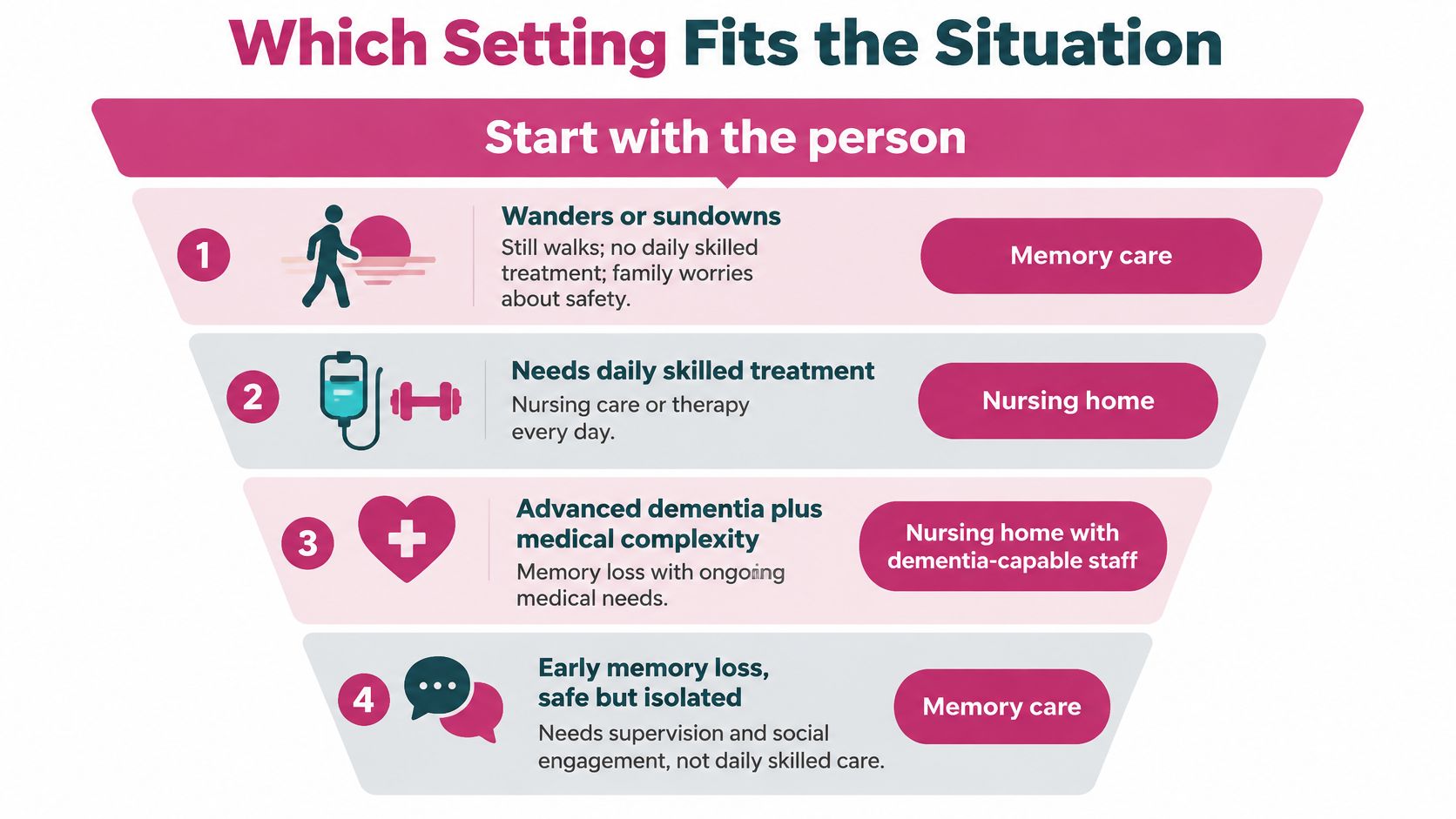
Wanders or sundowns, still walks, no daily skilled treatment. The family is up at night. Memory care is the usual fit because the risk is supervision and routine, not a treatment the nurse must perform. Flip it if a new wound, oxygen, or a daily skilled order appears. Residential memory care should not be the place that keeps sending the person out for care it cannot do.
Hip fracture, stroke, or another discharge with therapy orders. Start in a nursing home for rehabilitation, then reassess memory care only if skilled needs end and dementia supervision remains. The fact that flips this is a discharge with no measurable therapy goal and no daily skilled task. Rehab as a holding pattern wastes the benefit and the bed.
Advanced dementia plus wounds, oxygen, tube feeding, or daily skilled nursing. Choose a nursing home, and prefer one that can show dementia capability. A residential memory-care community that must send the person out for clinical care is the wrong license. The flip is a genuine end to those daily skilled tasks, with supervision as the remaining need.
Early cognitive change, a safe home, and reliable paid or family caregivers. Home care can be the first move, from a few hours a week up to around-the-clock help. It is not automatically safer or cheaper. Home fails when the caregivers fail.
Stop patching home care when any of these show up:
- Overnight wandering that repeats, not a single scare.
- Falls that keep happening despite a cleared hallway and a hired aide.
- Caregiver exhaustion, including the spouse who is no longer sleeping.
- A hospital discharge that needs skilled care the house cannot host.
- Home-care hours whose monthly cost is approaching residential care.
The workforce makes last-minute placement a different decision from a planned one. Recent reporting cites more than 770 U.S. Nursing-home closures since 2020. The Alzheimer's Association projects the country will need nearly 800,000 additional direct-care workers between 2024 and 2034, with annual turnover estimated at 79% for home-care workers and 99% for nursing assistants in nursing homes, as covered by Nature. A planned memory-care move can beat inconsistent home coverage. A bed you take the night of a crisis may not be the model you wanted.
Choose the Setting and Take the Next Step
Pick the setting from the dominant need, not from the sign out front. Then make the next move on paper, before another tour.
Write a one-page brief. Include diagnoses, hospital dates, wounds or oxygen, falls, wandering episodes, transfer help, a budget ceiling, and the New Jersey towns you will drive to. Compare memory care, nursing homes, and home care against that same list. Choosing a building type first is how people end up in a pretty unit that cannot do the work.
Life Senior Placement offers a free care quiz that narrows the starting level on the continuum, then advisor guidance to match health needs, budget, and location. We place people in licensed assisted living, memory care, nursing homes, independent living, and home care. Call (862) 398-2006. The service costs families nothing. Participating communities compensate us, and each community sets its own rates.
Do this next:
- Get a short list from the quiz or the call, aimed at one level of care.
- Tour two options at that level, not four buildings with a familiar name.
- Run the verification checks on training, turnover, nights, and incident follow-up before any deposit.
Two strong options at the right level beat four weak ones. If daily skilled treatment is needed, don't let a secured hallway talk you out of a nursing home. For example, with wandering and a stable medical picture, don't let a rehab wing become a long-term address by default.
Life Senior Placement helps New Jersey families match dementia supervision, skilled nursing, and home care to the need in front of them, with no-cost guidance and a short list you can tour. If you are weighing memory care against a nursing home, start with the care quiz or a call and compare licensed options against one written brief. Visit Life Senior Placement to begin.