
The national median cost for memory care is $6,690 per month, or $80,280 per year. In New Jersey, families usually pay more than that because labor, security, and real estate costs run higher here than the national average.
Your parent can't safely stay home alone anymore, the hospital discharge planner is pushing for a move, and you're staring at a stack of quotes that all look different. That's the point where most New Jersey families realize memory care isn't just a care decision, it's a budget decision that can't be guessed at.

If you're trying to understand the wider caregiving picture too, Understanding Ageing menopause metabolism insights is a useful reminder that aging-related decisions rarely come with a single line item. For local comparisons, start with memory care options in New Jersey and look at the full price, not just the headline rate.
Understanding the Real Cost for Memory Care
A New Jersey daughter calls after work and says her father has started wandering at night. She's comparing communities, but every tour starts with the same question, what does this cost? The answer is usually uncomfortable, because memory care costs more than standard senior housing for a reason.
The national baseline is $6,690 per month or $80,280 per year for memory care, compared with $5,419 per month for assisted living and $3,200 per month for independent living, according to a 2026 industry summary on SeniorLiving.org. That gap matters because it shows families exactly where memory care sits, above assisted living, well above independent living, and priced for more supervision, more structure, and more safety. SeniorLiving.org's cost overview also notes that the AARP-based average U.S. Memory care rent can run higher than the median, which is why your quote may feel bigger than what you first found online.
The mistake I see every week is treating that monthly number as the whole story. It isn't. In New Jersey, local labor markets and real estate costs usually push the price above the national median, and that's before you factor in whether the community uses all-inclusive pricing or tiers care separately.
Practical rule: If a community won't explain what's included in the monthly rate, assume the true price will be higher than the number on the brochure.
The best first step is simple, compare memory care to the actual alternative your family is using today, not to an abstract average. If home care is already unstable, or your loved one needs constant redirection, a slightly higher monthly facility bill can still be the more realistic option because it replaces a patchwork of unpaid family labor, home risk, and emergency decision-making.
What Drives Memory Care Prices Above Assisted Living
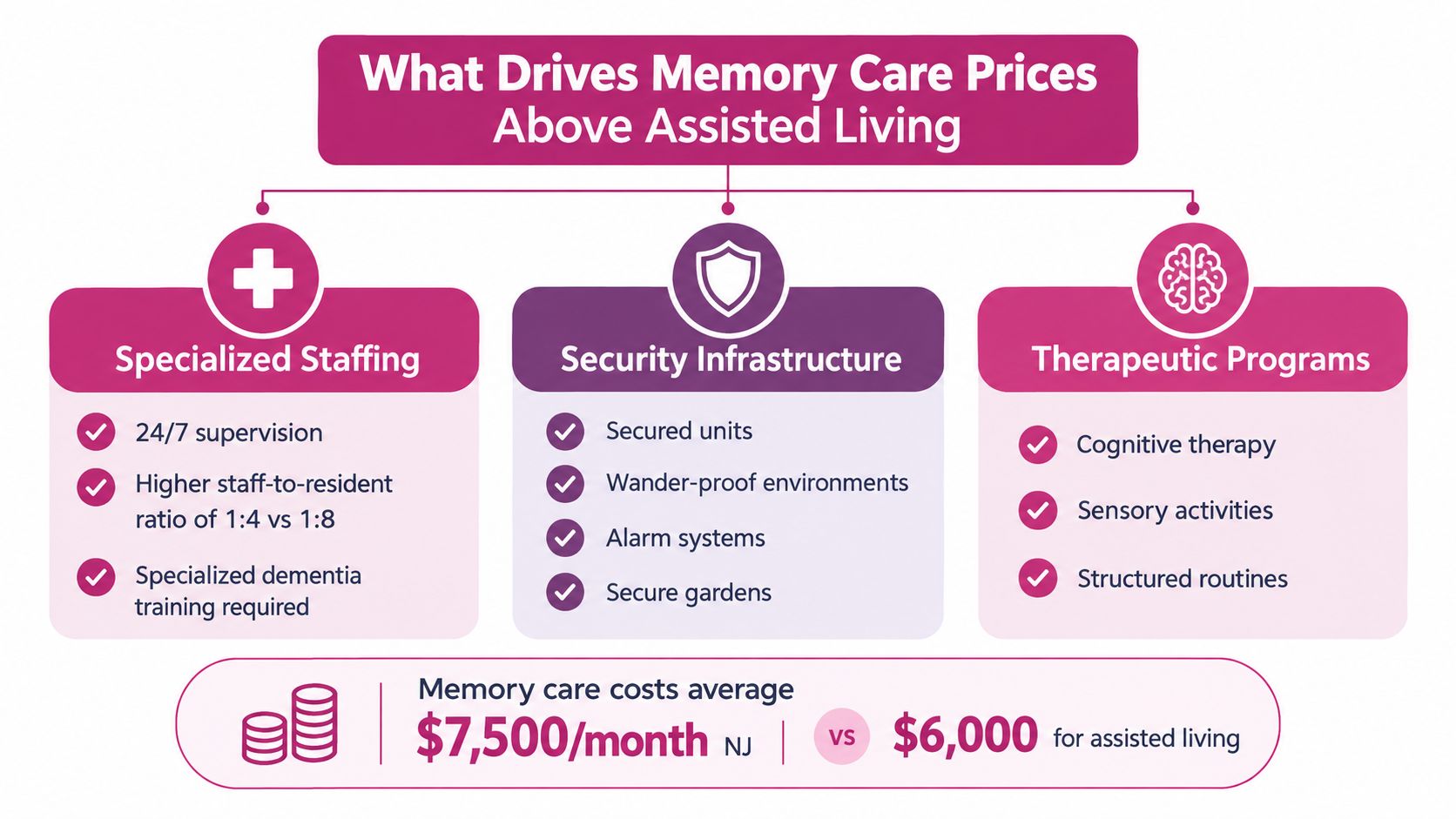
Memory care costs more than assisted living because the model is heavier, not because providers like charging more. You're paying for more staff attention, more specialized training, and a building that has to work harder to keep one vulnerable person safe from wandering, confusion, and sudden agitation. The U.S. News coverage tied to NIC data says memory care can carry a 15% to 25% premium over standard assisted living, and that premium is tied directly to how the service is built. U.S. News memory care cost guide
Specialized staffing changes the math
A memory care unit can't run like a standard apartment building with help on call. It needs lower resident-to-staff ratios, staff trained for dementia behaviors, and consistent supervision throughout the day, because residents often need repeated cueing, medication support, and redirection that a lower-intensity setting can't provide.
That's why a quote with a higher monthly rate may be the more honest quote. If one community is staffing properly and another is leaning on family members to fill gaps, the cheaper place isn't cheaper for long.
Security and therapeutic design add real cost
A secure unit costs money to design and operate. Controlled access, unique layouts, secured outdoor areas, and wayfinding features all exist to reduce wandering risk, and those are capital expenses, not decorative extras. The same goes for structured daily programming, which isn't a hobby schedule, it's part of the care model.
The cheapest community is often the one that charges later, through add-ons, level-of-care jumps, or family burnout.
When I review New Jersey options with families, I focus on three questions: who is on duty, what is included, and how fast the price can change if care needs increase. If a community can't answer those clearly, the sticker price doesn't mean much.
Why Memory Care Pricing Varies So Much by Source
Families get confused because the internet isn't giving them one number, it's giving them several. That doesn't mean the market is lying, it means different sources measure different things. One source may be reporting a national median, another may be estimating average rent, and another may be quoting a community's all-in monthly rate with care baked in.
The AARP-based estimate cited in the verified data puts average U.S. Memory care rent at $8,399 per month, compared with $6,694 for assisted living and $12,240 for nursing homes. That's not the same thing as the national median from another summary, and both can be useful if you understand what they represent. For families shopping in New Jersey, the practical takeaway is simple, a quote can be accurate and still not be comparable to another quote.
The quote depends on what's bundled
Some communities advertise a base rate and then add charges for higher care levels. Others use all-inclusive pricing that folds more support into the monthly bill. A rate that looks low on paper can jump quickly once the resident needs more cueing, more assistance with daily routines, or more specialized oversight.
That's why two families can hear two different prices from the same building. The resident's care profile matters, and so does the provider's billing model. A community that looks expensive at first glance may be easier to budget for if it keeps costs bundled.
Geography changes the number too
New Jersey is not a low-cost market. Labor, insurance, and property costs all shape what communities can charge while still staffing safely. That's also why a national average can be useful for context without being useful for decision-making in your town.
If you're seeing a big spread between quotes, don't assume one side is wrong. Assume the comparison is incomplete. Then force the issue by asking what care is included, what changes the rate, and whether the number is tied to today's needs or tomorrow's.
The Hidden Family-Side Costs Most Guides Ignore
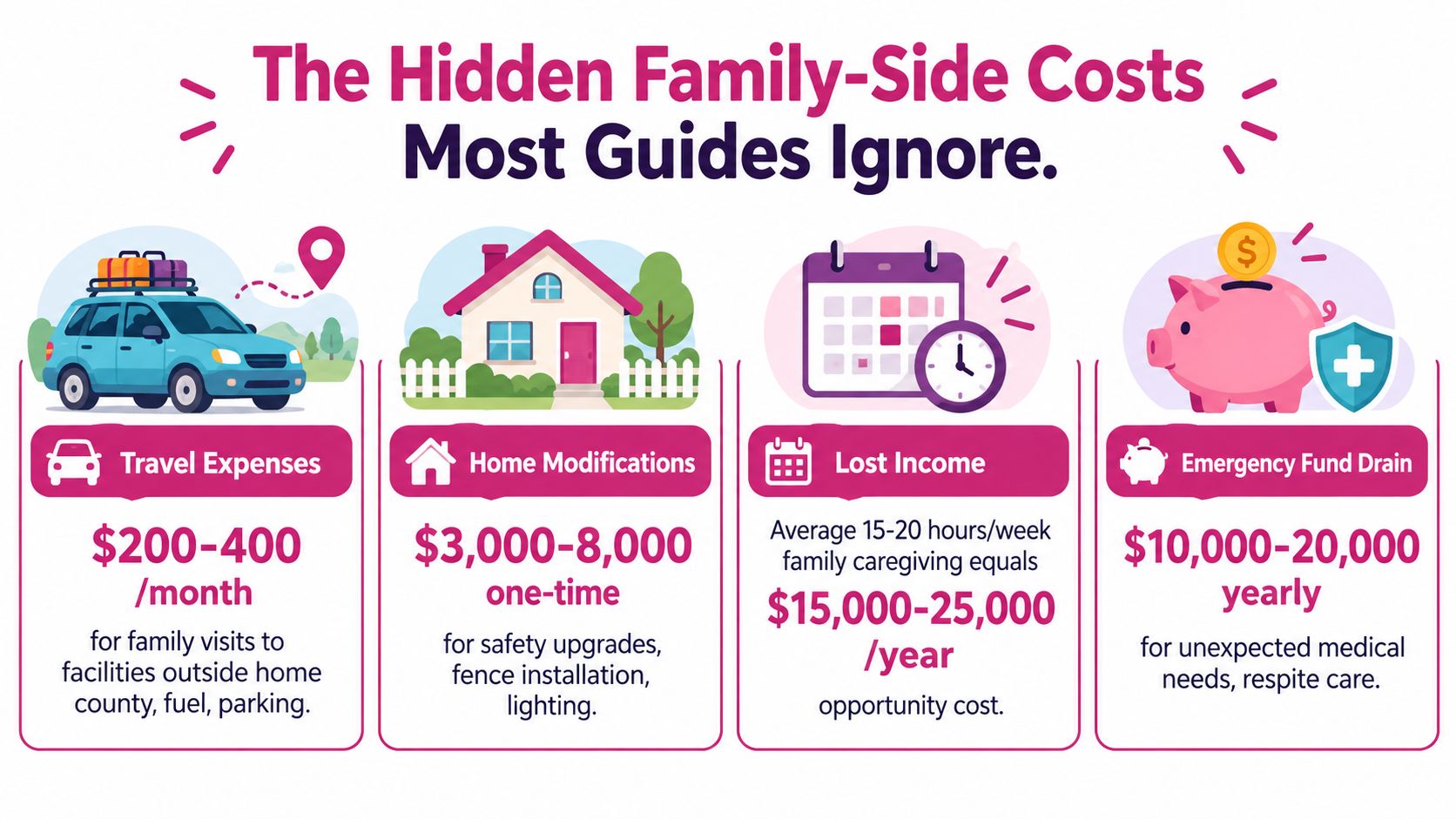
The monthly facility bill is only part of the financial damage dementia causes. The bigger problem is that families absorb costs that never show up on a community's pricing sheet, unpaid caregiving, missed work, travel, and out-of-pocket support that keeps the whole arrangement functioning. A 2025 estimate put U.S. Dementia-related medical and long-term care costs at $232 billion, while families and friends provided 6.8 billion hours of unpaid care worth $233 billion, and families still paid $52 billion out of pocket, according to USC's related coverage. USC's dementia cost estimate
That's why I push families to stop asking only, “What's the monthly rate?” The better question is, “What will this cost our household after the care gap is closed?” Once you ask it that way, the hidden expenses become impossible to ignore.
The costs that keep draining families
Travel adds up when the right community isn't close to home. Home modifications often happen before placement and can include safety work that no one expected to fund. Then there's lost income, which hits hard when adult children cut hours, leave jobs early, or spend weekday afternoons managing care crises.
Bottom line: The facility bill is visible. The family-side bill is what breaks budgets.
I've also seen emergency savings disappear because families keep covering small gaps, respite care, prescription issues, and one-off medical needs. That's why the hidden costs of premium senior living matter just as much as the monthly charge. If you ignore those extra layers, you'll underbudget and feel forced into a rushed move later.
How to Compare Memory Care Options Beyond Monthly Rates
A smart comparison starts with the rate and ends with the bill you'll pay. The first thing to examine is staffing, because that tells you whether the community is built to handle real dementia care or just marketing itself that way. After that, look at what's bundled and how often the price can change.
Ask the questions that expose the real cost
Ask for the rate sheet, the care add-on policy, and the move-in fee schedule before you tour a second time.
Use this checklist when you compare places:
| Comparison Factor | What to Ask | Red Flag |
|---|---|---|
| Staffing model | How many staff are on the memory care unit during the day and overnight? | Vague answers or “staff available as needed” |
| Included services | Does the monthly rate include meals, medication support, laundry, and daily programming? | Multiple “small” add-ons that keep appearing |
| Pricing structure | Is the rate fixed, or can it rise with level-of-care changes? | A low introductory rate with no written explanation |
| Security features | How is wandering risk reduced in the unit? | Open access without a clear safety plan |
| Programming | What does the community do each day for residents with dementia? | Activities described as optional or unstructured |
Don't compare polished brochures
Brochures are designed to sell the unit, not to protect your budget. The real comparison happens in the contract, the care plan, and the questions you ask during the tour. If a community won't give you straight answers, keep looking.
A good rule is to compare two or three communities side by side using the same checklist. That stops you from falling in love with a pretty dining room while missing the expensive parts of the deal. I'd rather see a family choose the less flashy building that explains billing clearly than the prettier one that buries costs in fine print.
Financing Memory Care and Getting Professional Guidance
Most families don't need a fantasy solution, they need a workable plan. Long-term care insurance may help if the policy is already in place. Veterans benefits can reduce the burden for eligible families. Medicaid planning may help later, but it usually requires careful timing and financial structure. Personal savings still cover a large share of placements, which is why so many families feel the pinch immediately.
If you want to preserve cash flow, read saving on healthcare with Fintrack with a practical eye, not as a cure-all. It's one more reminder that families need every legitimate planning tool they can use before they sign a contract.

For families who want help sorting options, senior placement services can shorten the search and make the financial comparison less chaotic. A no-cost placement advisor can narrow the field to licensed, vetted communities, compare what's included, and flag where a rate looks low only because care will be billed later.
Life Senior Placement is one New Jersey option for families who want no-cost guidance, verified listings, and advisor support while they compare memory care communities. If you're trying to avoid a rushed mistake, use that help before you commit, not after the contract is signed.
If you need a clearer read on the cost for memory care in New Jersey, start with a real comparison instead of another round of internet research. Life Senior Placement can help you review options, compare rates against care needs, and narrow the list before you tour, so you don't end up paying more than you expected for less support than your family needs.