
The common advice that a senior qualifies for assisted living because they're older, have dementia, or need help at home leaves out the decisions that determine admission. A diagnosis can explain a problem, but it doesn't tell a community what staff must do, whether the building can provide that help, or who will pay.
For New Jersey families learning how to qualify for assisted living, the useful starting point is a current care assessment, a sustainable budget, and confirmation that a particular community can accept both. Don't treat a promising tour or a benefits approval as a completed placement.
The Four Gates That Decide Assisted Living
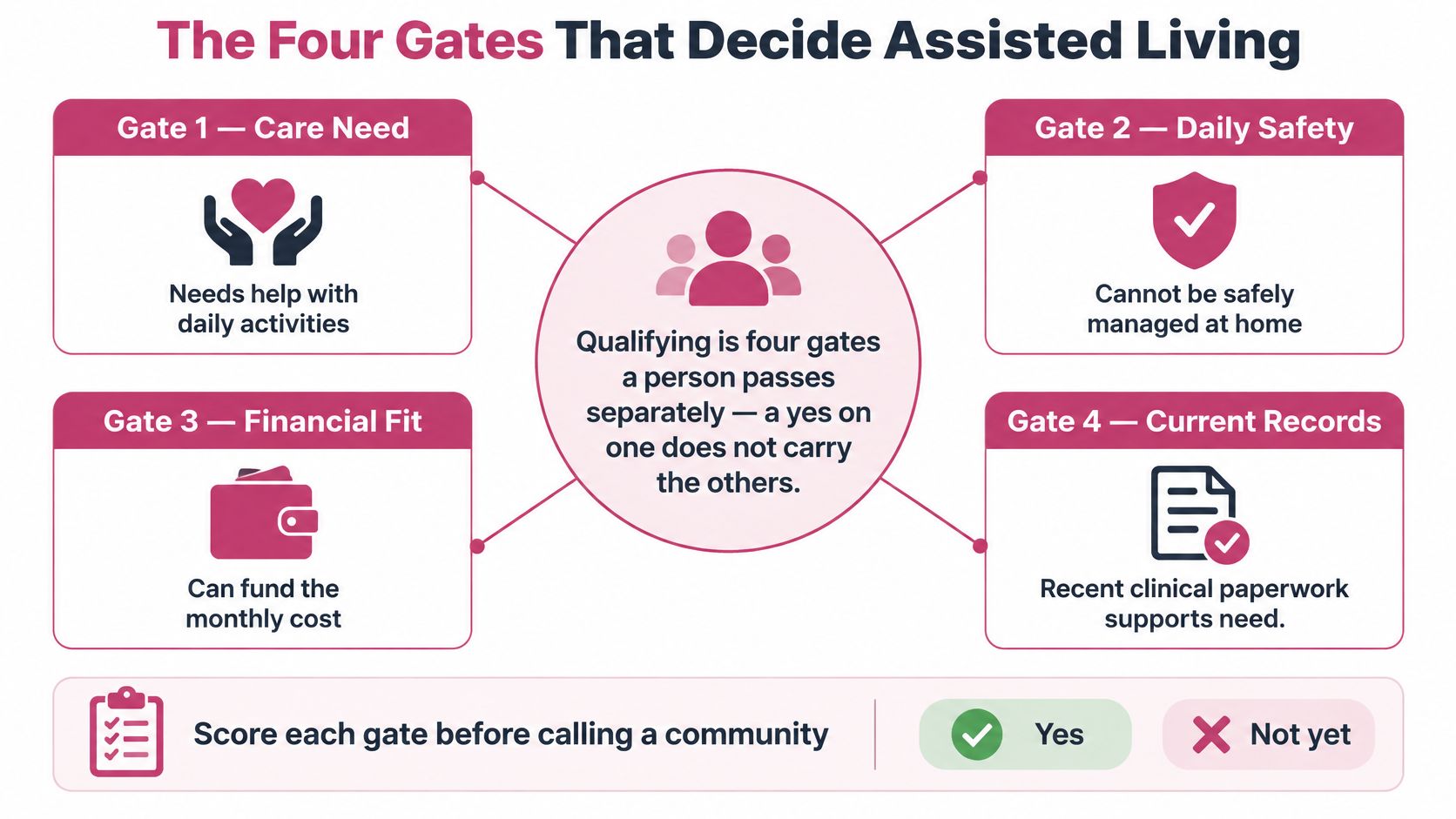
Qualifying means passing separate gates, not receiving one universal approval. Before calling communities, mark each gate yes, not yet, or wrong setting. Keep the reasons beside your answers so a reassuring conversation doesn't replace a missing assessment or an unfunded budget.
Four gates for assisted living qualification
| Gate | A real pass | Does not count as a pass | If it fails look at |
|---|---|---|---|
| Clinical need | Recurring help with bathing, dressing, medications, meals, mobility, or toileting, while stable enough for a residence | Age alone, or a diagnosis without task-level help | Home care or independent living for light needs; a nursing home for continuous skilled care |
| Private-pay ability | Budget covers housing, care tier, medication management, supplies, transportation, deposits, and a reserve | Paying only the advertised base rent at move-in | A clinically appropriate lower tier, a lower-cost community, or a legally reviewed spend-down plan |
| Medicaid services | State residency, program financial rules, the required level of care, and a participating community with availability | Medicare as the ongoing housing payer, or approval without an available Medicaid-supported placement | Private pay, home care, or a nursing facility that accepts the benefit |
| Facility fit | The community can safely staff the assessed tasks, cognitive needs, falls, and behaviors | Any licensed building, or a Medicaid letter without a matching apartment | Memory care, skilled nursing, or a different community |
Care eligibility and payment eligibility are different
The clinical gate asks what happens during an ordinary day. Can your parent dress without prompting? Can they get from bed to chair safely? Do they take medication correctly, or does someone have to organize and administer it?
The answer needs to describe recurring assistance, not just the condition behind it. Someone with Parkinson's may manage personal care independently, while another person with the same diagnosis needs hands-on help throughout the day.
The financial gates require a separate conversation. A private-pay family needs a workable funding plan. A family seeking Medicaid-supported services needs program approval and a community that participates under terms the family can meet. These are alternative payment pathways, not a requirement that every resident qualify for both.
According to the Government Accountability Office's assisted-living coverage review, 44 states covered some assisted-living services as of March 2025, and 29 of those states used home- and community-based-services waivers. Those different pathways help explain why another family's experience in another state isn't a reliable admission checklist for New Jersey.
An available apartment must also be appropriate
Facility fit is the final practical test. A residence may offer medication assistance but lack the staffing or program needed for a particular transfer, nighttime behavior, or supervision requirement. A license doesn't mean every building can accept every resident.
Placement rule: Medicaid approval reserves no apartment. Medicaid-supported assisted-living services don't include room and board, so confirm the resident's housing responsibility separately.
Suppose your mother needs help dressing and taking medication, and her funding is approved. That still doesn't establish whether the community has an appropriate opening or can safely respond when she becomes disoriented overnight. The placement is ready only when the care, payment, and availability decisions line up.
How to Document Need Before a New Jersey Admission
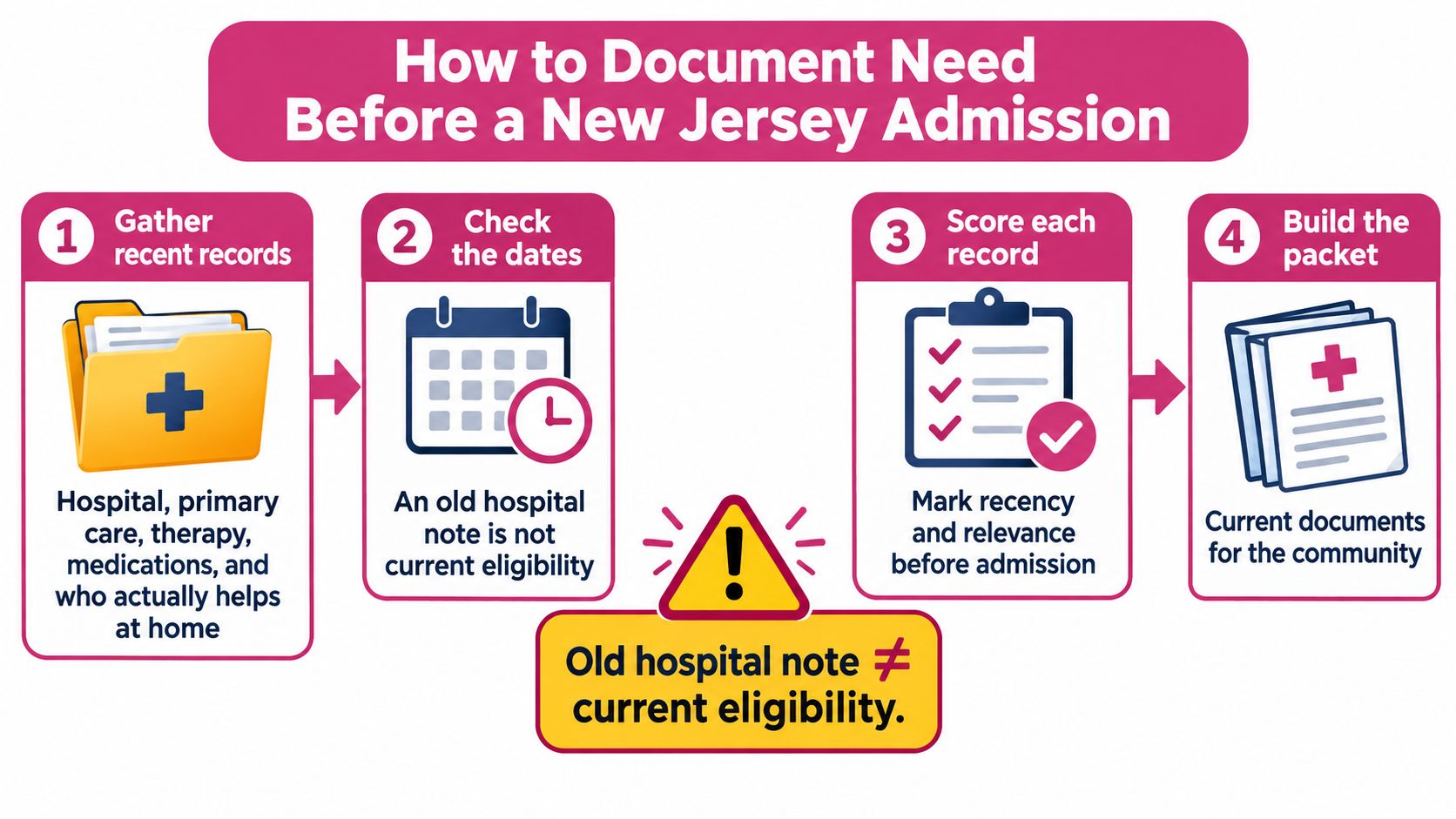
A useful admission packet explains what your parent can do now. A discharge summary describes a hospital episode; it may not describe how your parent functions after rehabilitation or a medication change.
Build the packet in this order, with observations from the people who provide care.
Gather evidence of everyday performance
- Collect recent records and identify the caregivers. Include hospital summaries, primary-care notes, therapy recommendations, and the current medication list. Add who helps at home, what they do, and whether they're available overnight.
- Describe each daily task. Use practical categories: independent, setup only, supervision, or hands-on assistance. Our guide to activities of daily living can help you organize bathing, dressing, toileting, eating, and transfers without turning the list into medical jargon.
- Separate the diagnosis from its effects. Write “needs verbal prompts to begin dressing and physical help with fasteners,” rather than “has dementia.” Include falls, wandering, continence needs, medication mistakes, and behaviors that affect safety.
A family description such as “Dad walks fine” can hide important details. A better observation is that he walks with a walker but needs someone beside him when turning or getting up from the toilet. That tells an assessor what kind of assistance to evaluate.
Match the assessment to the residence
- Arrange the practitioner assessment. The federal ASPE compilation of New Jersey assisted-living requirements describes an assessment obtained within 30 days before admission, confirming appropriateness for that level of care, followed by an initial registered-nurse assessment and, when services are needed, a general service plan within 14 days after admission. Coordinate the admission paperwork with the residence, including caregiver information about nursing needs, routines, and preferences.
- Compare the findings with admission and retention rules. Ask the clinical team to distinguish intermittent assistance from continuous supervision or skilled care. Transfers requiring additional staff, wound care, and complex nursing needs deserve individual review; they aren't automatically problems that a higher fee can solve.
- Review the move-in care plan. Make sure the nurse's findings translate into specific staff responsibilities. Check who assists with bathing, how medication is handled, what happens overnight, and whom the family contacts when needs change.
Describe the help your parent needs on a difficult ordinary day, not only what they can demonstrate during a good appointment.
Finish with a one-page care summary attached to the supporting records. Include diagnoses, medications, falls, cognitive changes, mobility limitations, exact assistance tasks, and caregiver contact information. Date your observations and flag anything that changed after the records were written.
The 12-Month Test and the Medicaid Screen
A family can establish a clear need for assisted living and still lack a sustainable way to fund it. Treat money as its own assessment, not a detail to settle after choosing an apartment.
For private pay, use a 12-month planning test. This is a family budgeting tool, not a New Jersey admission rule: can the family fund the higher likely care tier for that period while preserving the reserve the community requires?
Build a total cost, not a rent estimate
CareScout's assisted-living cost analysis reports a 2025 national median of $6,200 per month, up 5% that year, and a New Jersey median of $8,710 per month; it also found families initially estimated budgets about 20% below what they could afford after accounting for included services. That last finding concerns how families understood affordability, not proof that every community adds a particular surcharge.
2025 assisted living cost benchmarks for a sustainability test
| Benchmark | 2025 figure | How to use it |
|---|---|---|
| National median | $6,200 per month, up 5% that year | A broad comparison point, not a price floor or New Jersey quote |
| New Jersey median | $8,710 per month | A planning reference until a community provides a written, tiered quote |
| First family estimate | About 20% below what families could afford after accounting for included services | Compare included services with expenses the household would no longer pay separately |
| Sustainability pass | Proposed planning test: 12 months at the higher likely tier, reserve intact | Don't confuse move-in affordability with a durable plan |
Request an itemized quote that separates housing and dining from care charges. Add medication management, incontinence supplies, transportation, deposits, entrance fees, and other one-time costs. Identify which services are included, which are optional, and which become necessary when assessed needs increase.
Then build a second version using the next plausible care tier. If your parent currently needs reminders but may need hands-on bathing assistance, ask the community to price that situation rather than guessing at an increase.
- Recurring income: List the income available for care after continuing obligations.
- Liquid resources: Identify savings and investments that can be used, rather than counting property that hasn't been sold.
- Benefits: Confirm long-term-care insurance terms and any veterans' benefits before counting them as available.
- Reserve and fallback: Preserve required reserves and decide what happens if care rises or an expected benefit isn't ready.
Don't count an insurance benefit merely because a policy exists. Review its eligibility triggers, covered setting, reimbursement method, and any requirements the insurer must approve.
Screen Medicaid separately
Medicaid-supported assisted living requires both a financial review and a demonstrated need for long-term services. Having a small bank balance doesn't establish the care requirement, and needing extensive help doesn't establish financial eligibility.
The National Council on Aging's Medicaid assisted-living guide describes a general waiver benchmark of income up to 300% of the Federal Benefit Rate and $2,000 in countable assets for an individual, while emphasizing state and program differences; it also describes a federal functional standard involving substantial help with at least two of toileting, transferring, and eating. These are orientation points, not a self-administered New Jersey eligibility test.
The state's assessment must consider the person's actual circumstances. Cognitive impairment and substantial safety supervision may matter even when someone can physically complete a task. Likewise, marital status, exempt resources, and applicable financial protections can change the financial review.
Prepare an inventory of bank accounts, investments, real estate, vehicles, trusts, income, and gifts or transfers. Don't decide that an asset is exempt because a friend kept something similar, and don't give money away to make an account balance look eligible.
For an introduction to the financial and care-need questions, the Law Office of Bryan Fagan, PLLC offers a guide to qualifying for Medicaid long-term care. Use it to prepare questions, then obtain New Jersey-specific guidance before making transfers, creating trusts, or relying on a spend-down strategy.
Budget safeguard: Count only benefits that have been confirmed for the person, the service, and the intended setting.
Medicare generally isn't the primary payer for ongoing assisted-living housing. Your final worksheet should show exactly which costs a benefit would pay, which remain personal expenses, and what the family will do if a suitable Medicaid-supported opening isn't available.
Apply for a New Jersey Medicaid Waiver Slot
Move from a possible eligibility finding to an actual placement by confirming the community, assessment, application, and start date. In New Jersey, use the state's program terminology when speaking with application staff; a community's informal description of a Medicaid bed doesn't replace enrollment approval.
Follow the application sequence
- Check participation and current availability. Ask whether the residence accepts Medicaid-supported services for your parent's assessed care level, whether it has an appropriate opening, and whether private payment is required first. Record the answer and the name of the person who gave it.
- Request the functional assessment. Bring the current task list, medication records, and clinical paperwork. The New Jersey Managed Long Term Services and Supports guide can help you understand the program pathway and prepare for the care review.
- Assemble the financial record. Gather bank statements, income letters, deeds, vehicle titles, trust documents, and a written account of gifts or transfers for the period the application team requests. Get legal advice before making a gift or moving ownership.
- Submit through the appropriate application office. Contact the county social services office handling Medicaid applications to confirm the submission route and required forms. Keep copies, proof of delivery, and a dated log of calls, missing-document requests, and responses.
- Obtain written confirmation before changing housing. Ask for program approval, the service-enrollment date, the community's acceptance, and the resident's financial responsibility. Don't give notice at home based only on a verbal expectation.
Approval, enrollment, and move-in are separate events. Confirm all of them before committing to a transition.
If the process stalls, use a safe interim arrangement that the family can fund. That may mean home care or temporary private payment, but it should never mean choosing a lower level of assistance than the person needs.
Mistakes That Block a Safe Placement
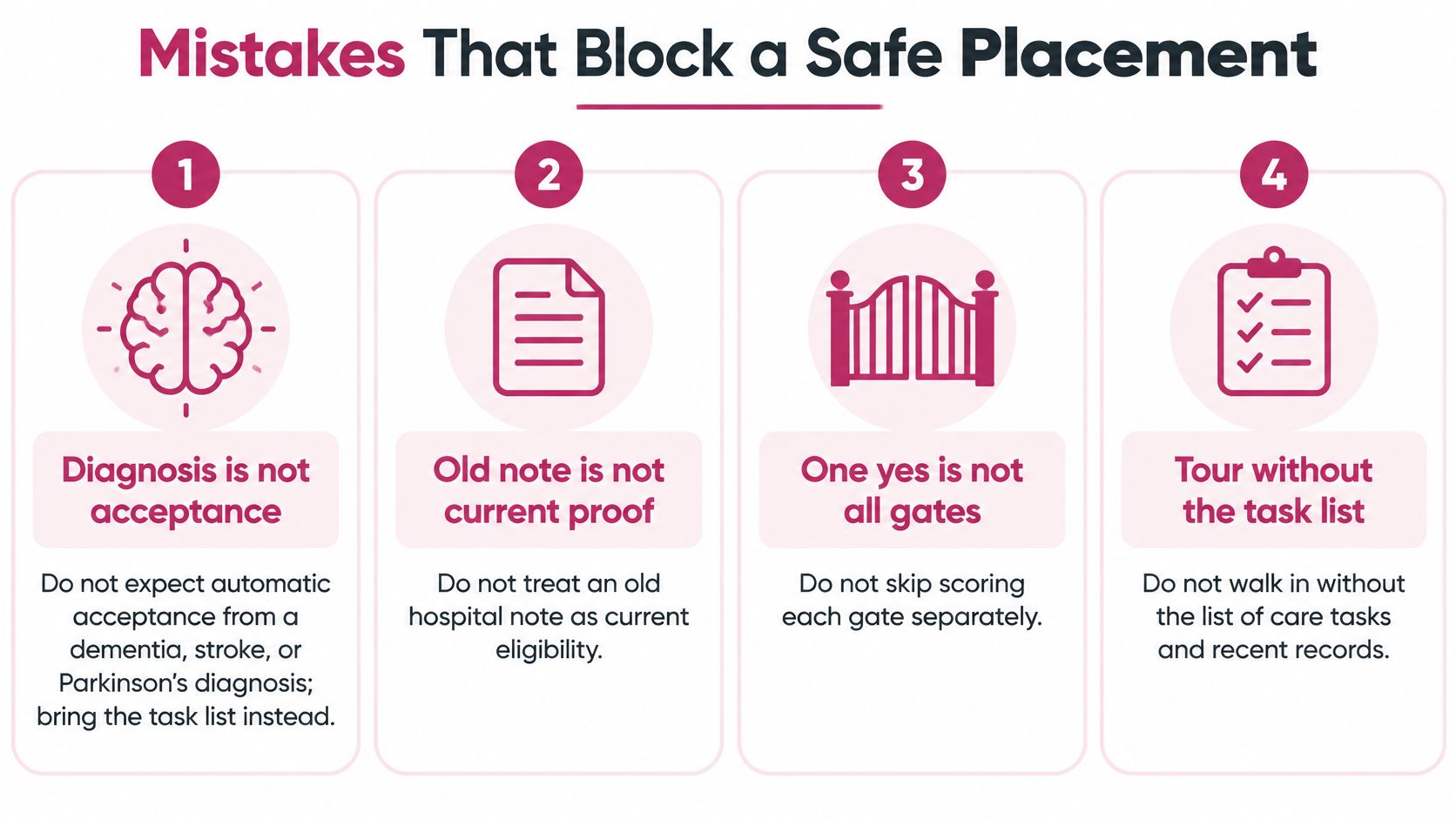
Walking into a tour with a dementia, stroke, or Parkinson's diagnosis and expecting acceptance puts the conversation on the wrong footing. Bring the task list instead, and ask the nurse to explain which needs the residence can meet.
The U.S. News guide to assisted-living qualification emphasizes current functional performance, cognitive safety, medication complexity, and the facility's capabilities rather than diagnosis alone. Use the tour to test those specifics, not just the apartment's appeal.
Turn each concern into a question
- After a hospitalization: If the paperwork predates a fall, medication change, or decline in transfers, ask, “What updated assessment do you need before deciding?”
- During the evening-staff discussion: If your parent wakes confused or seeks exits, ask, “Who responds overnight, and what behavior would require a different setting?”
- At the fee presentation: If the residence accepts Medicaid only after a private-pay period, ask for that policy in writing before paying a community fee.
- When availability sounds vague: Ask whether the offered apartment is available under the intended payer and for the assessed care needs, rather than accepting a general statement that the building takes Medicaid.
Don't negotiate away a care mismatch
If the clinical fit is sound but the budget fails, compare a less expensive community or a safe home-care arrangement. A smaller care package is appropriate only if it still meets the assessed needs.
If skilled care must be continuous, ask the hospital discharge team or community clinician about nursing-home placement. Paying for a higher assisted-living tier won't make an unsuitable staffing model safe.
Before paying a deposit, put these questions in writing:
- Retention: What would make you discharge my parent?
- Care escalation: What would the fee become if bathing assistance increased substantially?
- Payment: Which payer will you accept on the move-in date?
Keep the written answers with the contract. If a sales explanation conflicts with the clinical team's assessment or the agreement, resolve the discrepancy before transferring money.
Choose the Setting and Build a Shortlist
Choose the setting around the help someone needs, not around the label the family finds most comfortable. An attractive apartment won't solve an unmet supervision need, and a medical diagnosis doesn't automatically make a nursing home necessary.
Match the starting point to the person
- If daily personal support is the main need, and the person is stable enough for residential living, start with assisted living for help with dressing, meals, and medication.
- If dementia makes supervision and a secure environment the priority, investigate memory care rather than assuming a standard apartment will work.
- If the person is active and home upkeep is the main problem, compare independent living.
- If assistance is intermittent and the home can remain safe, consider home care as an ongoing option or a bridge.
- If continuous skilled nursing is necessary, ask the clinical team about nursing-home placement rather than continuing an unsuitable assisted-living search.
Shortlist only communities that match
Choose the preferred town or travel area, then filter for the actual care tasks and sustainable budget. Use a simple comparison sheet with columns for clinical acceptance, overnight support, total quoted cost, payer acceptance, and current availability.
A useful assisted living community comparison should consider daily support and living arrangements together. Tour with the care summary so each residence evaluates the same person, not a different version of the story.
Before moving money or giving notice, read the contract, care-tier schedule, admission and discharge policies, and state survey results. Ask how the residence corrected identified problems and how it communicates changes in care or charges.
We review state survey reports, physical safety standards, and operational histories when helping families evaluate local options. Our care quiz can also help narrow down which level of assistance makes sense when the family isn't sure where to begin.
The shortlist is ready when each option can explain how it will meet the person's needs and provide written payment terms the family can sustain. Keep preferences such as dining, activities, and proximity in the decision, but don't let them substitute for that confirmation.
At Life Senior Placement, we offer free, objective guidance to help families evaluate New Jersey care options and choose an appropriate setting. Call (862) 398-2006 with your care summary, preferred location, and budget for guidance on local assisted living and home care services.


