
Your father says he's managing, but you've found missed pills in his organizer, and he's recovering from a bathroom fall. You're trying to work out whether he can stay home with help, needs assisted living, or requires nursing care. Meanwhile, he's worried that asking for help means losing control over his life.
A level of care assessment should turn those worries into specific questions about what he can do safely, what help he needs, and who can reliably provide it. You don't need to arrive knowing the right setting. You need a clear account of daily life, including the difficult moments that a brief conversation might miss.
What a Level of Care Assessment Measures
A level of care assessment is a structured review of daily function, cognition, medical complexity, safety, caregiver support, and affordability that helps identify an appropriate care arrangement.
It's not just a diagnosis check. An assessor needs to understand both a person's abilities and the conditions under which those abilities hold up. Someone may dress independently but forget to eat, or walk comfortably during an appointment but struggle to reach the bathroom at night.
The range of possible needs is substantial. The U.S. Administration for Community Living estimates that a person turning 65 has an almost 70% probability of needing some form of long-term-care services or supports during their remaining lifetime, while about one-third may never need that support. Those are population estimates, not a forecast for your parent.
What the assessment records and why it changes placement
| Domain | What the assessor records | Why it affects placement |
|---|---|---|
| Daily self-care (ADLs) | Bathing, dressing, toileting, transferring, eating, and the help each needs | Establishes hands-on staffing needs and daily personal care |
| Household tasks (IADLs) | Medication handling, meals, shopping, transport, and finances | Shows whether independent living is safe without regular support |
| Cognition and behavior | Memory, orientation, wandering, agitation, and supervision needs | Helps distinguish standard assisted living from secured memory care |
| Medical complexity | Diagnoses, wound care, intravenous therapy, complex medicines, and continuous observation needs | Identifies whether nursing or skilled services are required |
| Safety and falls | Recent falls, weight loss, medication errors, and continence | Identifies gaps requiring closer supervision or further evaluation |
| Caregiver capacity | Weekly hours available, backup coverage, overnight availability, and caregiver health | Shows whether a home-care arrangement is sustainable |
| Access and money | Housing safety, food, utilities, transport, benefits, deposits, and recurring fees | Identifies which recommended arrangements are realistically accessible |
ADLs are activities of daily living, the basic tasks of personal care. IADLs, or advanced activities of daily living, are the more complex tasks involved in managing a household and living independently.
According to an Administration for Community Living report to Congress, 54% of Americans aged 85 and older cannot perform critical activities of daily living and require long-term support, while more than 91% of older Americans have at least one chronic condition. Having a condition is therefore much less informative than understanding how it affects everyday life.
Ask for the reasoning: A useful recommendation connects each proposed service to an observed need, rather than relying on age or a diagnosis label.
The output should be a recommended setting or service arrangement with written reasons. You can question those reasons, correct missing information, and ask what alternatives would safely meet the same needs.
How Daily Function Scores Decide the Setting
Consider people who both have diabetes. One walks safely, dresses independently, checks blood sugar, and manages insulin correctly. Independent living may be appropriate because the person can perform essential tasks without another person's help.
The other needs hands-on assistance with bathing and transfers and cannot reliably follow the medication routine. Assisted living may be appropriate if the community can meet those needs and the medical situation is stable. The shared diagnosis doesn't produce the same placement recommendation.
How assessors describe help
The most useful assessment describes what happens during each activity, not merely whether the person completes it. Families can use this plain-language scale to understand the findings, although formal tools may use different labels:
- Independent: Completes the task safely without another person's help.
- Supervision: Needs reminders, cueing, setup, or someone nearby for safety.
- Limited hands-on help: Performs much of the task but needs physical assistance with part of it.
- Extensive help: Needs substantial physical support, including help bearing weight.
- Total dependence: Relies on staff or caregivers to perform the task.
Our guide to activities of daily living can help you describe these tasks before the assessment. Bring concrete examples, such as whether your father pushes himself out of a chair or someone must lift and steady him.
Frequency matters too. A person who needs occasional reminders has a different support pattern from someone who needs physical assistance whenever they get up. Record the difficult periods, including fatigue, pain, nighttime bathroom trips, and confusion after waking.
What a score can miss
The CMS Five-Star Quality Rating System guide describes ADL assessment using observed assistance and dependence, and uses deterioration in at least two late-loss ADLs, bed mobility, transfers, eating, and toileting, as a nursing-home quality indicator. That indicator is not a universal admission cutoff or an automatic instruction to move someone.
A useful record captures both the assistance usually required and the greatest level required when performance changes. It should also explain whether the person is recovering, stable, or losing function. Last year's successful arrangement may no longer cover today's needs.
Preserved self-care and mobility may support independent living with targeted help. Conversely, an apparently reassuring total score shouldn't obscure unsafe medication use, behavioral symptoms, or skilled medical needs.
Before accepting the interpretation, ask:
- Frequency: How often is help required, and during which tasks?
- Direction: Is the need stable, improving, or worsening?
- Coverage: What do these findings mean for nighttime assistance and supervision?
Those answers are more actionable than a score without explanation.
Which Care Setting Fits Which Assessed Profile
Find the profile closest to the assessment findings, then read across to the support and warning sign. Treat this as a conversation guide, not an admission rule. Each provider must confirm that its staffing, services, and clinical capabilities match the person's actual needs.
Assessed profile, care setting and its warning sign
| Care setting | Typical assessed profile | Support on site | Warning sign it does not fit |
|---|---|---|---|
| Independent living | Intact daily self-care; mainly wants housekeeping, meals, or amenities | Minimal on-site personal care | Daily-living dependence or unsafe medication handling without reliable outside support |
| Assisted living | Needs help with bathing, dressing, or medication; cognition is stable or manageable within the program | Daily personal care and medication support | Nursing needs, frequent falls, or wandering beyond the community's capabilities |
| Memory care | Dementia with wandering, agitation, or ongoing supervision needs | Secured environment, dementia-trained staff, and structured routines | Medical needs beyond the program's clinical capabilities |
| Home care | Can remain safe at home when paid or family caregivers cover identified gaps | Scheduled caregiver visits, with registered-nurse supervision where included in the plan | Caregiver burnout, uncovered overnight needs, or unsafe gaps between visits |
| Nursing home | Requires round-the-clock medical supervision, rehabilitation, or complex health support | Licensed nursing around the clock | Only routine daily-living help is needed and a less clinical setting could safely provide it |
Independent living offers the least direct care in this comparison. Assisted living adds daily personal assistance, while memory care provides a specialized environment for cognitive and behavioral needs. A nursing setting adds clinical resources that personal-care services alone may not supply.
Home care isn't a fixed rung on that ladder. It's a way of delivering support in someone's home, and its suitability rests on the services, caregiver coverage, and environment arranged around that person.
Where straightforward matching breaks down
Someone with dementia may be medically stable yet repeatedly leave home and become lost. The central issue is safe supervision, so standard assisted living may not provide the right environment even when bathing and dressing remain intact.
Conversely, someone may perform personal-care tasks independently yet need intravenous therapy or continuous nursing observation. The clinical team must decide whether those needs can be managed through home-based skilled services or require a nursing setting. Our comparison of skilled nursing and assisted living explains that distinction.
For a home-based plan, equipment deserves a separate review. DME Superstore's guide can help you compare hospital beds and safety gear, but equipment should match the clinical team's recommendations and the caregiver's ability to use it safely.
A safer room can support a caregiver. It can't replace a caregiver who isn't available.
A higher-acuity setting isn't automatically the better choice. Unnecessary clinical services can increase costs without addressing a person's priorities. Take this table into the assessment conversation and ask which profile the assessor is using, what rules alternatives out, and what future change would require another setting.
How the Assessment Runs From Intake to Move-In
A placement advisor can organize information and help compare options. Clinical evaluation belongs to the clinical team. We don't evaluate clinical needs or determine eligibility for insurance coverage or public programs.
The interRAI assessment overview from Nebraska's Department of Health and Human Services describes standardized assessment of needs, strengths, and preferences to support care planning and monitoring. That's the useful principle: create a record that can be updated and compared, rather than relying on impressions from a single conversation.
The overview below shows the main phases; the detailed checklist adds the reviews that make those phases useful.
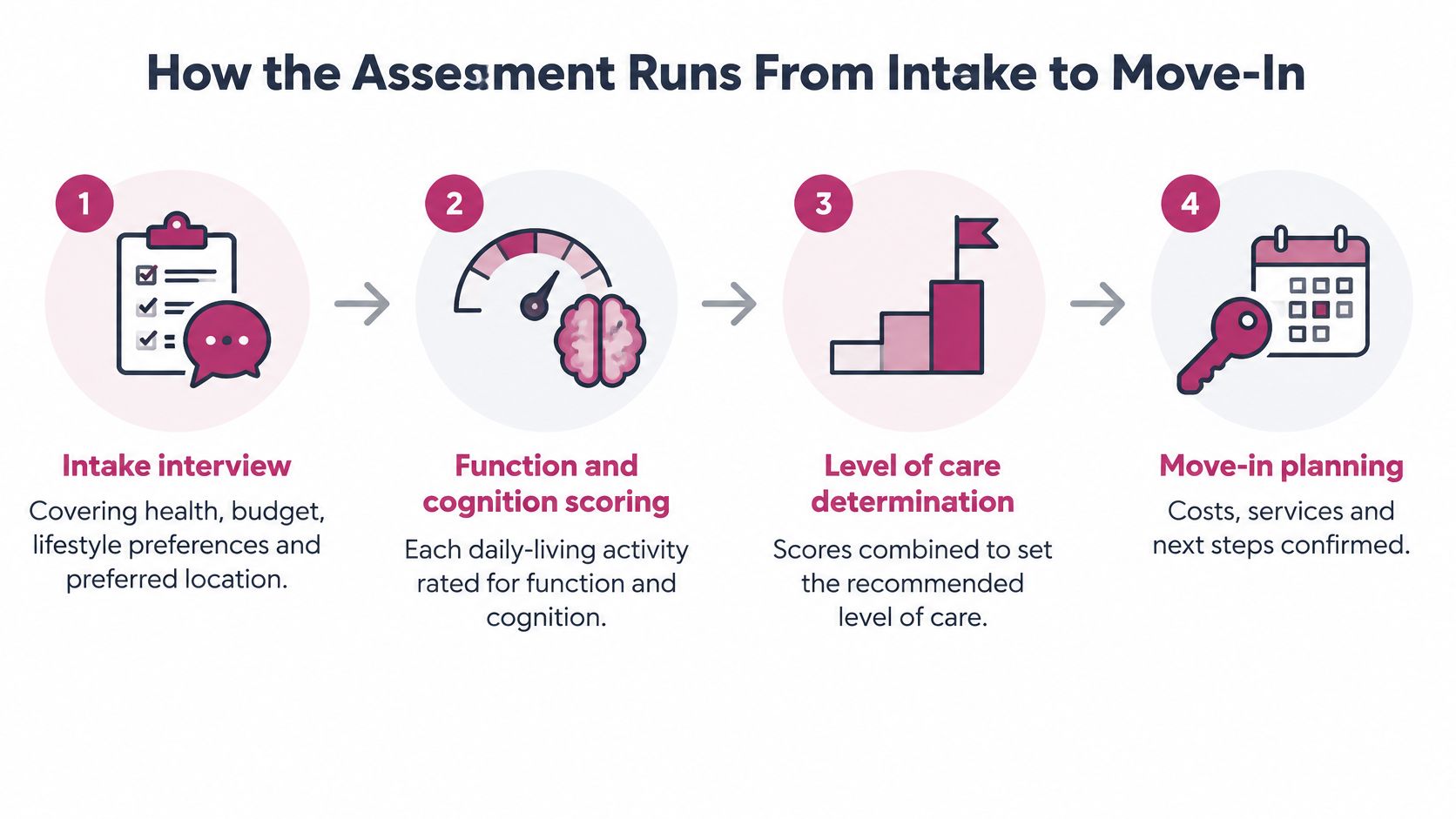
From intake to a usable care plan
- Start with the intake interview. Document health concerns, budget, preferred location, routines, and lifestyle preferences. Include the older adult's priorities so safety planning doesn't erase choices that matter to them.
- Assess function and cognition. The appropriate assessor reviews daily activities, memory, judgment, and supervision needs. Describe actual performance, including what happens when nobody prompts or assists the person.
- Review medical information and medications. Gather the current medication list, diagnoses, discharge instructions, fall history, continence concerns, and wound or treatment orders. This helps the clinical team separate routine personal assistance from rehabilitation, wound care, intravenous therapy, or other skilled needs.
- Check caregiver capacity before matching settings. Record available hours, backup coverage, nighttime availability, physical ability, and caregiver health. A home-based recommendation shouldn't assume that relatives can fill every gap left by scheduled services.
- Review access and affordability. Identify housing concerns, food access, transportation, available benefits, and the family's sustainable budget. Questions about coverage or public-program eligibility need to go to the appropriate insurer or program, not be treated as settled by a placement recommendation.
- Match settings and arrange tours. Compare the documented needs with each provider's actual capabilities, then consider location and personal preferences. On tours, we examine staffing, dining, activity levels, and included care, and ask questions on the family's behalf.
- Confirm the personalized care plan. The clinical team builds a detailed plan that the family approves before service begins. It should identify the help to be delivered, responsibilities, and any arrangements needed before the move or start of home services.
What to keep in the family's records
Ask for the assessment tool's name, its findings or score, the recommended setting, and the written rationale. Keep the assessment alongside the medication list and care plan so later reviewers can identify what changed.
Use this video as an additional conversation aid when preparing for the process.
A complete paper record also identifies unresolved questions and a reassessment date. It doesn't promise permanent suitability, guarantee admission, or establish insurance coverage. It gives the family and care team a shared starting point for decisions and future reviews.
How Caregiver Capacity and Cost Change the Answer
Say families are supporting parents with similar mobility and supervision needs. In one household, a son works remotely, can safely assist with transfers, and has dependable overnight backup. In the other, a daughter works outside the home and has nobody available at night.
The parents' clinical needs may be similar, but the safe arrangements may differ. Working remotely alone doesn't establish availability, and being a devoted daughter doesn't create overnight coverage. The assessment should record what each caregiver can realistically provide, not what the family hopes will be possible.
Make unpaid care visible
A 2025 scoping review published in Frontiers in Aging identified 140 studies and 29 different instruments addressing family-caregiver burden, stress, and needs. Ask which instrument the assessor uses and how the findings appear in the care recommendation.
A practical capacity check should document:
- Available time: Hours the caregiver can reliably cover, accounting for employment and other responsibilities.
- Backup: Who takes over during illness, travel, or an emergency.
- Overnight support: Who can respond when help is needed after bedtime.
- Physical ability: Whether the caregiver can safely assist with lifting and transfers.
- Behavioral demands: Whether wandering, agitation, or disrupted sleep exceeds the caregiver's ability to respond.
- Health and strain: Exhaustion, pain, emotional distress, or missed medical appointments.
- Transportation: Who can manage appointments, shopping, and prescription collection.
Sustainability matters: A plan that works only while a caregiver sacrifices sleep, employment, or health needs revision.
Compare the full cost of workable coverage
Don't compare an assisted living base rate with a small block of home-care hours if the home plan leaves essential periods uncovered. Compare arrangements that meet the same documented needs.
For residential care, request a written breakdown of housing, care-level charges, room type, deposits, recurring fees, and services billed separately. For home care, calculate the scheduled hours across the month and identify who covers the remaining time. Our senior living cost guide can help organize the categories for comparison.
We explain how care level, room type, and town affect a family's costs during the first call, at no cost. Bring a sustainable budget, not just the amount available for an initial move.
Caregiver resources change which arrangement can safely meet the need. They don't change the person's underlying clinical requirements, and a limited budget doesn't make an unsafe gap acceptable.
When to Reassess and Plan Your Next Step
Request a fresh assessment when daily life changes, rather than waiting until the arrangement fails. Keep a simple checklist where relatives and caregivers can record concerns.
- Falls: A new fall, repeated near-falls, or difficulty getting up safely.
- Hospitalizations: Repeated admissions or new discharge instructions that change care.
- Wandering: Leaving unsupervised or becoming lost.
- Weight loss: Unintended loss or signs that meals aren't being eaten.
- Medication errors: Missed, duplicated, or incorrect doses.
- Behavior changes: New confusion, agitation, or disrupted sleep.
- Caregiver health: Illness or declining ability to provide the agreed support.
Use this checklist to prepare for the next review.
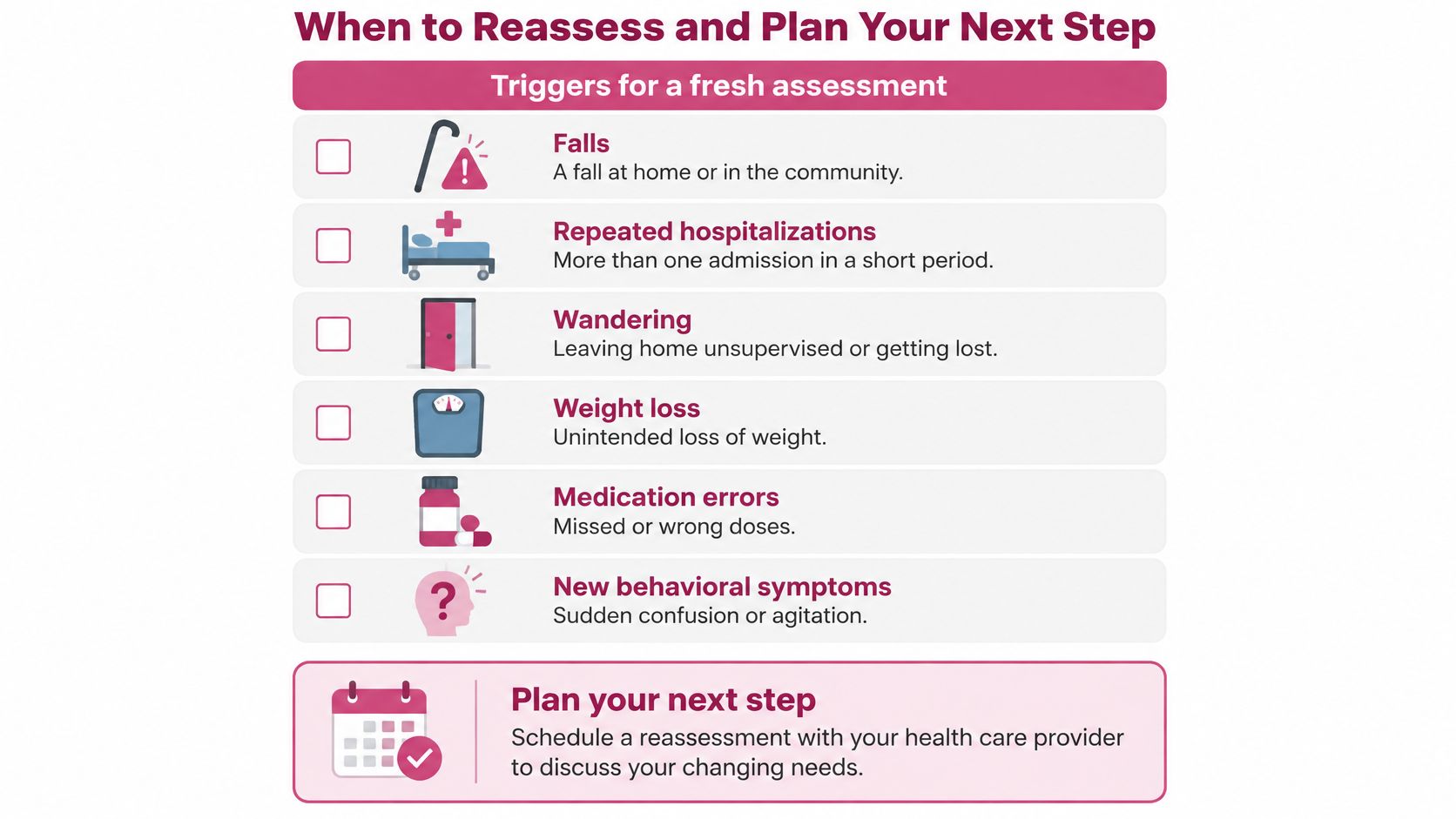
A sudden change in health may need prompt medical evaluation, not merely a placement appointment. Once immediate concerns are addressed, update the care record to reflect the new situation.
Prepare before discharge creates a deadline
For hospital discharges, our team usually arranges a move the same day by checking licensed communities with an open room, arranging a tour or virtual walkthrough, and coordinating with the discharge planner. That makes having the clinical assessment and discharge requirements ready especially important. An available room isn't enough unless the receiving provider can meet those requirements.
Access also needs explicit attention. OECD reporting on long-term-care settings identifies unmet long-term-care needs among people aged 65 and older living at home with ADL limitations. Needing care and receiving care aren't the same thing.
Check housing safety, food, utilities, transportation, language, cultural fit, and potential Medicaid or other public-benefit eligibility with the relevant program. Confirm that deposits and ongoing charges fit the available resources.
Put the fallback plan in writing
Keep a brief decision record with these entries:
- Recommended arrangement: The option that meets the assessed needs and preferences.
- Affordable safe alternative: A realistic arrangement that still covers essential care, with unresolved funding gaps clearly identified.
- Escalation option: The service or setting to consider if the current provider cannot meet increased needs.
- Review date: When the plan will be reassessed and who will arrange that review.
For the first call, bring the help level for each daily activity, caregiver hours available each week, and monthly budget. Call (862) 398-2006 for guidance on local assisted living and home care services, and request a recommendation with reasons.
On tours, ask about staffing, dining, activity levels, what the base rate includes, and which fees increase with added help. Before committing, request the reassessment date in writing and ask exactly how the plan changes if needs increase or the caregiver can no longer cover the gap.
Life Senior Placement offers a care quiz to help families narrow down a sensible starting point, along with no-cost guidance on local care options. Visit Life Senior Placement with your daily-care notes, caregiver availability, and budget to begin comparing arrangements that fit your family's situation.


