
You're standing in a New Jersey hospital hallway with a discharge planner's list in your hand. Your mother is medically cleared to leave, but she's not strong enough to go home alone. Someone says skilled nursing, someone else says assisted living, and you have days, not weeks, to decide. Getting the difference between skilled nursing and assisted living right at this moment protects her safety, your budget, and your ability to avoid a second move.
When Families First Face the Skilled Nursing vs Assisted Living Question
The call usually comes after a fall, a surgery, a stroke, or an infection that landed your parent in the hospital. The discharge planner hands you names of skilled nursing facilities and asks for your top choices. Meanwhile, a neighbor mentions an assisted living community in town that looks like a hotel, and your parent insists she just wants to go home.
You're not choosing between two versions of the same thing. You're choosing between a medical treatment episode and a residential living arrangement. Confusing them leads to two common mistakes: sending someone who needs daily clinical care to a community that can't legally provide it, or placing someone who needs long term support into a short term rehab bed that ends without a plan.
Why This Decision Feels So Rushed
Hospital discharge timelines never match family decision timelines. Beds fill, insurance authorizations move on their own schedule, and your parent may look better on a good morning than she will manage at 2 a.m. At home. Adult children often tour under pressure, focus on dining rooms and apartment size, and skip the questions that determine fit.
- Clinical need right now: Does she need daily nursing, therapy, wound care, or IV medication?
- Function at home before admission: Was she already struggling with bathing, meals, or medications?
- Recovery goal: Are you trying to get her home, or are you choosing where she'll live next?
Don't start with buildings. Start with the job you need the setting to do for the next 30 days, and then for the next year.
That framing changes everything. A short rehab stay followed by assisted living is a common, sensible sequence. Assisted living directly from the hospital can also work, but only if she's medically stable and the community can meet her needs on every shift. My recommendation is simple: name the primary problem first, medical recovery or unsafe daily living, and let that answer lead your shortlist.
What Skilled Nursing and Assisted Living Are at Their Core
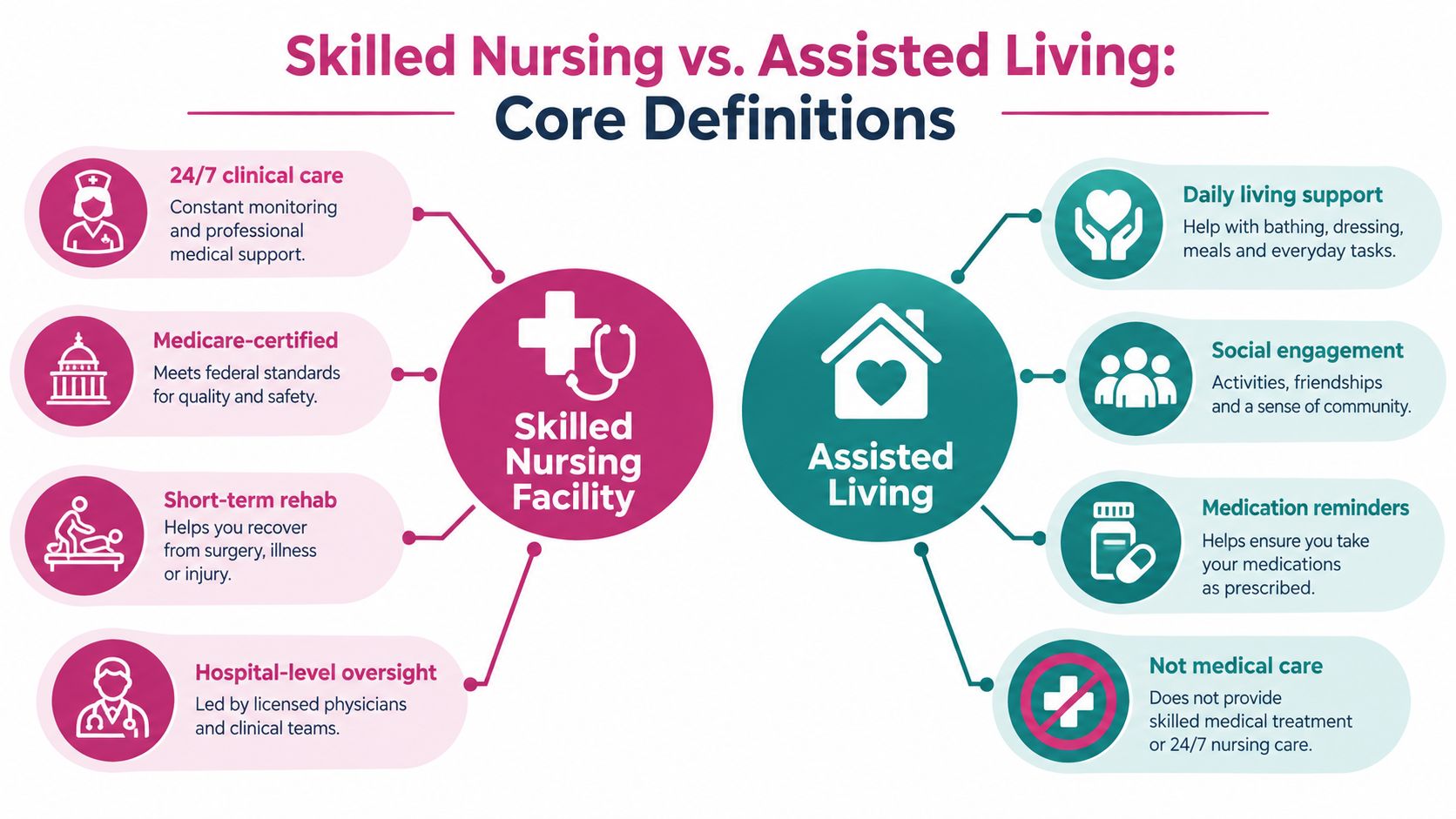
A skilled nursing facility (SNF) is a medically oriented setting for patients who need nursing or rehabilitative therapy that can be safely and effectively delivered only by qualified professionals, and under Medicare's definition of an SNF as primarily engaged in inpatient skilled nursing and rehabilitation, it must meet specific certification requirements, including hospital transfer arrangements. It's built for treatment, not for open ended residence.
Assisted living is primarily residential supportive care. It combines housing with meals, supervision, medication assistance, and help with activities of daily living. A person may live there for years. That doesn't make it a lesser version of a nursing home. It's a different model, governed largely by state rules rather than one uniform federal Medicare standard.
This visual summary captures the core distinction before you get into staffing and payment details.
The Practical Threshold
Ask one question: does this person need measurable, ongoing clinical intervention that requires licensed professionals? Post acute rehabilitation, complex wound care, intravenous therapy, and skilled nursing assessment point toward an SNF. If she's medically stable but can't safely manage bathing, dressing, meals, or medications, assisted living is usually the right starting point.
Scale confirms assisted living's residential role. National data show approximately 32,200 residential care communities, 1,313,600 licensed beds, and 988,800 residents in 2022, with 94% of residents age 65 or older and 52.8% age 85 or older, according to CDC data on residential care communities. About 6 in 10 residents needed assistance with three or more activities of daily living, yet the setting remained residential, not equivalent to 24 hour skilled nursing.
That's the line families miss. Needing a lot of hands on help doesn't automatically mean needing skilled nursing, and needing rehab after surgery doesn't mean assisted living can substitute for it.
Side-by-Side Comparison of Services, Staffing, and Stays
Licensure, staffing, and documentation separate these settings more clearly than brochures do. An SNF operates under federal Medicare and Medicaid certification. Assisted living operates primarily under state regulation, so permitted services and nurse coverage vary from community to community. You can't compare them by name alone. You have to compare what each building is staffed and licensed to do.
CMS requires SNFs to perform a standardized assessment using the Minimum Data Set and maintain documentation covering skilled services, patient response, treatment rationale, complexity, and future care planning, as described in CMS compliance guidance for skilled nursing facility services. Assisted living doesn't follow that same federal assessment system, which is why your tour questions matter so much there.
Skilled Nursing vs Assisted Living at a Glance
| Variable | Skilled Nursing | Assisted Living |
|---|---|---|
| Primary purpose | Daily skilled nursing and rehabilitation | Housing plus help with daily activities |
| Who provides care | Registered nurses, licensed practical nurses, therapists, physicians | Aides and caregivers, with nurse availability varying by community |
| Rehabilitation | Structured, medically ordered, often daily | Maintenance or outside therapy by arrangement, not the core model |
| Length of stay | Often a defined post hospital episode, sometimes long term for complex needs | Open ended residential stay |
| Regulation | Federal certification plus state licensure | Primarily state governed |
| Move trigger | Recovery, plateau, or change in medical necessity | Needs exceed license, staffing, or safety capability |
Where Families Get Misled
24/7 awake staff is not 24/7 licensed nursing. An assisted living community may have aides overnight and a nurse on call, which is very different from licensed nurses physically present on every shift. Ask specifically who is in the building at night, who can administer medications, who handles injections or wound care, and what happens after a fall.
Length of stay also changes your planning. An SNF episode is built around orders, goals, and reassessment. Assisted living is built around daily life, supervision, meals, and social programming. If you need treatment, choose treatment. If you need a safe place to live with support, choose that, but verify the ceiling of care in writing before move in.
How Costs and Coverage Actually Work for Each Setting
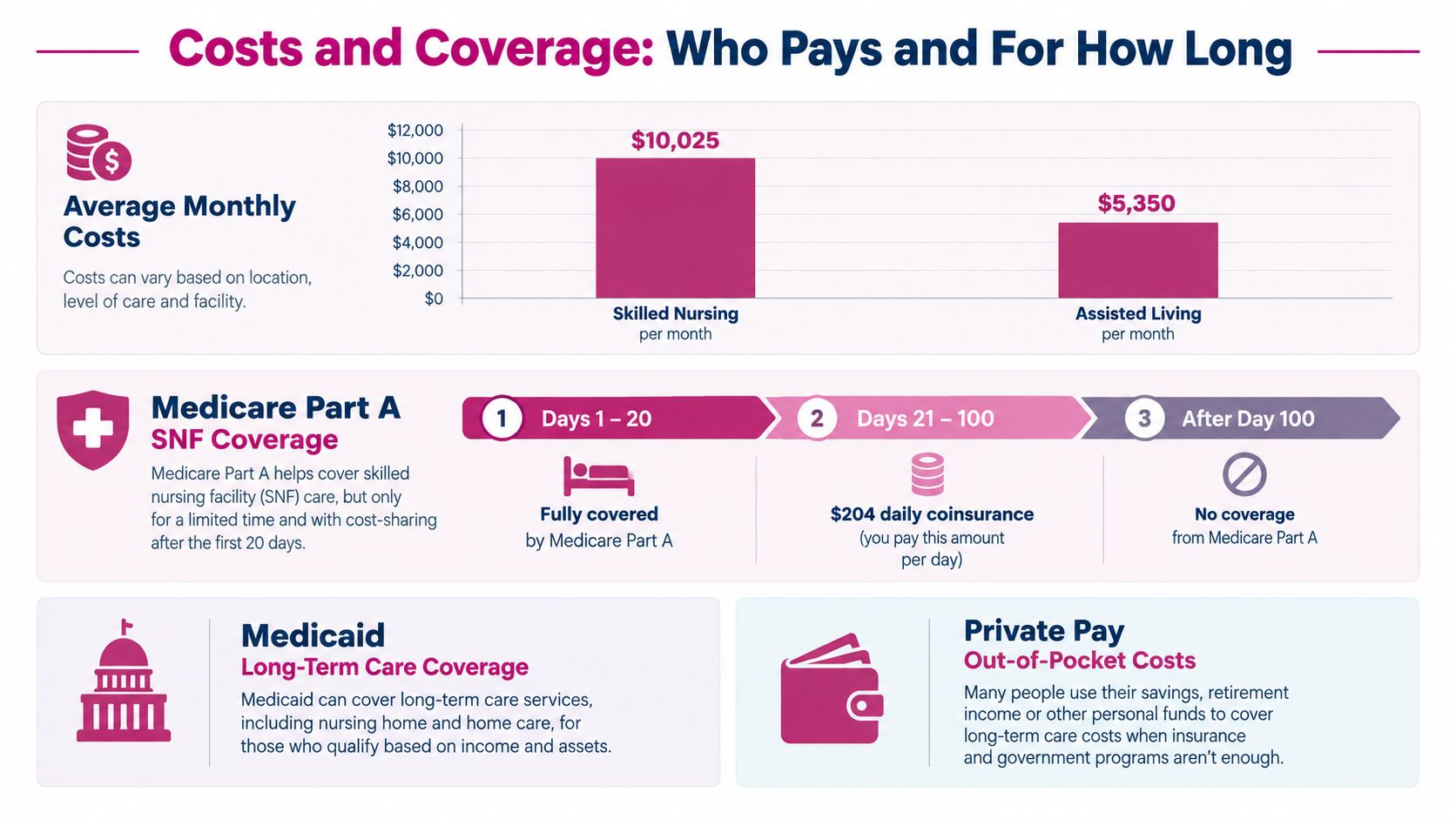
Medicare pays for skilled nursing under narrow conditions, and it generally doesn't pay for custodial assisted living residence. That single fact explains why a short rehab stay can feel affordable while a long term assisted living placement becomes a major monthly private expense. Families who don't separate these payment systems make budget decisions on false assumptions.
For a qualifying SNF stay, a beneficiary generally must have a medically necessary inpatient hospital stay of at least 3 consecutive days, begin SNF care generally within 30 days, and require daily skilled services ordered by a physician, with coverage up to 100 days per benefit period, the first 20 days fully covered and daily coinsurance on days 21 through 100, under the framework summarized in the core definitions above. After day 100, costs are generally not covered by Medicare.
The chart below helps separate the Medicare episode from long term payment planning.
Assisted Living Payment Is Different
Only 17% of assisted living residents had some or all of their long term care services paid by Medicaid in 2022, based on the national residential care figures cited earlier. Most families I work with should assume assisted living is private pay unless they've confirmed a specific benefit applies. Don't tour based on a hope that Medicare will cover the apartment. It won't cover custodial residence.
If Medicaid may become part of your plan later, review what NJ Medicaid covers for nursing home care before you sign anything, and ask each community directly whether it participates, what it requires first, and what happens if funds run down.
Budget rule: Price the next setting as if you'll need it for a year, even if you're hoping for a shorter stay. Optimism isn't a payment plan.
Get the full monthly picture in writing: base rent, care level charges, medication management, incontinence support, and added fees for higher assistance. Then compare that against the realistic duration of need, not the best case discharge story.
Hidden Staffing and Capability Gaps Inside Assisted Living
Two assisted living communities can carry the same label and deliver very different levels of clinical readiness. That's the gap most comparison articles skip. A memory care sign, a medication program, and a nurse's office don't tell you who is present overnight or what condition forces a transfer out.
Start by reviewing the staffing questions in this visual checklist before your next tour.
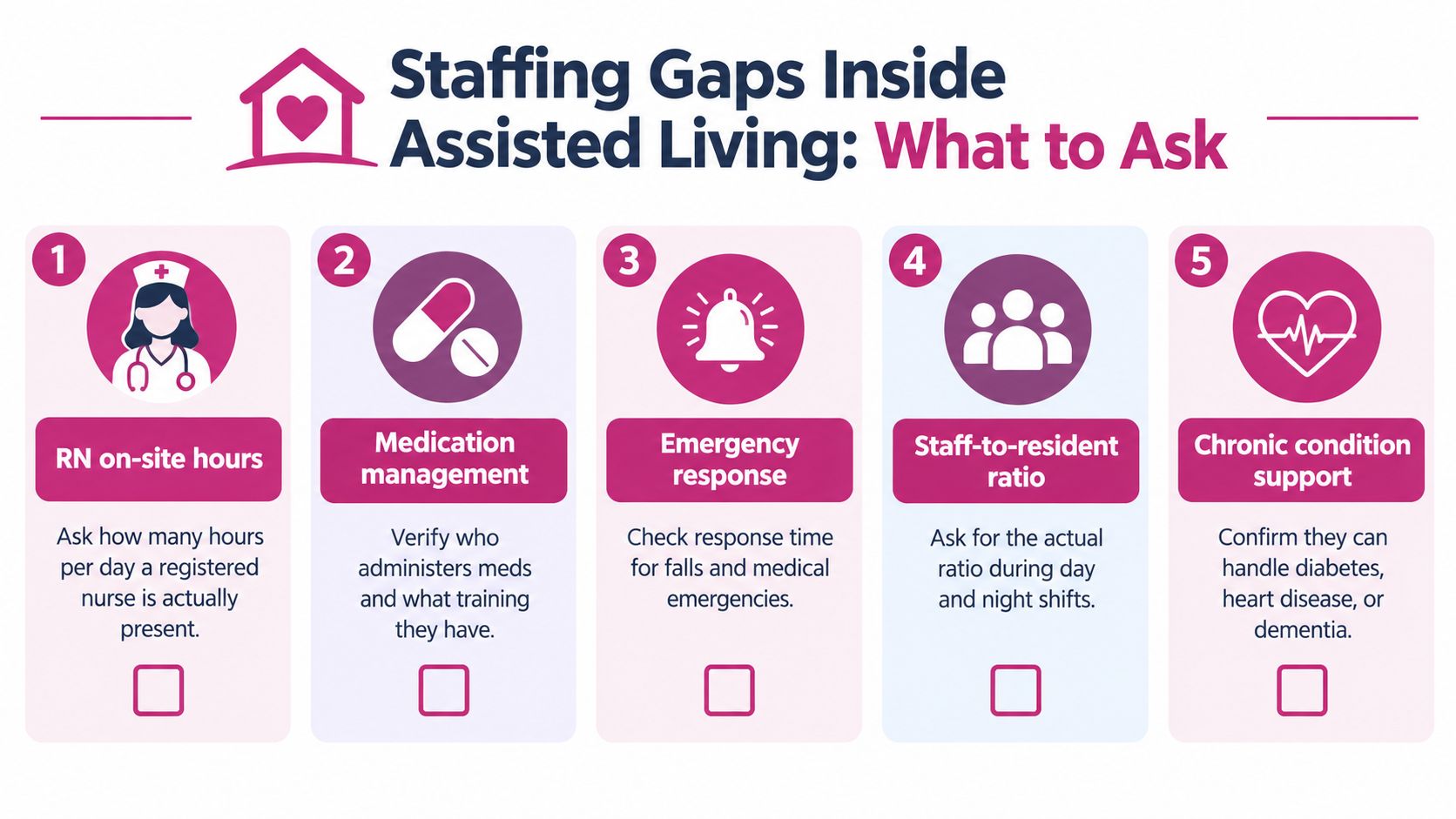
National staffing data show why specifics matter. Residential care communities averaged 2 hours and 48 minutes of nursing staffing per resident per day, aides made up 76.0% of nursing staff, 72.3% offered dementia care training, and only 58.4% offered end of life training, according to CDC data on long term care staffing. Those figures don't condemn assisted living. They prove you can't assume capability from marketing language.
Questions That Reveal the Real Ceiling
Use direct questions, and insist on direct answers. The video below is a useful prompt for what to listen for when administrators describe coverage.
- Overnight coverage: Is a licensed nurse physically present, or only on call?
- Medication scope: Who administers medications, handles injections, and manages changes?
- Escalation: What happens with wounds, falls, sudden deterioration, or hospice needs?
- Transfer policy: What specific conditions require a move to skilled nursing?
For a deeper set of prompts, review questions to ask about nursing home staffing ratios and adapt them to assisted living tours. If answers stay vague, treat that as an answer. A community that can't explain its limits clearly before move in won't manage them well during a crisis.
When Skilled Nursing Is Not the Automatic Choice
Rehab needed doesn't automatically mean SNF is the safest or most effective choice. That's uncomfortable for families to hear during discharge, because an institution feels safer than home. But the right question isn't which setting sounds most medical. It's which setting matches this patient's complexity, mobility, home safety, and caregiver capacity.
Medicare SNF eligibility generally requires a qualifying hospital stay and daily skilled care. Home health follows different eligibility rules and doesn't require a prior hospital stay. That distinction matters when a patient is medically stable enough to recover at home with intensive support, or when the long-term need is supervision rather than daily skilled treatment.
This consultation image reflects the conversation I want families to have before defaulting to the first available SNF bed.

What the Home Rehab Evidence Means
A 2025 peer reviewed study found that selected Medicare patients with low to moderate medical complexity and mobility deficits achieved better adjusted mobility outcomes through high intensity home rehabilitation than through SNF placement, with Medicare costs over 90 days approximately $17,123 lower and no difference in hospital length of stay or readmission odds, as summarized in MedPAC's post acute care overview.
Don't overread that finding. It applies to selected patients, not everyone leaving a hospital. People entering SNFs, home health, and inpatient rehabilitation differ substantially in medical complexity and functional status, so outcomes can't be compared casually.
Use this screen instead. If daily skilled nursing is required, home isn't enough. If she's stable, motivated, has a safe home layout, medication support, and a caregiver who can actually be present, ask the discharge team to compare home rehabilitation seriously. If home is unsafe even after recovery, assisted living may be the better transition than returning home alone.
Matching the Setting to Real NJ Family Situations
Diagnoses don't make placement decisions. Function, stability, safety, and caregiver capacity do. The same hip fracture can lead to an SNF, then home, or an SNF, then assisted living, depending on what life looked like before the fall and how recovery progresses.
Common Patterns I See
Post acute rehab after hip fracture or stroke. Start with skilled nursing if daily therapy or nursing is ordered. Reassess weekly. The transition trigger is progress toward safe mobility, medication stability, and a realistic destination, not just the calendar. If she can't manage stairs, bathing, or meals after rehab, assisted living becomes the next conversation, not a failure.
Gradual decline at home. No hospital event, but missed medications, weight loss, poor hygiene, and family exhaustion. That's usually assisted living, provided she's medically stable. Families sometimes explore modifications first, and a resource like Trademaster Construction aging in place can help you think through grab bars, lighting, and bathroom safety before deciding home is no longer workable.
Mid stage dementia with wandering risk. Don't rely on a general assisted living promise. Verify secure exits, overnight supervision, staff training, response protocols, and hospitalization thresholds. If behaviors, falls, or medical needs escalate beyond what staff can safely manage, skilled nursing or a more specialized setting may be required.
End of life with complex symptoms. Ask how hospice coordination works, who manages pain related medication changes, and whether staff have end of life training. Comfort focused care still requires competent escalation and communication.
Watch the first month closely. Repeated falls, missed medications, rapid weight loss, or frequent emergency calls mean the setting may not match the need.
Your goal isn't to pick a forever label. It's to pick the right setting for this stage, with clear triggers for reassessment.
A Practical NJ Placement Checklist and How an Advisor Helps
Don't tour until you've documented the need. Communities can't give you an honest yes if you give them a vague summary like mom needs some help. Case managers and admissions nurses make decisions from orders, tasks, frequency, and payer status. Bring that information with you.
Before You Contact Communities
- Referring diagnosis: What caused the hospitalization or decline?
- Therapy frequency: What physical, occupational, or speech therapy is ordered?
- Nursing tasks: Wound care, IV therapy, injections, or skilled assessment?
- Physician orders and duration: What's ordered, and for how long is it expected?
- Payer authorization: What's approved, what's pending, and what's private pay?
Skilled personnel can include registered nurses, licensed practical or vocational nurses, physicians, physical and occupational therapists, speech language pathologists, and audiologists, as outlined in CMS information on skilled nursing facility provider resources. If your loved one needs those services daily, say so plainly and screen accordingly.
On the Tour
Verify nurse coverage by shift, medication management scope, maximum assistance levels, transfer and lift policies, dementia security, hospice coordination, and escalation triggers. Ask what would make the community say it can no longer safely keep her. Write down the answer.
A placement advisor helps by compressing this process: structured intake, matched options from licensed and vetted communities, coordinated tours, and side by side comparison based on care need, budget, and location. If you want to understand that model first, read about senior care consulting and advisor support before you start calling buildings at random.
My advice is direct. Don't choose the prettiest building or the first available bed. Choose the setting whose license, staffing, and escalation plan match the hardest night your loved one is likely to have, not the best afternoon tour.
If you're weighing skilled nursing against assisted living after a hospitalization or a decline at home, Life Senior Placement can help you document care needs, compare vetted New Jersey options, and coordinate tours that match your budget and timeline. Start with a clear, no cost conversation about the right level of care by visiting Life Senior Placement today.