
The hospital wants a discharge plan, your parent says they're going home, and you're calling New Jersey assisted living communities between work meetings. Someone offers a tour. Someone else asks for medical records. Nobody has told you whether your parent's care needs and payment source will qualify.
Start with care acceptance and money, not an apartment reservation. Learning how to apply for assisted living means getting a community to confirm that it can support your parent, establishing who will pay, and putting those commitments in writing before move-in.
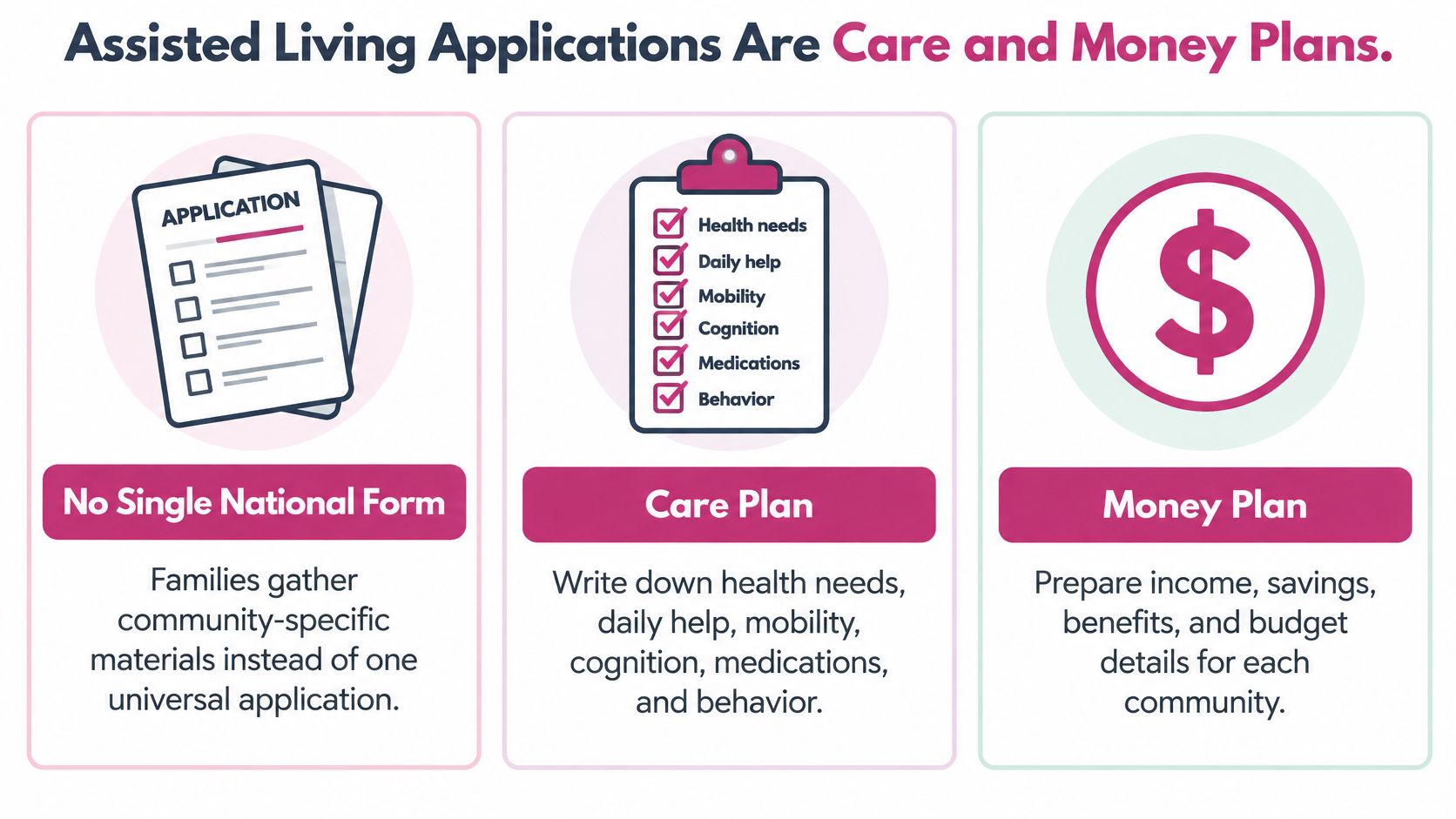
Assisted Living Applications Are Care and Money Plans
If a community offers an apartment before reviewing care needs and payment, don't treat that offer as acceptance. Assisted living applications combine two decisions: whether the community can meet your parent's needs and whether the payment plan can cover the stay.
Assisted living is generally privately funded. Medicare generally doesn't cover room, board, or routine custodial services. Use Genworth and CareScout's cost-of-care information to plan for long-term expenses, and don't assume a Medicare card or recent hospital admission establishes how the bill will be paid.
New Jersey Medicaid assistance follows state eligibility and program rules. Contact the New Jersey Medicaid agency early. Ask each community whether it participates and whether it has an appropriate opening for your parent's proposed payment source.
Build a plan admissions staff can evaluate
Prepare a short intake summary for the admissions nurse and financial office:
- Care needs: Diagnoses, mobility, memory changes, medication help, toileting, bathing, and behavioral concerns.
- Location: Preferred New Jersey towns and the distance family can realistically travel.
- Funding: Income, accessible savings, insurance, possible benefits, and committed family contributions.
- Budget and timing: A sustainable monthly ceiling, target move date, and any hospital discharge deadline.
Keep the summary focused on what the community must decide: whether it can provide the needed care and whether the proposed funding can support admission.
Screen licensed communities, request assessments, submit records, and review written acceptance and the admission agreement before arranging payment and move-in. An appealing apartment does not resolve a clinical or financial mismatch.
Ask about the payment transition now
Ask admissions whether the community accepts Medicaid-supported residents, whether an appropriate funded opening is available, and what happens if a resident enters privately and later needs public assistance. Get answers for your parent's proposed admission. General statements about a community's policies don't confirm that it can accept your parent.
If outside home care will supplement services, keep that provider's agreement separate from the residential contract. Review the provider's responsibilities and charges on their own terms, including any contract management for home care businesses arrangements.
Practical rule: A hospital discharge date is a deadline to coordinate around, not permission to skip clinical review or payment confirmation.
Papers and Payment Proof to Assemble First
Give the family a shared document checklist and assign owners. One sibling can request clinical records while another gathers financial statements and the person with signing authority reviews legal documents. Keep a dated master packet so admissions teams aren't evaluating different versions of your parent's condition.
The affordability pressure is real: the 2025 Caregiving in the U.S. Executive summary found that 63 million U.S. Adults provided ongoing care, while 28% of family caregivers reported difficulty finding affordable services. Your job isn't just to find a lower advertised rent. It's to establish a workable payment plan for the care being requested.
Application packet and what each item open up
| Item | What to collect | What it decides |
|---|---|---|
| Health and function | Diagnoses, mobility, cognition, continence, activities of daily living, behavior | Whether assisted living can accept the resident |
| Medications | Current list with doses and who administers them | Included service versus an extra medication fee |
| Recent records | Discharge summary and hospital or rehab notes | Pre-entry clinical review and required exams |
| Signing authority | Power of attorney or guardianship and advance directives | Who can sign the admission agreement |
| Income | Social Security, pension, and other monthly income | How much of the bill recurring income covers |
| Assets | Bank, investments, and home equity with sale timing | Private-pay duration, spend-down planning, and backup funds |
| Insurance and VA | Long-term-care policy terms and Aid and Attendance status | Benefit amount, waiting period, and start date |
| Medicaid | Application status and whether a funded unit is open | Eligibility versus an available Medicaid bed now |
Start with health and function, not just diagnosis names. Describe what assistance looks like: Does your parent need reminders to dress, hands-on help standing, or supervision because they leave the building? Identify the clinician who can explain recent changes.
Next, reconcile medications against the current discharge instructions. An old medication list can create avoidable questions or an inaccurate care quote. Ask the receiving nurse which records are needed and how to transmit them; SendItFax's guide on how to securely fax lab results can help with transmission preparation, but verify the recipient, consent requirements, and approved method directly.
Separate authority from family involvement
Being the adult child who answers every call doesn't automatically establish authority to sign for a parent. Supply the relevant legal documents and ask the community to confirm who signs, in what capacity, and whether anyone is being asked to assume personal financial responsibility.
For insurance, collect the actual policy, not a recollection that your parent bought coverage. Ask about the elimination period, benefit limits, required documentation, and payment timing. For veterans' benefits, record whether an application is pending or an award is already active.
Finally, distinguish private-pay admission from public-benefit eligibility. An open Medicaid application doesn't prove that a particular community has an appropriate funded space. On the packet's cover sheet, name the payment source that can cover the needed care this month, and identify who will pay while anything else remains pending.
How to Apply From Assessment Through Move-In
Follow a clinical-first sequence. Under New Jersey's assisted living standards, assisted living includes coordinated supportive personal and health services available 24 hours a day to assessed residents, including some people requiring nursing-home-level care, and residents must receive an admission agreement describing services and related charges before or at admission. That doesn't mean every community can accept every applicant.
Follow the admission sequence
- Write the needs summary and target date. Include diagnoses, mobility, cognition, continence, medications, daily assistance, behavior, and preferred New Jersey location. Describe the resident's current condition, not how they functioned before hospitalization. Add the discharge planner's or clinician's contact information so admissions can resolve questions directly.
- Screen licensed communities before touring. Ask whether staff can legally and operationally support the specific needs you've listed. If your parent needs help transferring, explain exactly how that help is provided now. If there's wandering or resistance to care, disclose it. An apartment opening isn't proof of an appropriate care opening.
- Submit records for the pre-entry assessment. Have the clinician or hospital case manager send diagnoses, the reconciled medication list, functional notes, and recent hospital or rehabilitation records. Ask who conducts the assessment and who gives final clinical approval. Missing records can leave admissions unable to make a decision even when the family is ready.
- Get the service boundaries in writing. Request confirmation of included care, extra-charge services, overnight staffing, emergency response, and medication administration. Identify outside providers and who coordinates them. Ask what change in condition would require additional support or transfer, rather than accepting a broad assurance that the community can handle changing needs.
The visual below summarizes the larger milestones. Keep the detailed clinical and contract checks attached to your application.
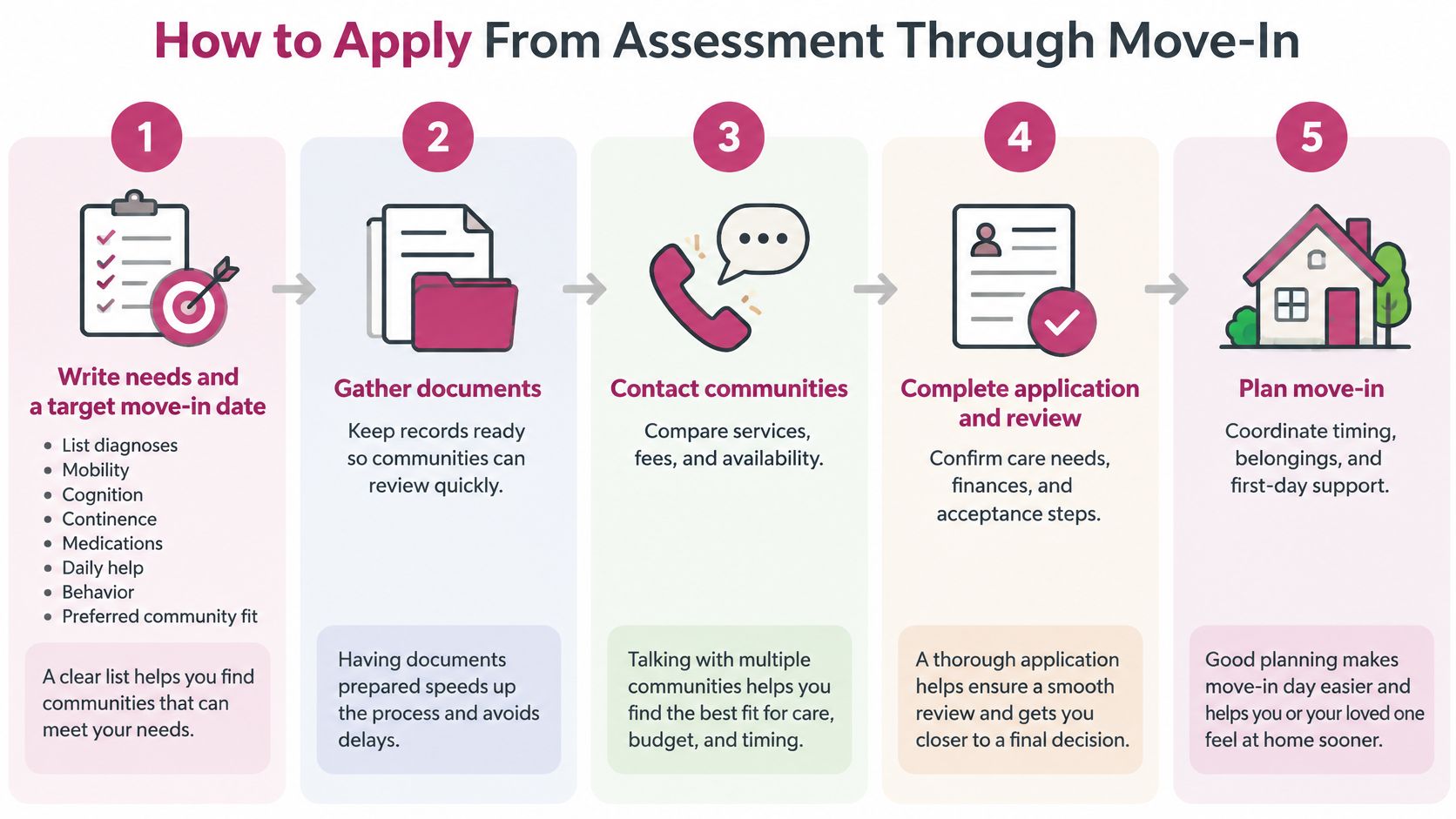
Turn an assessment into a confirmed admission
- Compare written offers on the same assumptions. Use the same care summary and apartment preference for each quote. Compare total annual spending, care scope, staffing arrangements, and exit conditions. If you need help coordinating the search, assisted living placement guidance explains how advisor support fits into the process. It doesn't replace the community's clinical approval.
- Read the admission agreement before committing. Match the agreement against the assessment and fee schedule. If admissions promised a service that the agreement excludes or leaves unclear, request clarification in writing. A friendly conversation isn't a substitute for an enforceable description of responsibilities.
- Resolve outstanding conditions. Confirm required examinations, written acceptance, deposit terms, refunds, and discharge criteria. Ask whether acceptance remains conditional on another review. Record the assessment turnaround, deposit deadline, and earliest feasible move-in date alongside benefit-processing estimates so you can identify any privately funded gap.
- Coordinate payment and the handover. Pay when acceptance and the contract match the agreed care plan. Arrange medication delivery, prescriptions, equipment, transportation, and the receiving staff contact. Confirm who will meet your parent and how staff will receive the latest care instructions.
Choosing by décor creates the wrong kind of commitment. Families can become attached to an apartment before the nurse reviews the records, then face rejection or an unaffordable care quote. Let the assessment determine whether the tour is worth your time.
Build a Monthly Cost That Survives a Care Increase
A lower starting price can become the more expensive choice once care charges rise. Compare written 12-month estimates from at least three communities, including housing, assessed care, medication management, supplies, transportation, separately billed meals, and move-in charges. AARP's assisted living budgeting guidance offers a useful framework for comparing expenses.
All-in cost compared across three offers
Use this hypothetical comparison to see how the charges add up. The figures illustrate the calculation, not New Jersey market prices.
| Cost line | Offer A | Offer B | Offer C |
|---|---|---|---|
| Base housing per month | $5,000 | $5,400 | $4,700 |
| Care tier per month | $1,000 | $700 | $1,500 |
| Medication management per month | $200 | Included | $250 |
| Supplies and transportation per month | $150 | $250 | $200 |
| Community or move-in fee | $2,000 | $1,500 | $2,500 |
| 12-month total at quoted rate, including fee | $78,200 | $77,700 | $82,300 |
| One care level higher, repriced annual total, including fee | $86,600 | $86,100 | $94,300 |
| Rate notice and refund rule | 30 days' notice; fee nonrefundable | 60 days' notice; partial refund | 30 days' notice; fee nonrefundable |
For the first row of annual totals, multiply monthly charges by 12, then add the move-in fee. For example, Offer A costs ($5,000 + $1,000 + $200 + $150) × 12 + $2,000, or $78,200. The higher-care estimate uses a hypothetical $700 monthly increase for Offer A, $700 for Offer B, and $1,000 for Offer C. Confirm the community's actual rate-change notice and refund terms in writing.
Keep an annual comparison and a separate cash-due calendar. A move-in fee may be payable upfront, so a manageable average monthly cost does not guarantee you can cover the deposit and opening charges when they are due. Use the New Jersey assisted living cost guide for local budgeting context, then compare it with resident-specific written quotes.
Test the budget against changing needs
Calculate three scenarios: current care, one higher care tier, and a possible skilled-nursing transfer. For each, subtract recurring income from expenses and work out how much accessible savings would cover the shortfall. Keep funds needed by a spouse at home separate from funds available for placement.
Count insurance and benefits only after confirming eligibility, covered expenses, start dates, and reimbursement timing. Ask a qualified tax adviser about a proposed home sale before treating estimated equity as available cash.
A quote that works only while care needs stay unchanged is a fragile payment plan. Before choosing an offer, get written answers about reassessment frequency, rate-change notice, departure refunds, and what happens if funds run low. Confirm whether the agreement could require a move if the current payment plan no longer covers the cost.
Speed Placement After a New Jersey Hospital Stay
The discharge clock can make any available bed feel like a solution. It isn't. Fast placement is useful only when the receiving team can safely provide the care described in the discharge plan.
Use the hospital conversation to establish what your parent needs now.

The 2025 Caregiving in the U.S. Findings from AARP show that more than 40% of caregivers provide high-intensity care, while only 22% receive training for complex tasks such as injections or equipment management. Don't agree to fill a clinical gap merely because someone says the family can help.
Run the rapid-placement check
Before anyone promises a move, obtain:
- Discharge records: The summary, current medication list, and outstanding follow-up instructions.
- Functional assessment: Current transfer, walking, toileting, cognition, and supervision needs.
- Clinical review: The receiving nurse's review of the records and a clear acceptance decision.
- Authorized contact: The person who can consent and sign, with supporting documents ready.
During a rushed tour, ask how overnight coverage works and who responds when your parent needs hands-on assistance. For dementia, ask how staff handle exit-seeking and behavior changes, and whether the proposed placement is within a separate secured memory-care program.
Ask how staff respond to falls, administer medications, and decide that a resident needs transfer. Request the written policy, not just a reassuring example.
This video can support the family's placement discussion.
Choose the right destination
Assisted living is appropriate when the community confirms it can meet the assessed needs throughout the day and night. Ask the treating team about skilled nursing when medical or rehabilitation requirements exceed that capability. Consider home care when the team determines a return home is safe with a defined caregiver plan.
For a compressed timeline, use the New Jersey weekend hospital-discharge placement checklist to organize calls and responsibilities. Tell the discharge planner immediately if a proposed community hasn't clinically accepted your parent.
Refuse a fast bed that fails the care test. An avoidable second move means another handover, another adjustment, and another contract to evaluate while your parent is already vulnerable.
Confirm Payment and Care Fit Before You Sign
Your decision should be a documented yes or a deliberate pause. Don't let a tentative reservation become a commitment because nobody stopped to identify what remains unresolved.
Require a complete written decision
Before signing and paying, insist on these conditions:
- Clinical acceptance: The community has reviewed current records and accepted the actual care needs, including disclosed risks.
- Usable payment: A named funding source can cover the agreed services when charges begin, with responsibility assigned for any processing gap.
- Contract clarity: The agreement identifies services, extra fees, refund terms, and discharge rules, without relying on contradictory verbal promises.
If any condition exists only in a phone conversation, request written confirmation. If the agreement says something different, resolve the discrepancy before proceeding. A salesperson's reassurance shouldn't leave you guessing about the nurse's decision or the business office's requirements.
Signing test: Could another family member read the documents and explain who provides the care, who pays, and what could end the placement?
Finish the unresolved work this week
Complete the application packet and label missing items with an owner and a follow-up date. Reconcile the quotes against the same needs summary. Schedule assessments with communities that have indicated a plausible clinical fit, rather than spending your remaining time on unsuitable tours.
If discharge is imminent, give the hospital case manager a concise status update: records sent, clinical review pending or complete, payment established or unresolved, and the remaining move-in conditions. That makes it easier to address a specific obstacle instead of repeating the whole search.
A placement advisor can organize intake, narrow licensed options, coordinate tours, and stay involved in move-in calls. Confirm the advisor's terms and each community's fees directly; this guide doesn't verify individual arrangements. Advisor support helps adult children and hospital case managers manage the search, but it doesn't replace the clinician's assessment or your reading of the agreement.
Before move-in day, answer the contingency question in writing: If care rises to a higher level or Medicaid is still pending, where will your parent live, and who pays? If nobody can answer, the application isn't ready for a confident commitment.
Life Senior Placement offers New Jersey families intake based on care needs, budget, and location, along with community matching, tour coordination, and move-in support. Visit to discuss your parent's current needs and discharge timeline, and bring the medication list and funding summary so the search starts with clinical fit and a workable payment plan.