
Your mother is leaving the hospital, but the discharge planner needs an answer before you feel ready to give one. Your family is comparing assisted living communities online, calling places that don't return messages, and trying to understand whether a diagnosis, a walker, or help with medication changes the level of care she needs. Meanwhile, the community you like most may have limited availability or a waitlist.
This is why assisted living placement should be treated as a structured care decision, not a directory search. The right process starts with function, urgency, budget, and location, then turns those facts into a realistic shortlist and a clear touring plan.
Navigating the Senior Care Search
At 10 a.m., a family may be searching for assisted living in New Jersey. By lunchtime, they may be discussing memory care. By the afternoon, a hospital representative may be asking whether a move-in can happen soon. Every conversation adds another opinion, but none of it necessarily produces a safe decision.
That confusion is normal. Senior care information is scattered across directories, community websites, referral networks, hospital paperwork, and family recommendations. Each source describes services differently. One community may advertise medication support, while another may use the same phrase to describe a very different staffing model. Families can spend hours comparing amenities before confirming whether a residence can safely manage transfers, dementia-related behaviors, or post-surgical supervision.
The modern assisted living model itself is relatively recent. A historical review in The Gerontologist's account of assisted living's development traces the category's evolution in the United States from 1979 to the present. That history matters because families aren't choosing from a single standardized system. They're navigating a broad category that has developed across different community types and care models.
What an advisor changes
A placement advisor gives the family one consistent point of contact. Instead of asking every community the same basic questions, you provide your parent's health information, functional needs, financial boundaries, preferred area, and timing once. The advisor then uses those criteria to narrow the field.
That doesn't remove the family's responsibility to visit and decide. It removes the wasted motion. You still need to evaluate the residence, read the agreement, and confirm that the care plan is appropriate. But you shouldn't have to discover every possible option through disconnected searches while a move-in deadline approaches.
Practical rule: Start with the care problem and the deadline, not with a favorite building.
A useful placement conversation should answer four questions quickly:
- What can the senior do safely? Focus on bathing, dressing, toileting, transferring, walking, eating, and managing medications.
- What support is needed now? Separate current needs from possible future concerns.
- What can the family afford? Establish a realistic monthly boundary before touring.
- Where can the senior move soon? Availability matters as much as appearance when a discharge is pending.
Families often begin by asking, “Which community is best?” The better question is, “Which community can safely support this person, within our boundaries, on the timeline we have?”
Determining the Right Level of Care
A diagnosis doesn't determine placement by itself. Two people with the same diagnosis may need very different settings because their mobility, cognition, judgment, and ability to complete daily tasks aren't the same.
The most useful starting point is functional capacity, especially performance in Activities of Daily Living and Instrumental Activities of Daily Living. A policy synthesis from the U.S. Department of Health and Human Services identifies functional status as a central placement-relevant factor, and a long-term-care study cited in that synthesis found ADL and IADL performance to be the most predictive factor in a first discharge outcome.
Ask what happens during an ordinary day
Assess the senior without softening the answers. “She can bathe” may mean she can wash her face independently but needs someone nearby, help entering the shower, and assistance drying and dressing. “He manages medications” may mean he takes pills only when a family member fills a dispenser and calls to remind him.
Look at the actual tasks:
- Bathing and dressing: Can the senior complete these safely, or does balance, weakness, or confusion create risk?
- Transfers: Can the senior move from bed to chair, rise from a toilet, and get in or out of a vehicle?
- Toileting: Is assistance needed with timing, hygiene, continence products, or nighttime safety?
- Walking: Does the senior use a walker correctly, tire quickly, or require hands-on support?
- Medication management: Can the senior identify medications, follow instructions, and recognize a missed dose?
- IADLs: Can the senior handle meals, shopping, finances, transportation, communication, and appointments?
A senior who needs reminders and limited personal assistance may fit assisted living. Someone who needs secure wandering protection and dementia-specific programming may need memory care. Someone requiring extensive clinical oversight, complex rehabilitation, or continuous nursing services may need skilled nursing instead.
Don't use a community's marketing language as the final clinical answer. Ask the hospital team, primary physician, or rehabilitation professional to describe the assistance required, the restrictions after surgery, and the supervision level that would be unsafe to reduce.
For a family-friendly overview of the setting itself, review this complete guide to assisted living, then compare its general description with the senior's actual daily abilities. A placement advisor can help organize the information, but the community must confirm that it can meet the resident's needs.
The level of care also needs to account for change. A residence may accept a senior today but lack the staffing or clinical capacity to support a likely decline. Ask what happens when needs increase, which services are available on site, and when a resident must transfer elsewhere.
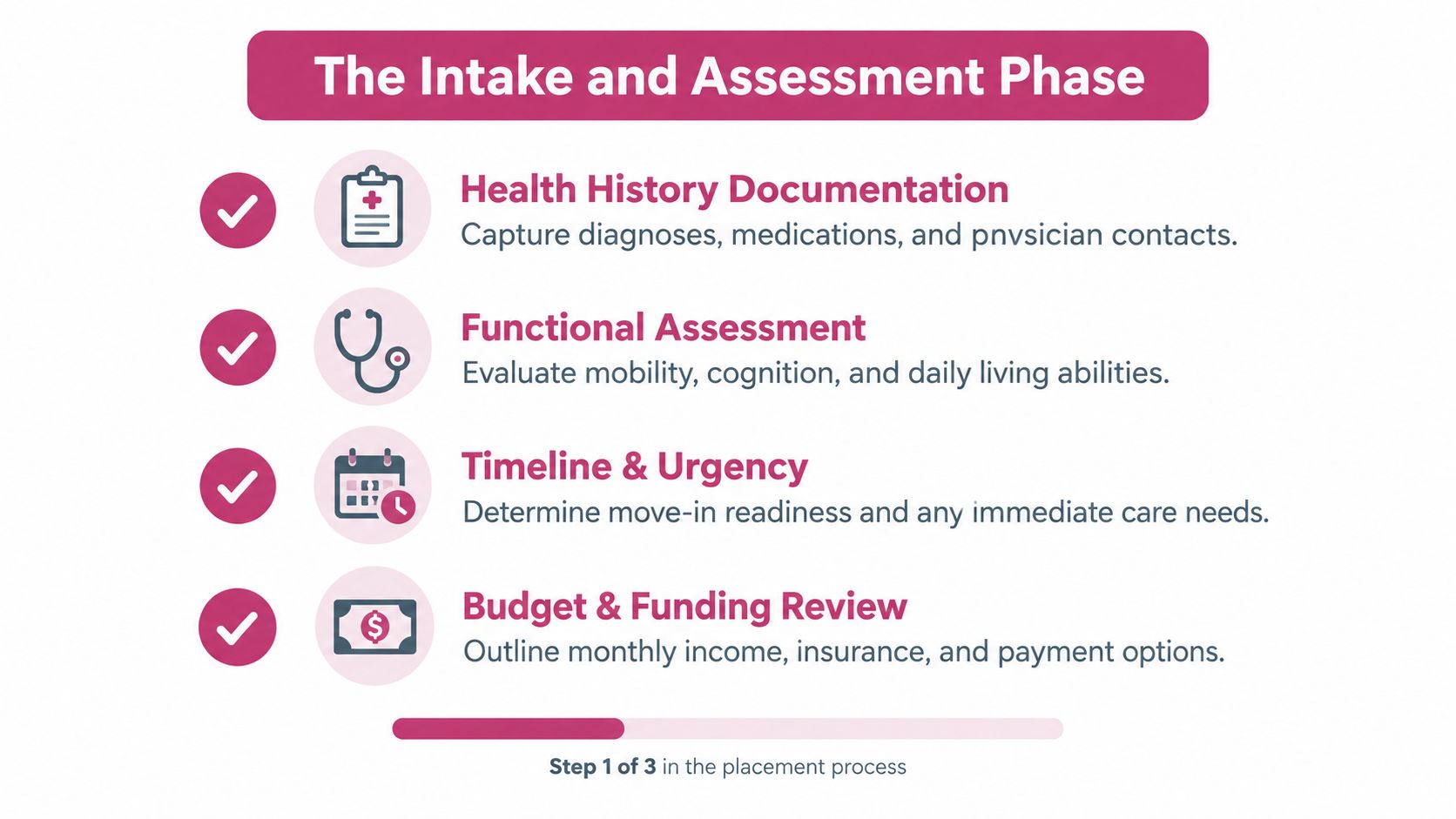
The Intake and Assessment Phase
The intake is where a stressful family story becomes usable placement information. A good advisor doesn't just record a diagnosis and a preferred town. They build a practical profile that communities can evaluate.
Start by gathering the documents and observations that will prevent repeated calls.
Prepare the core information
Bring or collect:
- Health history: List diagnoses, recent hospitalizations, surgeries, allergies, precautions, and current symptoms.
- Medication details: Include medication names, doses, schedules, and who currently administers or organizes them.
- Functional observations: Describe how the senior bathes, dresses, walks, transfers, toilets, eats, and handles nighttime needs.
- Cognitive and behavioral information: Note memory loss, poor judgment, agitation, wandering, sleep disruption, or resistance to care.
- Clinical contacts: Keep physician, rehabilitation, pharmacy, and hospital contact information available.
- Timeline: State whether the move is exploratory, planned, or tied to a discharge or urgent change at home.
- Financial boundaries: Identify income sources, available assets, benefits, insurance considerations, and the amount the family can sustain.
- Personal preferences: Record location priorities, room preferences, food needs, pets, religious or cultural preferences, activities, and transportation requirements.
Be specific about what happens at home. “Needs help” is less useful than “needs hands-on help standing from the toilet at night” or “misses medication unless another person stays present.”
Separate requirements from preferences
Mark each item as a requirement, a strong preference, or a convenience. Safe transfers, medication administration, memory support, and discharge timing may be requirements. A particular flooring style or dining-room layout is a preference.
This distinction keeps the search honest. If every preference becomes mandatory, the shortlist may disappear. If safety requirements are treated as flexible, the family may tour a community that cannot accept the senior.
The intake should also identify what remains unknown. If nobody knows whether the senior can manage a shower safely, schedule an assessment rather than guessing. If the post-hospital plan is unclear, ask the hospital team for written restrictions and rehabilitation expectations.
The purpose isn't to produce a perfect file. It's to give the advisor and each community the same accurate starting point. That reduces unsuitable tours, exposes missing information early, and makes availability checks more meaningful.
Matching Families to Vetted Communities
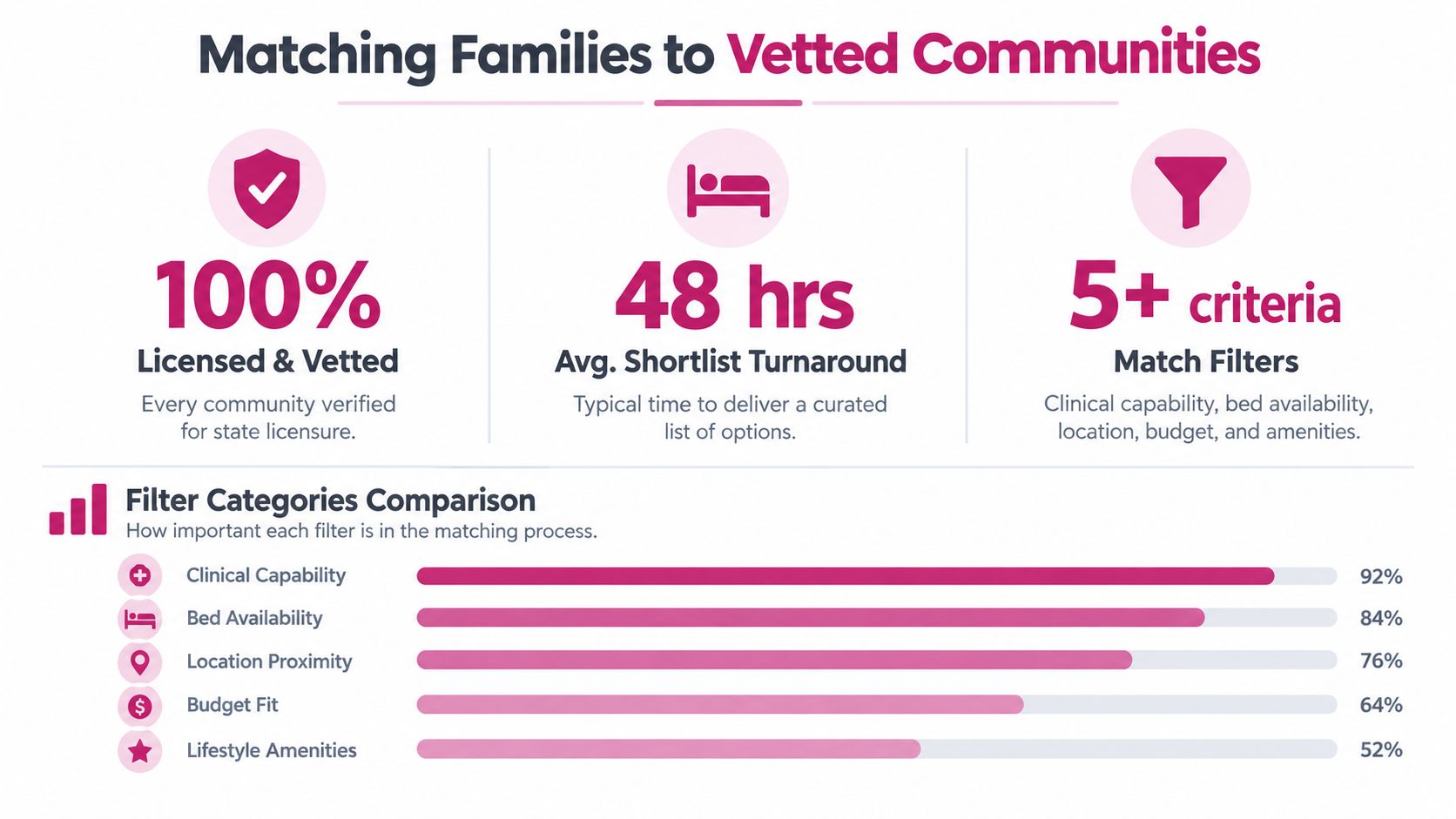
A shortlist should be built around care capability, current availability, and timing, in that order. A beautiful residence with no suitable room does not solve an urgent placement. A community with an open room is not a solution if its staff cannot safely support the resident.
The market makes this discipline essential. In the 31 NIC MAP Primary Markets, assisted living occupancy reached 88.4% in the second quarter of 2026, its twentieth consecutive quarterly increase. It was 84.3% in the second quarter of 2024, a gain of 4.1 percentage points across that period, while supply growth was only 0.3% year over year, below the long-run average of more than 3%, according to the 2026 assisted living market analysis citing National Investment Center data.
That combination means families can't assume the preferred room will remain open while they compare options casually. Availability changes, room types differ, and a community may have space for one care profile but not another.
Build a primary option and a backup plan
Your advisor should separate the shortlist into practical categories:
- First-choice match: Meets the care requirements, budget, location preference, and timing.
- Strong alternative: Satisfies the essential requirements but involves a manageable tradeoff, such as a different neighborhood or room type.
- Bridge option: Provides safe short-term support while the preferred community has no immediate opening or while the senior completes rehabilitation.
A backup isn't a failure. It's protection against a discharge deadline, a sudden change in condition, or a room becoming unavailable. Ask every community whether it maintains a waitlist, how it prioritizes openings, what deposit or application steps apply, and whether the listed availability reflects a room that can support the senior.
Post-acute placement requires particular care. Research involving Medicare beneficiaries found that discharge to skilled nursing after hospitalization was associated with lower odds of emergency department visits and readmissions than discharge home without home health, but higher odds of long-stay nursing home placement and mortality. For assisted living residents, the researchers emphasized that discharge planners need exact information about services available at the community. Review the study on post-acute transitions and assisted living service capacity with the care team when a hospital release is involved.
The advisor should ask direct operational questions, not just collect brochures. Can the community accept the resident on the required date? Can it provide the prescribed supervision? What happens if rehabilitation takes longer? What is the plan if the senior's needs exceed the community's capacity?
Families coordinating several providers may also benefit from practical guidance on simplifying healthcare management, especially when medication, physician communication, transportation, and rehabilitation all need to stay aligned during a move.
Touring and Evaluating Your Options
A tour should test the community's daily operation, not its staged presentation. A polished lobby tells you almost nothing about whether staff respond promptly at night, administer medications consistently, or help residents reach meals safely.
Visit at a normal activity time when possible. Observe whether residents are engaged, isolated, rushed, or waiting for help. Notice how staff speak to residents, whether they know names, and whether the environment feels calm without being overly quiet.
Use a care-focused tour checklist
Ask to see the areas that affect the senior's actual routine:
- Staffing and supervision: Who helps with bathing, transfers, toileting, meals, and nighttime needs? Ask how the community handles call-outs and changing care requirements.
- Medication management: Who orders, stores, administers, and documents medications? Ask how missed doses, refusals, and changes from a physician are handled.
- Mobility and safety: Check hallways, bathrooms, elevators, handrails, lighting, transfer spaces, and emergency response procedures.
- Memory support: If cognition is a concern, ask about secured exits, wandering response, staff training, behavioral support, and how the community manages a resident who becomes distressed.
- Food and hydration: Ask how the kitchen handles allergies, swallowing concerns, therapeutic diets, preferences, and missed meals.
- Activities and relationships: Look beyond the activity calendar. Ask how staff include residents who are frail, hard of hearing, or reluctant to join group events.
Request a sample care plan and a complete fee explanation. Ask which services are included, which trigger additional charges, how care levels are assessed, and how families receive updates. Don't accept “we'll determine that after move-in” without asking what information the community needs before admission.
Add post-hospital questions
A senior recovering from surgery or illness needs more than a welcoming apartment. Ask whether physical, occupational, or speech therapy comes to the community, who coordinates orders, and how staff communicate with the hospital, physician, pharmacy, and rehabilitation team.
Ask these questions plainly:
- Can the community accept the current mobility restrictions?
- Who helps with transfers while strength returns?
- How are follow-up appointments and transportation arranged?
- What symptoms trigger a call to the family or physician?
- How does the community respond if the resident falls, becomes confused, or needs more supervision?
- What services aren't available on site?
Use these questions to ask at every assisted living community during the tour. Write down answers immediately, because communities can blur together after several visits.
The right tour doesn't leave you impressed. It leaves you informed about what happens on an ordinary difficult day.
Benefits of Using a Placement Service
Searching alone gives you access to information. It doesn't guarantee that the information is current, comparable, or relevant to your parent's needs. Families often call communities one by one, repeat the same medical history, miss differences in care policies, and discover late in the process that a preferred residence can't accommodate the senior.
A placement advisor changes the workload. One professional can organize the intake, identify suitable communities, check current availability, coordinate tours, and help the family compare written answers. That matters when several relatives live in different places or when one person is handling a hospital discharge while working and caring for children.
The financial question
Many placement services operate at no cost to families because participating communities compensate them. Confirm the arrangement before sharing information. Ask whether the advisor works with every relevant provider, how recommendations are selected, whether the family can tour communities outside the network, and whether the service continues after move-in.
No-cost doesn't mean no responsibility. The family should still verify the admission agreement, monthly charges, care assessment, refund terms, and discharge policies directly with the residence. An advisor can clarify questions, but the contract controls the relationship.
The advocacy value
A good advisor does more than send names. They challenge vague answers, explain tradeoffs, and help the family avoid choosing based on a lobby, a sales presentation, or an attractive online listing. They can also help the family decide when to hold a backup room, keep a waitlist position, or consider a temporary setting.
Regional knowledge is useful in New Jersey because location affects hospital access, family travel, transportation, and familiarity with local providers. Current listings also matter. A community's website may show a service without clarifying whether it is available to a resident with a particular level of need.
Families looking for a structured process can review senior placement services and how they support the search. The key is to choose an advisor who explains the matching logic and gives you enough information to make an informed decision.
Exploring the Full Continuum of Care
Assisted living is appropriate for many seniors who need daily support but don't require continuous skilled nursing. It isn't the default answer for every older adult. The right setting depends on function, cognition, medical complexity, supervision, and the kind of help available at home.
| Care Type | Best Suited For | Key Features |
|---|---|---|
| Independent living | Active seniors who want less home maintenance | Residential setting, meals, activities, transportation, and household support with limited personal care |
| Assisted living | Seniors who need help with daily activities | Assistance with personal care, medication support, meals, housekeeping, activities, and varying supervision |
| Memory care | Seniors with dementia or Alzheimer's who need specialized structure | Secured environment, dementia-focused routines, cognitive support, and trained supervision |
| Skilled nursing | Seniors with complex medical or rehabilitation needs | Ongoing nursing oversight, clinical monitoring, rehabilitation, and support for higher-acuity conditions |
| In-home care | Seniors who can remain at home with reliable support | Personal care, companionship, household help, and health-related assistance delivered in the home |
Know when another option fits better
Independent living makes sense when the senior is safe alone, manages personal care, and mainly wants to stop handling home maintenance. It may also provide social connection and convenient services without introducing a higher level of care than necessary.
Assisted living fits when the senior needs regular help with bathing, dressing, medication routines, meals, mobility, or household tasks. The resident may still participate in decisions and activities, but staff provide support that family members can't reliably deliver every day.
Memory care deserves separate consideration when confusion, wandering, impaired judgment, or dementia-related behaviors create safety concerns. A general assisted living setting may support some residents with memory loss, but families need clear information about security, supervision, and progression policies.
Skilled nursing is the better direction when the senior needs ongoing clinical management or rehabilitation that assisted living can't provide. In-home care can work when the home is safe, the senior's needs are manageable there, and a dependable caregiver schedule can be maintained. It becomes less practical when the senior needs around-the-clock supervision, extensive transfers, or frequent clinical intervention.
Assisted living placement should include a plan for change. Ask what happens if the senior needs more help, develops advanced dementia, or returns from the hospital with new restrictions. A thoughtful placement decision doesn't promise that one setting will work forever. It identifies the safest fit now and clarifies the next step if care needs rise.
Life Senior Placement offers no-cost New Jersey guidance, structured intake, verified community listings, matched assisted living and memory care options, tour coordination, and support through the move-in process. If your family needs to secure appropriate care while availability is tight, visit Life Senior Placement to begin a focused placement conversation.