
New Jersey assisted living costs have a statewide benchmark of approximately $8,710 per month, or $104,520 annually, before additional fees and care-related charges. That figure is a planning baseline, not a guaranteed quote, because the final bill depends on location, apartment type, care needs, and how the community prices services.
Families often start by comparing advertised monthly rent. That's understandable, but it can produce a misleading budget. A community with a lower base rate may charge separately for medication management, bathing assistance, transportation, incontinence supplies, or memory-care supervision. Another community with a higher starting rate may include more services in its standard package.
The practical question isn't just, “What's the monthly rent?” It's, “What will this resident's complete monthly bill look like now, and how could it change as care needs increase?”
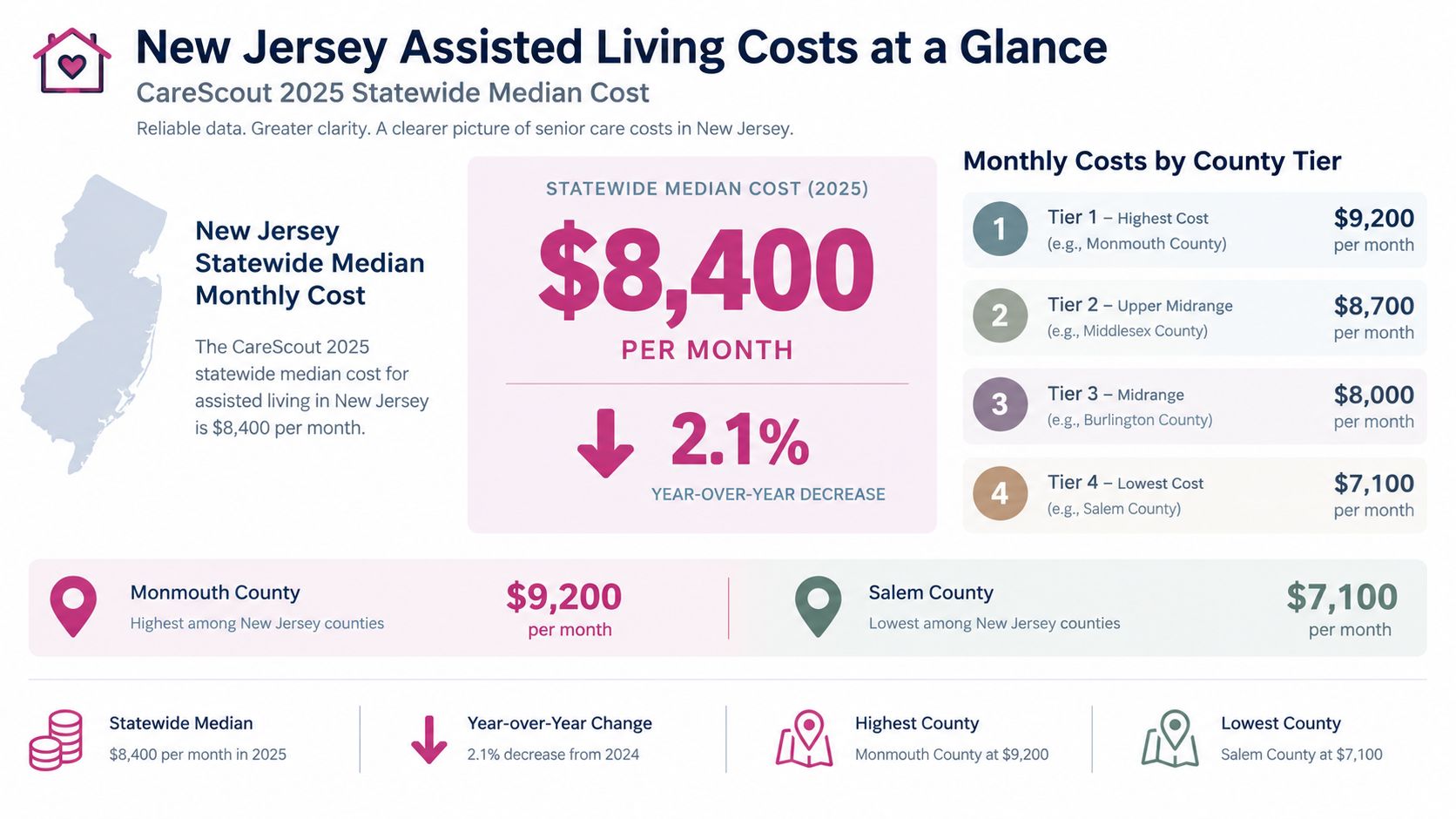
New Jersey Assisted Living Costs at a Glance
The benchmark many families see first is $8,710 per month, or $104,520 per year, for assisted living in New Jersey. That statewide median is useful for orientation, but it is not the bill most families end up paying. In practice, the gap between an advertised starting rate and the actual monthly total can be wide once care tiers, community fees, medication support, and other add-ons are applied. New Jersey also runs well above the national median, which is why budgets built on national averages often fall apart fast. (CareScout benchmark and New Jersey comparison)
A second benchmark helps confirm the same pricing reality. A 2024 Genworth survey put New Jersey's assisted living median at $8,548 per month, or $102,570 annually, compared with a national median of $5,900 monthly, or $70,800 annually. Genworth collected provider rate information from July through December 2024 across more than 140,000 long-term-care providers nationwide. (Genworth's 2024 New Jersey cost data)
Assisted living versus nursing-home care
Families also need the right comparison point. Assisted living and skilled nursing are priced differently because they provide different levels of supervision and clinical support. In New Jersey's 2024 benchmark data, a semi-private nursing-home room had a median cost of $12,380 per month, or $148,555 annually, and a private room reached $14,357 per month, or $172,280 annually. (New Jersey nursing-home and home-care benchmarks)
Home care can look cheaper at first glance, but that comparison often misses major household costs. The same benchmark showed homemaker services at $6,864 per month and home-health aides at $7,055 per month. Those figures do not include rent or mortgage, meals, utilities, transportation, and home upkeep. For New Jersey families, the actual budgeting question is the full monthly cost of safe care in each setting, and whether a resident may later need a level of support that changes what Medicaid will and will not cover.
How Location Shapes Your Monthly Rate
A statewide median helps with first-pass planning, but it can't tell you what a specific community will charge. New Jersey pricing changes with local real estate, labor markets, demand, apartment inventory, proximity to major employment centers, and the amount of private space included in the rate.
A family comparing a community near a dense metropolitan area with one in a less expensive region may see a meaningful difference in base pricing. That difference can be useful, but only if the lower-priced option provides the same service bundle. A studio with limited included care isn't directly comparable to a larger apartment with medication management, transportation, housekeeping, and broader staffing built into the monthly fee.
Compare regions, not just listings
Geographic flexibility can create a cost-control opportunity. A family might consider whether the resident needs to remain near a particular hospital, whether relatives can visit regularly, and whether a move to another county would affect social support. A lower monthly rate may lose its financial advantage if family members must travel farther, arrange additional transportation, or pay for services excluded from the base package.
Use a guide to assisted living costs by ZIP code as a starting point for organizing local research, then request current written quotes from individual communities. ZIP-level comparisons can identify patterns, but they won't replace a care assessment or itemized fee schedule.
Apartment type is another major variable. A private studio, one-bedroom apartment, shared suite, and specialized memory-care residence may each use a different pricing model. Ask every community to quote the same hypothetical resident, the same apartment category, and the same list of services. Without that consistency, families often compare a headline number rather than a comparable monthly bill.
Understanding Care Levels and Their Costs
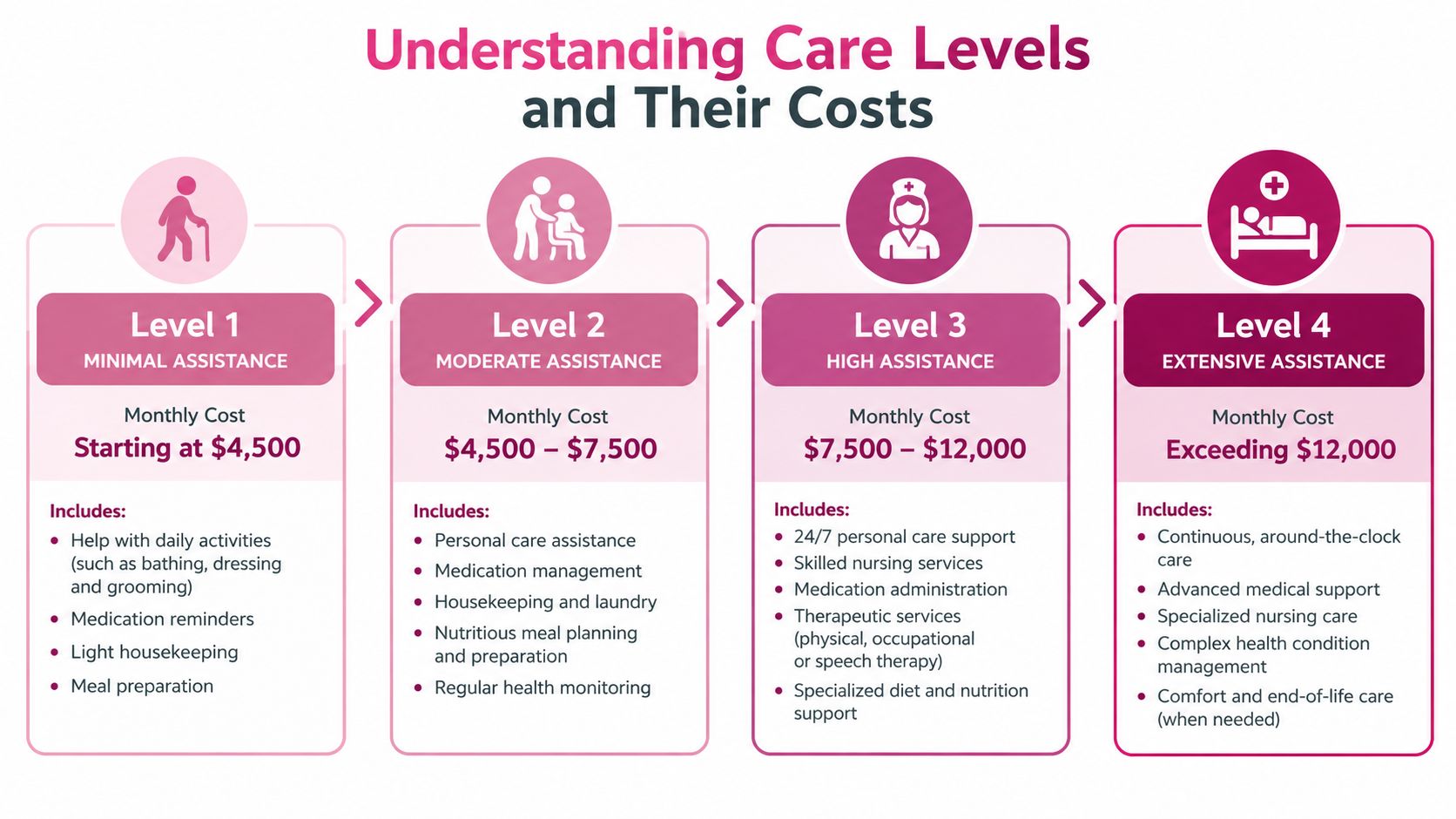
Assisted living pricing usually begins with a housing and service package, then adjusts after the community assesses the resident's needs. The assessment may consider mobility, bathing, dressing, toileting, eating, medication management, nighttime support, and supervision. Some communities use named care tiers, while others use points or individual service charges.
That structure creates the hidden gap between base rent and total monthly cost. A resident who moves in mostly independent may later need hands-on help with bathing, more frequent medication administration, or closer supervision. The community may then move the resident into a higher tier or add services line by line.
Ask what triggers a higher tier
Before signing, ask for the assessment criteria in writing. You need to know whether a single new need can trigger a full tier increase, whether services are billed individually, and how often the community reassesses residents.
A useful conversation includes specific scenarios:
- Medication changes: Ask whether additional medications, injections, or more frequent reminders change the fee.
- Mobility changes: Clarify how the community prices transfers, wheelchair assistance, or escorting a resident to meals.
- Personal care: Ask how bathing, dressing, toileting, and incontinence support are classified.
- Cognitive supervision: Determine whether wandering, redirection, or nighttime monitoring moves the resident into memory care.
- Temporary needs: Ask whether recovery after hospitalization creates a temporary surcharge or a permanent reassessment.
The New Jersey assisted living care-level pricing guide can help families organize these questions before tours. The best comparison isn't the community with the lowest initial tier. It's the community whose pricing rules remain understandable as the resident's needs evolve.
Practical rule: Ask each community to show the current monthly bill and the bill that would apply if the resident needed the next likely level of assistance.
Hidden Fees That Increase Total Costs
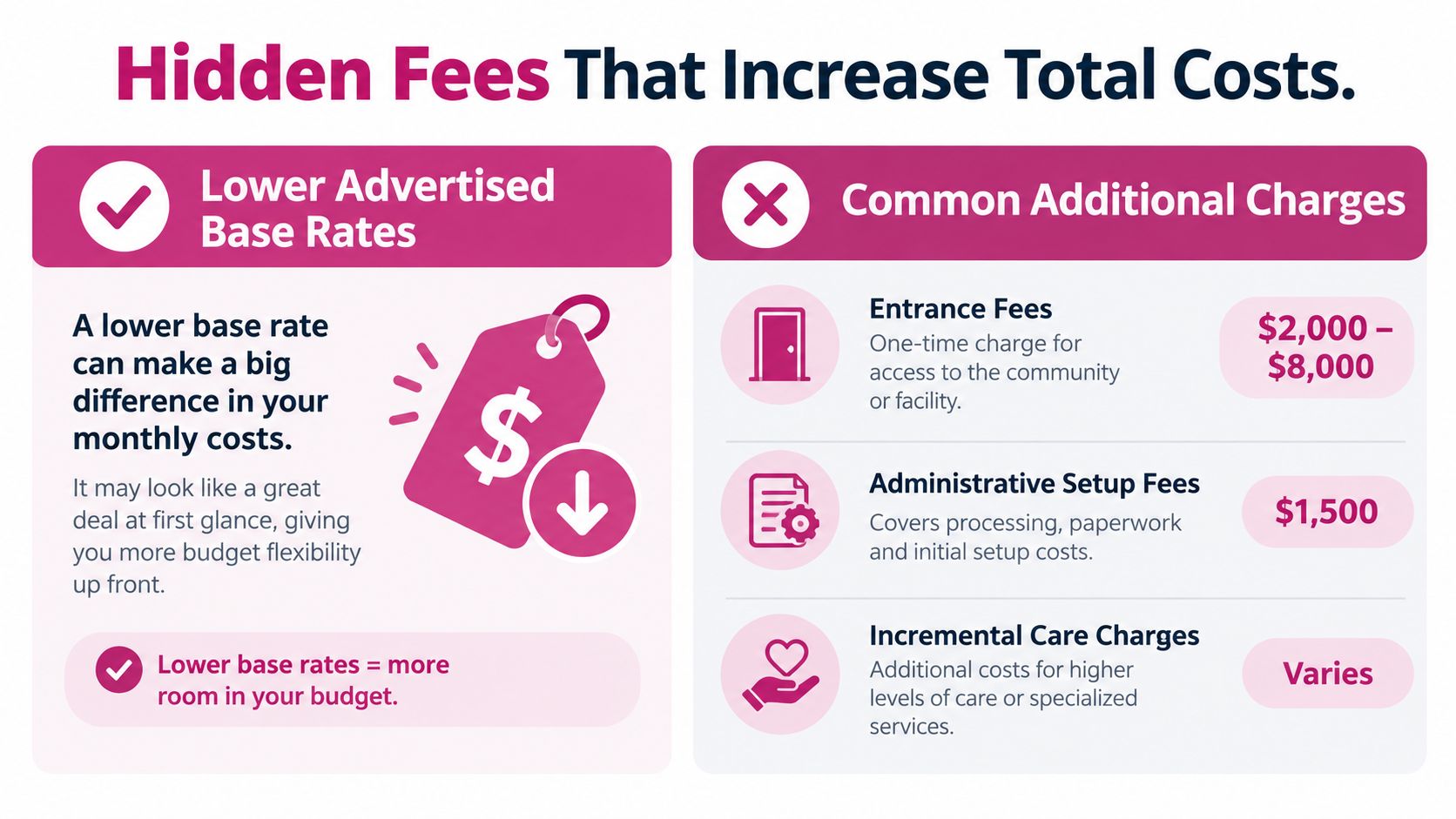
A lower advertised rate isn't automatically the lower-cost choice. The base rent may exclude one-time entrance charges, administrative setup, transportation, medication management, incontinence supplies, guest meals, enhanced activities, or dementia-related supervision. Each charge may be reasonable on its own, but the combined effect can change the first-year budget substantially.
Some communities bundle services into a broad monthly package. Others separate housing, care, and optional services. Neither model is better on its own. The problem arises when a family compares a bundled quote with an unbundled quote and assumes the lower headline price represents the lower total cost.
Build an apples-to-apples fee sheet
Request a written estimate that separates recurring and one-time charges. Include the apartment, meals, utilities, housekeeping, laundry, transportation, medication support, personal care, emergency response, and any memory-care supplement. Ask whether fees can change after an assessment and whether the community provides notice before increasing charges.
Your worksheet should also record:
- Move-in charges: Deposits, community fees, administrative fees, and apartment preparation.
- Care charges: Tier amounts, point values, minimum service packages, and reassessment rules.
- Ancillary expenses: Supplies, salon services, pharmacy costs, transportation, and guest meals.
- Transition costs: Charges that may apply if the resident moves to memory care or skilled nursing.
- Annual changes: Contract language covering rate increases, service changes, and notice periods.
Watch the video below as a general reminder that advertised pricing and total senior-care expenses don't always align.
The most reliable document is the community's itemized fee sheet paired with a sample monthly statement. If the sales conversation stays vague, treat that lack of clarity as a budgeting risk.
Payment Options and Financial Assistance in New Jersey
Most New Jersey families pay for assisted living in layers. Savings or monthly income often cover the early months, then long-term-care insurance, veterans benefits, or public programs may pick up part of the bill later. Medicare usually does not pay the ongoing room, board, and custodial portion of assisted living, so the practical question is not whether a family has help, but whether that help covers the parts of the bill that drive the monthly total.
Medicaid is the area where families get tripped up most often. New Jersey's Medicaid MLTSS program may cover eligible care services in an assisted living setting, but room and board usually remain the resident's responsibility, so approval does not erase the monthly bill. Families should confirm how much income must be contributed, what personal-needs allowance remains, and whether the community accepts MLTSS before they count on Medicaid to close the gap. (New Jersey Medicaid payment guidance)
The rate side matters too, because the state payment level and the community's actual charges are rarely the same thing. New Jersey's FY2025 Department of Human Services budget sets assisted-living Medicaid per-diem rates at $89.50 for assisted-living residences, $79.50 for full personal-care homes, and $69.50 for assisted-living programs. The proposed FY2026 rates are $98.45, $87.45, and $76.45. Those figures help explain why some buildings limit Medicaid inventory, require a private-pay period, or accept only certain residents under MLTSS. They are payment rates, not a guarantee that a specific community will take a Medicaid case at move-in.
| Care Type | Monthly Cost | Annual Cost | Medicaid Per-Diem |
|---|---|---|---|
| Assisted living | $8,548 | $102,570 | $89.50 |
| Semi-private nursing-home room | $12,380 | $148,555 | Not specified |
| Private nursing-home room | $14,357 | $172,280 | Not specified |
| Homemaker services | $6,864 | Not specified | Not specified |
| Home-health aide | $7,055 | Not specified | Not specified |
If money is tight now, start with the immediate pressure points. Families can find housing and food assistance while they sort out eligibility, gather documents, and compare settings.
The best sequence is straightforward: estimate how long private funds will last, review insurance and veterans benefits, ask the community whether it accepts MLTSS and under what conditions, confirm the resident's room-and-board obligation, and get answers in writing about what happens if funds run short. This guide on how to pay for assisted living without draining savings is also useful if the advertised rate looks manageable but the full monthly bill does not.
Building a Realistic Multi-Year Budget
A first-month quote rarely matches the bill a family ends up carrying over two or three years. In New Jersey, the gap usually shows up after move-in, when care needs rise, medication management changes, transportation gets used more often, and the community applies its annual increase schedule. The right budget starts with the contract, not a statewide average.
Break the quote into four working lines so you can see what is fixed, what can change, and what could hit all at once:
- Housing and included services: Record base rent, meals, housekeeping, utilities, and any services included in the package.
- Current care: Add the resident's present care tier, medication help, continence support, escorts, and other recurring charges.
- Variable expenses: List pharmacy delivery, supplies, salon, transportation, family travel, and personal spending.
- Transition reserve: Set aside room in the plan for memory care, short-term private duty help, skilled nursing, or a return home with paid support.
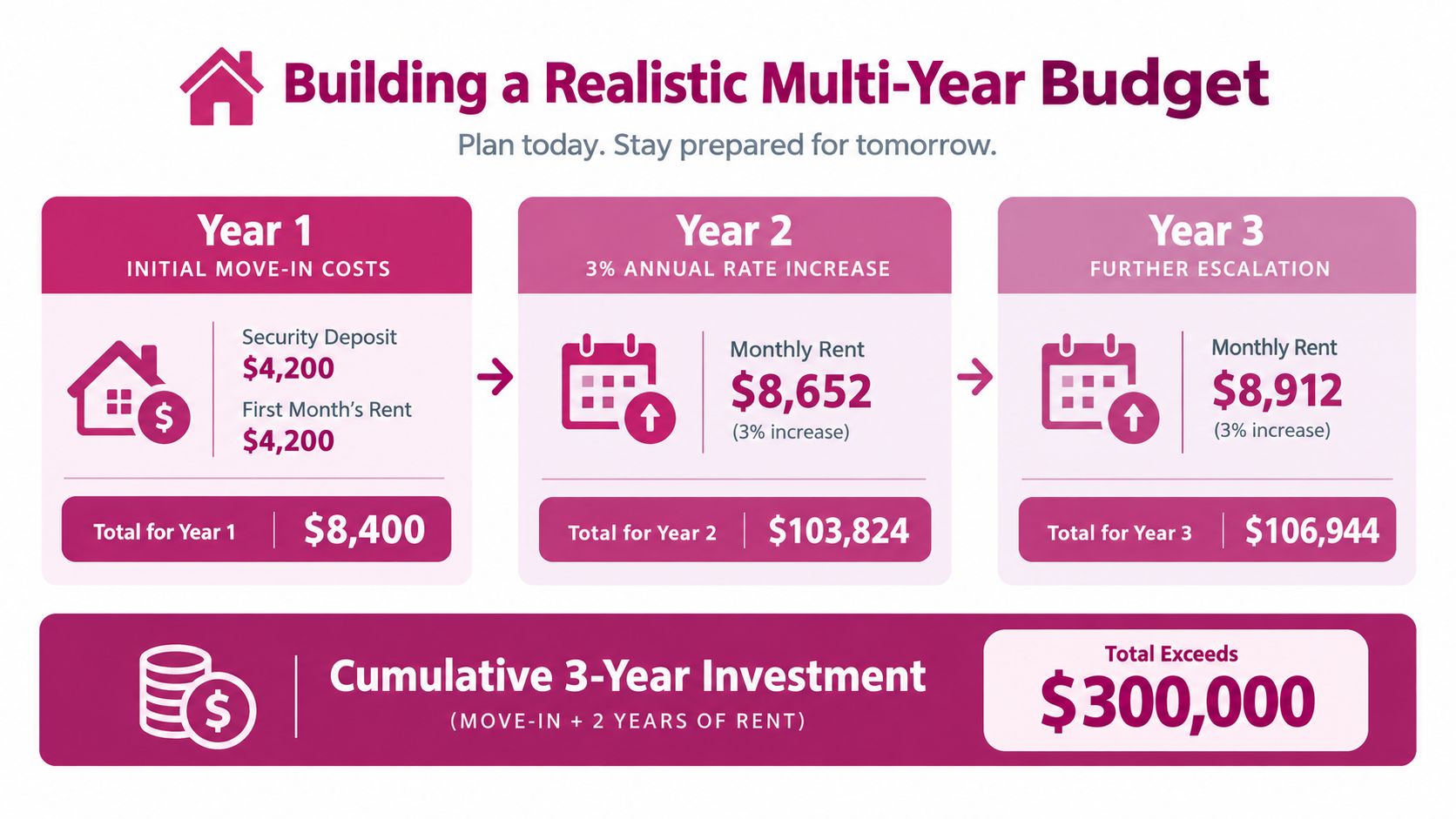
Start from the community's written quote, then apply the rate-increase language in the agreement to project years two and three. Build at least three versions of the budget: one where care stays stable, one where the resident moves up a tier, and one where a higher-acuity setting becomes necessary. That exercise shows whether the move is affordable only at admission or still workable after the resident's needs change.
A worksheet that exposes risk
A useful worksheet tracks more than monthly rent. For each year, record the expected monthly bill, any months spent at a higher care level, one-time fees, personal expenses, and remaining liquid assets. Also note which assets can be used quickly and which would take time to access.
I tell families to pressure-test the numbers with plain questions:
- How long will private funds cover the likely bill, not just the starting bill?
- What charge changes if care needs increase after a hospitalization?
- If memory care becomes the better fit, what does that do to monthly cost?
- If MLTSS may be needed later, can the resident stay in place, and under what conditions?
- Who in the family will review invoices and catch billing changes early?
A three-year view exposes trade-offs clearly. A lower advertised rent can produce a less predictable total bill, while a higher bundled rate may be easier to sustain.
Evaluating Communities with Cost in Mind
Touring should produce documents, not just impressions. Ask the executive director or admissions representative for a complete rate sheet, sample contract, care assessment, move-in fee schedule, and sample monthly invoice. If the community can't explain what causes a bill to change, you don't yet have enough information to compare it.
Use the same resident profile at every tour. Describe mobility, medications, bathing, dressing, toileting, nighttime needs, cognition, and transportation requirements consistently. Then ask each community to price the current situation and the next likely level of care.
Questions that expose the real price
- What's included? Ask for every service bundled into base rent.
- What's assessed separately? Request the point schedule or tier definitions.
- Who decides? Identify the person or team responsible for care-level changes.
- How often is care reassessed? Confirm whether reassessments occur routinely or after an incident.
- What happens after hospitalization? Ask about re-entry requirements, rehabilitation needs, and temporary charges.
- What happens if funds decline? Clarify Medicaid policies, private-pay expectations, and available transition options.
Families should also compare assisted living with staying at home, but they need to count the full home budget, including paid care, maintenance, meals, utilities, transportation, and supervision. A practical discussion of that alternative appears in Prime Journal's staying put article.
A no-cost placement advisor can help organize health information, compare communities, coordinate tours, and identify questions families may overlook. Life Senior Placement provides New Jersey matching and directory support across assisted living, memory care, nursing homes, independent living, and home care, with advisor assistance through selection and move-in.
Frequently Asked Questions About New Jersey Assisted Living Costs
Does memory care cost more than assisted living?
It can, particularly when the community adds secure supervision, specialized programming, higher staffing needs, or additional cognitive support. The exact difference depends on whether memory care is a separate monthly package, a care-tier increase, or a combination of base rent and individual services.
Ask for two written quotes using the same apartment and resident profile. One should show standard assisted living, and the other should show the community's memory-care pricing. Also ask what clinical or behavioral changes trigger a move, because a family needs to understand both the financial and operational consequences.
Will Medicaid pay for assisted living in New Jersey?
New Jersey Medicaid MLTSS may cover eligible care services for a qualifying resident in an assisted-living setting, but room and board generally remain the resident's responsibility. The resident also retains a limited personal-needs allowance and contributes remaining income toward costs. (New Jersey Medicaid guidance)
Eligibility alone doesn't guarantee placement. Ask whether the community accepts Medicaid, whether it requires private pay first, whether Medicaid units are available, and how the community handles a resident whose funds decline.
Does a Medicaid-accepting community guarantee priority access?
No. Acceptance policies, availability, admission requirements, and service authorization still matter. A community may accept Medicaid in principle but have limited openings or conditions affecting when a resident can transition to public coverage.
Get the answer in writing and ask who manages the application and authorization process. Families should also understand the room-and-board obligation before assuming public assistance closes the affordability gap.
What usually triggers a move to a higher level of care?
Common triggers include increasing help with daily activities, repeated falls, medication-management difficulty, wandering, nighttime supervision needs, or clinical requirements beyond the community's license and staffing model. The decision should follow an assessment and a clear discussion with the family.
Ask what services the current community can safely provide, what it cannot provide, and how much notice the family receives. Planning before a crisis gives you more choices than waiting until a hospital discharge creates an immediate deadline.
How can families compare communities fairly?
Use one resident profile, one apartment type, and one service checklist for every quote. Compare the 12-month total, not just the first monthly figure, and include move-in charges, care tiers, medication support, transportation, supplies, and likely transitions.
Keep the documents together and review them with someone who can challenge assumptions. The strongest decision is usually the one with the clearest pricing rules and a credible plan for changing care needs, not just the lowest advertised rate.
Life Senior Placement helps New Jersey families compare assisted living, memory care, nursing homes, and home-care options according to care needs, budget, and location. Visit Life Senior Placement to request guidance, review vetted communities, and arrange tours with a clearer understanding of the total cost.