
What happens if the apartment you choose today can't support the help you need later? That question matters more than a beautiful dining room or a busy activities calendar. Independent living placement is a housing decision with a future care plan, not a search for retirement amenities.
For New Jersey families, a useful starting point is the person's daily abilities, a sustainable monthly budget, and a clear route to more support. Once those are settled, it's easier to judge which community will fit.
Which Care Level Fits and Who Should Wait
Independent living is housing where residents rent apartments or cottages, share dining and activities, and manage their own daily care, with optional services added where permitted.
Think of care levels as a ladder. Independent living sits on the lowest rung of hands-on assistance; assisted living adds personal care, while memory care and skilled nursing address different supervision and clinical needs. Home care brings assistance into an existing home instead of requiring a move.
Care levels compared by who they suit and what they include
| Care level | Who it suits | Daily help included | Medical support | Typical setting |
|---|---|---|---|---|
| Independent living | Seniors who want housing without home upkeep and can manage daily care | Little or none; optional services may be arranged | Outside clinicians; visiting services may be available | Apartments or cottages with shared amenities |
| Assisted living | Seniors needing help with bathing, dressing, or medications | Personal care according to an assessed service plan | Medication support and nursing services within the provider's scope | Apartment-style residence with staff on site |
| Memory care | People with dementia who need structured support and supervision | Personal care, supervision, and cueing | Dementia-focused support; skilled care must be confirmed separately | Secured wing or dedicated community |
| Skilled nursing home | Residents needing around-the-clock clinical or rehabilitative care | Assistance according to assessed needs | Licensed nursing and therapy services | Nursing facility with clinical staff |
| In-home care | People who prefer to remain at home | Scheduled or live-in caregiver assistance | Nonmedical caregivers do not replace separately arranged skilled nursing | The person's own residence |
Age alone doesn't choose the rung. The U.S. Census Bureau counted 55.8 million Americans age 65 or older in 2020, a population spanning very different abilities and support needs.
Regular help with bathing, dressing, or medication administration calls for an assisted-living or home-care assessment. A dementia diagnosis warrants a cognitive and safety assessment, but it doesn't automatically mean someone needs a secured memory-care setting. Wandering, unsafe decisions, and the need for ongoing cueing are important considerations. A guide to choosing a level of care can help families distinguish these needs.
Check abilities before choosing amenities
Ask whether the person can:
- Move safely: Manage bathing, transfers, and the routes they'll use every day.
- Handle medications: Follow the prescribed schedule without missed or duplicate doses.
- Reach essential services: Drive safely or reliably arrange transportation.
- Stay connected: Initiate meals, activities, and contact with others.
- Get help promptly: Use an emergency system and have a realistic plan after a fall.
Don't ask someone to demonstrate getting up from the floor without professional guidance. Several concerns warrant an assessment rather than a quick housing application.
Remaining home is a legitimate alternative: 75% of U.S. Adults aged 50 and older wanted to stay in their current homes, according to coverage of AARP's home and community preferences report.
For people comparing retirement housing categories, Marilynn Wolfe, LLC's guide to community options for buyers downsizing after 55 offers a useful housing comparison, although it addresses Florida rather than New Jersey care placement.
Decision rule: Choose according to current abilities and foreseeable needs, not the lowest advertised rent.
NORC research commissioned by NIC found associations between senior housing and favorable health-service outcomes, but those findings don't establish that independent living guarantees better health or supplies nursing care.
Features That Keep Independent Living Safe as Needs Change
A welcoming apartment should also work on a difficult day, when someone is tired, moving slowly, or returning from an appointment. Evaluate the routes and services the resident will use, not just the model apartment.
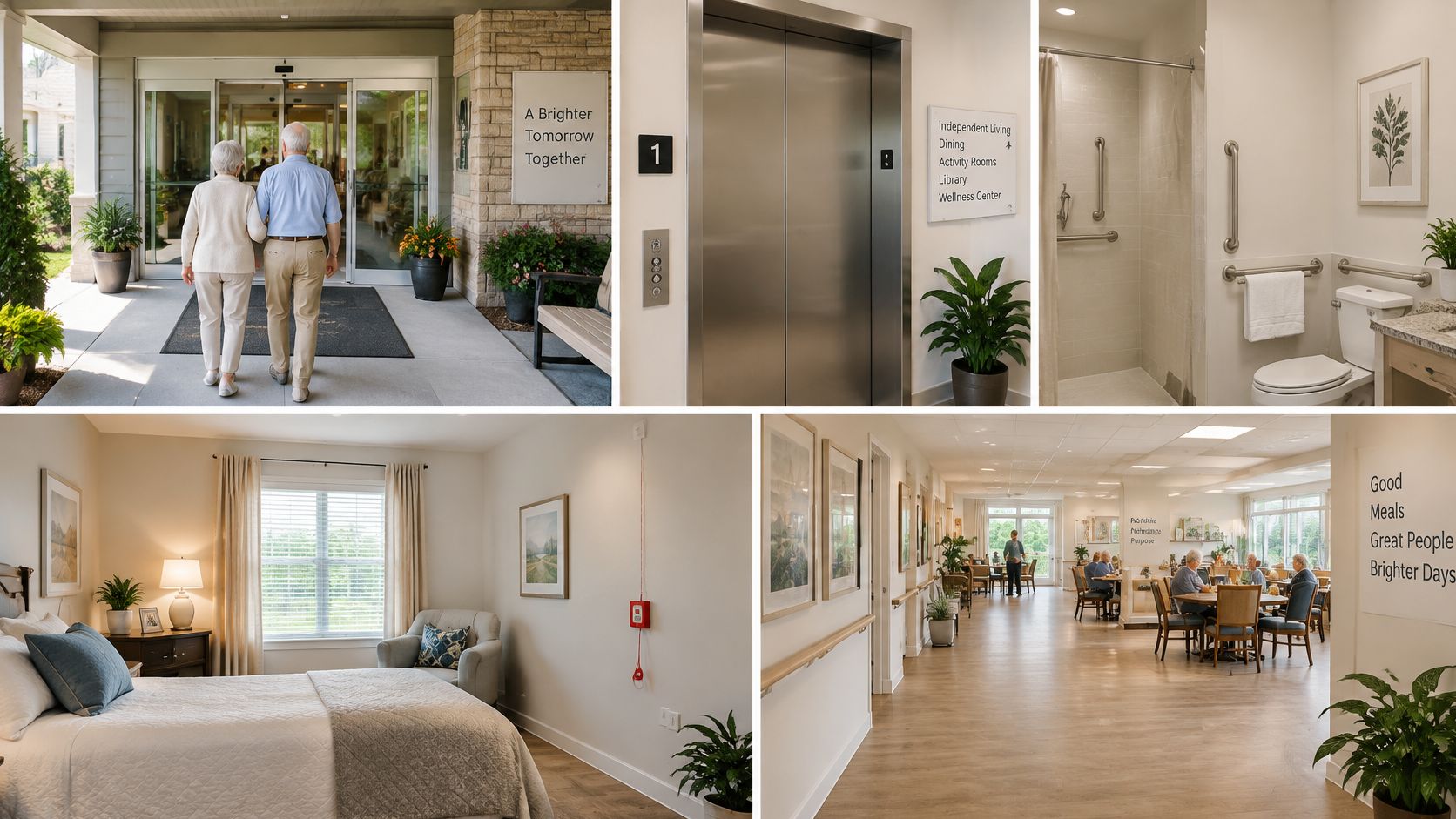
Use this visual as a prompt for checking private and shared spaces.
Physical access and daily routines
Walk from the proposed apartment to dining, the mail area, transportation pickup, and outdoor seating. Look for step-free entrances, working elevators, resting places, clear signs, and lighting that doesn't leave dark stretches. In the bathroom, check the shower threshold, grab-bar placement, and space for a mobility aid.
Ask where emergency pull cords or wearable buttons work. A bathroom cord isn't useful if someone can't reach it after falling. Request an explanation of who receives an alert and what happens when the resident doesn't answer.
Furniture matters too. A low, soft chair can make standing difficult even in an accessible apartment. Gates Home Furnishings' explanation of Medicare coverage for lift chairs can help frame equipment questions, but coverage should be checked against the person's circumstances rather than assumed from a product description.
Support must be specific
A transportation program may serve shopping trips but not an early medical appointment. Ask about service boundaries, booking notice, wheelchair accommodation, escorts, cancellations, and return rides when an appointment runs late.
For health and social supports, get concrete answers:
- Medication boundaries: Can staff only remind residents, or is a separate provider needed to administer medication?
- Visiting services: Who arranges nursing, therapy, or home care, and can residents choose their provider?
- Participation support: Does anyone help a new resident find suitable dining companions or activities?
- Emergency monitoring: Is monitoring included, and who responds overnight?
The following video can support a family discussion about what to look for during a visit.
Ask how a transition actually works
A campus offering several care levels may make a later move easier, but an apartment elsewhere on campus isn't necessarily guaranteed. Ask what triggers reassessment, who makes the decision, and whether outside caregivers can support the resident while arrangements are made.
Request the transfer policy before signing. It should explain eligibility, availability, priority access, additional charges, and what happens if the campus cannot meet the resident's needs.
A promise of future care is useful only when the agreement explains how the resident gains access to it.
What Independent Living Costs in New Jersey
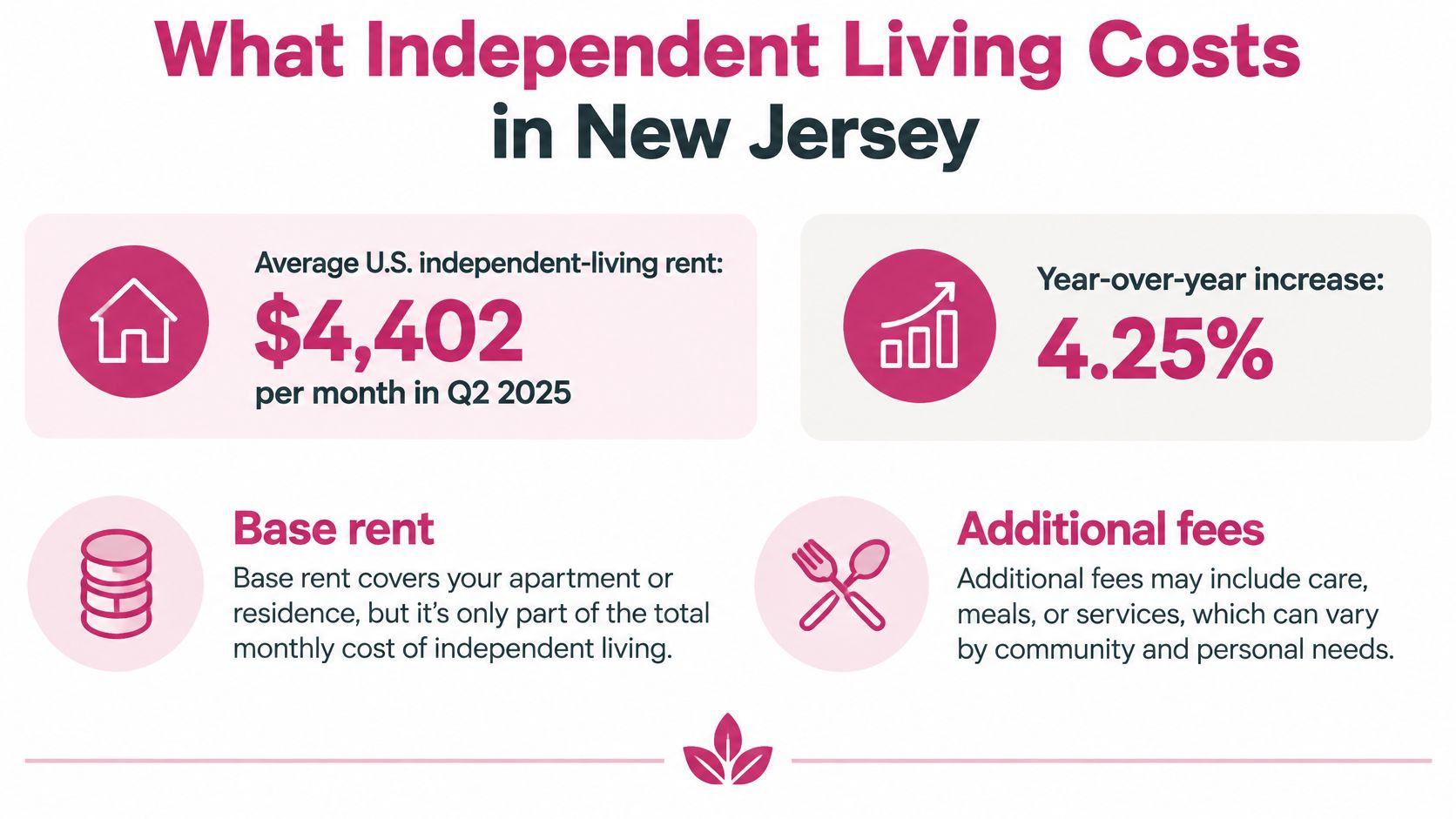
Start with a benchmark, not a New Jersey price promise. Average U.S. Independent-living rent was $4,402 per month in Q2 2025, with a 4.25% year-over-year increase, according to NIC MAP figures reported by NIC.
New Jersey quotes must be gathered community by community. County, apartment layout, included services, and contract structure can change the household's actual bill.
This infographic summarizes the national benchmark rather than a local quote.
Compare the full bill
Ask for a written fee schedule for the specific apartment under consideration. A brochure's starting price may exclude services the resident will use every day.
| Cost item | What to confirm | Billing watch-out |
|---|---|---|
| Base monthly rent | Apartment size, contract term, and included utilities | Renewal increases may change affordability |
| Entrance or community fee | Refundable portion, conditions, and refund timing | Nonrefundable amounts reduce available reserves |
| Meal plan | Included meals, dining locations, and guest charges | Extra meals or delivery may cost more |
| Housekeeping and laundry | Visit frequency, tasks, and linen service | Additional visits may be billed separately |
| Transportation | Destinations, booking rules, and medical rides | Charges may apply per trip or beyond the service area |
| Emergency response | Equipment, monitoring, and response procedures | Monitoring may sit outside base rent |
| Care escalation | Outside caregiver charges and transfer pricing | Each community sets service and transfer charges |
Rising prices deserve attention before a contract is signed. Independent-living asking rates increased 6.7% year over year and in-place rents increased 9.1% year over year as of June 2025, according to NIC's analysis of independent-living pricing. These are different measures from the benchmark above, not competing quotes for the same apartment.
Ask the community for its rent-increase history and the agreement's notice provisions. Don't assume that a move-in discount continues at renewal or that today's increase predicts the next one.
Test affordability beyond move-in
Build a household worksheet with predictable income on one side and recurring expenses on the other. Include insurance, prescriptions, personal spending, existing debts, and any continuing costs associated with an unsold home.
Then examine a higher-cost scenario. Model future rent increases, an added caregiver, and a possible transfer to a more supportive setting. Keep liquid funds available rather than committing every accessible dollar to an entrance fee.
Say a resident can afford the apartment only while a family member provides daily unpaid help. That arrangement needs its own backup plan, including who takes over during illness, travel, or caregiver exhaustion.
Budget safeguard: An affordable apartment is one the resident can sustain without relying on support that nobody has agreed to provide.
Compare several communities using identical cost lines. Leave unresolved charges marked for follow-up rather than treating a blank cell as free.
Eligibility and Payment Options in New Jersey
Admission requirements belong to the individual community. Ask for its minimum-age policy, financial criteria, health requirements, and rules for additional occupants before paying an application fee.
Independent living eligibility is not a medical clearance. Someone may meet a community's financial requirements but still need more personal assistance than the housing provides.
Prepare for the application
The usual sequence is straightforward:
- Provide identifying information. Submit contact details, an emergency contact, and the requested application documents.
- Confirm financial requirements. Ask what income or asset documentation is needed and whether screening carries a fee.
- Describe support needs clearly. Include mobility limitations, medication assistance, cognitive concerns, and any proposed outside caregivers.
- Review the residency agreement. Check included services, reassessment criteria, termination provisions, and refund terms.
Don't minimize needs to secure admission. An inaccurate picture can lead to an unsuitable move.
Establish who pays
Plan for independent living as a private housing expense, using resources such as retirement income, savings, or home-sale proceeds. Don't assume Medicare will pay apartment rent, meals, or housekeeping because a community serves older adults.
Ask the community whether subsidized apartments or housing assistance are available and confirm eligibility with the relevant program. Medicaid eligibility and coverage for care services should be checked separately from housing charges.
If the resident has long-term care insurance, ask the insurer which care needs trigger benefits, which providers qualify, and whether the proposed services are covered. Request written confirmation rather than relying on an admissions conversation.
For New Jersey properties offering clinical or personal-care services, confirm the applicable license and service category with the New Jersey Department of Health. An independent-living apartment shouldn't be described as licensed assisted living because both are on the same campus.
Availability and Timing in Tight Markets
Searching only after a crisis can leave families choosing among available apartments rather than suitable ones. Think of a restaurant where most tables are booked: getting seated is possible, but the location and timing may not be what you wanted.
In Q2 2025, independent living averaged 89.7% occupancy across NIC's 31 primary markets, according to the National Investment Center for Seniors Housing & Care. That benchmark covers major markets, not every New Jersey community, so it cannot establish whether a particular town has a shortage.
Start while choices remain practical
Use a planned search rather than an emergency-only search:
- Begin with a change in circumstances. Difficulty maintaining the home, stopping driving, or increasing isolation can justify gathering information before a move becomes urgent.
- Tour a manageable shortlist. Visit communities that meet the person's support needs and budget, not every property within driving distance.
- Ask about actual inventory. Request the earliest suitable apartment date, available layouts, and whether the quoted unit is ready for occupancy.
- Clarify the waitlist. Find out how priority works, whether deposits are refundable, and what happens if an offered apartment isn't suitable.
- Keep an alternative ready. Identify another acceptable community or an interim home-support arrangement.
A guide to how waiting lists work can help families prepare questions before placing a deposit. A waitlist position isn't the same as a promised move-in date.
Separate housing availability from care readiness
A vacant independent-living apartment may not be appropriate after hospitalization. Ask the discharge team what assistance is needed with walking, bathing, medications, and follow-up care before treating vacancy as the deciding factor.
If a resident temporarily leaves for rehabilitation, ask whether the apartment remains theirs, which charges continue, and whether reassessment is required before returning. Get the answer in the agreement or written policy.
Avoid giving up a workable home arrangement before admission and move-in are confirmed. A rushed choice can mean accepting a longer family drive, an unsuitable layout, or charges that weren't fully reviewed.
Local availability changes. Confirm it directly when arranging tours and again before committing funds.
How Life Senior Placement Matches You to a Community
An advisor can help organize the search, alongside direct community inquiries, clinician recommendations, and family visits. The useful role is to turn a broad list of properties into options that match the person, not to choose an apartment on the family's behalf.
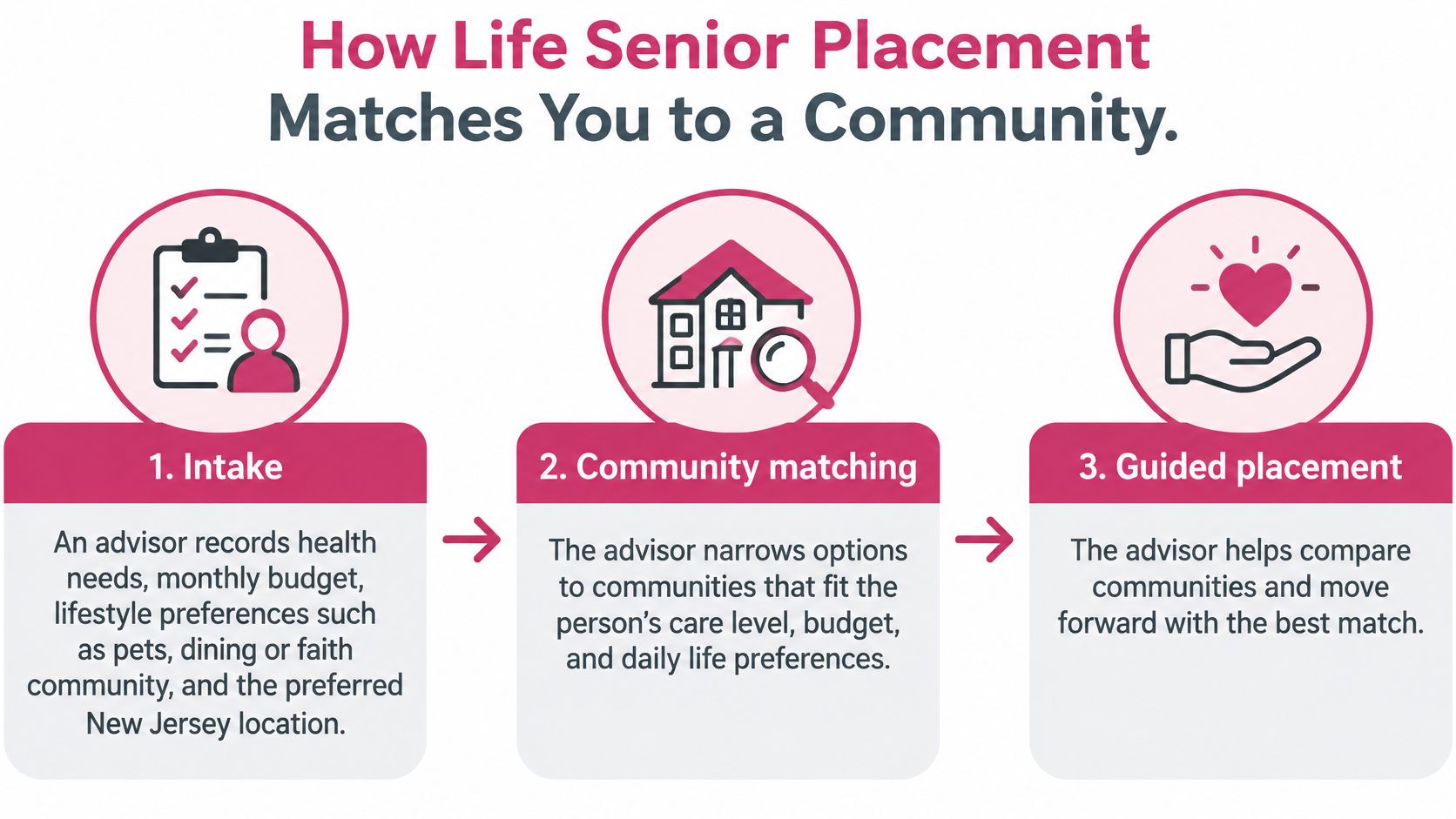
The matching process follows this sequence.
Intake begins with the person
The advisor records health needs, spending limits, preferred New Jersey location, and practical preferences. Pets, food choices, proximity to a faith community, and access to familiar clinicians can all affect whether a move works.
Be clear about must-haves versus preferences. An accessible shower may be essential; a balcony may be negotiable. If family members disagree, identify who is making the decision and include the prospective resident's priorities wherever possible.
For a time-sensitive discharge, share the discharge plan with appropriate consent. The advisor needs to understand required support, not just the desired move date.
Matching narrows the choices
The directory supports searching by city, ZIP code, or community. The advisor uses intake information to narrow options and checks current availability when timing is pressing.
Listing information is verified through direct collaboration with communities and agencies. Still, confirm the exact apartment, current charges, applicable licensing, and admission criteria during the search. A verified listing doesn't eliminate the need to review the individual agreement.
The New Jersey team is based in East Hanover and focuses on regional providers. That local focus can help families consider travel routes, nearby support, and alternatives outside their initial search area.
Tours turn a shortlist into a decision
The team coordinates visits and helps compare fees, included services, and amenities. Families can use that support to keep unanswered questions visible instead of relying on impressions from separate tours.
For example, one community might include transportation but offer fewer destinations, while another charges separately for a more useful service. The advisor can help organize those differences; the resident and family decide which arrangement fits daily life.
The overview of senior placement services explains the advisor's role in selection and move-in support.
The service is free to families, and participating communities compensate the company. Ask which providers participate, whether an option outside the network can be considered, and how the shortlist was selected.
Keep decision-making authority with the resident and family. An advisor's recommendation should come with understandable reasons and room to ask questions.
Guidance can continue through the agreement and move-in process. Clinical assessments should still come from qualified professionals, and legal questions about a substantial contract may warrant independent advice.
Book an Intake and Tour Before Units Fill
You don't need every answer before starting an intake. You do need an honest account of what daily life looks like now, including the help relatives are already providing.
Prepare and compare
- Contact the advisor. Call (862) 398-2006 or email hello@seniorplacement.life to discuss independent living placement and whether another care assessment is needed.
- Gather useful documents. Prepare a current medication list, relevant physician notes, a monthly budget, and essential housing features. Share health documents through the method the advisor recommends.
- Rank the matched options. Put access, support boundaries, and sustainable cost ahead of decorative finishes. Record why an option stays on or leaves the shortlist.
- Tour with permission to test details. Observe a meal, ask about staff turnover, and request a demonstration of the emergency system rather than activating it unannounced.
Confirm before committing
- Reconcile the written charges. Compare fee schedules, rent-increase history, and entrance-fee refund provisions. Ask staff to explain any difference between the tour discussion and the paperwork.
- Read the agreement before signing. Ensure it identifies included services and reassessment procedures. Request clarification of unclear terms in writing.
- Plan the arrival. Confirm the apartment, moving arrangements, furniture fit, medication routine, transportation bookings, and who will help the resident settle in.
Keep one shared document containing every answer, fee, contact name, and unresolved question. With the resident's permission, give involved relatives access so nobody has to reconstruct decisions from scattered messages.
Ask the advisor to remain the point of contact after move-in, including when needs change or another setting must be considered. Arrange an early check-in to discuss what's working and what needs adjustment.
The next action is simple: contact the advisor with the person's preferred location, current support needs, and comfortable monthly spending limit.
Life Senior Placement offers no-cost advisor guidance to help New Jersey families compare independent living communities, arrange tours, and understand options when care needs change. Visit Life Senior Placement to begin an intake focused on daily abilities, total cost, and a workable plan for future support.