
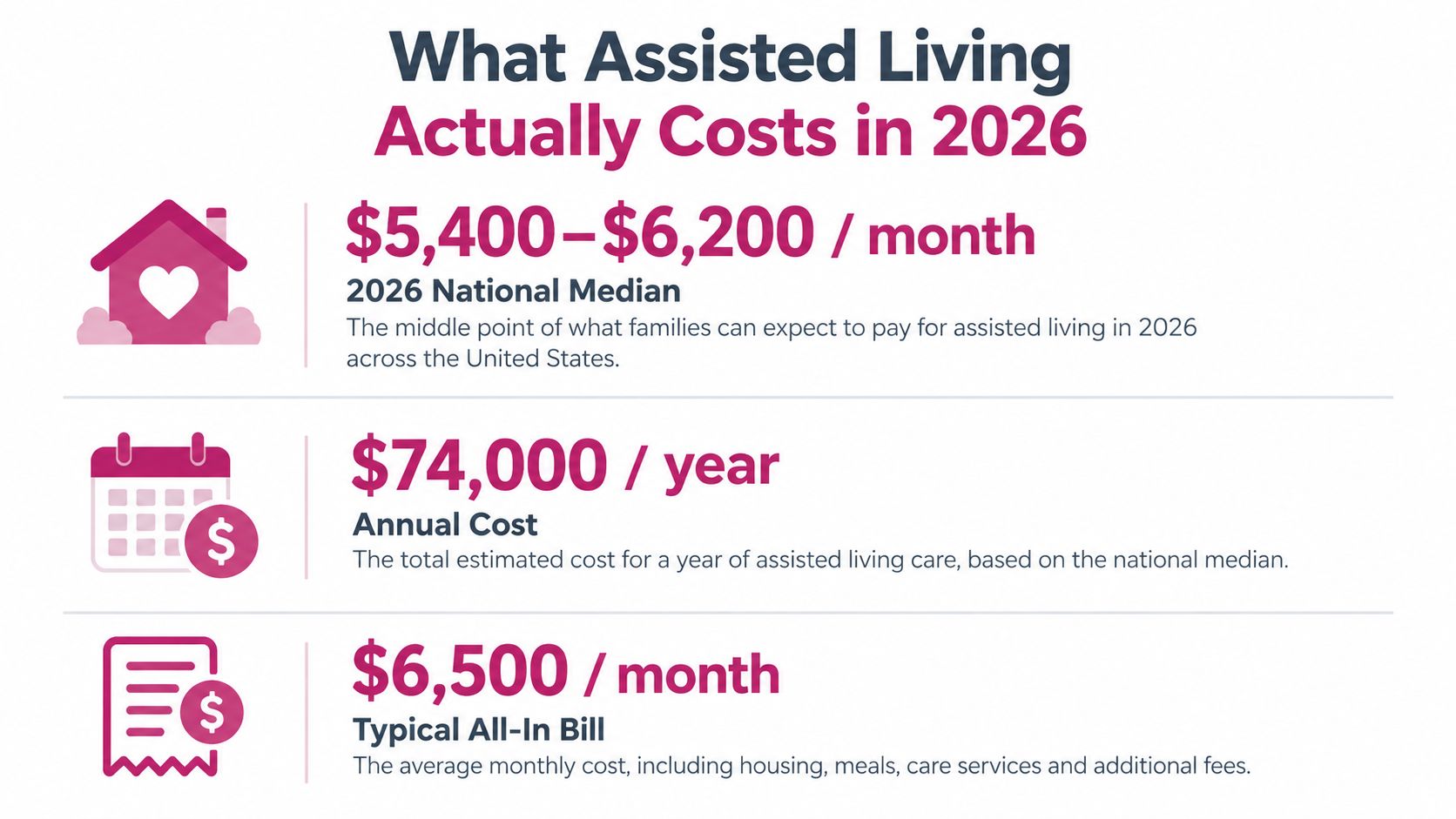
A 2026 assisted living cost typically falls between roughly $5,400 and $6,200 per month, or about $74,000 per year. The actual bill is often higher because care tiers, medication support, transportation, laundry, and other services sit outside the advertised base rate.
Families usually start with one number and discover several more after the assessment. That's where assisted living budgeting goes wrong. A community may advertise an attractive apartment rate, but the final invoice reflects the resident's care needs, apartment type, location, and every service billed separately.
In New Jersey, I tell families to treat the base rate as a starting point, not a budget. Before touring, ask for the complete fee schedule and calculate the likely monthly total for the person who will move in.
What Assisted Living Actually Costs in 2026
The 2026 national median assisted living cost is roughly $5,400 to $6,200 per month, with annual figures near $74,000, according to figures summarized by the American Health Care Association's assisted living cost information. That range is useful for orientation, but it isn't a reliable quote for any particular community.
A published median is a midpoint. It doesn't tell you whether the figure represents a studio or one-bedroom, whether personal care is bundled, or whether medication management carries a separate charge. It also doesn't show how a community reassesses care after move-in.
Why the headline rate misleads
Most assisted living bills contain several layers:
- Apartment and hospitality services: The base rate may include the residence, meals, housekeeping, activities, and some transportation.
- Personal care: Help with bathing, dressing, grooming, mobility, toileting, or transfers may be assigned to a care tier.
- Clinical or medication support: Medication administration, reminders, or coordination can create an additional monthly charge.
- Optional services: Laundry, salon appointments, escorts, guest meals, and special transportation may be billed separately.
- One-time charges: Community fees, deposits, assessments, and move-in costs can affect the first invoice even when they don't recur monthly.
A community can therefore be affordable at the base-rate level and unaffordable after the resident's care plan is priced. The right question isn't, “What does this community cost?” Ask, “What will this resident's complete monthly bill look like now, and what services could be added later?”
Turn a quote into a working budget
Request three documents before relying on a price:
- The full base-rate sheet, including apartment types and included services.
- The care assessment and every available care tier.
- The separate fee schedule for medication, transportation, laundry, incontinence support, escorts, and reassessments.
Then ask the community to price a sample monthly bill using the resident's actual needs. A national average can help you spot an unusually high or low quote, but only an individualized estimate can support a move-in decision.
Practical rule: Never compare one community's base rate with another community's all-in estimate. Put both on the same monthly cost sheet first.
How Assisted Living Fees Are Structured
An assisted living quote has four parts: base rent, the care charge, à la carte services, and one-time fees or deposits. Families should price all four before comparing communities. The advertised rate describes the apartment and standard hospitality, not necessarily the resident's complete monthly bill.
Base rent usually covers the apartment, meals, housekeeping, scheduled activities, common areas, and routine transportation. A studio generally starts below a one-bedroom because the unit is smaller. Ask for a written list of included services. Terms such as “supportive living” and “personalized care” do not define what the community will actually provide.
The care charge comes from an assessment of daily tasks. A resident who bathes and dresses independently may receive a lower care rate than someone who needs hands-on help with transfers, toileting, medication, or meals. Review how the community counts those needs. One provider may group several tasks into a care tier, while another may bill each service separately.
Build the comparison around a real resident
Give each community the same resident profile and request a written monthly estimate. Include the apartment, meals, housekeeping, medication support, transportation, and personal care. Ask for the revised price if the resident needs more help later.
| Line Item | Lower Cost Scenario | Higher Cost Scenario |
|---|---|---|
| Base apartment and standard services | Community-specific | Community-specific |
| Care-level charge | Lower tier | Higher tier |
| Medication support | Included or separate | Tiered or service-based |
| Personal care | Limited assistance | Frequent hands-on assistance |
| Transportation and escorts | Included within limits | Billed per service |
| Laundry, salon, and guest meals | Optional | À la carte |
| Community fee and deposits | May apply once | May include separate charges |
A reported example shows the gap clearly. A $5,000 base rate rose to $7,680 after laundry, personal care, medication help, meal assistance, and pet services were added, according to reporting on rising senior care costs and family budgets. That example is not a universal quote. It is a practical warning: use the base rate to start the comparison, then budget from the resident's likely all-in bill.
Review community fees, deposits, and assessments separately. Ask which charges are refundable, which are due before move-in, and whether any can recur if the resident transfers to memory care or another service level. Put each community's base rate, care tier, recurring add-ons, and first-invoice charges on one worksheet. That gives families a workable number before they tour.
State-by-State Pricing and Where New Jersey Fits
Reported monthly assisted living costs range from $4,715 in Mississippi to about $12,000 in Hawaii, with Alaska around $10,819, New York near $7,323, and California near $7,210, according to state-by-state assisted living cost estimates from SeniorLiving.org.
That spread exceeds $7,000 per month, or $86,000 annually, between the reported low and high markets. A national median cannot set a useful New Jersey budget. Families need comparable local quotes and a clear view of what sits above the advertised base rate.
A regional budgeting view
| Region | Low Monthly | High Monthly |
|---|---|---|
| Lower-cost states | About $4,715 | Varies by community |
| New York and California markets | About $7,210 | About $7,323 |
| Alaska | About $10,819 | About $10,819 |
| Hawaii | About $12,000 | About $12,000 |
| New Jersey | Upper-tier market | Community-specific |
New Jersey belongs in an upper-cost planning conversation. Land, staffing, and building expenses shape local rates, but the base price still tells only part of the story. A community's real monthly bill may rise after care charges, medication support, personal assistance, transportation, laundry, salon services, or guest meals are added.
Build a working budget with four lines: base apartment and standard services, recurring care charges, service add-ons, and first-invoice costs such as deposits or community fees. Record whether each item is included, tiered, billed per service, refundable, or charged again after a move to memory care or another service level.
Use a New Jersey assisted living cost guide to identify local questions, then request written quotes by town, apartment type, and care level. Compare the fee schedules, not just the headline rates.
Location also carries a practical cost. A cheaper community several hours away can mean more travel, missed visits, and harder coordination with physicians and family. Price the community and the support network together before choosing the lower advertised rate.
What Drives the Biggest Price Differences
A one-bedroom starting price can be $900 to $1,200 per month higher than a studio, depending on the market and community, according to Care.com's assisted living cost breakdown. That gap makes apartment size the first item to match when comparing quotes.
Three variables move an assisted living price most often: apartment size, local market, and care intensity. Two communities may offer similar dining, activities, and amenities while producing very different monthly bills. A studio with light support is not comparable to a larger apartment with daily hands-on care.
Apartment size and location set the base rate
Larger apartments cost more than studios because they use more space and may follow a separate pricing schedule. Demand, layout, and the community's amenity level can also affect the starting rate.
Geography changes the base rate as well. A community in a high-cost coastal town may charge more than a similar building elsewhere in the same state. Local wages, real estate costs, taxes, and building expenses all shape the advertised price.
The base rate still does not equal the final bill. Care charges, medication support, personal assistance, transportation, laundry, or other services can raise the monthly total after the apartment price is quoted.
Care intensity changes the real comparison
A community assessment may assign a resident to a care tier based on help with bathing, dressing, transfers, toileting, medication, or other daily activities. Price a resident according to the assistance required, not only the apartment selected.
| Driver | Lower-cost example | Higher-cost example | What to verify |
|---|---|---|---|
| Apartment size | Studio | One-bedroom | Whether the rate includes standard services |
| Location | Lower-cost local market | Coastal or high-cost local market | Local fees and included amenities |
| Care level | Occasional assistance | Frequent hands-on assistance | Tier definitions and assessment rules |
| Medication | Included reminders | Managed medications | Medication pricing schedule |
| Transportation | Scheduled group service | Private escort or special trip | Escort and waiting-time charges |
Ask every community for two written calculations: the monthly price for today's needs and the price at the next care tier. Request both using the same apartment type and service list. That comparison shows whether a family can absorb a care change without facing an unexpected bill or moving again.
A fair comparison uses the same apartment type, the same care needs, and the same list of included services.
Hidden Add-Ons That Push Bills Higher
One reported monthly bill climbed from a $5,000 base rate to $7,680 after the community added laundry, personal care, medication help, meal assistance, and pet services, according to coverage of hidden senior living costs. That gap is the number families need to investigate. Budget for the resident's actual services, not the apartment price shown in an advertisement.
Ask about these charges directly
Communities may explain these costs late in the sales process or place them in an attachment instead of the main quote. Ask for each item in writing:
- Move-in assessment: Confirm whether the initial evaluation has a separate charge.
- Care reassessment: Ask whether a new assessment can move the resident into a higher tier immediately.
- Medication management: Find out whether the price changes based on the number or type of medications.
- Incontinence support: Separate supply costs, reminders, and hands-on assistance.
- Medical escorts: Confirm whether transportation includes an escort and whether waiting time is billed.
- Personal laundry: Check how much laundry the base rate covers and what extra service costs.
- Guest meals: Ask for the price of family meals and whether special events use a different rate.
- Second-person occupancy: Confirm whether a spouse or companion creates another monthly charge.
- Pet services: Ask about deposits, grooming, walking, and other pet-related costs.
Do not accept “services included” as a complete answer. Request a written fee schedule that marks every line as included, optional, tiered, or billed per use. The schedule should cover services the resident may need later, not only today's requirements.
Make the first invoice predictable
Ask the community to prepare a sample monthly bill using the resident's current care profile. Have the representative show the base rate, every recurring add-on, and any per-use charge separately. Then ask what would change that estimate.
The answer should identify the trigger for a higher charge, who completes the assessment, how the family receives notice, and whether the resident can remain in the same apartment after the increase. Ask for a second sample bill using the next likely care tier. That comparison gives the family a working range for monthly budgeting before choosing a community.
Keep pricing out of the verbal-only stage. If a representative will not provide the full schedule, treat that lack of transparency as a serious warning and continue comparing communities. A clear quote protects the budget and exposes whether the advertised rate bears any resemblance to the eventual bill.
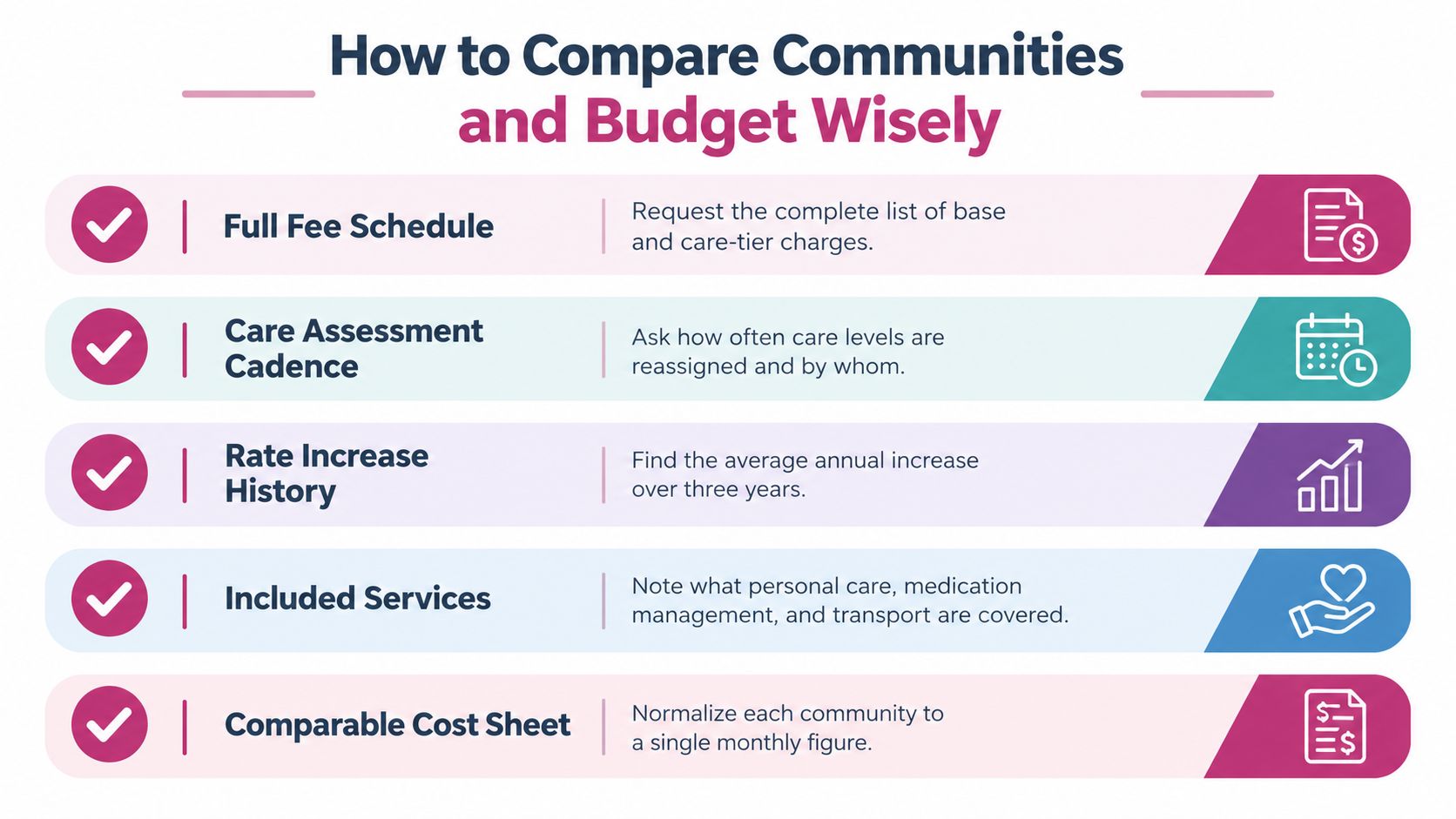
How to Compare Communities and Budget Wisely
The advertised base rate is only the starting point. A useful comparison shows what the resident will pay now, what the bill could become after a care change, and which services remain outside the monthly package.
Build one comparison sheet for every community. Record the apartment type, base rent, current care tier, medication support, transportation, laundry, assessments, deposits, community fees, and per-use charges. Use the same resident profile and the same assumptions for each quote. A New Jersey family can then compare local proposals against the national benchmark discussed earlier without mistaking a low starting rate for a low total cost.
Ask the same questions at every tour
Use this sequence with each representative:
- What does the base rate cover? List the specific services included and identify what is billed separately.
- How is the care tier assigned? Ask who performs the assessment, which daily activities affect the result, and how the decision is recorded.
- What causes a reassessment? Request examples such as a fall, hospitalization, medication change, or reduced mobility.
- Which needs raise the bill? Have the representative price bathing, transfers, toileting, incontinence care, medication help, and transportation.
- What happens after a care change? Confirm whether the resident can stay in the same apartment, move within the community, or require another setting.
- What does the residency agreement permit? Review rate increases, notice periods, deposits, refunds, termination terms, and move-out conditions.
Put the results side by side. Show the base rate, current monthly total, one-time charges, and likely future adjustments in separate columns. That format makes the difference between an attractive headline and a workable monthly budget visible.
Ask whether the community will reduce or waive a community fee, second-person charge, or selected move-in cost. Any concession belongs in the written agreement, not in a verbal promise.
Tour at least three communities with the same worksheet. A lower base rate may leave the family paying more after care and daily services are added. A premium package may also waste money when it includes support the resident does not use.
The video walkthrough on assisted living cost comparisons can help families organize questions before touring.
Building a Realistic Assisted Living Budget
Start with the household's dependable monthly resources, then compare them with the community's full projected bill. Record Social Security, pensions, annuity deposits, and benefits. List savings, long-term care insurance, home equity, and other assets separately. An asset is not monthly income until you know how quickly and reliably the family can access it.
Use the national median established earlier in this guide as a broad reference point. For a New Jersey household, build the working budget from a local community quote, then add a separate reserve for care increases, medication support, personal care, and one-time move-in costs. The base rate is only the starting line.
A practical budget worksheet
| Budget Step | What to Record |
|---|---|
| Fixed income | Monthly deposits and dependable benefits |
| Long-term care resources | Insurance coverage, savings, home equity, and other assets |
| Community estimate | Base rate plus the resident-specific care plan |
| Extra charges | Medication, laundry, transportation, supplies, and assessments |
| Initial cash requirement | Deposits, community fees, moving expenses, and furnishings |
| Future pressure points | Reassessment rules, rate increases, and possible care changes |
For a clearer household plan, use these zero-based budgeting family tips before comparing communities. Assign each available dollar to a defined purpose, including recurring care charges and a reserve. This prevents the advertised rent from becoming the family's entire financial plan.
Ask each community for a written fee schedule and a resident-specific estimate. Request the base rate, care charges, medication fees, transportation, laundry, supplies, deposits, and community fees as separate line items. Then review the reassessment process and possible rate changes.
Families comparing funding choices can review ways to pay for assisted living without draining savings. Life Senior Placement offers no-cost guidance, verified listings, advisor support, and tour coordination across New Jersey. Visit Life Senior Placement to compare communities against care needs, location, and a defensible monthly budget.