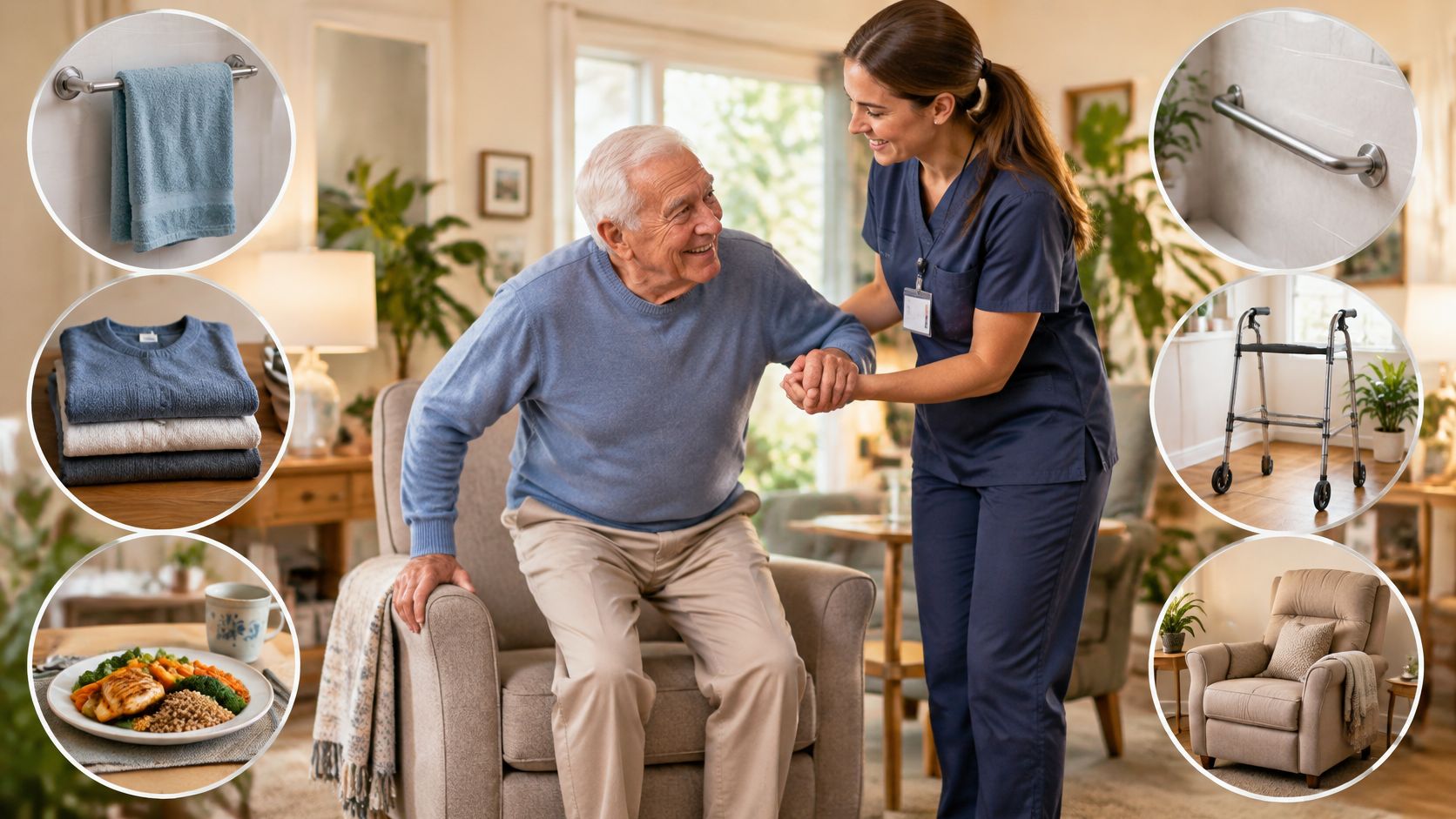
What is assisted living, once the tour is over and the needs start to change?
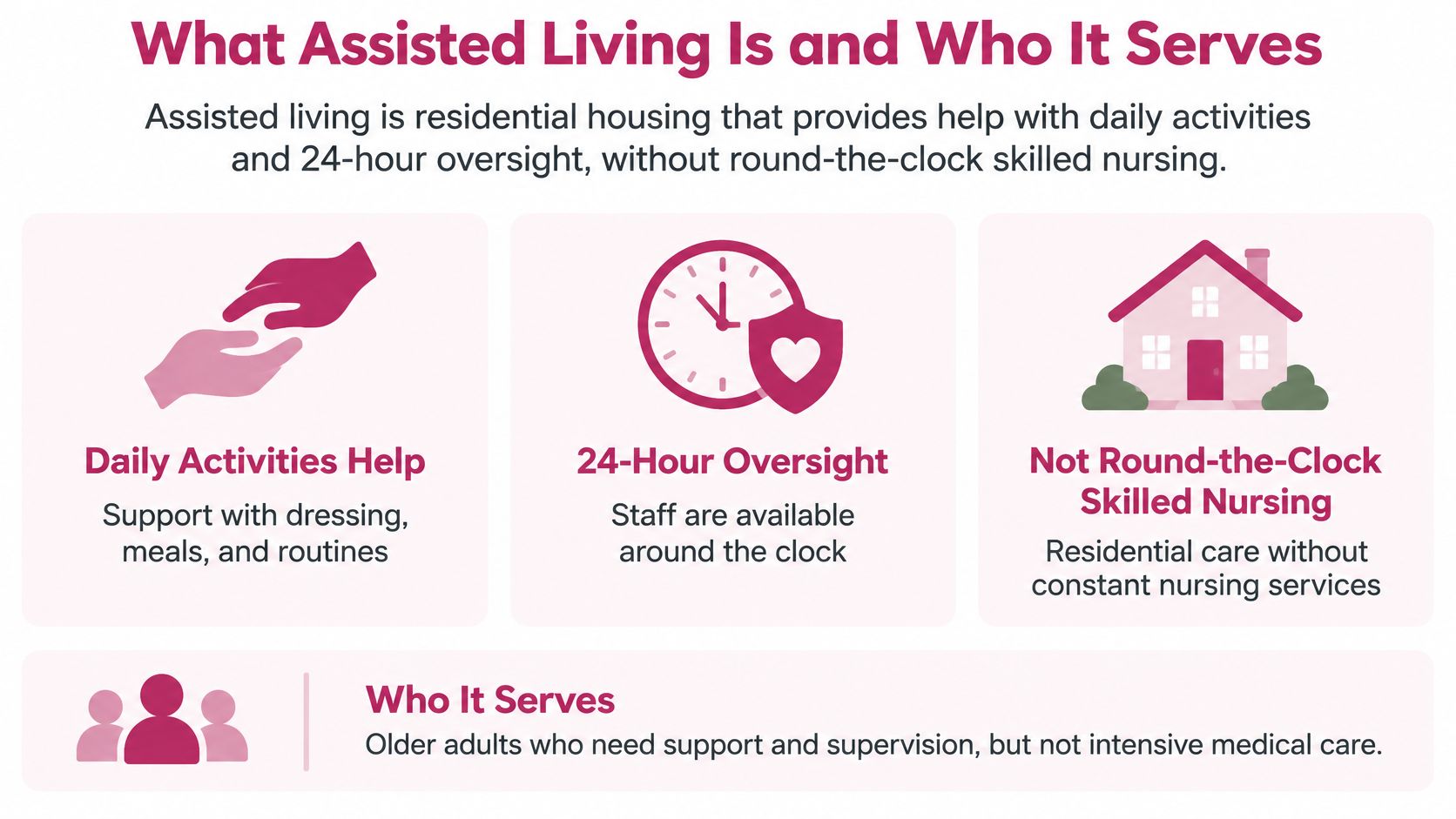
Assisted living is residential housing with help for daily activities and staff available around the clock. It serves older adults who need some daily support and do not need hospital-level medical care or continuous skilled nursing.
A dining room, a fitness class, and a bus to the doctor describe the building. Month nine is a different question. A resident who arrived walking on her own may then need two staff members to move her from bed to chair. That shift is the true test of the setting.
Assisted living works like a starting floor, not a permanent address. The name on the brochure gets someone in the door. What keeps care workable later is the staffing model, the license, and the written rule for what the community does when needs grow past the services it first advertised. Judge the care level by how needs will change, and by what the community is prepared to do when they do. Amenities stay easy to see. Capacity is what the monthly fee is buying.
What Assisted Living Is and Who It Serves
A studio or one-bedroom apartment tells you more about assisted living than the activity calendar does. Kitchenette. Grab bars beside the toilet. A call cord within reach of the shower. A dining room two corridors away. The building looks ordinary on purpose. What changed is the job list: the shower, the pills, and the walk to dinner now belong to staff.
Families hear two labels that sound almost identical, and mixing them up points the search at the wrong building. Learn the split before anyone quotes a monthly rate.
Activities of daily living (ADLs) are the body-level tasks: bathing, dressing, grooming, toileting, transferring from bed to chair, eating, and managing continence. Getting dressed is the clearest example. Choosing the shirt is one thing. Getting an arm through the sleeve without help is the ADL.
Instrumental activities of daily living (IADLs) are the tasks that keep a household running: meal preparation, housekeeping, laundry, transportation, managing money, and managing medication. Paying the electric bill and sorting the pillbox sit here, even when the person still walks unaided.
Assisted living is built for both lists, along with meals and social programming. A published review of assisted living care research reports that roughly 40% of assisted living residents need help with at least three ADLs, and that most need assistance with bathing, meal preparation, or medication management.
The typical move-in follows a trigger, not a slow, tidy decline. A fall on the back steps. A hospital stay that revealed the cooking had stopped. Early memory loss that shows up as an unpaid electric bill. The death of a spouse who handled the medication box and the driving.
The person usually wants the same three things afterward: a front door that locks, a schedule they still set, and help only with the tasks that stopped being safe. The sign on the building does not guarantee that help will still fit if those tasks multiply.
A Test You Can Run This Week
Before any tour, write down every task your relative struggled with in the past seven days. Sort each one into three columns: ADL, IADL, or skilled need. Skilled needs decide the setting. Wound care, insulin titration, IV therapy, frequent nursing assessment, or hands-on help with every transfer point toward licensed nursing on site around the clock.
If the list lands mostly in the first two columns, assisted living is the right conversation. Then ask one forward question: if three ADLs this month become help with every transfer later, what does this community do? If the list already sits in the third column, you are looking at the wrong building type.
Assisted Living Next to Other Care Settings
Which name on the building matches the care, and which one only matches today's brochure?
Care settings sit on a continuum. The right one depends on daily help and medical needs, not on age alone. The differences work like rungs on a ladder: each rung adds a kind of help, and the resident climbs only as far as the tasks require.
| Care setting | Daily help | Medical care | Typical resident |
|---|---|---|---|
| Independent living | Meals and housekeeping, little personal care | None built in | Active seniors who want amenities without home upkeep |
| Assisted living | Help with bathing, dressing, medication and meals | Basic or occasional health support | Seniors who need some daily help but not round-the-clock nursing |
| Memory care | Structured daily support in a secured unit | Staff trained in dementia and Alzheimer's care | Residents with dementia who need supervision and routine |
| Nursing home | Full personal care | 24-hour skilled nursing and rehabilitation | Residents with complex or post-acute medical needs |
| Home care | Aides or caregivers in the person's own home | Aide-level support, with nursing only if the plan includes it | People who want to stay at home and can manage with scheduled help |
Assisted living holds the middle rung, between independent living or home care on one side and nursing-home-level care on the other. Its core model emphasizes residential living, personal assistance, meals, supervision and help with activities of daily living rather than around-the-clock medical treatment. The people in those apartments are mostly older: in 2022, approximately 94% of residents were age 65 or older, and 52.8% were 85 or older, according to the Congressional Research Service summary of CDC data.
Help inside those buildings is real, and it is uneven. Some residents need a hand with one or two tasks. Others need help with several activities of daily living, such as bathing, dressing, toileting, transferring or eating. Families often notice the bathroom and the hallway first. Those are the places where a missed step becomes a fall.
Where Memory Care Fits
Memory care works like a specialized version of the same rung, not a new floor of the building. It usually means a secured unit or building with controlled exits, dementia-trained staff, smaller dining rooms, visual cues on doors, and structured routines that reduce confusion. That unit can sit inside a standard assisted living community, or it can be a standalone building run by the same operator. Ask which one you are touring. A locked wing attached to a general population behaves differently from a dedicated house.
For a family weighing a hospital discharge, the clinical line matters more than the residential one. This comparison of skilled nursing and assisted living is a useful check on which side of that line a discharge planner is describing.
A setting chosen only for today's needs fails next year if nobody has asked what the community does when a resident starts falling twice a month. Labels stay fixed. Needs do not. The check is whether staff can add help, move the person into memory care, or say plainly when skilled nursing is the next step.
Daily Services and What Stays With Family
Break a Tuesday into its parts and the service list stops being abstract.
The morning starts with a knock at 7:30. A staff member helps with the shower, lays out clothes, and sets out the morning pills from a blister pack the pharmacy delivers. Breakfast is downstairs, in a dining room with assigned-ish tables where the same four people sit together. Housekeeping turns the apartment over mid-morning and swaps the linens; laundry comes back folded with a room number on the tag.

After lunch there's an exercise class, a visiting musician, or a van to the grocery store. A scheduled driver covers the cardiology appointment on Thursday. In the evening, staff do a medication pass and a welfare check, and someone is awake overnight to answer the call system.
The amenities list is usually shorter than the brochure implies, and each item means something specific:
- 24-hour staff presence means someone is physically in the building at 3 a.m., not on call from home.
- An emergency call system means a cord or pendant that reaches a responder, and you should ask how long the response takes.
- Prepared meals usually means three a day in a shared dining room, with a tray delivered during illness.
- Linen and laundry service means weekly, not daily, so ask the schedule.
- Scheduled transportation means set days and destinations, not on-demand rides.
Programming quality varies far more than the glossy calendar suggests. A published list of 15 activity ideas for senior communities is a fair benchmark: if the calendar in front of you carries fewer entries and nobody can name who runs activities on a weekend, the social side is thinner than advertised.
What Stays With the Family
Moving in doesn't end caregiving. Pooled U.S. Data show that 63.8% of residential care residents had an identified caregiver, and 46.7% of those caregivers reported emotional difficulty, compared with 31.5% of caregivers of older adults still living in the community, according to research on family involvement after placement.
The practical work that stays behind includes appointment scheduling and attendance, finances and insurance paperwork, buying clothing and supplies, advocating during a health change, and checking that the care plan on paper is the care delivered.
This short tour of what daily life looks like inside a community is worth watching before you visit, so you know what to look for in the rooms rather than the lobby.
Before signing, write the split down on one page: the tasks the community covers, the tasks the family still owns, and who is told when something changes. Get staff to agree to that page in writing. The workload becomes predictable at the moment that document exists, and not one minute before.
New Jersey Licensing and Rules That Apply
Start with the structure, because it explains why two communities with the same marketing language can operate under different rules. Assisted living regulation in the United States is primarily state-based rather than governed by one nationwide license, so terminology, staffing rules, admission standards, medication policies and Medicaid coverage differ substantially by jurisdiction, as the federal report on residential care settings documents.
In New Jersey, the state Department of Health licenses assisted living residences. A residence can also hold an assisted living program certification, which permits a higher level of care and is the pathway through which Medicaid coverage becomes possible. Those are two different things on paper, and families routinely confuse them because the marketing uses the same phrase for both.
What a License Does and Doesn't Tell You
A license certifies that a building meets minimum standards for resident rights, admission and discharge, medication handling, and emergencies. It does not measure whether the aides are kind, whether the overnight shift is thin, or whether the care plan gets followed on a Sunday.
Practical rule: the license category tells you what the building is legally allowed to do. Only the staffing schedule and the inspection history tell you what it actually does.
Verify in Five Steps
Run this before you fall in love with a floor plan.
- Ask for the license number during the first call, and ask whether the community also holds the program certification.
- Confirm the license on the state Department of Health listing rather than accepting a photocopy.
- Request the most recent inspection report and read the deficiency section, not just the cover page.
- Review complaint history and any citations, and ask the administrator what changed afterward.
- Confirm the certification you need matches the level of care your relative will require within the year, not just on move-in day.
New Jersey's license types trip up more families than any other part of the search, and this breakdown of ALR, CPCH and ALP license types explains which one authorizes which services.
Then ask the question most families never think to ask. Put it in writing: if my mother's needs exceed what this license allows, what is the discharge and transfer process, how much notice do we get, and who helps us find the next placement?
What Assisted Living Costs and How It Is Paid For
Most communities price in two layers. A base monthly rate covers the apartment, utilities, dining and activities. On top of that sit tiered care fees that rise as help increases: medication administration, bathing assistance, mobility support, and a second staff member for transfers each carry a monthly charge.
That structure is why the advertised number can understate the bill by a wide margin. A resident who arrives needing help with showers can be on a higher tier within months after one fall, and the increase appears on an invoice.
Ask these five questions before you sign anything:
- What the base rate covers, item by item, including utilities, cable, housekeeping frequency and transportation.
- The monthly fee for each care tier, in writing, not a verbal range.
- How often care levels are reassessed, and who can trigger a reassessment besides staff.
- What triggers extra charges, such as escorts to meals, incontinence care, a second-person transfer, or medication administered by a nurse rather than an aide.
- The community fee and deposit, and whether either is refundable if the resident moves out or dies.
For scale, Life Senior Placement's pricing data puts the New Jersey median at $8,710 a month, the fifth highest in the country, against a national median of $6,200 a month. The residency agreement is the document that sets the fee schedule and the reassessment rules, so read it as a contract rather than a welcome packet.
| Payment source | What it covers | Main limit |
|---|---|---|
| Private pay | Monthly base rate and care-level fees | Costs rise as care needs increase |
| Long-term care insurance | Daily or monthly benefit for assisted living under the policy | Policy terms and elimination period govern payout |
| New Jersey Medicaid assisted living programs | Services at certified assisted living programs for eligible residents | Income, asset and functional eligibility, plus limited availability |
| Veterans Aid and Attendance | Monthly pension add-on for eligible wartime veterans and surviving spouses | Service, income and asset requirements |
| Medicare | Skilled nursing facility stays after a qualifying hospital stay | Does not pay for custodial assisted living care |
The most expensive error families make is assuming Medicare will pick up the residential bill. It won't. Medicare covers short-term skilled care; it does not pay for custodial assisted living. Medicaid is the means-tested program that can help, but only through a certified program and only after income and asset eligibility is established.
Then build a twelve-month budget, not a first-month budget. Take the quoted base rate, add the care tier you expect at move-in, then add one more tier for the second half of the year. If that total is unaffordable, the community is unaffordable regardless of how the first invoice looks. For the full inventory of funding routes, this guide to ways to pay for assisted living without draining savings covers the sequencing.
How to Evaluate a Community Before Signing
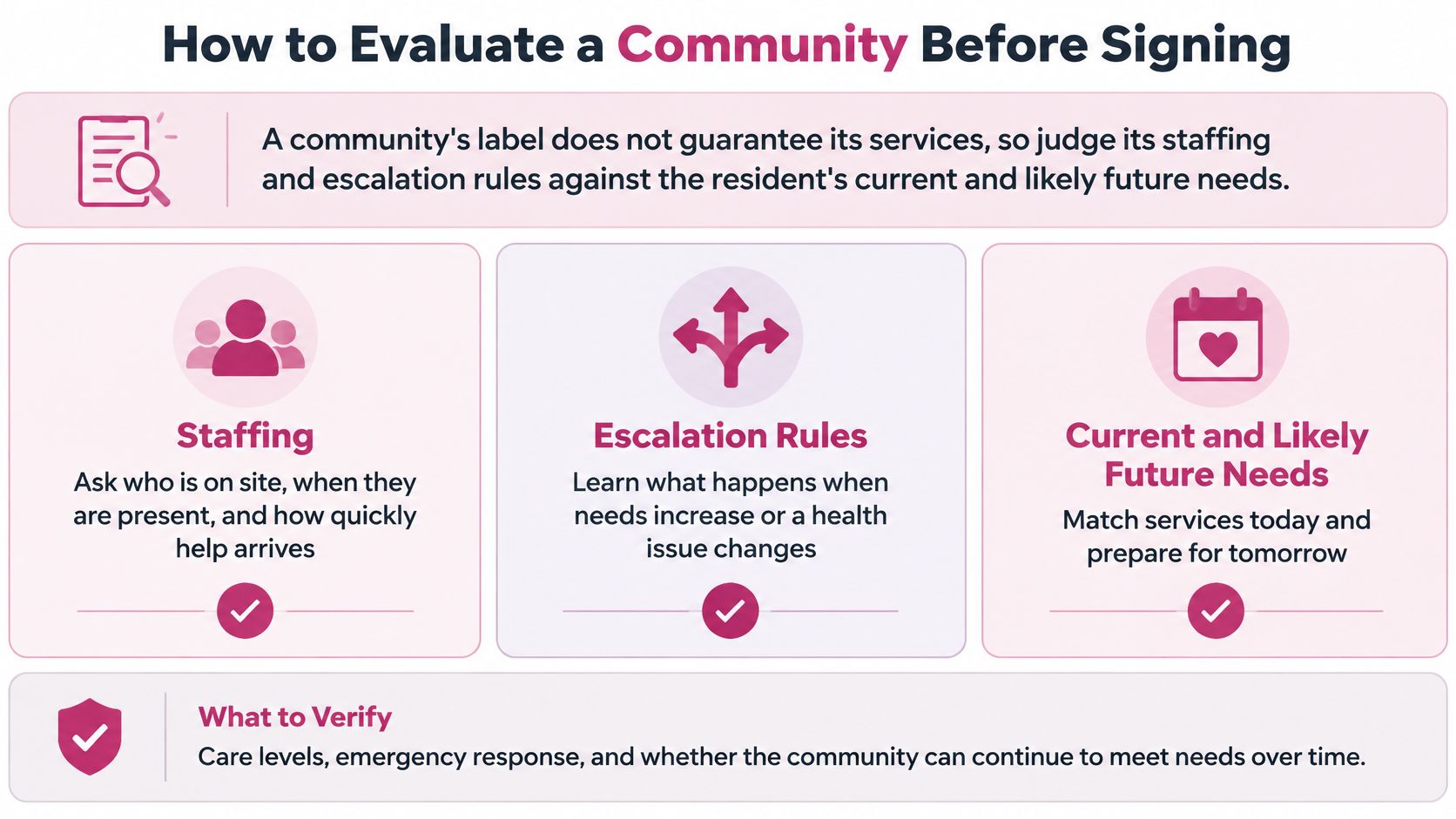
A community's label names a care level. It does not lock in what happens when needs change. Judge staffing and escalation rules against today's help and against the help likely within a year or two, including what the building does on the day it can no longer provide that help.
Staffing is the variable families misread, and it is also the one with the least national oversight. The United States has no federal minimum requirement governing assisted living staffing numbers or composition. Research associates more specific rules for direct-care workers, rules that define levels or ratios instead of vague language like "sufficient staffing," with lower hospitalization risk, including among residents with dementia.
That point has a direct use on a tour. A posted schedule beats a warm assurance. Overnight coverage works like a fire-station roster: the useful count is who is in the building when the alarm rings, not everyone listed on the payroll. Direct-care staff are the people who help with dressing, bathing, and getting to the bathroom. A licensed nurse on duty during office hours is a separate fact. A total headcount of 22 employees tells you nothing about who is on the floor at 2 a.m.
| Criterion | Question to ask | Red flag |
|---|---|---|
| Staffing by shift | How many direct-care staff work days, evenings and nights? | Only a total headcount is given |
| Overnight response | How quickly does a staff member reach a resident who falls at night? | One night aide covers a large wing |
| Care-level changes | What does a higher care level cost and how is it reassessed? | Vague answers about transfers out |
| Medication handling | Who administers medication and how are errors logged? | Residents manage their own medication without an assessment |
| Staff turnover | What share of staff left in the past year, and how many are agency workers? | Frequent agency staff with no training records |
| Incident notices | How quickly are families told about falls, hospital trips and care changes? | No written notice timeline |
A Worked Example
Say a resident moves in needing standby help in the shower. Four months later she falls, and her care plan now requires a two-person transfer with a gait belt, a strap staff use so two people can help her stand safely. Three things have to happen together: the community reassesses her care level, the fee changes to reflect the added staff time, and somebody decides whether the building can still meet her needs under its license.
Ask that sequence on the tour. "If this happens here, who does the reassessment, how fast, what does the new tier cost, and what is the process if you cannot keep her?" Compare that later monthly fee with the move-in quote. The answer separates communities that plan for decline from communities that manage it one crisis at a time.
The most honest thing a community can tell you is exactly which needs it cannot serve, and what it does on the day a resident develops one.
The Tour Routine
- Book the visit during a shift change, typically late afternoon, when handoffs show how well staff pass information.
- Time a call bell. Note how long it takes before someone appears, and whether that person is a caregiver or a housekeeper.
- Ask to speak with a current family, not a hand-picked ambassador, about weekend coverage and how quickly they hear about incidents.
- Request the care plan template and check whether it has a written escalation section, including the point at which the license no longer covers the care.
Confirm the Right Setting Before You Choose
Three answers decide this, and you can write all three on one page.
- Are the daily needs supportive or clinical? Bathing, dressing, meals and medication management point to assisted living. Ongoing nursing assessment, wound care or complex transfers point elsewhere.
- Are the needs stable or changing? A stable picture fits a standard residence. A declining one needs a community with a written reassessment process and a clear next step when it can't continue.
- Does the budget cover the care level likely within twelve months? Not the starting rate, the realistic one.
Then add the fourth item that families forget: the list of tasks you will still handle after the move. Appointments, finances, supplies, advocacy and the phone call after an incident don't disappear. They get easier only when the split is agreed in writing.
Life Senior Placement works through those questions as a starting point rather than an afterthought. We help families compare five care types, assisted living, memory care, nursing home, independent living and home care, and we sit down with the health needs, budget and preferred location before suggesting a single building. The intake comes first, the shortlist second, the tours third.
Your next step is concrete. Write the three answers and the family task list, then book two tours at different times of day, one during a shift change, and ask every community the escalation question in writing. Compare the answers side by side before anyone signs a residency agreement.
Life Senior Placement helps New Jersey families turn those three answers into a shortlist, comparing assisted living, memory care, nursing home, independent living and home care options against a real budget and a real care level. When you're ready to tour, we'll help you line up visits at different times of day and ask the escalation questions that brochures never answer. Start with the Life Senior Placement directory to see verified communities near you, then compare them on the things that hold up in month nine.