You're sitting at a New Jersey hospital with a discharge folder when someone says your parent shouldn't go home alone. Your sibling has brochures, your parent wants their own bed, and you're wondering whether a pleasant-looking community can manage bathroom trips, medications, and help getting out of a chair at night.
When Assisted Living Becomes the Question
A brochure can show a dining room. It can't tell you whether someone will be available when your father needs help transferring from bed, or whether your mother's evening confusion fits the staff's capabilities.
That's why criteria for assisted living are fit tests, not a single age or diagnosis cutoff. The decision is more like matching a key to a lock than buying the nicest building. A community can look right and still be wrong for the person who needs to live there.
Start with the day your parent actually has
Instead of beginning with available apartments, describe an ordinary day. Can your parent get dressed before breakfast? Who organizes medication? What happens when they need the bathroom after everyone else has gone to sleep?
Be specific about what changed after the hospital stay, too. You don't want siblings comparing different versions of the same person, with one remembering last summer's independence and another describing yesterday's difficulties.
- Separate observations from assumptions. Needing help standing yesterday is useful information. Assuming that help will always be temporary isn't.
- Include your parent's priorities. Privacy, familiar routines, food, and access to family belong in the decision alongside safety.
- Name the unanswered questions. If nobody knows what overnight help involves, ask the care team rather than guessing.
A useful search ends with evidence
You need to establish what your parent needs help doing, identify clinical or safety concerns, and decide whether a move is necessary at all. Only then does comparing buildings become useful.
Practical rule: Don't ask whether a community can handle an older adult in general. Ask whether it can handle your parent's actual day and night.
Keep separate notes for care capability and personal preference. An attractive apartment shouldn't cancel out an unanswered transfer question, and an appropriate care plan shouldn't erase your parent's wishes.
The practical outcome is a shortlist you can explain: why staying home might work, why assisted living might fit, or why memory care or nursing care deserves closer attention. Your tour questions should test those reasons, not just collect impressions.
Functional Needs That Define Assisted Living
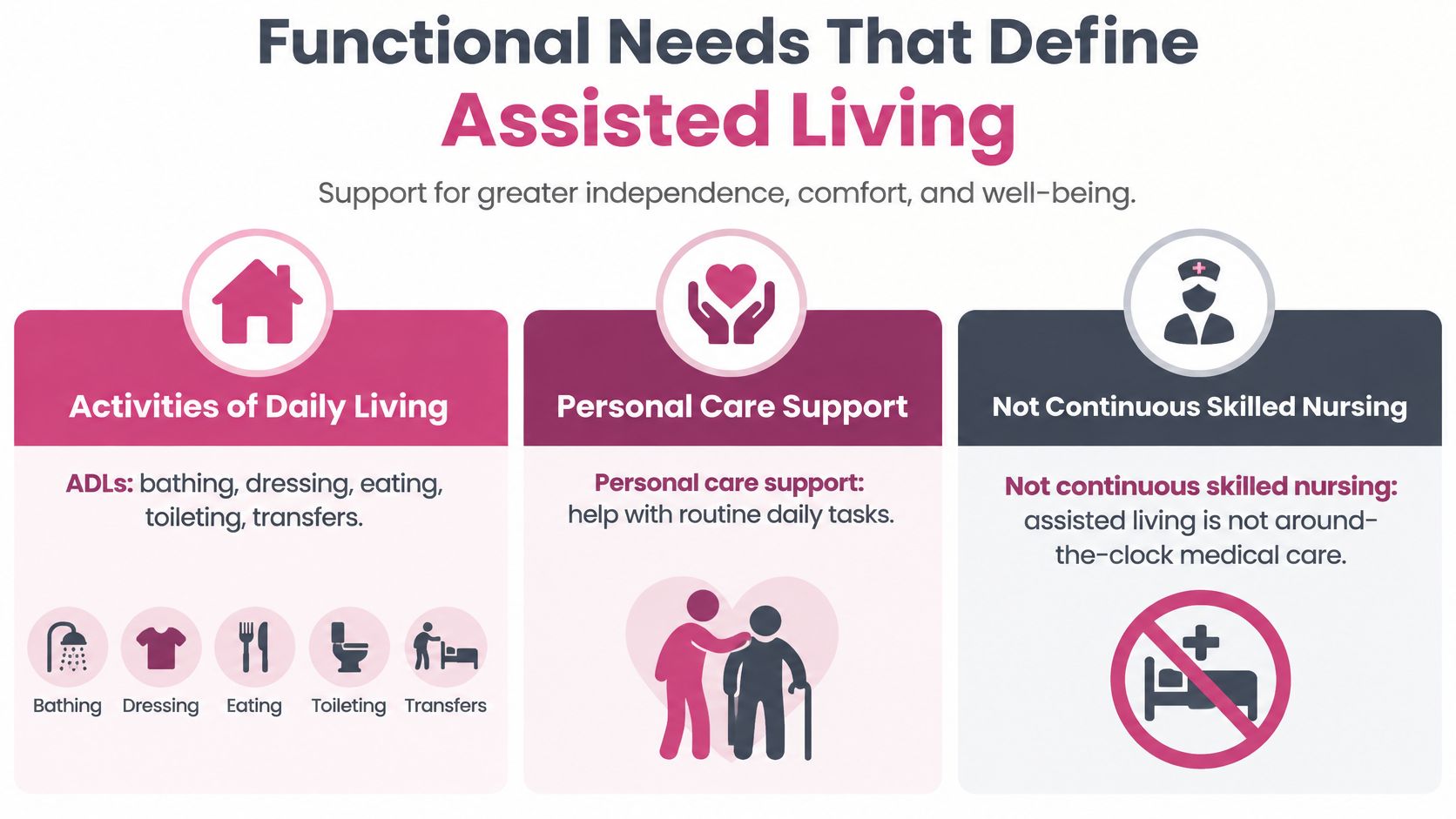
Activities of daily living, usually called ADLs, are routine personal-care tasks: bathing, walking, dressing, transferring, toileting, and eating. Transferring means moving between surfaces, such as a bed and a chair.
In 2022, residential care communities served an estimated 1 million or more residents across approximately 32,200 settings; 62% needed help with several ADLs, specifically three or more, 26% needed help with one or two, and 12% needed no ADL assistance, according to the Congressional Research Service's residential-care overview. In that same national picture, bathing and walking were especially common needs.
Distinguish personal care from household independence
Activities of daily living beyond basic self-care, or IADLs, involve managing everyday life: medications, money, transportation, and household tasks. Someone might dress independently but be unable to organize prescriptions or arrange a ride.
The categories help organize a conversation, but counting tasks isn't enough. Needing someone nearby during a shower is different from needing hands-on help throughout it.
This visual separates routine support from continuous medical care.
Write a functional profile
For each task, record what happens, how often assistance is needed, and what the helper does.
- Independent or device-assisted. Can the person complete the task safely without another person?
- Supervision. Does someone need to watch, remind, or guide?
- Hands-on assistance. What physical help is required, and at which point?
- Transfer support. Does the task require more than one helper or particular equipment?
Clinicians may use the Katz Index, Barthel ADL Index, or Lawton IADL Scale. CMS recognizes these instruments and treats ADL support as the maximum human assistance required during a defined observation period, making recent, task-specific documentation more useful than a general impression of frailty; its framework also identifies safety risks when assistance doesn't match need in transfers, toileting, eating, or medication administration (CMS ADL assessment guidance).
For example, write that your parent needs hands-on help rising from a chair after dinner, rather than writing “mobility problems.” If seating equipment is part of the discussion, Willis Furniture & Mattress's resource on lift chair safety features for seniors can help you prepare equipment questions. A chair purchase doesn't replace a professional transfer assessment.
Bring this profile to communities and ask how their bathing support, equipment, medication services, and emergency response match it.
Clinical and Safety Screens Before Admission
Consider a hypothetical parent who needs only modest dressing help but can't leave the building safely during an emergency. Their ADL list may look manageable; their evacuation needs raise a different question.
An admission screen needs to cover physical health, medical conditions, function, behavior, mental health, cognition, mobility, and evacuation safety. A review of assisted-living admission policies identifies needs that may exceed a community's capacity, including intravenous therapy, gastric feeding, communicable-disease precautions, unsafe evacuation limitations, and dementia-related aggression or risk of harm. These aren't universal rejection rules. They're reasons to verify the particular community's license and capabilities.
Assemble the clinical picture
Ask the treating team to clarify the current plan rather than relying on a discharge diagnosis alone. The information should describe both scheduled care and what happens when something goes wrong.
- Medical tasks. Document current diagnoses, medication complexity, wound or catheter care, oxygen needs, and recent hospitalizations.
- Movement and safety. Include falls, the transfer method, evacuation assistance, and equipment needs.
- Cognition and behavior. Describe confusion, behavioral triggers, risk to others, mental-health concerns, and nighttime supervision.
- Recovery changes. Identify what's expected to improve and what remains uncertain after illness or surgery.
The New Jersey assisted-living nurse assessment guide can help families organize questions before the community's clinical review. Send relevant records ahead of a tour when possible, so a nurse can address substantive concerns instead of leaving them for move-in day.
Require an operational answer
Match the clinical findings to nurse availability, staff skills, emergency systems, and secured-memory-care capabilities. Ask who performs each clinical task, when that person is present, and what staff do outside those hours.
A reassuring admission answer should describe who provides the care, not simply say that care is available.
Request the written discharge thresholds as well. You need to know what would happen if a wound worsened, transfers became harder, or nighttime behavior changed.
If home remains a temporary option, Aquastar Cleaning Services, LLC's home safety advice for local residents offers household fall-safety topics to review. Household precautions don't establish clinical readiness, however.
After stabilization, ask for reassessment before committing to a setting based on an outdated hospital snapshot. Confirm whether the community can increase services if recovery takes longer than expected.
Eligibility Versus the Right Level of Care
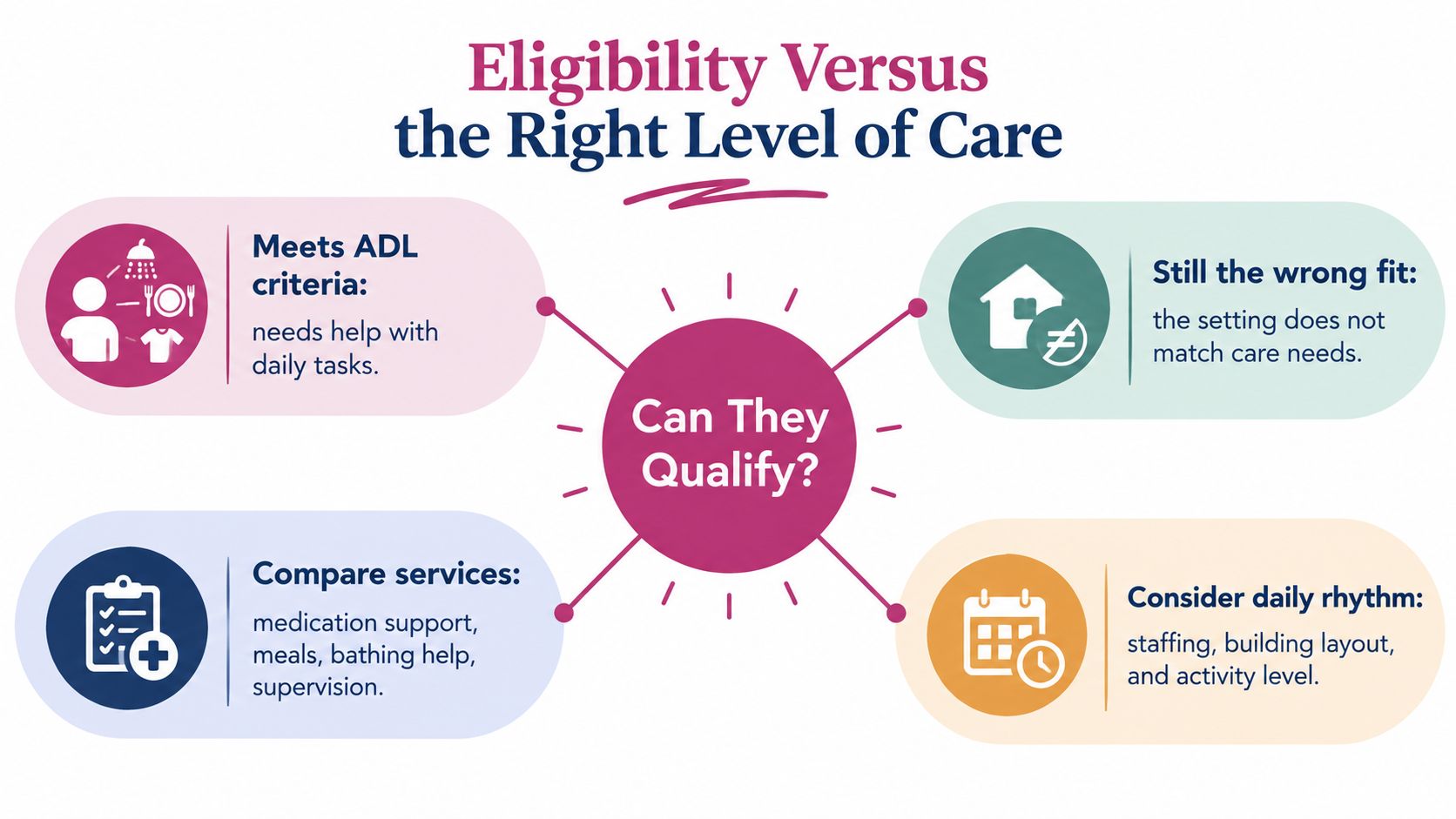
Financial eligibility and clinical appropriateness answer different questions. One concerns access to a payment pathway. The other concerns whether a particular provider can safely deliver the required care.
Medicaid-related eligibility may involve income, assets, and a state-defined institutional level of care, with substantial variation among states. Financial qualification doesn't establish that an individual community will accept someone or meet their needs, as the GAO discussion of Medicaid assisted-living services and oversight helps explain.
For New Jersey families, the useful question isn't whether a parent qualifies. It's what this community can legally and operationally provide, and whether it can continue doing so as needs change.
Apply four distinct tests
Use the same tests regardless of the payment source.
- Functional needs. Compare the written daily-help profile with the proposed care plan. Look for explicit answers rather than a broad care-level label.
- Clinical complexity. Identify who would manage injections, wounds, oxygen, or rehabilitation needs, where applicable.
- Behavioral and cognitive risks. Determine whether the setting can address wandering, aggression, or overnight needs without assuming that a dementia diagnosis describes the whole person.
- Admission and retention limits. Read what the provider accepts at move-in and what would trigger reassessment, additional services, or discharge.
The distinction between meeting criteria and finding an appropriate setting is easier to see when the questions stay separate.
Compare capabilities rather than labels
Assisted living may fit routine personal support, while a dementia-focused program may better address particular supervision needs. A nursing setting deserves consideration when clinical demands exceed what the proposed residential setting can provide. Home care deserves the same scrutiny: who will perform the tasks, and what happens when that person isn't there?
These aren't rungs on a ladder that everyone climbs in order. They're different arrangements with different capabilities.
For payment-related questions, use the New Jersey assisted-living program eligibility guide to prepare for a discussion of the applicable pathway. Keep that conversation separate from the community's clinical acceptance.
A financially possible placement can still be unsuitable. Before signing, ask the community to identify any current need it can't meet and any foreseeable change that would require another move.
Comparing Home Care with Assisted Living
Before scoring communities, ask whether assisted living is needed at all. Your parent's preference belongs at the beginning of that discussion, not after the family has chosen a building.
In survey findings summarized by the University of Minnesota Rural Health Research Center, 62.5% of rural respondents and 60.4% of urban respondents preferred long-term care at home from family, friends, or paid help. Preference is a starting point, though, not proof that a home arrangement will be safe or sustainable.
Build an honest coverage plan
Write out when help is required, who is available, and who provides backup. Include transportation, home modifications, and time when a spouse or adult child needs to sleep, work, or leave.
As a hypothetical comparison, a parent who needs scheduled bathing help and transportation may have a workable home plan. Another who needs unpredictable overnight supervision may leave substantial gaps even when relatives visit daily. Don't count willingness as availability.
For couples, the home care versus assisted living guide for New Jersey spouses offers a way to frame that household decision without assuming one spouse can provide unlimited care.
Which Setting Fits the Need
Use this as a discussion guide, then verify each provider's actual capabilities.
| Setting | Usually fits when | Look elsewhere when |
|---|---|---|
| Home care | Needed help can be scheduled reliably, with backup and a workable home environment | Supervision gaps, an unsafe home, or unavailable caregivers leave essential needs unmet |
| Independent living | The person mainly wants amenities, social opportunities, and relief from home maintenance | Personal-care or supervision needs exceed the available arrangement |
| Assisted living | Routine personal support matches the community's assessed capabilities | Clinical or behavioral needs exceed its staffing or license |
| Memory care | Dementia-related safety needs match the program's supervision and staff skills | The program can't address the person's specific behaviors or medical needs |
| Nursing care | Ongoing clinical or rehabilitative needs require that setting's services | Assessment supports a less intensive arrangement that meets the person's needs |
Compare total cost and uncovered risk, not a housing charge against a caregiver's hourly rate. Add the help required, including backup, rather than pricing only the easiest hours.
A reasonable conclusion may be staying home for now, moving to assisted living, or seeking a more clinically supported setting. Write down the reasons and the changes that would prompt another assessment.
Staffing Services Cost and Daily Life
Once the level of care is settled, compare how communities would carry out the same written plan. Ask each one to explain a difficult part of your parent's day, not just describe its services.
During a tour, look past the amenities to how residents would use them.
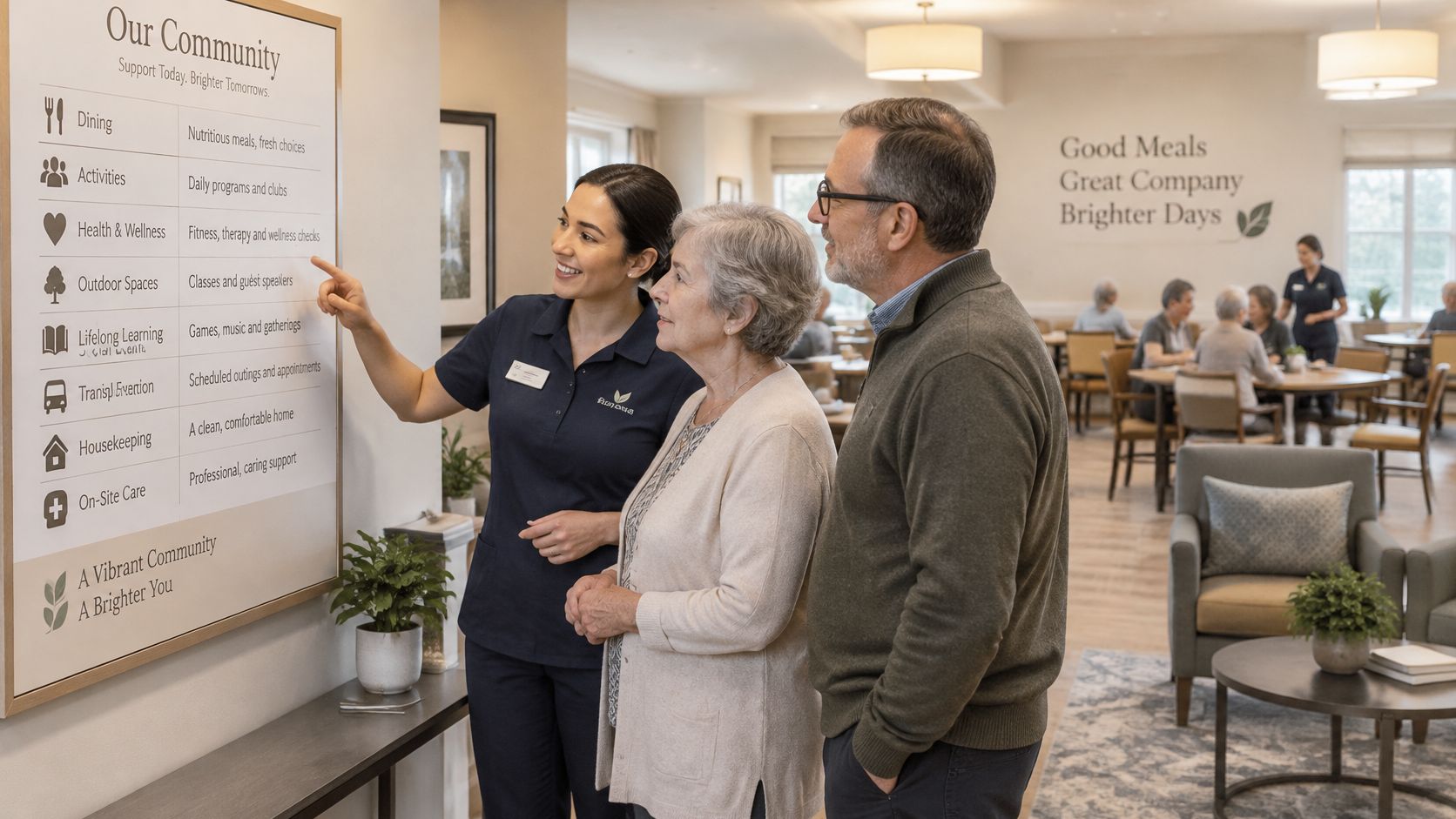
Score the answer behind the promise
Use simple categories such as confirmed fit, needs clarification, and cannot provide. Don't average a safety gap into an otherwise favorable score.
- Staffing and nights. Ask who responds to unscheduled needs and how staff obtain additional help.
- Transfers and bathing. Verify equipment, assistance methods, and whether routines can accommodate your parent's needs.
- Medication support. Clarify the service provided, who performs it, and how changes are communicated.
- Dementia support. Ask about staff training, individualized routines, and responses to distress. A secured door alone doesn't describe a care program.
Use the task-level evidence described earlier, including the highest assistance needed during the assessment period. That's more useful than asking staff to plan around your parent's best afternoon.
Compare the life and the bill
Ask for a written estimate showing included services, care-related additions, and circumstances that change the charge. Compare it with a home-care plan that reflects actual needs, not an incomplete version that assumes unpaid relatives fill every gap.
Then consider dining, activities your parent would attend, room preferences, and distance from family. For bedroom questions, Castus's resource on supporting senior sleep with cleaner air can prompt a discussion about comfort and the sleeping environment without substituting for a medical sleep assessment.
Use this video as another prompt for your visit questions.
Families can compare providers directly, work with a hospital case manager, or use a placement advisor. A no-cost New Jersey advisor and directory can document health needs, budget, lifestyle, and location, match licensed, vetted options, and coordinate tours. Ask how the advisor is paid; compensation from participating communities is relevant to understanding the shortlist.
Tour takeaway: Leave with written answers to unresolved care questions, not just a folder and an apartment preference.
A Practical Next Step for New Jersey Families
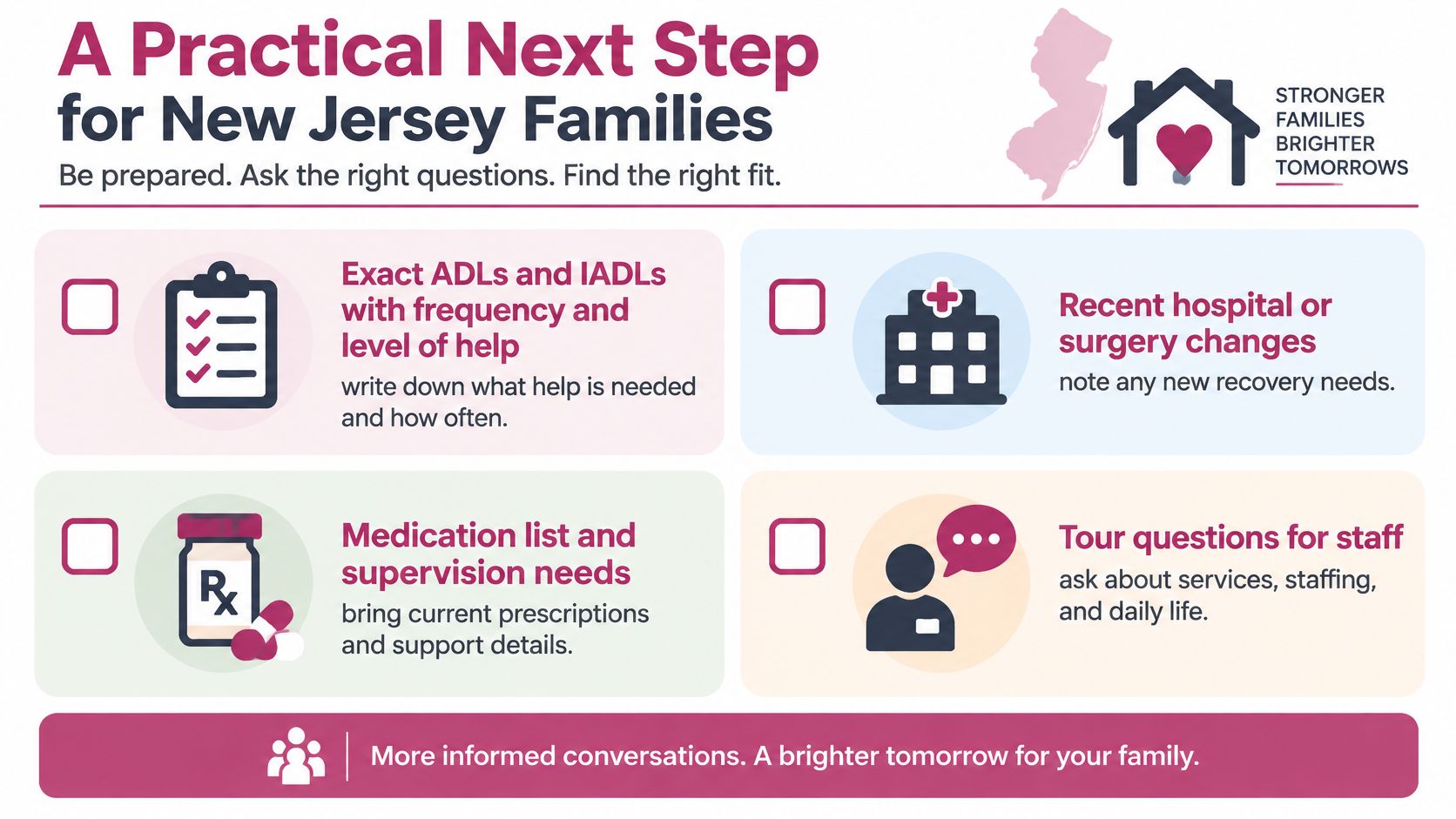
Prepare a pre-tour care sheet that every community receives. Consistent information makes it easier to compare responses and prevents important details from getting lost between siblings, clinicians, and admissions staff.
Keep the wording plain. Describe the help required rather than trying to diagnose the cause yourself, and mark uncertain information for the clinician to clarify.
Bring the facts that affect placement
- ADLs and IADLs. List exact tasks, frequency, assistance level, devices, and who currently helps.
- Recent changes. Note hospital stays, surgery, recovery needs, and assessments that may need updating.
- Medication and clinical tasks. Bring the current medication list and instructions for any ongoing treatments.
- Nighttime and evacuation needs. Describe supervision, transfer assistance, and emergency concerns.
- Cognitive and behavioral triggers. Explain what happens, when it happens, and approaches that have helped.
- Budget and location. Identify what the total must include, preferred cities or ZIP codes, and essential lifestyle preferences.
- Admission questions. Ask what the community can legally provide and what triggers discharge.
This checklist can help organize the documents before you leave home.
Use one intake for a consistent comparison
An East Hanover-based placement advisor offers a process of intake, matched options, and touring and decision support. The structured intake captures health needs, budget, lifestyle, and location, with statewide options spanning home care, independent living, assisted living, memory care, and nursing care.
Hospital case managers can use the same intake when placement is time-sensitive. Ask them to identify unresolved clinical questions so urgency doesn't turn an assumption into an admission plan.
Bring your care sheet to each tour and request written follow-up on anything staff can't confirm. Before move-in, reconcile the final service plan with the assessment and the quoted charges.
You can contact the advisor at (862) 398-2006 or email the placement team to begin an intake or discuss the records needed.
Life Senior Placement offers no-cost guidance to help New Jersey families match assisted-living criteria with licensed, vetted options, with compensation from participating communities. Visit Life Senior Placement to complete the intake, review matched options, and arrange tours, or call (862) 398-2006 with your care sheet ready.