
Your mother is in a hospital bed after a fall, infection, stroke, or surgery. The physician says she's medically ready to leave, but she still can't walk safely, manage medications, or get in and out of the bathroom without help. The hospital wants an answer quickly, and your family is suddenly expected to choose a nursing facility before you've had time to process what happened.
The first available bed is not automatically the right bed. Temporary nursing home placement is a clinical transition, not a housing transaction. The facility must be able to manage the patient's diagnoses, medications, therapy needs, equipment, precautions, and likely path home. A vacancy matters, but clinical fit matters more.
When the Hospital Bed Is No Longer Enough
The pressure usually arrives in a single conversation. A discharge planner calls and asks whether your family has chosen a skilled nursing facility. Your parent is stable enough to leave the hospital, but “stable” doesn't mean independent. She may still need wound care, oxygen, intravenous treatment, therapy, medication supervision, or assistance with every transfer.
That's where temporary nursing home placement begins. The stay may follow a hip fracture, stroke, serious infection, or major operation. The purpose isn't to provide a room after discharge. It's to give the patient continued clinical support and rehabilitation while the care team works toward a safe next step.
The shift toward short-term post-acute care has deep roots. Medicare's Inpatient Prospective Payment System, implemented in 1983, paid hospitals a predetermined amount based on diagnosis rather than reimbursing every inpatient day. That structure encouraged shorter hospital stays and increased the need for rehabilitation and clinical support after discharge. Research covering every U.S. Nursing home from 2001 through 2017 found that average Medicare admissions per nursing-home bed rose from 1.2 in 2001 to 1.6 in 2017, a 41% relative increase. In 2018, one-fifth of hospitalized Medicare beneficiaries were discharged to a skilled nursing facility, generating $28.5 billion in Medicare spending. (Research on Medicare admissions and post-acute nursing-home care)
Temporary means functional, not necessarily brief
A temporary stay is defined by its purpose and expected outcome, not just by the number of nights. A patient might need skilled rehabilitation with the goal of returning home, a short bridge while family arranges safer housing, or respite while a caregiver handles an urgent personal matter.
Before you accept a facility, ask what it can do for this patient. Can it manage the oxygen requirement? Is physical, occupational, or speech therapy available? Can staff handle a lift transfer, a complex wound, behavioral symptoms, or infection precautions? Families comparing levels of care should also understand what a skilled nursing facility provides before agreeing to a placement.
Practical rule: A bed that cannot support the patient's care plan is not an available solution. It's a delayed problem.
The home environment may also influence the plan. If your parent will eventually recover at home, ask whether an adjustable bed, bathroom equipment, transfer devices, or other supports will be needed. A resource on adjustable bed health benefits can help families think through positioning, transfers, and comfort before discharge, but equipment should be selected with guidance from the clinical team.
Understanding the Types of Short-Term Stays
“Temporary” describes several different arrangements. The purpose of admission determines the documentation, payer, and care plan. A family that asks only for “a short stay” may receive an unsuitable service or an inaccurate cost estimate. Treat the placement as a clinical transition, not a search for an empty bed.
| Type | Primary Goal | Typical Payer |
|---|---|---|
| Post-acute skilled rehabilitation | Restore function after hospitalization, surgery, injury, or serious illness | Medicare skilled benefit, Medicare Advantage, or private health insurance when eligibility requirements are met |
| Skilled nursing or clinical bridge | Provide nursing, wound care, medication management, or medical oversight while the next setting is arranged | Medicare or private health insurance for eligible skilled care, otherwise private payment or Medicaid when eligible |
| Custodial respite | Give a caregiver temporary relief while maintaining personal care and supervision | Private payment in many situations, with limited coverage depending on the program |
| Hospice respite | Provide short relief for a caregiver supporting a hospice patient | Hospice benefit under applicable eligibility and program rules |
Post-acute rehabilitation
This is the placement families commonly consider after hospitalization. The patient needs therapy or skilled nursing after a medical event, with a plan to improve function and return home or to another community setting. The referral packet should state therapy goals, weight-bearing status, baseline function, wound or oxygen needs, cognition, precautions, and the expected discharge destination.
Require the facility to confirm that it can deliver the ordered care. Ask who will manage therapy, medications, oxygen, wounds, transfers, cognitive symptoms, and infection precautions. A facility that cannot support the patient's plan is not an available bed. It is a delayed discharge problem.
Short stays became a major part of nursing-home use before the current discharge environment. A CDC historical analysis found that discharges for residents staying fewer than three months rose from 46 per 100 beds in 1977 to 92 per 100 beds in 1999, while short-stay discharges represented 95% of the overall increase in discharge activity during that period. The Medicare publication on skilled nursing facility coverage also explains the type of post-hospital care that may qualify for coverage. (Medicare coverage information on skilled nursing facility care)
Respite and bridge placement
Respite provides caregiver relief. It does not automatically include rehabilitation or Medicare-covered skilled care because the patient stays in a nursing facility. A bridge placement can fit a family arranging long-term care, repairing a home, waiting for a suitable opening, or assessing whether the patient can return safely.
Hospice respite has its own purpose and eligibility rules. The National Institute on Aging states that Original Medicare generally covers hospice respite for up to five consecutive days in a hospital or skilled nursing facility. Most private health insurance does not cover respite, and Medicaid assistance varies by program and state. (National Institute on Aging guidance on respite care)
Ask the admissions representative to identify the requested stay in writing: rehabilitation, skilled nursing, custodial respite, hospice respite, or bridge placement. Confirm the payer and the services included before signing admission paperwork. If staff cannot explain both clearly, pause the placement and involve the hospital social worker, insurer, or placement advisor.
Navigating Insurance and Coverage Options
Coverage follows the level of care, not the building and not the family's assumption that every temporary stay is automatically paid for. Before you accept a bed, make the business office spell out the payer, authorization steps, covered services, patient responsibility, and the point where coverage ends.
Original Medicare can cover eligible skilled nursing facility care for up to 100 days during a benefit period when the patient meets the program's requirements. That coverage is for medically necessary post-hospital skilled care, not open-ended custodial residence. Keep Medicare's official skilled nursing facility coverage publication with the discharge papers and use it to press the billing office for straight answers.
Ask these questions before admission
- What is the exact payer for this admission? Get it in writing. “We accept Medicare” is not enough. Ask whether the facility accepts the patient's specific Medicare Advantage plan, private insurance plan, Medicaid program, hospice provider, or private-pay arrangement.
- What clinical service supports coverage? Therapy, wound care, medication management, and other skilled services must match the documented need. A vague promise that the patient will “receive care” tells you nothing about eligibility.
- What authorization is still pending? Ask who submitted the records, what documents the insurer still needs, and who will call the family if authorization is delayed or denied.
- What will the family owe? Ask for a written estimate that covers room charges, coinsurance, uncovered services, transportation, supplies, and any private-pay period. Do not rely on a verbal quote made during a rushed admission.
- What is the plan if the patient stops meeting skilled criteria? The facility should explain the move to private payment, Medicaid, long-term-care insurance, hospice, or another payer before the family gets hit with an unexpected bill.
Medicaid matters when the stay turns into long-term care and the patient meets the program's financial and clinical rules. New Jersey families should review what New Jersey Medicaid covers for nursing homes, then confirm the current rules with the state, the facility, and a qualified benefits or elder-law professional.
Long-term-care insurance can also help, but the policy language controls. Families researching how to find affordable long term care should check elimination periods, covered settings, benefit triggers, daily limits, and whether respite or custodial care qualifies.
Ask for the financial exit plan on the day of admission. A temporary placement can turn into a longer stay if recovery stalls, and the payer can change before the family feels ready.
The Critical Importance of Medication Safety
Medication reconciliation is the most dangerous paperwork in the transfer. Hospitals, pharmacies, physicians, and skilled nursing facilities may use different records, abbreviations, and ordering systems. A missing dose, duplicated prescription, or incorrect restart date can cause harm before the family realizes the list is wrong.

The risk is measurable. Up to 75% of patients transferred to skilled nursing facilities have at least one medication discrepancy between discharge documentation and the SNF admission plan. Approximately 91% of nursing-home residents take more than five medications daily, while 65% take more than ten. Medication errors affect an estimated 16% to 27% of residents. (AHRQ project on medication problems during skilled nursing transitions)
What the admitting nurse must verify
Bring every medication source you have, including the hospital discharge summary, pre-hospital medication list, pharmacy printout, specialist instructions, and the patient's own bottles. Don't assume the hospital list is complete or that the nursing facility will resolve contradictions without your involvement.
Ask the admitting nurse:
- Which list is the master list? The nurse should explain how the hospital record, referral packet, physician orders, and pharmacy profile will be compared.
- Who is reviewing high-risk drugs? Ask specifically about anticoagulants, opioids, insulin, and other hypoglycemics.
- When will verification be complete? Require pharmacist or nurse verification of high-risk medications within 24 hours of arrival, with a named person responsible for unresolved discrepancies.
- What changed in the hospital? Ask why medications were stopped, added, reduced, or changed in timing.
- How will the family receive updates? Establish who will call if the facility cannot confirm a medication, dose, allergy, or monitoring requirement.
Do not accept “the doctor will review it” as a complete answer. Ask which doctor, when the review will happen, and how the decision will be documented. Missing medication orders, unclear therapy instructions, or an absent follow-up appointment should delay transfer until the responsible professionals resolve the defect.
The following video can help families recognize why transitions require careful medication review:
A family member should call the facility after admission and compare the current medication administration record with the written discharge list. If something differs, ask whether the difference is intentional and request the clinical reason. Keep a dated record of the question, the person who answered it, and the resolution.
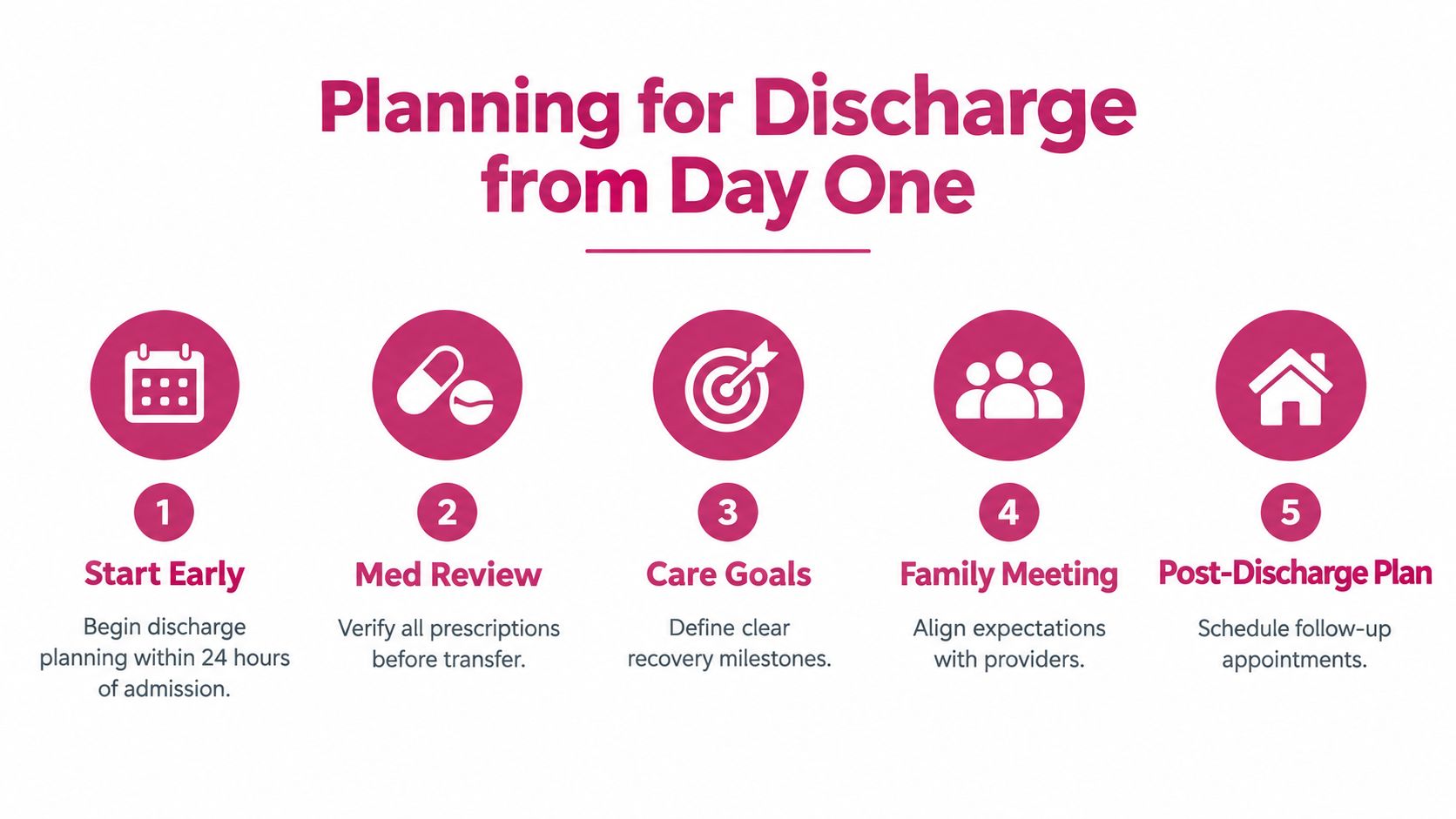
Planning for Discharge from Day One
Admission is not the finish line. It's the first day of the discharge plan.
At intake, establish the patient's baseline mobility and activities of daily living. Then ask the interdisciplinary team to define the milestones that would support discharge. Those might include transferring safely, walking a specified route with the recommended device, managing stairs, tolerating a diet, completing wound care, or having a caregiver trained in the required assistance.
Make the facility state its plan
Ask for a written estimated discharge date, even if it's subject to change. Review progress at least weekly with nursing, therapy, the patient, and family. A facility focused on recovery should be able to explain what has improved, what remains unsafe, and what must happen before the patient can leave.
The discharge destination also needs a practical assessment. If the plan is home, determine who will provide help, whether the caregiver can perform transfers, which equipment must be delivered, and whether home health or outpatient therapy is appropriate. If home isn't safe, begin discussing assisted living, long-term nursing care, memory care, or another setting before the final week.
Demand a complete release packet
Before the patient leaves, require:
- A current medication list: Include doses, schedules, discontinued medications, monitoring instructions, and the person to contact with questions.
- Follow-up appointments: Record the provider, date, purpose, transportation plan, and whether the appointment has been confirmed.
- Equipment instructions: Identify what must be delivered before arrival, including mobility, bathing, toileting, oxygen, or wound-care equipment.
- Warning signs: Ask which symptoms require a call to the physician, an urgent evaluation, or emergency care.
- Responsible contacts: Get names and phone numbers for the facility, home-health agency, pharmacy, physician, and family caregiver.
Discharge planning failures are common enough to demand scrutiny. An HHS Office of Inspector General review found that skilled nursing facilities failed to meet at least one discharge-planning requirement in 31% of stays, and 23% of stays lacked a post-discharge plan of care. In one reviewed study, researchers identified 1,389 medication discrepancies among 212 patients, an average of 6.6 discrepancies per patient, and judged 40.7% potentially capable of causing an adverse drug event. (HHS OIG review of skilled nursing facility discharge planning)
Track the outcomes that matter: therapy-goal attainment, medication discrepancies resolved before discharge, emergency-department returns, rehospitalization, and final discharge destination. CMS short-stay rehospitalization and potentially preventable SNF-readmission measures can also help families compare facilities rather than relying on appearance or sales language.
Using Professional Placement Services
Families can call facilities directly, but a hospital discharge rarely gives you enough time to compare clinical fit, payer rules, availability, and discharge performance on your own. A professional placement advisor can act as the organizing point between the family, hospital, facility, and insurer.
The useful model has three parts.
Start with a structured intake
A serious advisor begins with diagnoses, functional status, cognition, medications, therapy orders, equipment, infection precautions, behavioral needs, payer, budget, preferred location, and discharge destination. That information prevents a common mistake: touring attractive communities that cannot accept the patient's care profile.
Narrow the field to appropriate facilities
The advisor should match the patient's requirements against current availability, licensing, services, payer acceptance, and location. Ask what information has been verified and what still needs confirmation. Availability changes quickly, so a list that was accurate earlier in the day may not reflect the beds open when the hospital is ready to transfer.
Coordinate tours and decisions
A coordinated tour should answer practical questions about staffing, therapy, nursing coverage, equipment, meals, communication, infection control, and discharge planning. Compare facilities side by side, and ask each one the same clinical questions so the family can identify differences instead of being influenced by décor.
Families should also prepare for the patient's rehabilitation after placement. The clinical team must approve exercises, but resources on safe mobility exercises for elderly can help caregivers understand why strength, balance, transfers, and fall prevention remain central to a return home.
A placement advisor isn't a substitute for the hospital physician, therapist, insurer, or elder-law attorney. The advisor's value is coordination. In New Jersey, families can also review nursing home placement services to understand how structured intake, facility matching, tours, and move-in support can reduce the number of disconnected calls during a discharge crisis.
Taking the Next Steps with Confidence
Temporary nursing home placement should end with a safe transition, not merely a completed admission. Choose the facility that can manage the patient's actual clinical needs, verify the payer before transfer, reconcile medications immediately, and require a written discharge plan from the first day.
You're allowed to ask direct questions. Ask who is responsible for medication verification, how often therapy will occur, what progress will be reported, what could delay discharge, and what the family must arrange at home. If the answers are vague, keep looking or escalate the concern to the hospital discharge team.
The process is stressful, but informed pressure protects your loved one. A bed is only the beginning. The right placement connects clinical capability, financial eligibility, family proximity, measurable recovery goals, and a realistic path to the next setting.
Life Senior Placement offers no-cost New Jersey guidance, structured intake, matched nursing home and skilled nursing options, and coordinated tours for families managing a temporary placement. Visit Life Senior Placement to request practical support before accepting a facility that may not fit your loved one's needs.