
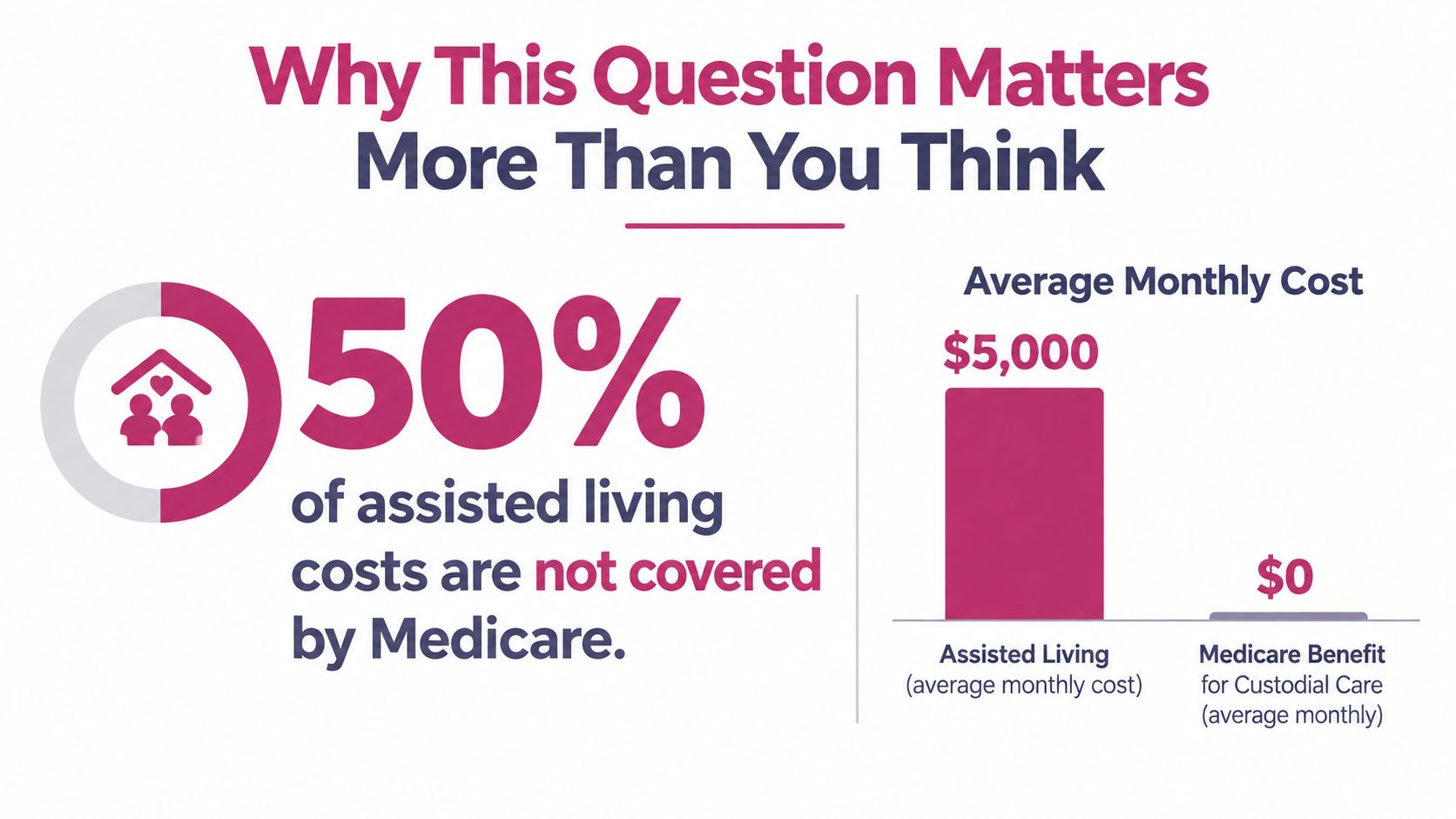
Medicare generally pays $0 toward assisted living room, board, and personal care, because the program was built for short-term medical needs, not long-term residential support. If you've been told Medicare will “kick in” once a parent moves to assisted living, that's the wrong advice, and it causes families to make bad financial decisions fast.
The better question is what Medicare still covers once someone is already living there, and what pays the monthly bill in New Jersey. That's where families get tripped up, because Medicare can still be useful inside assisted living, just not for the facility itself.
Why This Question Matters More Than You Think
The first shock for most New Jersey families is the bill, not the care plan. Assisted living isn't a medical bed in a hospital or a short rehab stay, it's a monthly housing-and-support package, and that distinction matters when you're comparing it with Medicare's rules.
You'll hear this question in hospital discharge meetings, on facility tours, and around kitchen tables because the Medicare name suggests broad coverage. It doesn't work that way. Original Medicare does not pay for assisted living room and board, and the same basic rule holds across the board for the facility's monthly fee, even though Medicare can still pay for covered medical services a resident receives there. NCOA's explanation of Medicare and assisted living lays out that boundary clearly.
The conversation is not, “Will Medicare pay the rent?” The conversation is, “What Medicare-covered care still follows Mom into the building, and what source covers everything else?” In New Jersey, that second question is the one that saves families from panic later.
Practical rule: If the monthly invoice is for housing, meals, and hands-on daily support, Medicare isn't your payer. If the bill is for a doctor visit, therapy, hospice, or another covered medical service, Medicare may still apply.
This is why families need a full funding stack, not just one insurance card. A good planner looks at medical coverage, long-term care coverage, veterans benefits, Medicaid pathways, and private funds together, because that's how the monthly gap gets closed in real life.
What Assisted Living Actually Is and Why Medicare Draws the Line
Assisted living is a residential setting, not a clinical one. Residents live in apartments or rooms, eat meals on site, and get help with daily routines such as bathing, dressing, medication reminders, and getting around safely. The monthly fee bundles housing and personal support, which is exactly why Medicare treats it differently than skilled medical care.
Why custodial care is the dividing line
Custodial care means non-medical help with daily activities. That's the work assisted living staff does most days, and Medicare generally excludes it because the program is built around medical treatment, not ongoing living assistance. When families hear “care,” they often assume Medicare covers it, but Medicare draws a hard line between helping someone live and treating an illness.
Skilled nursing is the opposite side of that line. It's care delivered by, or under the supervision of, licensed nurses and therapists, usually for a defined medical need. Medicare was designed to pay for that kind of short-term recovery care, not the ongoing residential support that defines assisted living. This complete guide to assisted living is useful if you want the housing model spelled out in plain English.
| Setting | Who Delivers Care | Typical Payer | Medicare Coverage |
|---|---|---|---|
| Assisted Living | Personal care staff, aides, nurses on site | Private pay, Medicaid waiver, long-term care insurance, veterans benefits | Generally no for room, board, and custodial help |
| Skilled Nursing | Licensed nurses and therapists | Medicare in limited cases, then other payers | Yes, but only under narrow rules |
| Custodial Care | Aides or family help with daily living | Private pay or long-term care funding | Generally no |
That table is the cleanest way to remember the rule. If the service is residential and personal, Medicare steps back. If the service is skilled and medically necessary, Medicare may step in.
The practical takeaway is simple. Assisted living costs are excluded because they are housing-plus-support costs, not medical treatment costs. That's why room, board, and personal care are off the Medicare menu, even when the resident still needs regular health services.
What Medicare Still Covers Once You Live in Assisted Living
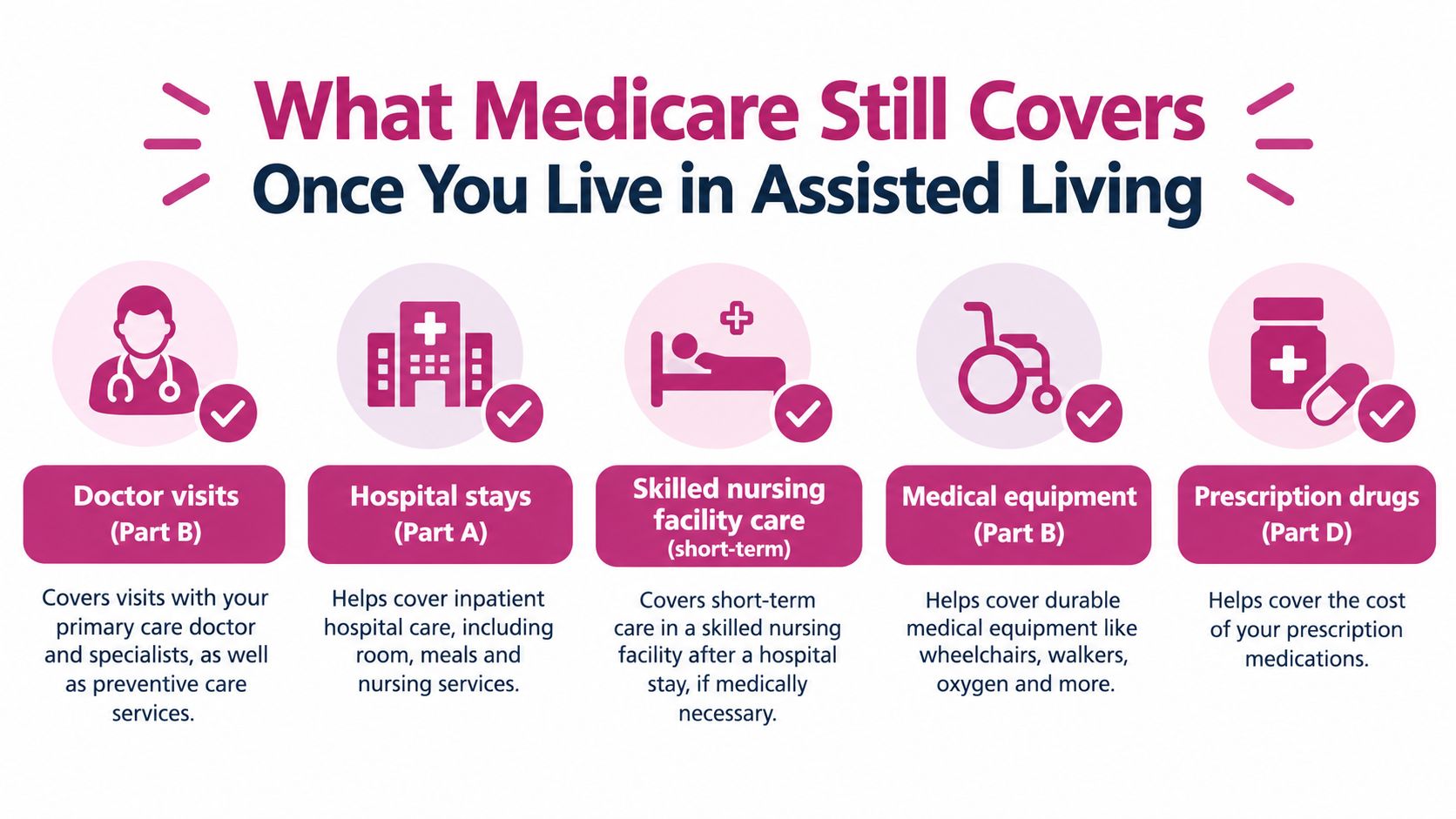
Medicare doesn't disappear when a person moves into assisted living. It just stops paying for the building's monthly fee. The resident can still use Medicare for the same covered services they'd use anywhere else, as long as the service itself meets Medicare rules.
The services that still bill to Medicare
Doctor visits still count. A resident can see a primary care doctor, specialist, gerontologist, psychiatrist, or podiatrist, and those claims can still go through Medicare when the service is covered and billed correctly. If the doctor comes to the building or a telehealth visit is arranged from the residence, the key issue is the service, not the address.
Therapy also remains on the table. Physical therapy, occupational therapy, and speech-language therapy can still be covered when they're ordered appropriately and provided by a Medicare-enrolled clinician. In many assisted living settings, that therapy comes on-site through outside providers, which keeps the resident from having to leave the community for every appointment.
Durable medical equipment is another area families overlook. Wheelchairs, walkers, hospital beds, oxygen, and diabetic supplies can still be billed to Medicare when they meet coverage rules. If a resident has Original Medicare, the usual coinsurance structure still applies, and a Medicare Supplement can help absorb some of that share. If you're trying to understand how that secondary coverage works, understanding Medigap benefits is a good place to start.
Hospice is separate, and families should treat it that way. When a resident has a terminal illness and meets hospice criteria, Medicare can cover hospice services tied to that diagnosis, including the team-based support, medications, and equipment that go with it.
The short version is this, Medicare can still pay for the medical pieces inside assisted living, but not the residential package. That's the billing distinction families need to keep straight, because the facility fee and the Medicare claim are usually two different things.
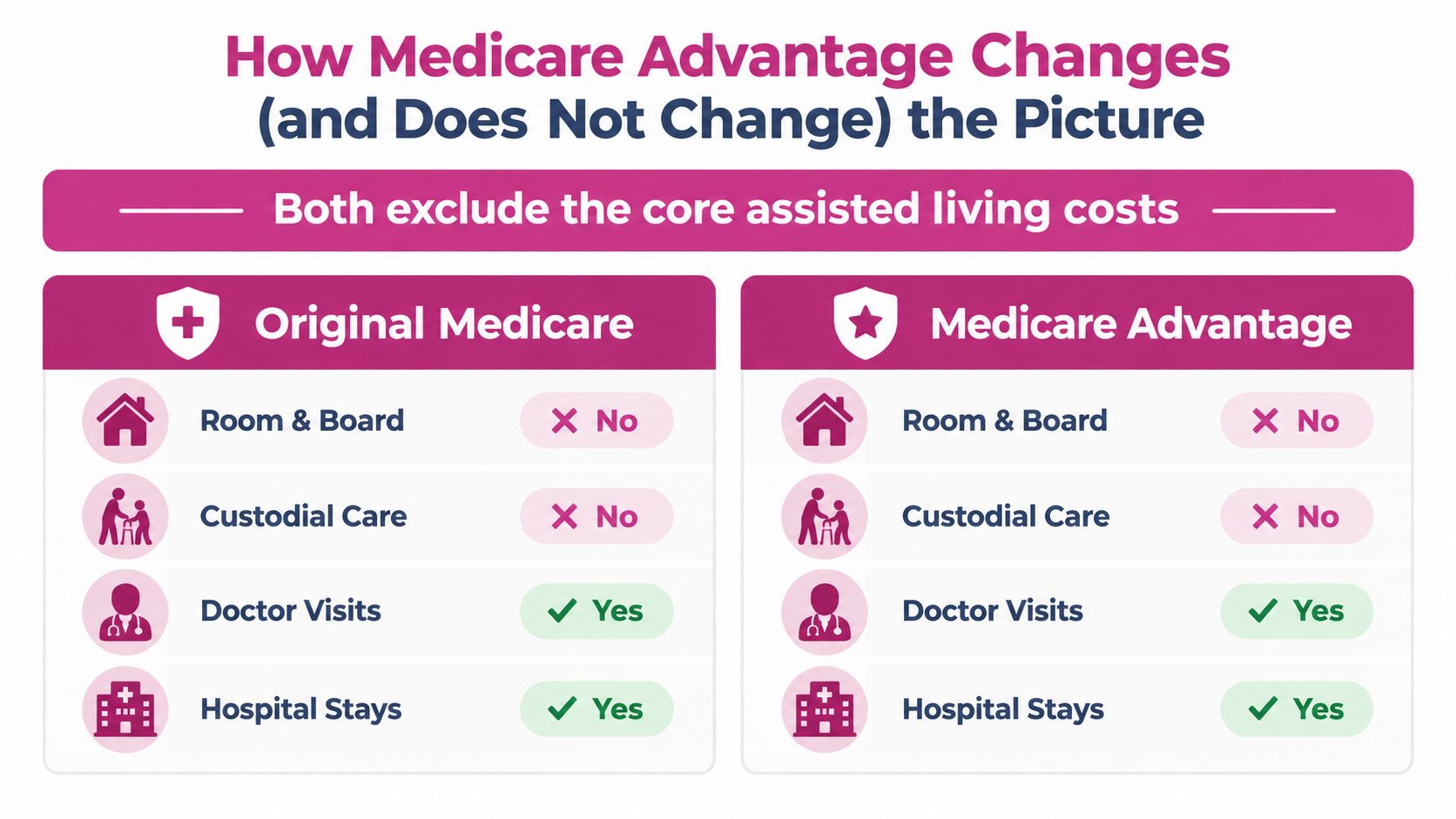
If a parent has Medicare Advantage instead of Original Medicare, the core rule doesn't change. The plan may add extra perks, but it still doesn't turn assisted living rent into a covered benefit.
The Skilled Nursing Exception and the 100-Day Rule
There is one Medicare pathway that can look a little like assisted living support, but it's really rehab in a skilled setting, not a long-term residence. That distinction matters, because families often hear “Medicare covered rehab” and assume the program is paying for ongoing care. It isn't.
How the exception actually works
The gateway is a qualifying inpatient hospital stay, followed by medically necessary skilled care in a Medicare-certified skilled nursing facility. This is the part people blur with assisted living, but the services are different. Skilled nursing is ordered and supervised clinical care, not the daily supportive help you get in assisted living.
Coverage under Part A can last up to 100 days per benefit period when the person qualifies. The first 20 days are fully covered, and the daily coinsurance after that is $217 in 2026 according to the verified data in this brief. Families should also know that the 2025 SNF deductible was $1,676 before Medicare began payment, which tells you how quickly the out-of-pocket side can show up even in the limited setting Medicare covers. Humana's Medicare resource on assisted living discusses the skilled nursing rule, and the limits are the part to remember.
A practical way to think about it is rehab versus residence. A hip-fracture recovery with therapy goals fits the skilled model. A long-term move because Mom needs help bathing, dressing, and remembering medications does not.
| Days of Stay | Skilled Need Required | Patient Pays |
|---|---|---|
| 1 to 20 | Yes | Nothing for covered days |
| 21 to 100 | Yes | Daily coinsurance applies |
| Beyond 100 | Yes | Out of pocket |
The clock can reset after a break in skilled care, but families should never plan around that as a strategy. The better move is to understand that Medicare's skilled nursing help is temporary, tied to recovery, and very different from the ongoing support model in assisted living. This nursing home guide is helpful if you're comparing post-hospital options for a parent who needs more than assisted living can safely provide.
Medicare's skilled nursing benefit is a recovery tool. It is not long-term residential financing in disguise.
How Medicare Advantage Changes and Does Not Change the Picture
Medicare Advantage makes the system feel more complicated than it is. The plan may look richer on paper, and sometimes it is, but it does not rewrite the basic rule about assisted living costs.
What stays the same
Both Original Medicare and Medicare Advantage leave the core assisted living bill alone. That means room, board, and custodial help are still not covered. If a plan representative sounds vague on this point, don't let that pass. Ask directly whether the facility fee is covered, because the answer is no.
What may be added
Some Medicare Advantage plans add transportation, limited in-home support visits through supplemental benefits, dental, vision, or richer drug coverage. Those extras can help around the edges, but they don't pay for the apartment, meals, or daily hands-on help that make assisted living work. For families comparing plans, that matters more than the marketing brochure.
Network rules also matter. If a parent moves into assisted living mid-year, the primary care doctor or specialist may be outside the plan's network, and then the family has to rework appointments quickly. Prior authorization can also be stricter, which means the assisted living nurse may need to send records, therapy notes, or medication lists before the plan approves certain services.
For families sorting through those tradeoffs, navigating nursing home care costs can be helpful background on why medical coverage and residential care keep landing in separate buckets.
The bottom line is blunt. Medicare Advantage can add convenience, but it doesn't erase the assisted living exclusion. If you're shopping for a plan because you need the monthly facility bill to go away, you're shopping in the wrong place.
The Funding Stack Families Use to Pay for Assisted Living
Once families accept that Medicare will not pay the assisted living invoice, the task is building the payment stack. In New Jersey, that usually means combining several sources, not hoping one program will cover everything.
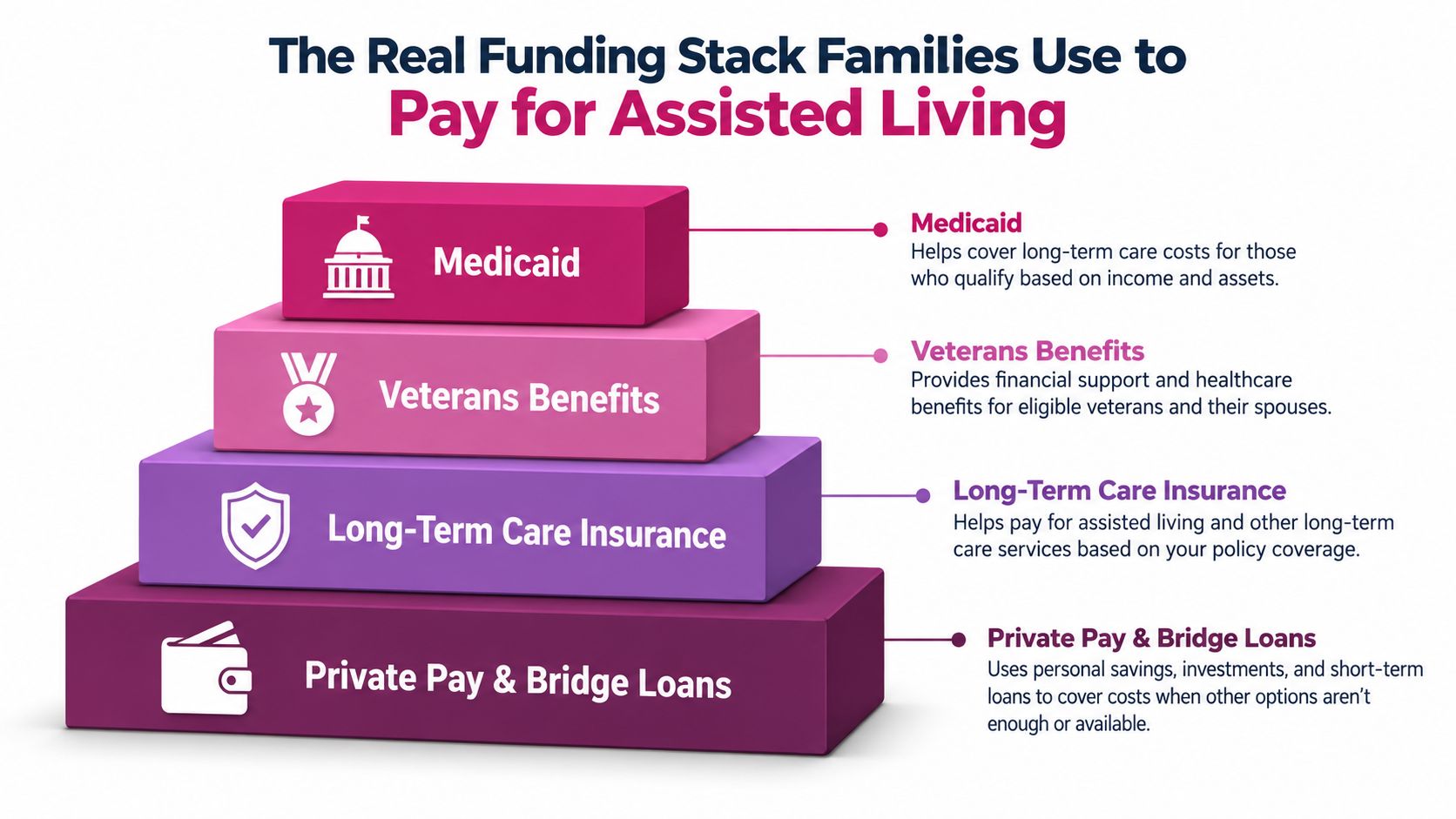
Private pay is the starting point. Savings, pension income, retirement withdrawals, family contributions, and bridge financing often keep a move from stalling when assets are not yet liquid.
Long-term care insurance is the next layer for families who already bought a policy. It helps only if the policy is active, the claim is filed correctly, and the elimination period has been met. If you are comparing policy language with estate planning questions, whole life and Medicaid rules is a useful reference before you move money around.
Veterans households should also check VA benefits. Aid and Attendance can help when a veteran or spouse meets the program's rules, and the pension structure can bridge part of the monthly gap for some families who would otherwise spend down too fast.
Medicaid is usually the last layer, but in New Jersey it is the one many families eventually need. The Global Options for Long-Term Care, or GO waiver, and PACE can help some eligible residents with long-term care needs, although the eligibility rules and service mix are different from Medicare. Medicaid does not pay assisted living rent, but for qualifying residents it often keeps care in place when private funds run thin.
Practical rule: Do not wait until the bank account is empty before asking about Medicaid, veterans benefits, or insurance claims. The cleanest placements happen when the funding plan is set before the move, not after the bill arrives.
Some households also use niche tools. Life settlements, reverse mortgages, and cost-sharing between adult siblings can all play a role, but only when the family has thought through the long-term tradeoffs. If you are trying to protect a spouse or preserve some estate value, these ways to pay for assisted living without draining savings are worth a close look.
Life Senior Placement also helps New Jersey families compare assisted living, memory care, nursing homes, and home care when the funding mix is the main obstacle. That matters because the right placement often depends as much on the payment plan as on the care need itself.
Common Misconceptions and Your Next Step Forward
The biggest mistake families make is treating Medicare like a universal long-term care policy. It isn't, and the myths around it create bad timing, bad expectations, and bad move-in decisions.
The myths that keep costing families money
Myth 1, Medicare covers assisted living after a hospital stay.
No. A hospital stay may open the door to short-term skilled nursing coverage, but it does not turn assisted living into a covered benefit.
Myth 2, a dementia diagnosis qualifies you for Medicare payment for memory care or assisted living.
No. Medicare may still cover medical treatment tied to dementia, but the residential memory care bill is still outside the program.
Myth 3, Medigap fills the assisted living gap.
No. Medigap helps with certain Medicare cost-sharing, not room, board, or custodial support.
Myth 4, Medicare Advantage dental or vision extras cover facility costs.
No. Those extras may help with specific services, but they don't pay for housing, meals, or daily personal care.
The right next move is to match the care setting to the actual need. If a parent is mostly independent, home care may be enough. If daily help is needed but medical care is still limited, assisted living may fit. If there's a skilled, short-term recovery need, skilled nursing is the right category.
Before you call a placement advisor or elder law attorney in New Jersey, gather the documents that shape the answer: the current medication list, recent hospital or rehab discharge papers, insurance cards, a list of monthly income, and a rough inventory of assets and long-term care coverage. That paperwork tells you much more than a guess ever will.
If you want a straight answer instead of another round of Medicare confusion, start with a care-level review and a funding review together. That's how you stop treating assisted living like a Medicare problem and start treating it like a placement and planning problem.
Life Senior Placement helps New Jersey families compare assisted living, memory care, nursing homes, and home care with a no-cost, advisor-guided process. If you're trying to figure out what Medicare will cover, what it won't, and which communities fit the budget, visit Life Senior Placement and start with a practical search that matches care needs to the right setting.