
58 million Americans were age 65 and older in 2022, and about 70% of older adults will need some form of long-term care. The right senior living solution comes from matching clinical needs, budget, and location through a structured intake process, not from browsing directories until something looks good enough.
That matters because the decision usually lands in your lap after a hospital discharge, a fall, or a quiet but unmistakable decline at home. You do not need more options. You need a clean way to separate the right level of care from the wrong one before a crisis forces a rushed move.
Navigating Senior Living Solutions in New Jersey
The most common mistake families make is treating a care decision like a shopping trip. It is not. If your parent just left the hospital, stopped managing medications, or started wandering at night, the question is no longer where they want to live in theory. The question is what setting can keep them safe today.

Start with the care problem, not the brochure
Use three filters from the beginning. First, define the clinical need, meaning bathing help, medication support, memory supervision, rehab, or skilled nursing. Second, set the budget reality, because many families discover too late that the monthly price and the actual out-of-pocket cost are not the same. Third, narrow by location, since family visits, doctor access, and discharge timing all affect whether a placement works.
That order matters because a beautiful building with the wrong care level is a bad placement. A smaller apartment, a less glamorous dining room, or a community farther from the shore is a better choice if it fits the person's condition and the family can sustain it. Good placement is not about finding the nicest tour. It is about finding the safest match.
Practical rule: If you cannot explain why a setting fits the person's diagnosis, daily function, and support needs, keep looking.
Families sometimes also consider unconventional housing models when standard senior housing feels too large or too expensive. A resource like senior living in a tiny home can be useful if you're weighing compact, lower-maintenance living alongside more traditional care settings. Just remember that a housing style is not the same thing as a care plan.
For a simple starting point on how the two most common choices differ, see independent living vs assisted living in New Jersey. That distinction is where many families either save weeks of confusion or lose weeks to the wrong search.
Comparing Core Senior Living Options
The right option depends on what daily life looks like. Some people need no hands-on care and just want less maintenance. Others need help every morning and evening. Some need secured memory support. A few need round-the-clock clinical oversight.
The main settings, side by side
| Option | Best fit | What matters most |
|---|---|---|
| Independent living | Active seniors who want amenities and less upkeep | Social life, convenience, lighter support |
| Assisted living | Seniors who need help with daily routines | Bathing, meals, medications, supervision |
| Memory care | People living with dementia or Alzheimer's | Secure environment, specialized staffing, structured routines |
| Nursing home | People with complex medical needs | Clinical oversight, rehab, 24/7 nursing |
| Home care | Seniors who want to stay home with support | Scheduling, caregiver reliability, family coordination |
Independent living is about convenience, not care. It works when someone is still managing most tasks and just wants a simpler lifestyle. Assisted living adds daily support while preserving as much independence as possible. Memory care is different again, because it is built for supervision, security, and dementia-specific routines.
Nursing homes are for medical complexity, not lifestyle preference. If someone needs ongoing skilled support, wound care, or rehab-level oversight, a residential apartment with minimal staffing is the wrong answer. Home care can bridge a gap, but it only works when the home environment, caregiver coverage, and family coordination are realistic.
Important point: Mismatching the setting usually costs more later, because families end up moving twice.
The memory care segment has expanded sharply over the last decade, with units rising by nearly 84% from 2013 to 2023 to 162,100 units, and the average monthly rent reached $8,399 in 2023, according to NIC data cited by AARP (AARP's memory care overview). That growth tells you two things. First, demand is real. Second, specialized care is expensive because the staffing and environment are different.
If you are trying to decide between home support and a move, ask one blunt question. Can this person stay safe and stable for the next six months without a scramble? If the answer is no, the search should shift toward a formal care setting now, not later.
Understanding New Jersey Market Dynamics
New Jersey families are shopping in a tight market. Demand is rising across senior living, especially in memory care and skilled nursing, so the question is not what looks good on a website. It is which communities can take the person's current level of care.
That pressure shows up in occupancy. Senior housing occupancy in the 31 NIC primary markets passed 90% in July 2026, with 61% of properties above 90% occupancy and another 16% between 85% and 90% (NIC occupancy update). In plain terms, families face shorter tour windows, faster move-in decisions, and a real chance that a promising option disappears before they are ready.
Senior Housing Market Indicators
| Metric | Value | Impact on Families |
|---|---|---|
| Senior housing occupancy in NIC primary markets | Above 90% | Faster move-in timelines and fewer open units |
| Properties above 90% occupancy | 61% | Strong competition for the most desirable communities |
| Properties between 85% and 90% occupancy | 16% | Limited flexibility if you delay a decision |
| U.S. Seniors living in private homes in 2021 | 97.5% | Aging in place remains the default, so transitions often happen late |
Construction is not catching up. At the end of 2025, U.S. Senior housing occupancy reached 89.1%, occupied units rose by nearly 20,000, and new units under construction were just 2.3% of inventory (NIC's 2025 market update). Families should expect wait-list risk and price pressure, especially if they want a specific neighborhood or a higher-acuity setting. For current pricing context, see the breakdown of the cost of assisted living in New Jersey and compare it to the care level you need.
New Jersey planning also depends on staffing. The state's nursing home reimbursement framework uses staffing benchmarks of 4.10 hours per resident day for Tier 1 and 3.74 HPRD for Tier 2, with 3.60 HPRD as the minimum eligibility threshold for improvement payments (New Jersey nursing home reimbursement framework). Families do not need to memorize the policy. They do need to read it as a signal of what a building can realistically handle, because staffing sets the ceiling on care.
Use location filters only after you test fit. The New Jersey ReloScore breakdown helps you compare neighborhood factors with care needs, which is useful if you are weighing several parts of the state. A move works only when the setting can absorb the person's current condition, not just their ZIP code.
The Structured Placement Process
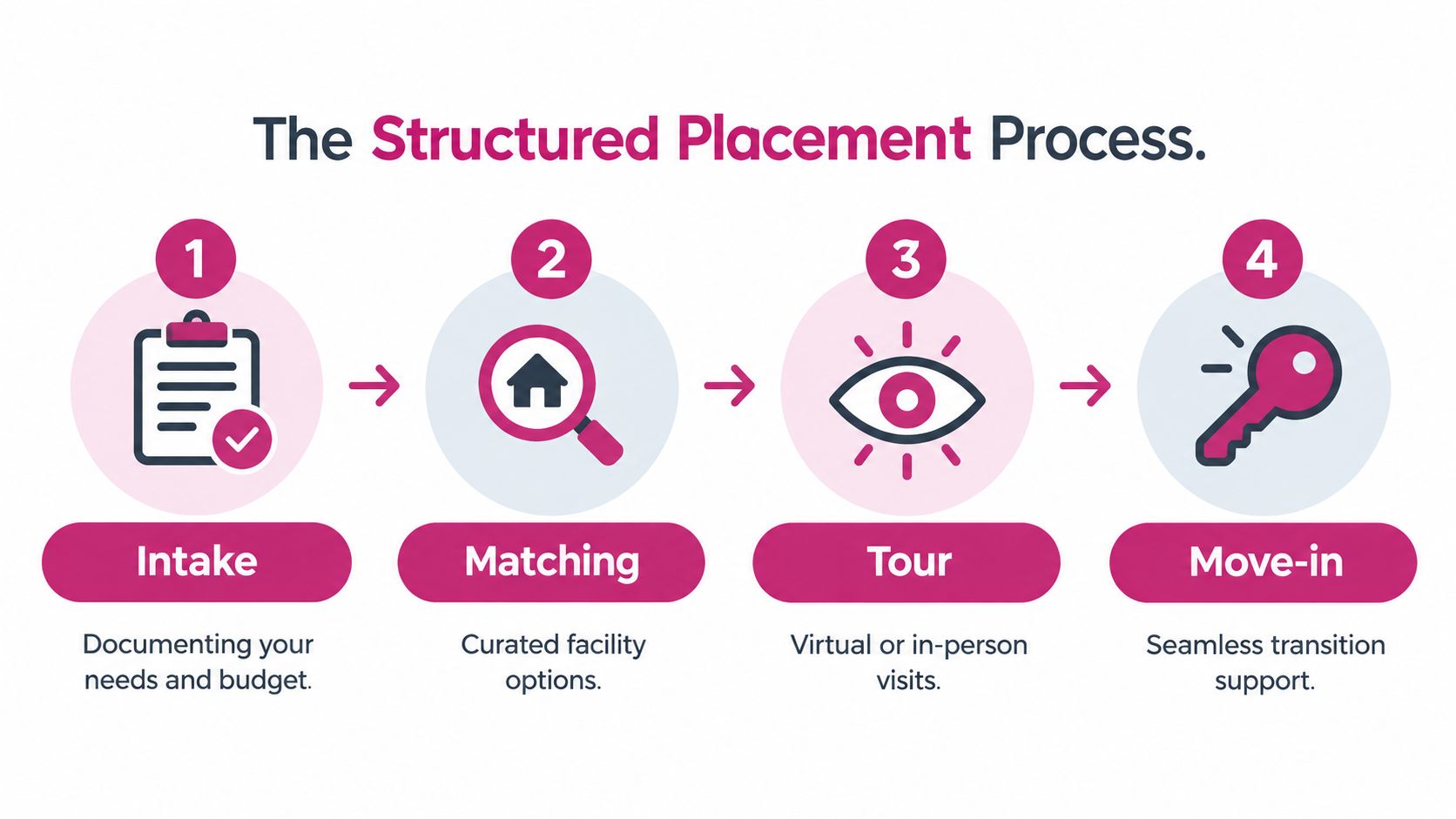
Good placement is a process, not a pile of links. Families who try to handle everything alone usually get buried in outdated listings, vague promises, and communities that do not fit the person's condition. A structured intake fixes that by turning a hard problem into a clear sequence.
Intake first, then matching
Start with a detailed intake that covers diagnosis, mobility, cognitive status, medication needs, budget, and preferred geography. That profile should also include what the family can realistically manage, because expectations matter. A spouse can't provide the same support as a full caregiving team, and a daughter who lives two states away can't serve as the on-site backup.
Once the intake is complete, the search narrows fast. You are no longer asking, “What's available?” You are asking, “What is available that can handle this case?” That shift saves time and reduces the chance of touring communities that were never appropriate.
Practical rule: If the placement conversation starts with amenities instead of care needs, the search is already drifting in the wrong direction.
The next step is a short list of licensed, vetted options. That is where a placement advisor adds value, because they can identify which communities have the right level of support, which ones are struggling with capacity, and which ones are more likely to accept a complex case. For families comparing services, senior placement services explains the mechanics of that process in plain language.
The actual tour should be comparative. Visit more than one community if possible, ask the same questions at each one, and compare how staff answer under pressure. Then check move-in logistics before you commit. A smooth placement is not just a signed lease or admission packet. It is a clean handoff from hospital, rehab, or home into the new setting.
Why Curated Options Beat Open Search
Open search feels independent, but it usually wastes the most valuable resource families have, time. Directories are full of communities that are no longer a fit, no longer have openings, or were never built for the level of need involved. If your parent is coming out of rehab or showing cognitive decline, you cannot afford to learn by trial and error.
Curated options reduce noise
A vetted shortlist does three things that open search cannot. It cuts out places that are clearly wrong. It surfaces communities that match the care level. And it gives you a better read on real-world factors like staffing stability, culture, and hidden charges before you make a move.
That last part matters. Two communities can look similar online and behave very differently once you ask hard questions. One may be honest about move-in timing and care thresholds. Another may be eager to take the deposit and sort out the details later. Families need the first kind.
When the search is urgent, curated placement also helps you move faster. A placement advisor who knows the local market can point you toward communities that are accepting new residents and are likely to work for the case in front of you. That is a very different task from clicking through dozens of listings on your own.
A no-cost service can be useful here if it narrows the field and supports the family through tours and move-in. Life Senior Placement does that kind of matching in New Jersey by helping families sort assisted living, memory care, nursing homes, independent living, and home care into a workable shortlist. The point is not more options. The point is fewer wrong ones.
Bottom line: An overwhelming directory is not a strategy. A vetted shortlist is.
Taking the Next Steps with Confidence
The right move starts before anyone signs anything. Families should compare current needs with what the person is likely to need in the next stage, because a placement that only fits today can fail quickly. If mobility is declining, cognition is slipping, or medical needs are stacking up, choose a setting that can absorb that change without forcing another move.
Ask direct questions when you tour. Who helps at night? How do they handle medication support? What happens if dementia symptoms worsen? What extra charges appear beyond the base rate? These are the questions that expose whether a community can handle the situation or just market itself well.
What to verify before you commit
- Care scope: Confirm exactly which daily tasks, therapies, or nursing supports are included.
- Staffing reality: Ask how the community handles higher-acuity residents and shift coverage.
- Cost structure: Separate room, care, and add-on charges so you know your actual monthly commitment.
- Move-in timing: Check whether the community can accept the person when you need it, not just eventually.
- Family access: Make sure the location works for visits, emergencies, and ongoing oversight.
Use in-person visits whenever you can. Photos and brochures do not reveal whether staff are attentive, whether residents look engaged, or whether the environment feels calm. That on-the-ground impression matters more than polished marketing.
If you are making this decision in New Jersey, the smartest move is to treat it as a care match, not a real estate search. Start with the person's needs, compare only the settings that can meet them, and move quickly once you find the right fit. The families who do that make better decisions and avoid the panic that comes from waiting too long.
If you need a clearer path through assisted living, memory care, nursing home, independent living, or home care options in New Jersey, Life Senior Placement can help you narrow the field and organize tours without wasting time on mismatched communities. Use it when the search feels too broad, or when you need a practical next step that matches care needs, budget, and timeline.