When every listing claims to offer care, how do you tell which community can meet your parent's needs? Start with the help your parent needs during an ordinary day, not the building's amenities. Medication assistance, overnight supervision, dementia support, and rehabilitation aren't interchangeable services.
Even within the same provider, care levels differ by address. A community offering independent living may not provide hands-on personal care. A memory care program may have admission limits that matter more than its activity calendar. Published starting prices also don't necessarily include the care your parent needs.
Comparing senior living communities in New Jersey means comparing specific locations, written service descriptions, and current availability. Treat a directory as a starting point for verification, not a final recommendation.
Start with care fit: Before booking a tour, describe your parent's mobility, medications, cognitive needs, and overnight routines. Ask whether the community can support those needs now and what would trigger another move.
The options below include a placement service and community operators. They serve different purposes. Use the town names to narrow travel distances, then use each verification checklist to compare licensing, included services, and tour arrangements.
1. Life Senior Placement
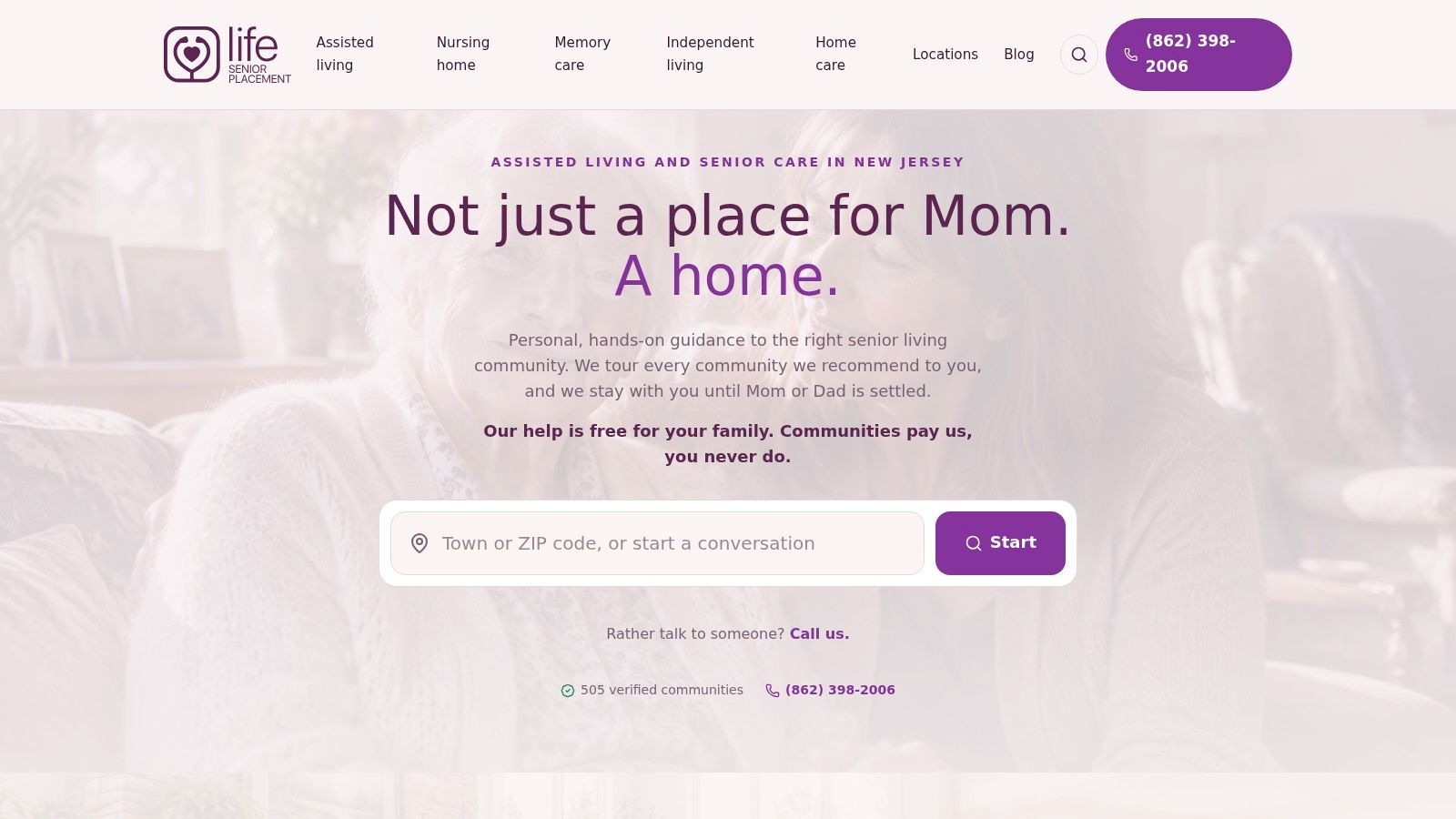
Best for families who need help identifying the right care setting before choosing a community. Life Senior Placement isn't a residential campus. We help New Jersey families compare assisted living, memory care, nursing homes, independent living, and home care through a no-cost, advisor-guided search.
Our coverage spans all 21 New Jersey counties, including areas around Lodi, Wall, Deal, Hope, and Elk. Geography needs careful handling: a local search page doesn't necessarily mean a community sits within that town's borders. Hope, for example, has no residential senior living campuses within its borders, so families need to consider nearby Hackettstown, Washington, and Newton.
We begin with care needs, budget, preferred location, and timing. From there, our process includes matched options, tour coordination, comparisons, and support through the decision and move-in. Our guide to senior placement services explains how advisor-led matching differs from browsing listings alone.
What to Verify Before Accepting a Shortlist
An advisor can organize the search, but the receiving community still needs to assess the prospective resident. A vacant apartment isn't the same as an approved admission.
- Care acceptance: Have each community review mobility, medication, cognitive, and personal-care needs before treating it as a viable option.
- License and address: Match the recommended property to its specific license record, rather than relying on the operator's name.
- Complete charges: Request the housing rate, assessed care charges, deposits, and optional services in writing.
- Tour logistics: Confirm who will attend, whether the care director is available, and whether you can see the proposed apartment.
The advantage is consistent help across different care categories, especially when family members are coordinating from different places. The trade-off is the compensation model: participating communities pay us after placement. Families should understand that relationship when reviewing recommendations.
Our directory and matching service at Life Senior Placement can help organize the comparison. Final availability, clinical acceptance, and contract terms still need confirmation with the receiving community.
2. Springpoint
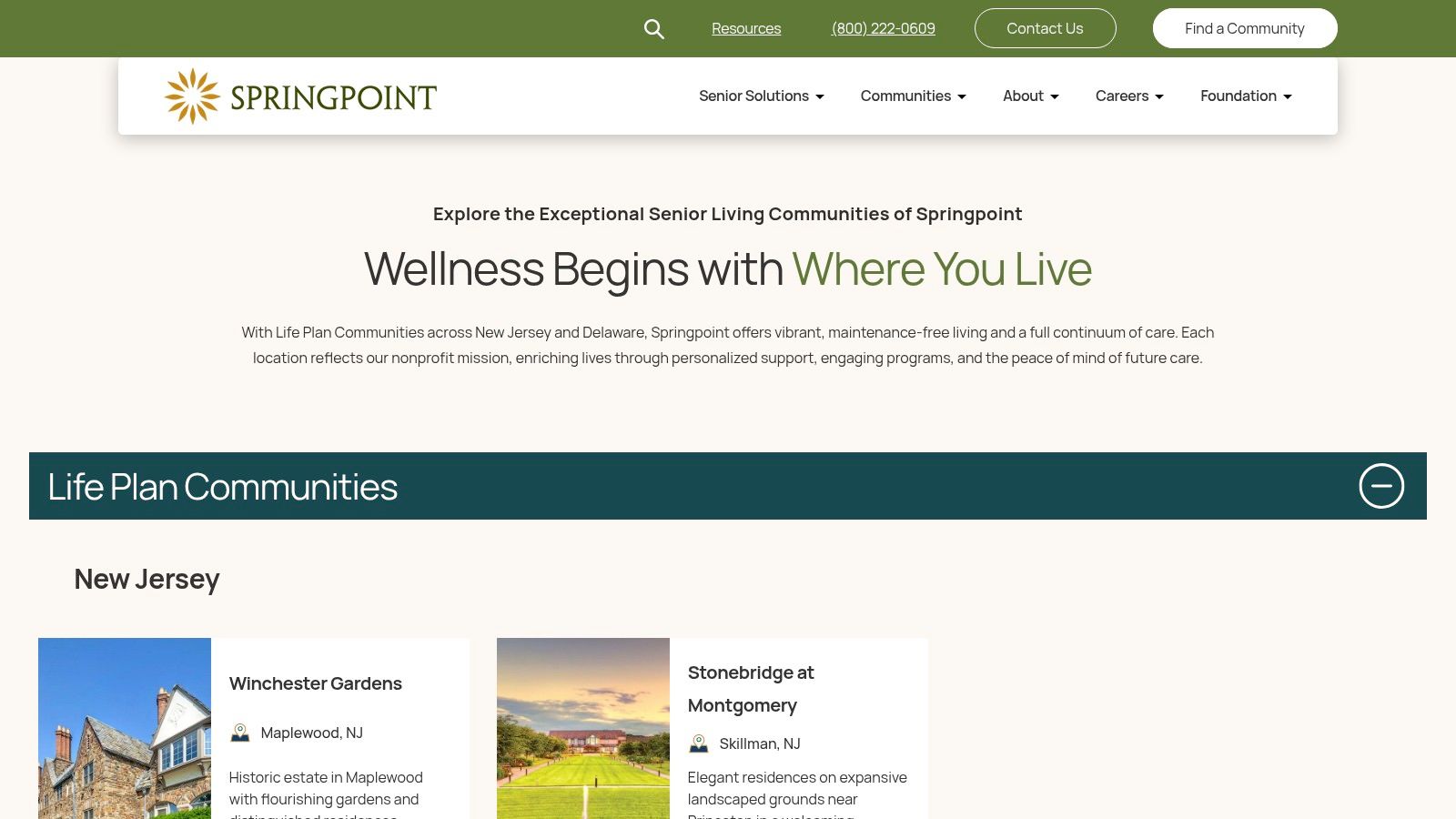
For an older adult who's still independent, Springpoint is a planning-ahead option, rather than a place to seek immediate personal care. The nonprofit provider offers Life Plan communities and affordable senior housing, with locations including Maplewood, Skillman, Denville, and Whiting.
Springpoint's community directory includes different residence types and service arrangements. Apartments, cottages, and villas can suit different preferences, while its LivWell programming provides a framework for wellness and enrichment. Don't assume affordable housing and a Life Plan campus come with equivalent services or financial terms.
The main advantage is the possibility of accessing additional care within a familiar community setting. The limitation is contractual complexity. Access to future care, accommodation availability, and payment arrangements need closer review than an apartment floor plan.
Compare the Contract Before the Amenities
Use our guide to independent living in New Jersey to distinguish maintenance-free housing from housing that includes personal assistance. Then bring these questions to the specific Springpoint campus:
- Care pathway: Which care settings are on campus, and which require a transfer elsewhere?
- Financial terms: What entrance payments, recurring charges, refund provisions, and future care charges apply?
- Included services: Which meals, utilities, housekeeping, transportation, and wellness activities are included?
- Tour arrangements: Can you view the actual residence type and meet someone who explains the contract?
For couples, ask what happens if only one partner needs additional support. Remaining within the same organization doesn't necessarily mean remaining in the same apartment. Springpoint deserves consideration when long-term planning matters, but its different housing models shouldn't be treated as interchangeable.
3. United Methodist Communities (UMC)

A hospital discharge and a planned retirement move require different searches. United Methodist Communities may suit either situation, depending on the campus, but families need to identify the service they're requesting.
The nonprofit's community directory includes locations in Newton, Collingswood, Pitman, and Ocean City. Across the organization, offerings include independent living, assisted living, memory care, respite, rehabilitation, and skilled nursing. Home care is also available through UMC HomeWorks.
That range is useful when families are weighing community living against support at home. It doesn't mean every campus provides every service, or that a rehabilitation admission automatically creates a long-term residential option.
Ask the admissions team to name the exact program accepting your parent. An organization's broad care menu isn't an admission approval.
Strengths include different care pathways and town or shore settings that may suit family visiting patterns. Limitations include campus-specific services and the absence of a single statewide pricing schedule.
For a skilled nursing comparison, look beyond the overall rating. New Jersey's nursing-home quality guidance identifies staffing and resident satisfaction benchmarks, while describing separate inspection, staffing, and clinical quality domains.
Before touring, verify:
- Admission purpose: Is the proposed stay rehabilitation, respite, assisted living, or long-term nursing care?
- Clinical coverage: Who manages medications, therapy, changing symptoms, and after-hours concerns?
- Payment arrangement: Which charges and payer requirements apply to this particular stay?
- Transition plan: What happens when rehabilitation ends or the resident needs a different care level?
- Tour access: Can you visit the relevant care area and speak with its clinical lead?
4. Mira Vie Senior Living

Brick, Toms River, Warren, and West Milford give families distinct geographic starting points within Mira Vie's New Jersey portfolio. Begin with the locations relatives can realistically visit, then compare care capabilities rather than choosing the shortest drive automatically.
Mira Vie's community listings describe assisted living, memory care, and respite care, with independent living at select locations. That mix makes the provider relevant to families comparing daily support with a more structured memory care setting.
The useful feature is having different locations to investigate under the same provider. The trade-off is that accommodations, services, and pricing still require property-level confirmation. Independent living shouldn't be assumed available at every address.
Test the Memory Care Details
Our guide to memory care facilities in New Jersey can help frame the comparison. On a tour, focus on how staff support the resident's actual routines, not just whether the community advertises a memory care program.
- Assessment: Describe wandering, sleep disruption, dressing assistance, eating difficulties, and distress during personal care.
- Environment: Ask how staff manage exits, outdoor access, emergency evacuation, and resident supervision.
- Staff preparation: Discuss dementia training, overnight assignments, and how staff respond when a resident refuses care.
- Respite terms: Confirm assessment requirements, medication arrangements, included services, and the process for extending or ending a stay.
- Tour timing: Request a visit during ordinary activities or a meal, not only a staged presentation.
A dedicated memory care label isn't enough. Ask what needs the community cannot support and how it handles changes after admission. Clear limits are more useful than a broad promise that staff can manage everything.
5. Brookdale Senior Living
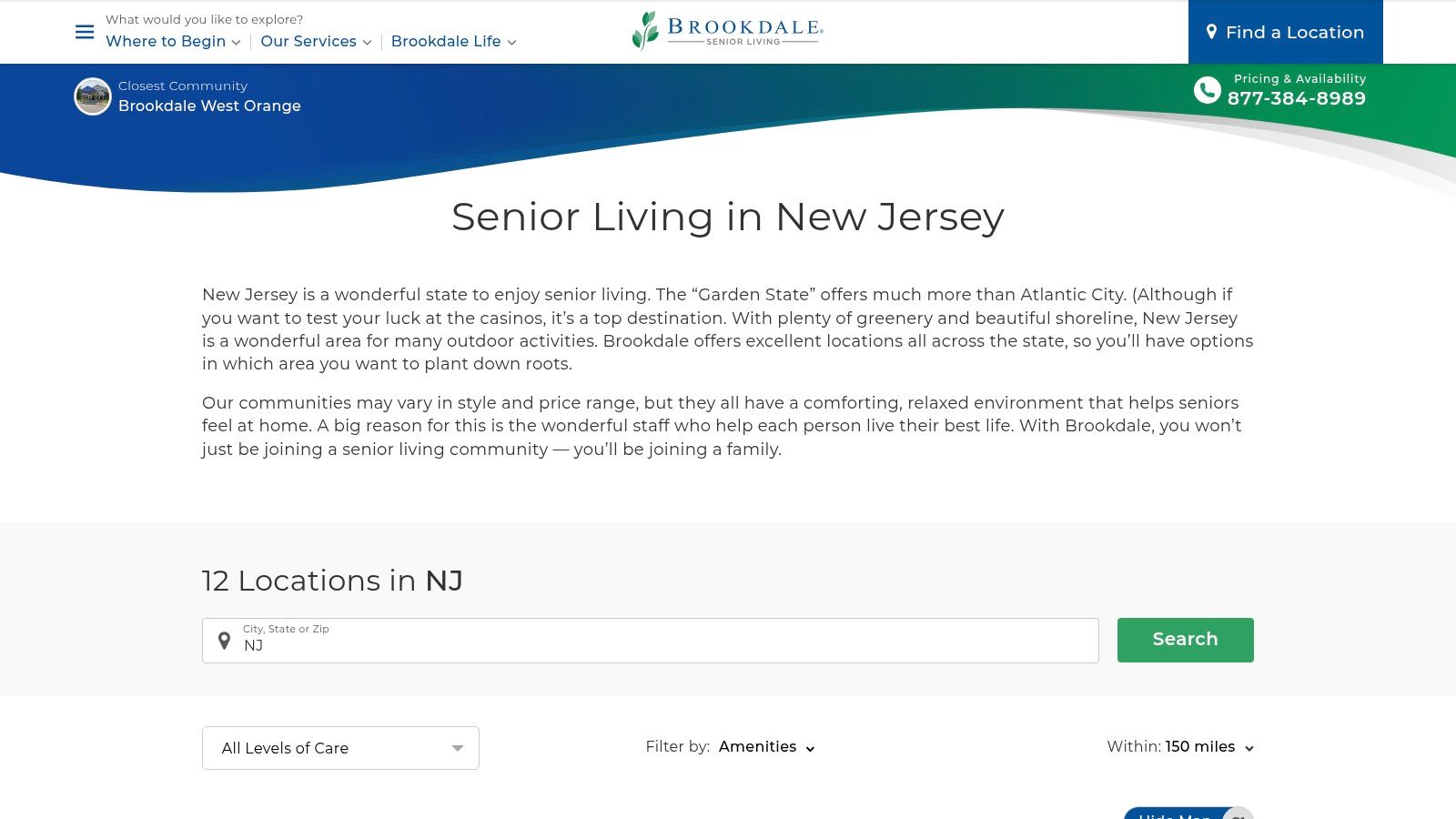
Brookdale offers a broad location search, which is useful when relatives live in different parts of the state. Its New Jersey footprint includes Cape May Court House, Voorhees, Emerson, Florence, Florham Park, Hamilton, Hillsborough, Monroe Township, Wayne, West Orange, and Westampton.
The Brookdale New Jersey directory lets families investigate property-specific care and amenities. Some communities offer assisted living and memory care, while HealthPlus clinical care coordination is available at select locations. Don't interpret that program as a service offered throughout the network.
The practical advantage is the ability to compare different locations and, on some community pages, starting rates. The drawback is that a published starting rate may not represent the assessed resident's final bill.
For budgeting context, CareScout's New Jersey cost-of-care release reported a median annual assisted living cost of $101,550 for 2025. That's a statewide benchmark, not a Brookdale quote.
Turn a Starting Rate Into a Usable Quote
- Rate assumptions: Ask which apartment type and service package the advertised price describes.
- Care assessment: Request a written estimate based on your parent's actual assistance needs.
- Additional charges: Clarify medication management, personal care, transportation, supplies, and move-in charges.
- Clinical coordination: Confirm whether HealthPlus operates at the selected property and what it includes.
- Tour comparison: Visit the apartment category used in the quote, not just a model with different features.
Amenities filters help narrow a search. They don't establish whether staff can safely assist your parent with transfers, nighttime needs, or cognitive changes. Resolve those questions before comparing gardens and fitness rooms.
6. Chelsea Senior Living

A short stay can help with a temporary care gap, but it shouldn't be treated as an informal hotel booking. Chelsea Senior Living is worth investigating for families considering assisted living, memory care, or a short-term stay at a participating location.
Its location finder includes New Jersey communities in Fair Lawn, Sparta, Washington Township, and West Orange. Chelsea describes structured memory care support and sensory-based engagement. Families should ask how that approach translates into an individual resident's daily care.
The benefit is a regional selection of communities with dedicated memory care among the stated offerings. The limitation is uneven geographic coverage and location-specific services. Independent living and short stays shouldn't be assumed available at every property.
A useful tour question: Ask who would respond if your parent needed help after bedtime, then ask how that response is documented and communicated to family.
Review safety records alongside the tour. New Jersey's assisted living rules require residences to post the latest Department of Health inspection report and make specified inspection and complaint deficiencies available.
For each Chelsea location, confirm:
- License and findings: Request the current license information, inspection findings, and explanations of corrective actions.
- Short-stay conditions: Ask about clinical acceptance, available rooms, included care, and discharge arrangements.
- Memory care delivery: Discuss staff assignments, individualized engagement, and responses to distress.
- Visit logistics: Meet the care lead and see the relevant residential area.
A complaint alone doesn't explain a community's current performance. Look at the seriousness of the finding, the response, and whether the same problem recurs.
7. Juniper Communities

Choose the Juniper location by care category first. Chatham lists independent living, while Paramus and Williamstown list assisted living and memory support. Those aren't equivalent options for someone who needs hands-on help.
Juniper's New Jersey community directory provides a relatively focused geographic search. Its Connect4Life offering is also relevant to families who want to understand how a community coordinates care. Ask what that coordination includes at the selected address rather than relying on the program name.
The distinction matters in a market serving residents with different clinical needs. The New Jersey Department of Health's 2025 resident profile survey reported a mean age of 83 among in-house assisted living residents. Age alone doesn't determine placement, but a brochure's lifestyle emphasis shouldn't replace a functional assessment.
Match the Address to the Support Needed
- Chatham: Confirm which services support independent living and what happens if personal care becomes necessary.
- Paramus and Williamstown: Ask how assisted living differs from memory support in staffing, environment, assessment, and charges.
- Care coordination: Establish who contacts physicians, follows up after appointments, and communicates medication changes.
- Service boundaries: Don't assume companywide rehabilitation or skilled care is available at a particular New Jersey property.
- Tour preparation: Bring a medication list and care summary, and arrange time with someone qualified to discuss admission suitability.
The strength is a clear starting distinction between independent living and supported care locations. The trade-off is more limited New Jersey geographic coverage than larger networks. Testimonials can provide questions to explore, but they don't establish current staffing, availability, or suitability for your parent.
How the seven New Jersey senior living providers compare on care types, named locations, and published pricing
Which provider stays on the shortlist: the one whose care level, town, and published price match what you can confirm?
| Item | Care Types Listed | Named NJ Locations | Published Pricing | Best For |
|---|---|---|---|---|
| Life Senior Placement | Assisted living, memory care, nursing homes, independent living, home care | All 21 New Jersey counties, including Lodi (Bergen), Wall and Deal (Monmouth), Hope, and Elk (Gloucester) | NJ assisted living median $8,710/month; semi-private nursing home median $12,775/month. Wall: independent living $3,000-$5,200/month; assisted living $5,500-$9,200/month. Around Lodi, independent living $3,200-$5,200/month. Placement help is free for families. | Families seeking no-cost help comparing care options |
| Springpoint | Independent living, Life Plan continuum of care, affordable senior housing | Maplewood, Skillman, Denville, Whiting | Not published; contact communities | Seniors planning ahead who want a continuum of care |
| United Methodist Communities (UMC) | Independent living, assisted living, memory care, respite, rehabilitation, skilled nursing, home care | Newton, Collingswood, Pitman, Ocean City | Not published as a statewide schedule | Families comparing nonprofit communities with varied care options |
| Mira Vie Senior Living | Assisted living, memory care, respite care, independent living at select locations | Brick, Toms River, Warren, West Milford | Not published as a standard statewide schedule | Families seeking multiple NJ locations, including memory care and respite |
| Brookdale Senior Living | Assisted living and memory care at select properties | Cape May Court House, Voorhees, Emerson, Florence, Florham Park, Hamilton, Hillsborough, Monroe Township, Wayne, West Orange, Westampton | Some communities publish starting rates; property-specific | Families comparing a large network, amenities, and select published starting rates |
| Chelsea Senior Living | Assisted living, memory care, short stays at select locations | Fair Lawn, Sparta, Washington Township, West Orange | Not published; inquire for rates | Families seeking regional options or dedicated memory care and short stays |
| Juniper Communities | Independent living, assisted living, memory support | Chatham, Paramus, Williamstown | Not identified publicly | Families seeking independent living or memory support at select NJ locations |
Life Senior Placement is a placement service, not one campus. Its figures are statewide medians and town ranges, so Wall assisted living at $5,500-$9,200 is not the bill in Elk or Hope. Springpoint, United Methodist Communities, Mira Vie, Chelsea, and Juniper do not publish a statewide schedule. Brookdale posts starting rates only at some properties. I would drop a row when the care type is wrong or no named town is close enough to visit. Ask that building for its license, included services, and a written monthly price before you compare two "from" rates.
Turn Your Shortlist Into Confident Tours and a Smooth Move-In
Use the comparison table to narrow your options to communities that match the care level, location, and budget you've confirmed. Don't keep a property on the shortlist because the lobby impressed you. If the admissions team hasn't reviewed your parent's needs, the care match remains unresolved.
Request a tour and ask each community for its current license status, included services, and complete proposed charges. Get the answers in writing. Keep a comparison sheet with separate fields for housing, assessed care, medication support, transportation, deposits, and contract conditions.
Make the Tour a Working Appointment
Bring a current medication list, a concise medical history, and a description of daily assistance needs. Include details that are easy to minimize in conversation, such as overnight bathroom help, difficulty using a call system, or resistance to bathing.
- Meet the care lead: Discuss who creates the service plan and how changes reach frontline staff.
- See the proposed setting: Walk the route between the apartment, dining room, and activity areas.
- Clarify admission steps: Identify required assessments, documents, approvals, and the person responsible for each.
- Plan for change: Ask what conditions could require a transfer and how the community helps arrange it.
For hospital-driven moves, separate an available room from a completed admission approval. The receiving team needs enough clinical information to make a decision. Coordinate medication orders, equipment, transportation, and the first care handoff before setting the move.
Once the destination is confirmed, use TLC Moving & Storage downsizing advice to organize belongings. Start with the new residence's dimensions and storage, then prioritize familiar furniture, clothing, and personal items your parent uses.
Families who want help across all 21 New Jersey counties can call Life Senior Placement at (862) 398-2006 for guidance on local assisted living and home care options. Have your preferred towns, care needs, budget, and timing ready so our advisors can help turn a broad search into a practical shortlist.
Life Senior Placement offers no-cost guidance for comparing New Jersey senior living options, arranging tours, and preparing for move-in. Visit Life Senior Placement to discuss your family's care needs and build a shortlist based on location, budget, and the support your parent requires.