
Finding someone friendly who can split the bills isn't the first step in senior house sharing. The first step is deciding what happens when the senior needs help that a housemate can't safely provide, and how either person can leave if the arrangement stops working.
Compatibility matters, but it won't resolve a medication error, an unpaid bill or an unsafe hospital discharge. For a New Jersey family, the strongest plan starts with care boundaries and an exit route, then considers the room, the rent and the person moving in.
Check Whether a Shared Home Fits the Care Need
Settle care needs before the budget. A spare bedroom can solve a housing problem without solving a care problem. Senior house sharing works best when residents manage their own daily lives or have dependable, separately arranged support.
Start by listing bathing, dressing, toileting, transfers, medications, meals, shopping and transportation. Mark each task as self-managed, needs reminders or needs hands-on help. Record what happens on a difficult day, not just when the senior feels rested and well.
Care level and whether a house share fits
| Care level | Typical daily needs | House share fit | Next step |
|---|---|---|---|
| Independent | Cooking, cleaning, driving, self-managed medications | Good fit | Write the agreement |
| Light support | Reminders, rides, meal help, occasional lifting of household items | Workable with a paid helper | Add home care hours |
| Hands-on personal care | Bathing, dressing, toileting, transfers | Poor fit without staff | Consider assisted living or home care |
| Complex medication | Multiple daily doses, insulin, timed schedules | Only with appropriate nursing or pharmacy support | Arrange professional medication management |
| Dementia with wandering | Day and night supervision, safe exits | Not a safe fit | Review memory care |
| Post-hospital or skilled needs | Wound care, IV treatment, therapy, continuous clinical oversight | Not a fit as a stand-alone arrangement | Review skilled nursing or rehab placement |
Lifting a laundry basket isn't the same as lifting a person. If someone needs transfer assistance, don't classify that as a casual household favor. Use a level-of-care assessment to clarify which services the senior needs.
Run separate financial and care screens
The financial screen includes rent, utilities, accessibility changes, transportation, meals, insurance, paid support and contingency funds. Research using U.S. Household data presented through the Federal Reserve Bank of Philadelphia estimates that older guests pay approximately $740 less per month than in otherwise comparable nonshared housing, while older hosts pay about $45 more on average. Savings aren't automatic, particularly for homeowners taking on additional household expenses.
The care screen asks who really handles medication problems, falls and emergencies. If the answer is that the housemate will probably manage, the plan hasn't passed.
For an independent senior comparing smaller housing options, CozyCube's guide to downsizing into a customizable tiny home can help frame questions about layout and accessibility. A smaller home still needs a separate care plan, local approvals and realistic access to services.
Go-or-no-go rule: If any task requires hands-on help or overnight supervision, treat an unsupported house share as a bridge at most. A sustainable arrangement needs assessed, dependable professional support, not an implied promise from a housemate.
How to Find and Vet a Compatible Housemate
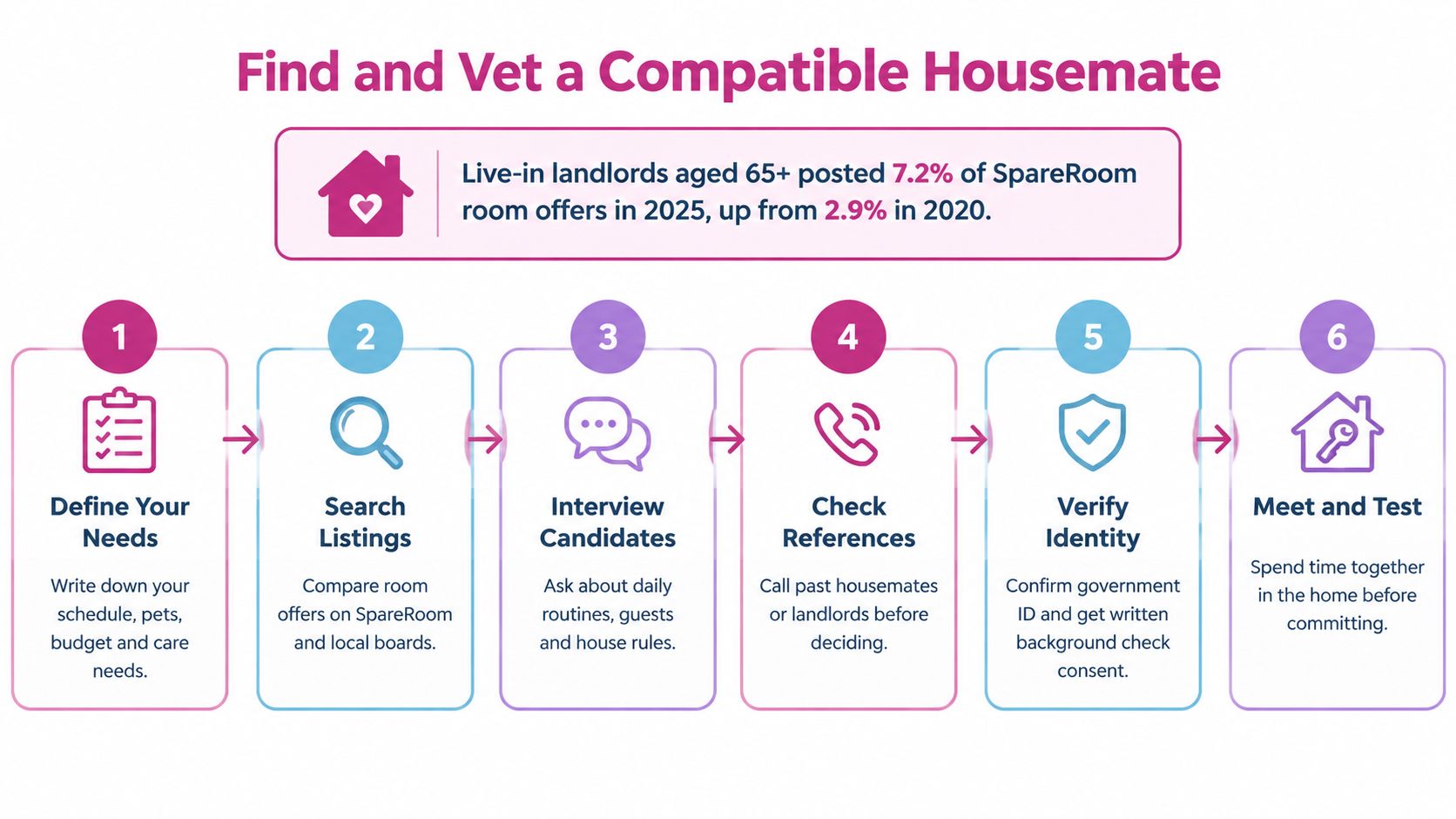
Older homeowners are increasingly advertising spare rooms: according to SpareRoom's analysis of its U.S. Platform, live-in landlords aged 65 and older posted 7.2% of room-offer advertisements in 2025, up from 2.9% in 2020. That measures advertisements on a particular platform, not the safety or suitability of the matches.
Use the same screening process whether a candidate comes through a congregation, a neighbor or a listing site. Familiarity can make people skip questions they would ask a stranger.
Screen for everyday behavior
- Write a household profile. Cover waking and sleeping schedules, pets, smoking, diet, quiet hours, overnight guests and expected help. Be explicit about whether companionship means shared dinners or simply another person living independently under the same roof.
- Search through several channels. Try senior centers, faith groups, community boards and listing sites such as SpareRoom. Track where candidates came from and which channel produces people who meet the actual household requirements, rather than choosing whoever responds fastest.
- Use fixed phone-screen questions. Ask why they want to share, what their daily routine looks like, how they handle guests, how they would resolve an unpaid bill and what they would do during a medical emergency. Listen for concrete actions rather than assurances that they're easygoing.
- Verify identity and obtain written screening consent. Use a reputable screening provider to review relevant criminal records, sex-offender registries and civil judgments where legally available. Ask New Jersey counsel how screening and selection rules apply; don't collect sensitive identity documents casually by text or email.
- Call references and test the details. Speak with former landlords or housemates and, when relevant, someone who knows the candidate in a caregiving role. Ask about payment reliability, boundaries and how the person responded when plans changed, not simply whether they're nice.
- Meet in daylight, then arrange a documented trial. Walk through the kitchen, bathroom, stairs, storage and entrances together. Before any overnight trial, obtain legal advice about occupancy rights and put payment, end conditions and departure arrangements in writing.
A trial reveals what an interview can't: whether someone cleans up, respects closed doors, tolerates another person's routines and follows through without prompting. Keep clinical help outside the trial's expectations.
A clean background check isn't proof of reliability. The decisive test is whether both people can live comfortably within the agreed boundaries, including when one says no.
Write the Agreement Covering Money, Access and Exit
A housemate is neither automatically dangerous nor automatically safe. Living together creates access to keys, mail, transportation and private information, sometimes before either person notices how much access they've granted.
HomeShare Oregon's guidance on protecting money while sharing housing addresses the financial safeguards these arrangements need. Treat safeguards as ordinary household management, not an accusation against the incoming resident.
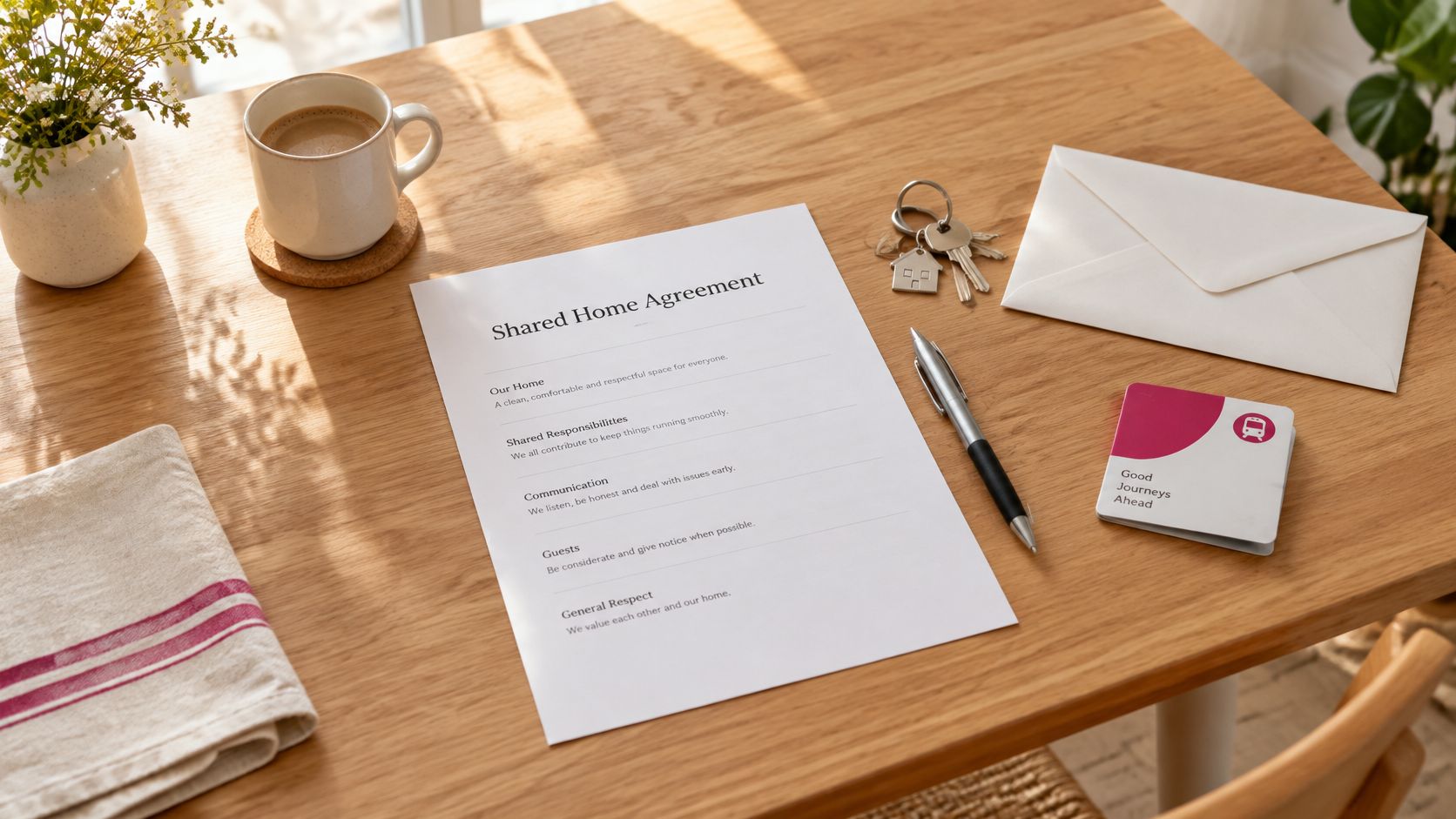
Clauses to include in a senior house-share agreement
| Clause | What to specify | Example |
|---|---|---|
| Rent and utilities | Amount, due date, internet, utility and cleaning allocation | Attach an expense schedule identifying each person's share |
| Deposit and move-out | Deposit amount, lawful return process, damage definition | Use signed condition photos and distinguish damage from ordinary wear |
| Separate finances | Separate accounts, no joint credit, no access to cards | Housemate has no online banking access |
| Keys, mail and access | Authorized keyholders, return process, mail handling | Log issued keys; prohibit opening another resident's mail |
| Care tasks | Voluntary help allowed, clinical tasks excluded | Offers meal reminders but never gives injections |
| Guests and overnights | Advance notice, agreed limits, use of shared space | Overnight visitors require the agreed notice and consent |
| Insurance and liability | Applicable coverage, exclusions, reporting responsibilities | Insurer confirms applicable coverage in writing before move-in |
| Accessibility changes | Who pays, who consents, who maintains or removes changes | Obtain appropriate written consent before installing grab bars |
| Termination | Lawful notice, safety response, no-fault exit, moving costs | Either person can request an exit using the reviewed notice procedure |
Keep payment records without sharing control
Use separate accounts and documented payments. The housemate shouldn't have the senior's debit card, passwords or authority to borrow against the home. If the senior needs financial assistance, arrange it through a properly authorized person rather than making it an informal condition of housing.
Give a dated receipt for every rent payment, including cash. Record the rental period, amount and any remaining balance, and let both parties retain a copy.
An expense ledger can help with groceries and utilities. Fintrack's comparison of shared expense apps for couples offers features worth considering for housemates, such as expense categories and settlement records. Choose a setup that doesn't expose either person's bank credentials or unrelated transactions.
Make the exit practical and lawful
Specify the notice process, who pays moving expenses and where a resident could stay temporarily if the home becomes unsafe. Distinguish immediate protective action from legal termination: an agreement can't create a right to evict someone instantly.
Ask the insurer whether the arrangement changes homeowners or renters coverage, whether paid caregiving creates exclusions and how injuries in shared areas would be handled. Don't assume either resident's policy covers the other's belongings or conduct.
For ramps, grab bars and other access changes, obtain appropriate written owner or landlord consent and document payment, maintenance and eventual removal. A simple roommate agreement doesn't resolve landlord-tenant, fair-housing, zoning or caregiving-liability questions. Have New Jersey counsel review the proposed arrangement before anyone signs.
Plan the Care Escalation Path Before Move-In
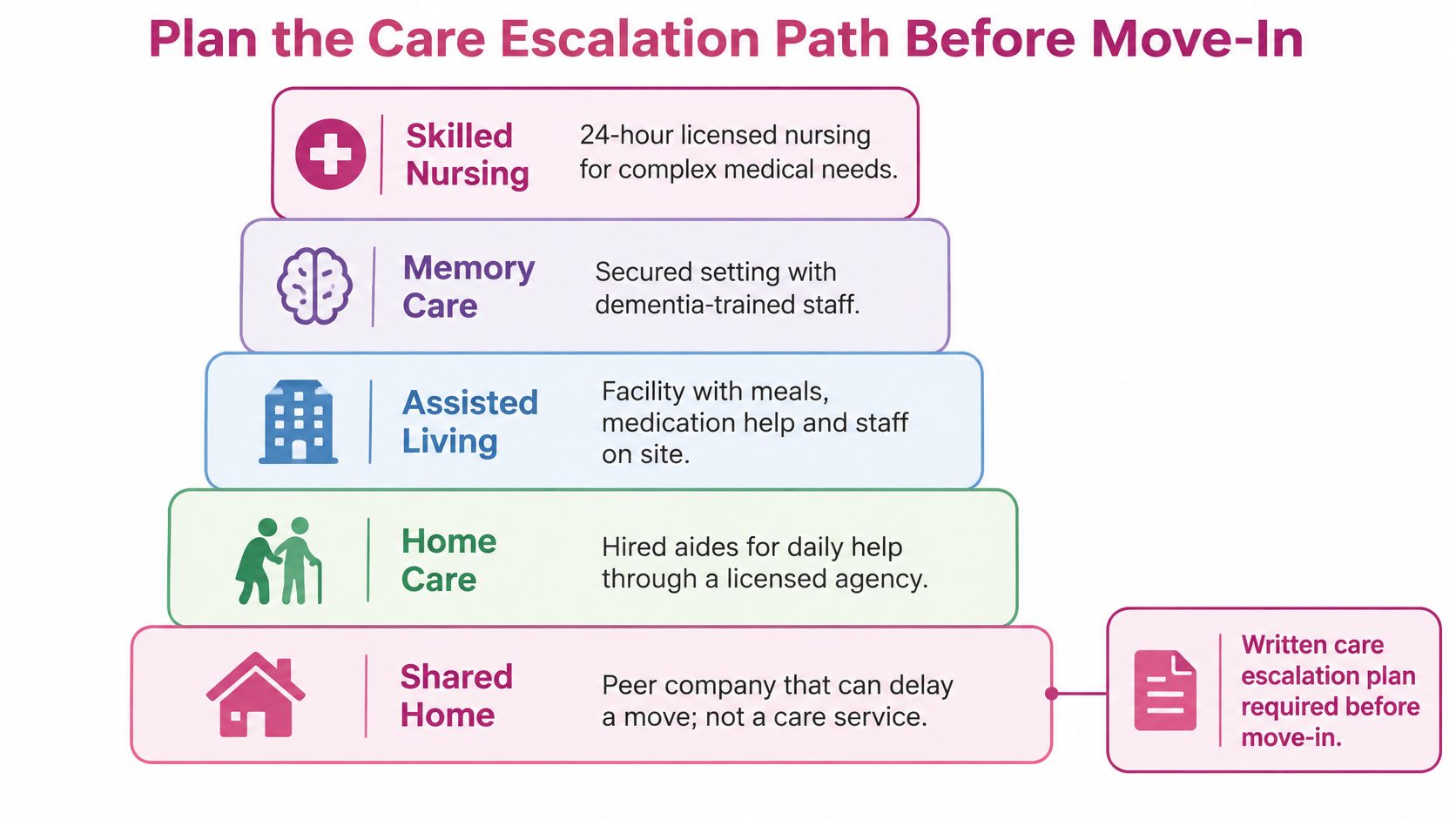
A housemate isn't a substitute for assisted living, memory care, home care or skilled nursing. Companionship may help someone remain at home, but it doesn't establish staffing, training or a duty to provide care.
The Boston Globe's coverage of older roommates and housing affordability highlights the need to distinguish shared housing from a sustainable care arrangement. Build that distinction into a written response plan before move-in.
Assign a responder to each trigger
Name a primary contact and a backup, and make sure both agree to the role. Post emergency contacts, the home's address and instructions for calling emergency services near the phone. A family member who lives far away isn't an adequate hands-on response plan unless someone local is also available.
Care triggers, responders and first actions
| Trigger | Who responds | First action |
|---|---|---|
| Fall with injury or cannot get up | Emergency services; designated family contact follows | Call emergency services, follow dispatcher instructions, don't attempt an untrained lift; log afterward |
| Missed or doubled medication | Pharmacist or nurse, not the housemate | Obtain urgent medication-specific advice; document and have a professional review the organizer |
| Wandering or night-time confusion | Paid caregiver or family; emergency services if missing or in danger | Arrange immediate supervision and a clinical assessment; review memory care without blocking safe escape routes |
| Cannot manage toileting, bathing or meals | Home care agency or family | Arrange prompt professional assessment and interim help before leaving the senior unsupported |
| Hospital discharge | Discharge planner and physician | Agree on a written care plan before the senior returns home |
| Housemate can no longer help | Adult child or care manager | Arrange replacement support and trigger a relocation review |
The responder should know what they can authorize, whom to call and what happens if the usual provider is unavailable. A non-medical home care service may cover personal assistance and household support, but clinical tasks need the appropriate professional.
A discharge destination isn't safe merely because someone else will be in the house.
Before discharge, ask the planner and physician to review mobility, medication management, equipment, follow-up treatment and actual caregiver availability. Don't describe the housemate as a caregiver unless that person has explicitly accepted a defined, appropriate role.
Keep a dated event log with the facts, response and outcome. Record a medication problem without guessing its cause, and document a fall without attempting a diagnosis. Reassess the plan after each trigger; residents don't have to progress through care settings in the order shown in a diagram.
Resolve Conflicts Before They Become Move-Outs
Noise, guests, kitchen use and money can turn an otherwise workable home into a place where neither resident feels comfortable. Problems become harder to resolve when people rely on hints, family intermediaries or resentment instead of naming the behavior.
Handle ordinary disagreements privately, with the senior involved directly. An adult child can support the conversation without taking over the senior's choices.
Use a reset process
- Describe the behavior, not the personality. Bring dates, messages or bills: the visitor stayed beyond the agreed arrangement, or the utility payment hasn't arrived. Avoid labels such as selfish, difficult or forgetful.
- Check the written terms. Determine whether the issue breaches the occupancy agreement, changes a care boundary or exposes an omission. If nobody agreed on kitchen storage, the immediate task is to negotiate storage, not accuse someone of breaking a nonexistent rule.
- Have a private conversation promptly. A useful script is: identify what happened, explain its effect and request a specific change. Give the other resident room to explain without turning the conversation into a debate about every past irritation.
- Write a reset plan. State what each person will do, how they'll confirm it happened and when they'll review the result. A shared calendar or printed household sheet works better than a vague promise to communicate more.
- Bring in a neutral person if the dispute continues. Ask the county Area Agency on Aging about appropriate referrals, or consider a mutually acceptable care manager or mediator. The neutral person shouldn't be someone who has already promised either resident that they'll win.
- Stop ordinary mediation when safety is at risk. Threats, coercion, suspected abuse or dangerous care gaps require protective action, not another household meeting. Arrange a safe place for the affected resident and involve emergency or protective services as appropriate.
Safety exception: Ending an unsafe living situation and legally removing an occupant are different actions. Protect the person first, then obtain legal direction.
Don't change locks, remove belongings or shut off utilities to force someone out. Ask New Jersey counsel which notice and removal procedures apply before taking action.
A match may be beyond repair when money disputes recur, agreed responsibilities repeatedly go unmet or the senior feels afraid to speak in their own home. The goal isn't to preserve the arrangement at any cost. It's to preserve safety, autonomy and a workable place to live.
New Jersey Resources That Support a Shared Home
| Resource | Use it for | When to call |
|---|---|---|
| NJ Division of Aging Services | Statewide aging programs and benefit information | Before choosing a shared home, to check support programs |
| County Area Agency on Aging | In-home services, caregiver support and appropriate mediation referrals | When care needs rise or a dispute stalls |
| NJ 2-1-1 | Free referrals to local housing, food and care services | When you need a local service quickly |
| Adult Protective Services | Assessment of suspected neglect, abuse or financial exploitation | As soon as exploitation or harm is suspected |
| Legal Services of New Jersey | Legal assistance for eligible residents | Before signing or ending a housing agreement |
Use these resources as a problem-solving toolkit, not a list you need to work through in full. Start with the county Area Agency on Aging for care questions. Add legal assistance when occupancy terms are unresolved, or Adult Protective Services when there's a concern about exploitation or harm.
Make the first call useful
Have the senior's county of residence, current living arrangement, daily support needs and immediate concern ready. Explain the gap specifically: someone can't safely bathe, a housemate has started handling bank withdrawals or the proposed discharge home has no overnight support.
Ask these questions before ending the call:
- Service ownership: Which office or provider handles this particular problem?
- Access requirements: Does the senior need an assessment, referral or eligibility review?
- Interim support: What can the family arrange while an application or assessment is pending?
- Follow-up responsibility: Who should the family contact if nobody responds?
For longer-term support planning, the New Jersey Managed Long Term Services and Supports guide can help families prepare eligibility and service questions. Don't assume that a referral means services have been approved or that a caregiver is scheduled.
County services, intake arrangements and program eligibility can differ. Confirm current contact information through official state or county websites rather than relying on an old handout or a third-party directory entry.
You don't need to establish proof before reporting suspected exploitation to Adult Protective Services. Describe what you observed, separate facts from suspicions and let the appropriate agency assess the concern. Immediate danger belongs with emergency services, not a routine referral queue.
Confirm the Arrangement Before You Sign
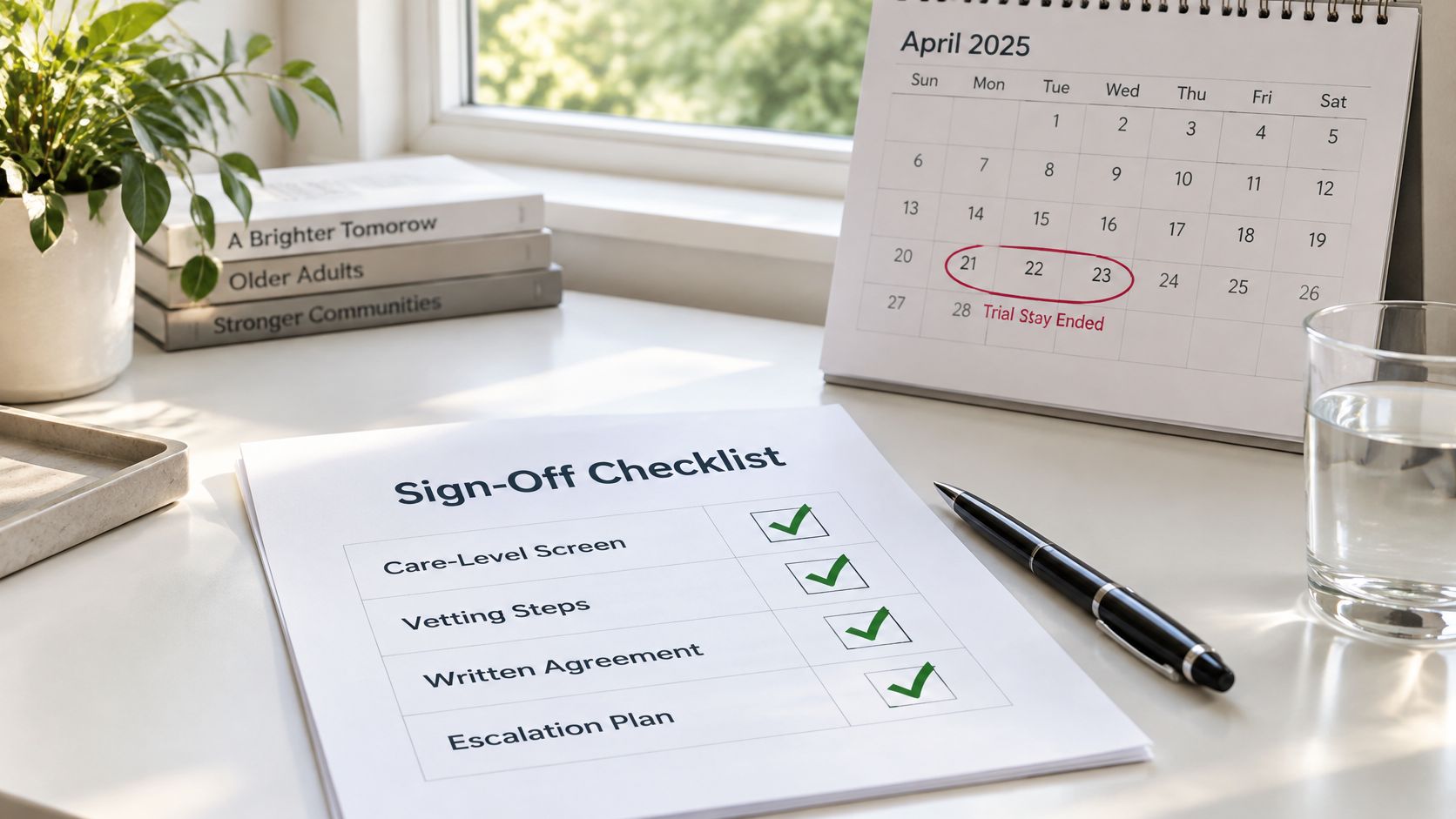
Sign only when the care screen, vetting, agreement and escalation plan all pass, and the trial has ended without unresolved safety or money problems. A pleasant meeting or an urgent need for housing isn't a reason to waive an unfinished check.
The senior must agree freely, with room to decline without family pressure. Confirm privately that they understand the financial obligations and aren't accepting a housemate because someone has told them they have no other option.
Require a complete handover
Before signing, confirm that the practical arrangements are ready, not merely promised.
- Written acceptance: Both residents have acknowledged the household rules and their specific roles in the response plan.
- Professional review: The insurer has clarified applicable coverage, and New Jersey counsel has reviewed the occupancy terms.
- Operational readiness: Required helpers, equipment and transportation are arranged; emergency contacts are posted.
- Exit understanding: Both residents have read the exit clause aloud and can explain what happens if either wants to leave.
Give each person a complete copy of the signed documents. Keep sensitive medical and financial information separate from anything displayed in common areas.
If the senior needs more support than the proposed arrangement can safely deliver, request a formal placement review through the county Area Agency on Aging or a qualified senior care placement advisor. A looser agreement won't make an unsupported living situation suitable.
This week, book a care-level screen with the county Area Agency on Aging or a qualified placement advisor, and bring the completed care table from your household assessment.
Life Senior Placement offers no-cost guidance to New Jersey families comparing home care, independent living, assisted living, memory care and skilled nursing options. If a proposed house share leaves unanswered care questions, visit Life Senior Placement for advisor support with needs, budget, provider comparisons and next steps.