
You're probably reading this on a phone while sitting in a hallway chair, a discharge planner is asking for a decision, and your parent's situation changed faster than anyone expected. Maybe the hospital says they're ready to leave. Maybe memory loss has made home unsafe. Either way, you're not shopping for a room. You're trying to make a clinical, financial, and family decision under pressure.
That's why senior care consulting matters. The job is to turn a confusing mix of medical needs, budgets, family schedules, and local availability into a placement that works. If you need a plain-language primer on the broader caregiving challenge, building a support system for seniors is a useful companion read.
Navigating the Senior Care Maze

A family usually doesn't start with a clean decision. It starts with a discharge call, a new diagnosis, or a moment that forces action, when Mom forgets the stove, Dad falls again, or rehab says the current setup is no longer safe. At that point, the market looks like a maze of independent living, assisted living, memory care, skilled nursing, and home care, and every brochure promises calm.
Good senior care consulting cuts through that noise. The first job is to read the clinical reality, then match it to the right setting. Senior housing is not a real estate search. A nice building does nothing for wound care, wandering risk, medication complexity, or a parent who can't transfer safely without help.
Practical rule: if the care need is medical or changing fast, start with function, not décor.
That is why experienced placement advisors push families to stop asking, “What looks nice?” and start asking, “What level of help does this person need today, and what will they need next month?” A family we see often tours three assisted living buildings for a parent who actually needs short-term skilled nursing, and that is the maze in action. For families also building a support system for seniors, building a support system for seniors is a useful companion read.
A placement advisor works like a project manager with a clinical lens. One person has to translate the chart, the discharge timeline, the caregiver's capacity, and the budget into a plan that can reliably hold. If that does not happen, families tour the wrong communities, lose time, and accept a move that breaks down after the first setback.
Why Families Need Objective Placement Guidance
The search gets hard because families are not just comparing communities, they are caregiving, working, commuting, and trying not to panic. The U.S. Administration for Community Living reports that about 80% of care delivered at home is provided by unpaid caregivers, and caregivers spend an average of 20 hours per week helping as reported by the agency. The same source cites a 2015 estimate that 43.5 million Americans had served as unpaid caregivers in the previous 12 months, and 14% of people caring for older adults were themselves at least 65 years old according to ACL.
Those numbers explain the mistake pattern. Families are not failing because they do not care. They are failing because they are overloaded, and overloaded people often sign with the first community that calls back. An overloaded daughter in this position often chooses the first place that responds, even when a memory-care unit two towns over is the better clinical match. A consultant should interrupt that pattern fast.
Ask who can safely supervise this person, support the activities of daily living they have lost, and adapt if cognition or mobility gets worse. Dining rooms do not answer that question.
Bottom line: if the adult child is doing all the triage alone, bias and burnout will shape the outcome.
A structured comparison matters more than a pile of brochures. Families need help weighing home care against residential care based on supervision, medication support, safety, and how much hands-on help the older adult needs. For readers who also care about how facilities are found and marketed online, questions about nursing home SEO made simple can help show how much noise surrounds the search. A useful placement lens starts with clinical fit, financial durability, and whether the staff can hold up when care needs change.
The Three-Step Placement Methodology
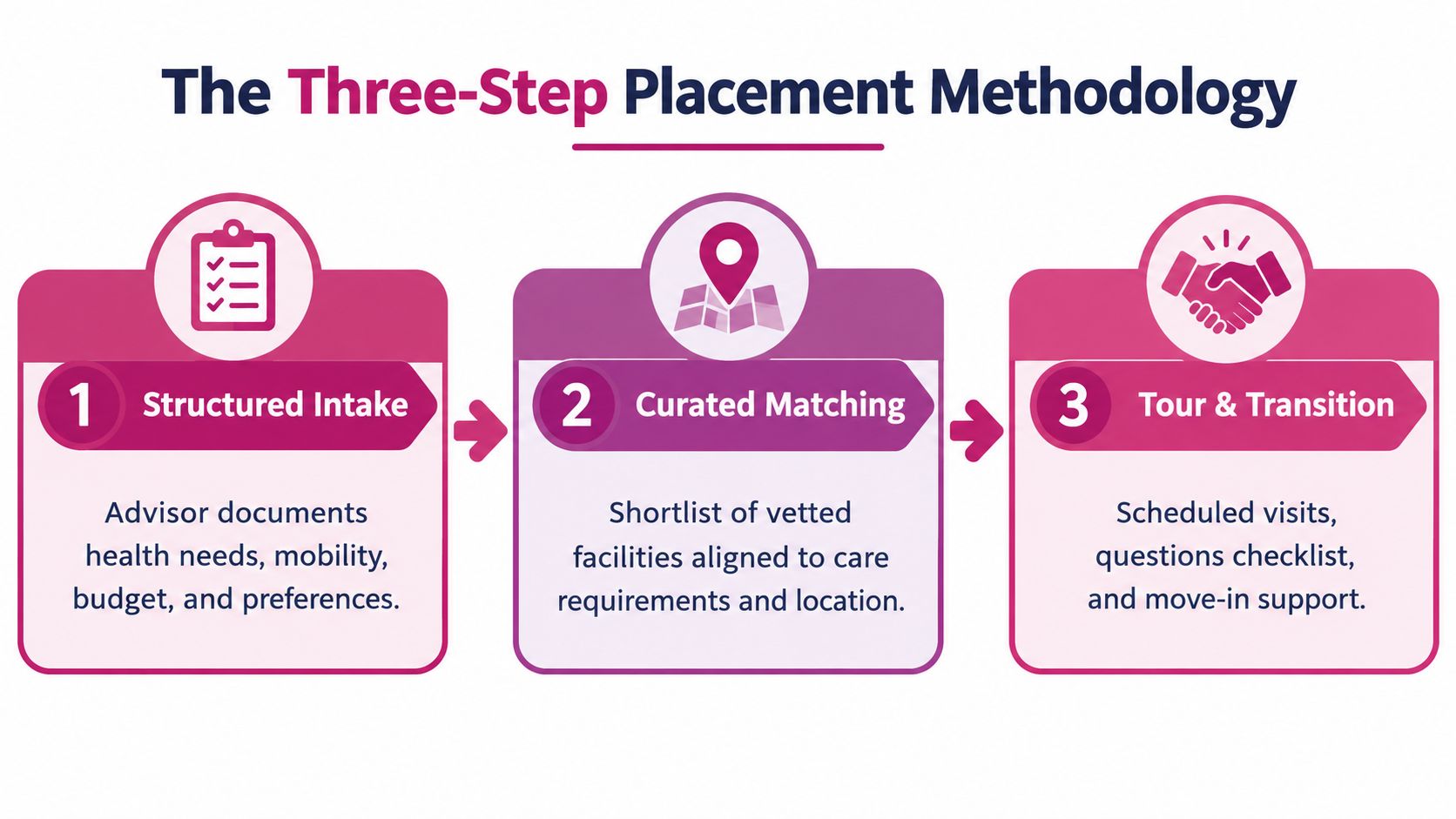
A serious placement process starts with intake, not touring. That means the advisor asks about diagnoses, mobility, behavior changes, medication management, budget, geography, family availability, and whether the person is coming from home, rehab, or the hospital. If that step is rushed, everything downstream breaks.
The second step is the shortlist. The consultant filters out communities that can't safely handle the resident's current needs, then narrows the options to licensed, vetted providers that fit. If you want a reference point for what a consumer-facing placement process can look like, assisted living placement should be handled as a matching exercise, not a guessing game.
The third step is decision support. Tours are scheduled, questions are organized, and the family gets help comparing answers instead of remembering fragments from three different visits. That support matters because the right community on paper can still be the wrong one if the admission team can't meet the person's needs when the bed opens.
Good placement is not speed alone. It's speed with filtration.
A clean process also reduces pointless emotional churn. Families stop calling places that were never a fit. They stop touring memory care when the actual need is short-term skilled nursing. They stop making decisions based on glossy websites and start making them based on match quality.
Evaluating Facility Quality Beyond the Headline Rating
Most families stop at the star rating. That is a mistake. A single score can hide thin weekend coverage, high turnover, or a building that looks fine until occupancy rises and the care team starts slipping.
CMS breaks its Five-Star system into separate domains, including health inspections, staffing, and quality measures in its user guide. The staffing domain covers registered-nurse hours per resident per day, total nursing hours per resident per day, weekend staffing, total nurse turnover, registered-nurse turnover, and administrator departures. CMS also adjusts staffing data for resident needs and reports it over a three-month period, while quality ratings draw from multiple measures built from clinical assessment data and Medicare claims across the four most recent available quarters. If you only look at the overall rating, you miss the weak link.
What to check instead
| Surface Metric | Deep-Dive Risk Signal | Why It Matters |
|---|---|---|
| Overall star rating | Weekend staffing | A place can look acceptable on weekdays and still struggle when coverage is thinner. |
| Inspection score | Nurse turnover | Constant turnover often signals instability in daily care. |
| Quality measure badge | Short-stay versus long-stay performance | Rehab success and long-term support are not the same thing. |
Ask for the date ranges behind every metric. Stale data can make a community look better than it really is.
Use questions to ask at every assisted living as a checklist, then press harder on staffing, turnover, and who is accountable when residents need help. A polished lobby tells you nothing about who answers the call bell at 2 a.m.
Managing the First 30 Days of Care Transition
Choosing the place solves only half the problem. The handoff is where families lose continuity, miss medication changes, or assume someone else already handled the details. Hospital discharge, rehab discharge, and the first admission into a new setting all demand close follow-up.
CMS notes that its data systems combine staffing submissions, resident assessments, and Medicare claims that can identify hospitalizations, admissions, readmissions, emergency-room visits, and discharges in its data-source overview. This is the situation families are trying to manage: the person is not just changing rooms, they are shifting care responsibility.
Treat the first month as a managed transition, not an informal handoff.
- Week 1, reconcile medications immediately. The receiving nurse should confirm what changed, what stopped, and what needs monitoring.
- Week 2, lock in follow-up appointments. A specialist visit slips fast when transportation is left to chance.
- Keep documents in one place. Insurance cards, Medicare information, advance directives, and contact lists should be easy to reach.
- Check for adjustment problems every day. Watch eating, sleeping, pain, confusion, mobility, and any new behavior change.
A fast placement can still be unsafe if nobody owns these tasks. The first 30 days need a named point person, usually the consultant or the family lead, who keeps pressure on the discharge loop and escalates when the facility is slow to respond.
Treat move-in day as the start of a short, fragile adjustment period. The first 30 days decide whether the placement holds.
Families working under a tight discharge window should ask one direct question: can this setting absorb the person's needs without delay? If the answer is no, widen the search to short-term rehab, a higher-support community, or temporary home care until the next move is safer.
Financial Durability and Workforce Reliability
The cheapest monthly rate can turn into the most expensive mistake. Assisted living, home care, and skilled nursing all have hidden add-ons, and families get burned when they compare only base prices. Medication management, transportation, incontinence supplies, two-person assistance, and memory-care surcharges can change the monthly picture fast.
That's why the finance conversation has to include more than one scenario. A smart plan tests private-pay, Medicaid-supported, and escalating-care paths side by side. If you want a consumer-oriented explanation of one piece of that puzzle, ways to pay for assisted living without draining savings is worth reviewing before you commit.
Home care also needs a harder look than it usually gets. 59% of home-care agencies reported insufficient staffing in 2025, which challenges the idea that care at home is automatically more dependable as reported by KFF. That doesn't mean home care is bad. It means backup staffing, missed-shift coverage, and service consistency matter a lot more than most marketing material admits.
What families should ask about money and coverage
- How long will the money last? Don't ask only what it costs this month, ask what happens when care needs increase.
- What is included? Base room rates and actual support services are not the same thing.
- Who fills the gap if staff call out? If the answer is vague, treat it as a risk.
- Can the setting absorb decline? A good plan should anticipate progression, not deny it.
This is the place to be blunt. If the budget only works while everything stays stable, the plan is fragile. A durable placement is one that still works when the resident needs more help, the family's savings are thinner, or the agency is short-staffed.
Selecting the Right Local Placement Advisor
Local expertise matters because providers, availability, and licensing realities are regional. In New Jersey, the difference between a community that sounds right and one that works well often comes down to who knows the local market, who can verify openings quickly, and who understands which providers consistently deliver.
Choose an advisor who uses a no-cost-to-family model, works with licensed and vetted providers, and gives you one consistent point of contact. If you're bounced between different people every time you call, you're not getting guidance, you're getting a phone tree. If the service can't explain how it screens communities or how it handles changing needs, keep looking.
A good advisor should do three things well. First, document the clinical picture without sugarcoating it. Second, narrow the field to real matches, not every building in a ZIP code. Third, stay involved through touring and move-in so the family isn't left to interpret the fine print alone.
One option is Life Senior Placement, which matches families with assisted living, memory care, nursing homes, independent living, and home care providers through no-cost guidance and advisor support. Use a service like that when you need speed, local knowledge, and a structured intake that turns a stressful search into a managed process.
If you need help making a safe placement decision in New Jersey, reach out to Life Senior Placement and start with a structured intake. The right advisor will help you compare care levels, verify availability, and keep the first 30 days of transition under control instead of leaving you to guess.