
The most common nursing home stay is short-term rehabilitation, measured in weeks, with short-stay residents averaging about 25 days. Long-term residents can stay for years, so the honest answer depends on why someone is entering the facility.
That distinction matters most when a hospital discharge planner calls the family and says, “A skilled nursing facility may be the next step.” Everyone usually asks the same question: How long will this be? The answer could be a few weeks after surgery, several months while a safe discharge plan develops, or a much longer residence when returning home is no longer realistic.
The phrase nursing home average stay sounds like it should produce one clean number. It doesn't. Different sources count different groups, including short-term rehabilitation patients, Medicare-covered skilled nursing stays, discharged residents, all residents, or a person's lifetime use of nursing homes. Those measurements can look contradictory even when each is accurate.
Why the Average Nursing Home Stay Has No Single Answer
A family may hear that the average stay is less than a month, then find another source describing stays lasting more than two years. Both figures can be valid because they answer different questions.
Consider a typical hospital discharge conversation. An older adult has had a hip replacement, is medically stable, and needs physical and occupational therapy before going home. The discharge planner recommends skilled nursing rehabilitation. In that situation, the family is usually planning around weeks, not an open-ended move.
Now consider a different admission. An adult has advanced mobility limitations, needs help with bathing and transfers, has no safe home arrangement, and requires daily supervision. That person may enter long-term custodial care. The family isn't planning a therapy episode with a clear homecoming target. They're evaluating a new living arrangement that could last months or years.
Why online figures seem to conflict
The population being measured changes the answer. A short-stay admission average describes people who enter after hospitalization and leave after recovery. An all-resident average includes people who remain in the facility for ongoing care, which pulls the number upward. A lifetime measure includes people who use a nursing home briefly and a smaller group who use many nights over a long period.
Historical data illustrate the problem. A U.S. HHS briefing on long-term-care statistics reported an average nursing home stay of 835 days, while the average among discharged residents was 270 days. Those figures aren't forecasts for every new resident. They reflect different ways of counting the population and the point at which researchers measure the stay.
Practical rule: Never ask only, “What is the average nursing home stay?” Ask, “Average for which type of resident, under which payer, and for what care goal?”
By the end of the decision process, families need more than a national average. They need a working estimate for one person, based on the reason for admission, expected therapy progress, coverage rules, health status, and the availability of a safe place to go next.
The Key Numbers Behind Nursing Home Stay Lengths
A nursing home stay can average 25 days, 270 days, or 835 days, depending on which residents researchers count. These figures are not competing answers. They describe different care pathways, so families need to match the measure to the person's admission reason and payer.
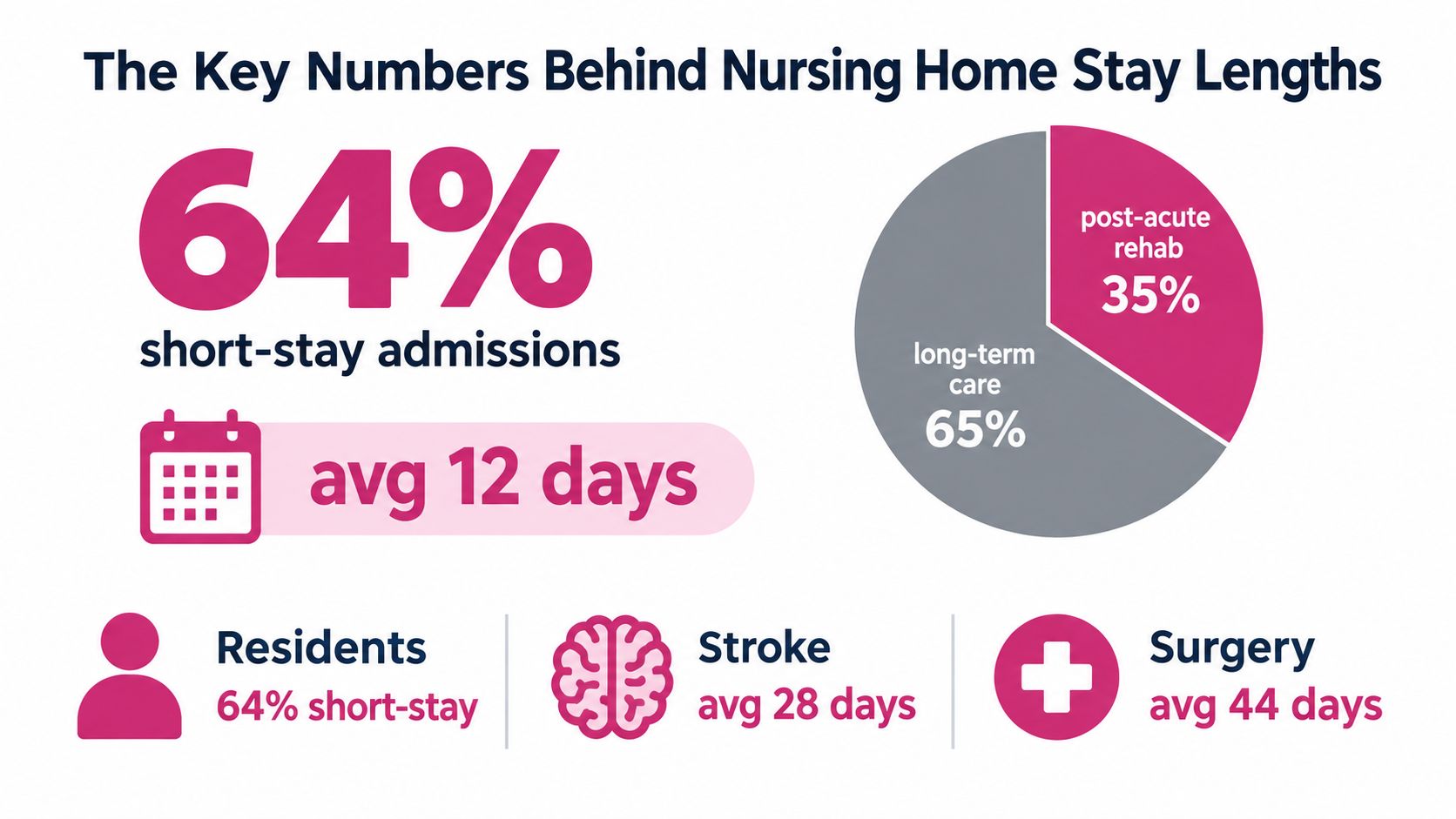
Four useful averages
| Measure | Population | Average Length |
|---|---|---|
| Short-stay admission | Short-stay residents in skilled nursing facilities | 25 days |
| Medicare utilization | Medicare beneficiaries in skilled nursing facilities | 27.1 days |
| Discharged resident | Residents measured at discharge | 270 days |
| All-resident historical average | Nursing home residents across the measured population | 835 days |
| Lifetime use | A birth cohort measured across its lifetime | 272 nights |
The AHCA/NCAL nursing home facts and research materials report that 64% of admissions are short-stay residents, with an average stay of about 25 days. Their definition of short-stay care is a stay under 100 days. The same utilization material gives an average skilled nursing facility stay of 27.1 days for Medicare beneficiaries. The 5th percentile falls below 15 days, while the 95th percentile exceeds 40 days, showing why an average is only a planning reference.
The longer measures answer different questions. The historical HHS figures report 270 days for residents measured at discharge and 835 days for the broader resident population. A peer-reviewed lifetime-use study found an average of 272 nights, but the median was just 10 nights. The 90th percentile reached 1,001 nights, and the 95th percentile reached 1,495 nights. Lifetime use combines brief rehabilitation stays with a smaller number of very long placements.
The houseguest problem
A nursing home population works like a house filled with guests. Many may stay briefly, while a smaller group remains for years. Those long stays pull the overall average upward, just as a few houseguests who never leave would change the average length of every visit.
The median identifies the middle experience. The average can rise sharply because of the long-stay group. For post-hospital rehabilitation, families should therefore discuss the short-stay or Medicare figure rather than the all-resident or lifetime measure.
A clear family-meeting statement is: “We're planning for a short rehabilitation stay, so the Medicare or short-stay benchmark is more relevant than the all-resident average.” For a custodial placement, the longer measures provide context, but the person's health, support needs, and coverage still determine the practical forecast.
Post-Acute Rehab Stays Versus Long-Term Care Stays
Post-acute rehabilitation and long-term custodial care may happen in the same building, but they represent different journeys.
A post-acute resident arrives after a hospital stay for an event such as surgery, a stroke, or a serious illness. The team assesses mobility, strength, balance, speech, self-care, and medical stability. Therapy sessions support a specific discharge goal, such as walking safely, transferring from a bed to a chair, managing stairs, or returning to an existing home arrangement.
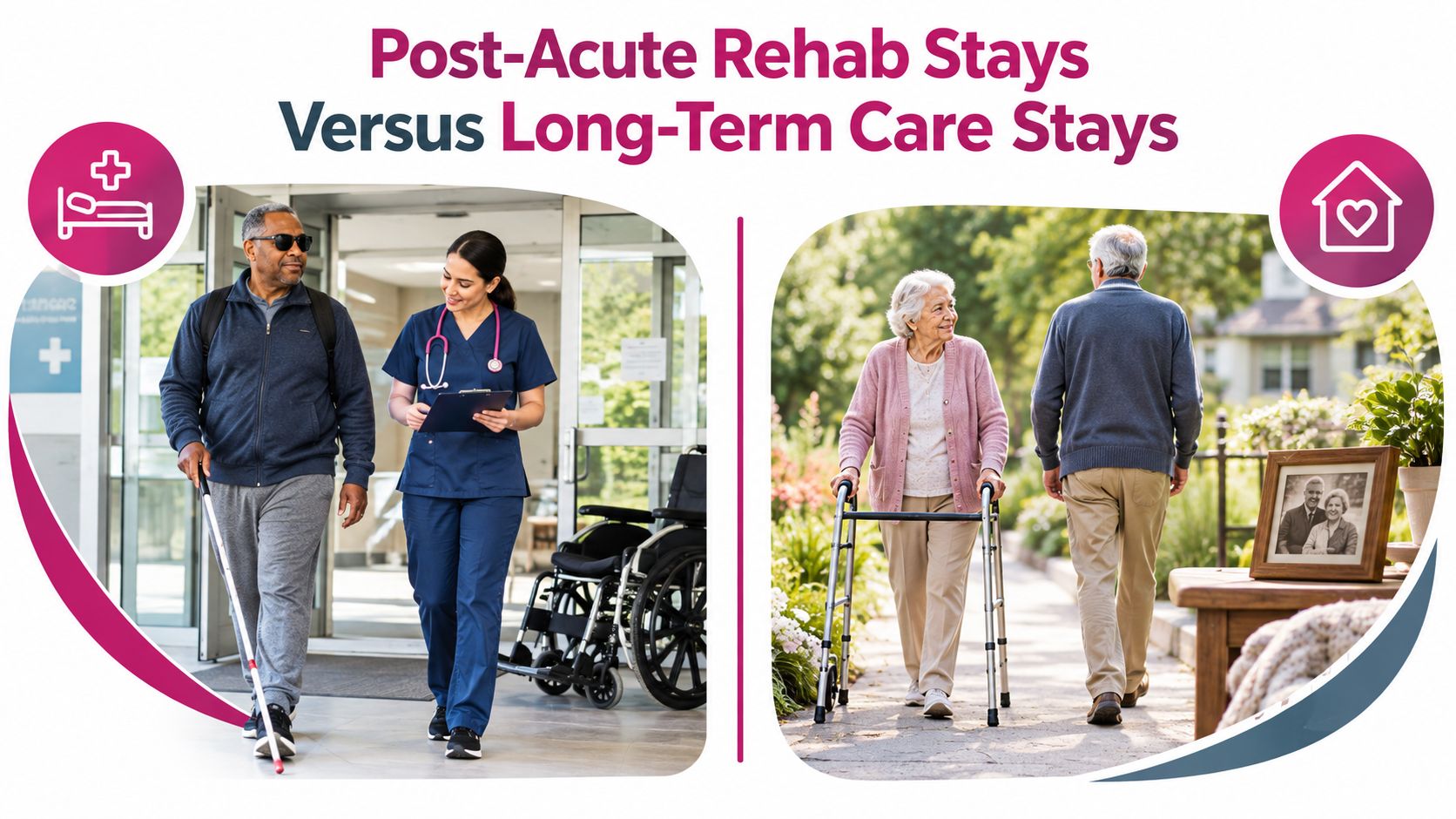
Two paths that look very different
Take a person recovering from knee surgery. Before hospitalization, the person lived with a spouse and managed independently. After surgery, they need help with transfers and walking. The rehabilitation plan centers on restoring function, arranging equipment, and confirming that someone can help safely at home. Discharge may follow when the person reaches the needed level of mobility and support.
A long-term resident may have a different starting point. The person may have progressive neurological disease, significant cognitive impairment, or multiple chronic limitations. The daily plan focuses less on returning to a prior home routine and more on reliable assistance with personal care, medication routines, meals, safety, and participation in the facility community.
The right question isn't simply, “How many days does this facility keep residents?” Ask, “What outcome would allow this resident to leave safely, and is that outcome realistic?”
Post-acute stays are shaped by functional progress and discharge readiness. Long-term stays are shaped by ongoing care needs and the availability of an appropriate alternative. A resident can also move from one category to the other. Someone admitted for rehabilitation may not regain enough function to return home, or may discover that the home environment can't support the required care.
Families arranging a placement after discharge may benefit from a practical guide to moving from hospital discharge to New Jersey rehabilitation, especially when the decision must be made quickly.
The following video can help families visualize the rehabilitation pathway and the questions that arise during placement.
What Actually Determines How Long a Stay Lasts
Payer type is one of the strongest predictors of the planning timeline. The national average Medicare skilled nursing facility stay is about 44 days, while the overall SNF length of stay is around 140 to 145 days, according to the 2025 Plante Moran SNF Edge Report. These figures represent different populations. The overall number includes long-term custodial residents, so it is not a reliable forecast for a typical Medicare rehabilitation admission.
Recent 2024 utilization trends also change the planning math. Reporting on the same market data found that the average hospital stay connected to SNF discharges fell from 8.65 days in 2023 to 8.43 days in 2024, while overall SNF length of stay edged down from 145 to 144 days. Medicare Advantage enrollees had an average SNF stay of 44 days in 2024, as reported by Becker's Hospital Review. A shorter hospital episode can leave families with less time to prepare for rehabilitation, equipment, and discharge support.
The factors behind the calendar
A person may arrive at the SNF with a focused rehabilitation plan after a shorter hospital stay. That does not guarantee a shorter nursing facility stay. Recovery still depends on the person's strength, cognition, medical stability, and ability to participate after admission.
Rehabilitation intensity matters. Someone who participates consistently in therapy may progress toward discharge faster than someone facing severe weakness, delirium, pain, infection, or cognitive barriers. The destination matters just as much. Returning to a one-floor apartment with a prepared caregiver requires a different plan from returning to a house with stairs and no dependable support.
The practical variables include:
- Coverage rules: Medicare, Medicare Advantage, Medicaid, private insurance, and private payment can involve different approval processes and time limits.
- Admission condition: Strength, cognition, continence, swallowing, balance, and medical complexity affect recovery.
- Discharge destination: Home, assisted living, a family residence, or another care setting may require different arrangements.
- Clinical milestones: Therapy participation, nursing needs, wound care, medication management, and equipment needs can change the recommendation.
- Family capacity: The availability and reliability of caregivers determine whether a proposed discharge plan will work.
Long-term data show why a lifetime or custodial average should not be confused with a short rehab estimate. MedPAC reported a median nursing home stay of 26 months for Medicare beneficiaries in 2023, reflecting long-stay residence rather than the rehabilitation episode many families picture after hospitalization. The payer, health condition, care goal, and destination must be considered together before an average becomes part of the family's plan.
How to Estimate the Stay Length for Your Own Situation
Families can make a useful first estimate by answering four questions before comparing facilities.
Start with the care goal
Ask whether the admission is intended to restore function or provide ongoing support. “Rehabilitation after a hospital stay” points toward a time-limited plan, while “needs 24-hour care with no safe home discharge” points toward a longer placement.
Next, identify the payer and coverage structure. Ask the hospital social worker or admissions coordinator which benefit is expected to apply, whether authorization is required, and what documentation supports the admission. Coverage doesn't determine the clinical outcome, but it strongly affects how the family should plan financially and administratively.
Assess the starting point
Look at the person's function on the day of admission, not their best day before the hospitalization. Can they sit up, stand, transfer, walk, eat, communicate needs, and follow therapy instructions? A person who was independent before an acute event may still need substantial recovery time if the event caused major weakness or cognitive changes.
Then examine the destination. A discharge plan needs a real place and real support. If home is the goal, ask who will help, what equipment is needed, whether the bathroom and entry are safe, and whether home health or private caregivers are available. If home isn't realistic, ask whether assisted living, memory care, or long-term nursing care better matches the need.
Use these questions with the admissions team:
- Comparable cases: How long do residents with this diagnosis and starting function typically remain in rehabilitation?
- Progress reviews: When will the team reassess therapy participation, transfers, walking, and self-care?
- Discharge triggers: What specific milestones would support a recommendation to go home?
- Coverage changes: What happens if the payer changes or skilled coverage ends before the person is ready?
- Alternative plans: Which setting would fit if the person can't return home safely?
- Family preparation: What training, equipment, or caregiver arrangements must be in place before discharge?
Treat the first estimate as provisional. Revisit it after the initial assessment, again around the two-week mark, and later around 30 days, using the person's actual progress rather than the original admission assumption.
What Stay Length Means for Costs and Coverage
A stay lasting weeks and one lasting months can follow completely different payment rules. Short-term skilled care is usually tied to rehabilitation needs, while long-term custodial care requires a separate financial plan.
After a qualifying hospital stay, Medicare may cover skilled nursing facility care for up to 100 days, provided eligibility and coverage requirements continue. That limit describes a possible benefit period, not a promised length of stay. A resident may leave sooner after meeting therapy goals, or remain longer while the family arranges another payer and care setting.

Separate the rehabilitation plan from the long-term plan
For a post-acute admission, ask the care team:
- Which benefit is paying for the skilled episode?
- What clinical requirements must remain documented for coverage?
- How will the facility report authorization changes?
- What will the resident owe if skilled coverage ends first?
A long-term placement calls for a different review. Check Medicaid eligibility, long-term care insurance, personal resources, and the facility's admission and billing policies. Medicaid rules vary by state and depend on income, assets, marital status, and care needs. New Jersey families can review what New Jersey Medicaid covers for nursing homes, then confirm eligibility and application details with a qualified benefits professional.
The four averages discussed in this article serve different planning purposes. A short-stay or Medicare average helps estimate a rehabilitation episode. A custodial or lifetime average points to a longer financial horizon. They should not be used interchangeably for one resident.
Coverage should be reviewed before admission, during progress meetings, and whenever staff discuss discharge, continued skilled services, or a change in care level. Ask for the resident's expected private-pay rate, the date skilled coverage may end, and the documents needed to apply for another source of payment. That information turns an average into a working budget rather than a misleading promise.
Planning Your Next Steps With the Right Support
The most useful nursing home average stay is the one that matches the person's situation. Start with the care goal, then verify the payer, assess the health and mobility picture, and identify a realistic discharge destination. Those four details usually produce a more practical estimate than a national average ever can.
New Jersey families may also need to compare licensed facilities quickly after a hospitalization. A senior placement advisor can help organize the search around clinical needs, location, availability, payer considerations, and the difference between rehabilitation and long-term care. A directory such as Life Senior Placement's nursing home placement service can be used alongside direct facility calls, hospital guidance, licensure checks, and in-person tours.
Ask for several matched options rather than choosing solely by distance. Filter directories by city or ZIP code, confirm that the facility can provide the required level of care, and compare therapy services, staffing questions, discharge support, room arrangements, and long-term availability. If the expected stay changes, the right placement process should be able to adapt without forcing the family to start from zero.
Understanding the numbers doesn't remove the uncertainty, but it gives that uncertainty a structure. A short rehabilitation episode needs one kind of plan. A long-term residence needs another. Once the family identifies which path is most likely, the next decisions become far more manageable.
Life Senior Placement offers no-cost guidance, verified senior care listings, matched nursing home and rehabilitation options, and support coordinating tours across New Jersey. Visit Life Senior Placement to describe your family member's care needs and begin comparing facilities suited to the expected stay.