
You've already done the hardest part, you know this isn't just about finding the closest building. It's about whether your parent is still safe at home, whether wandering is a risk, whether they need a secured neighborhood or full nursing oversight, and how much budget you can sustain without guessing. That's why searches for alzheimer's care facilities near me work best when they start with the care decision, not the address.
This list covers ten New Jersey options, but it is not a simple ranking. Compare them by security, staffing, programming, setting, scalability, pricing transparency, and the questions you can verify in person. Life Senior Placement can help families document needs, filter by city or ZIP code, compare participating vetted communities, coordinate tours, and manage move-in at no cost, while remembering that its network is limited to participating providers and compensation comes from communities.
1. Life Senior Placement | Search
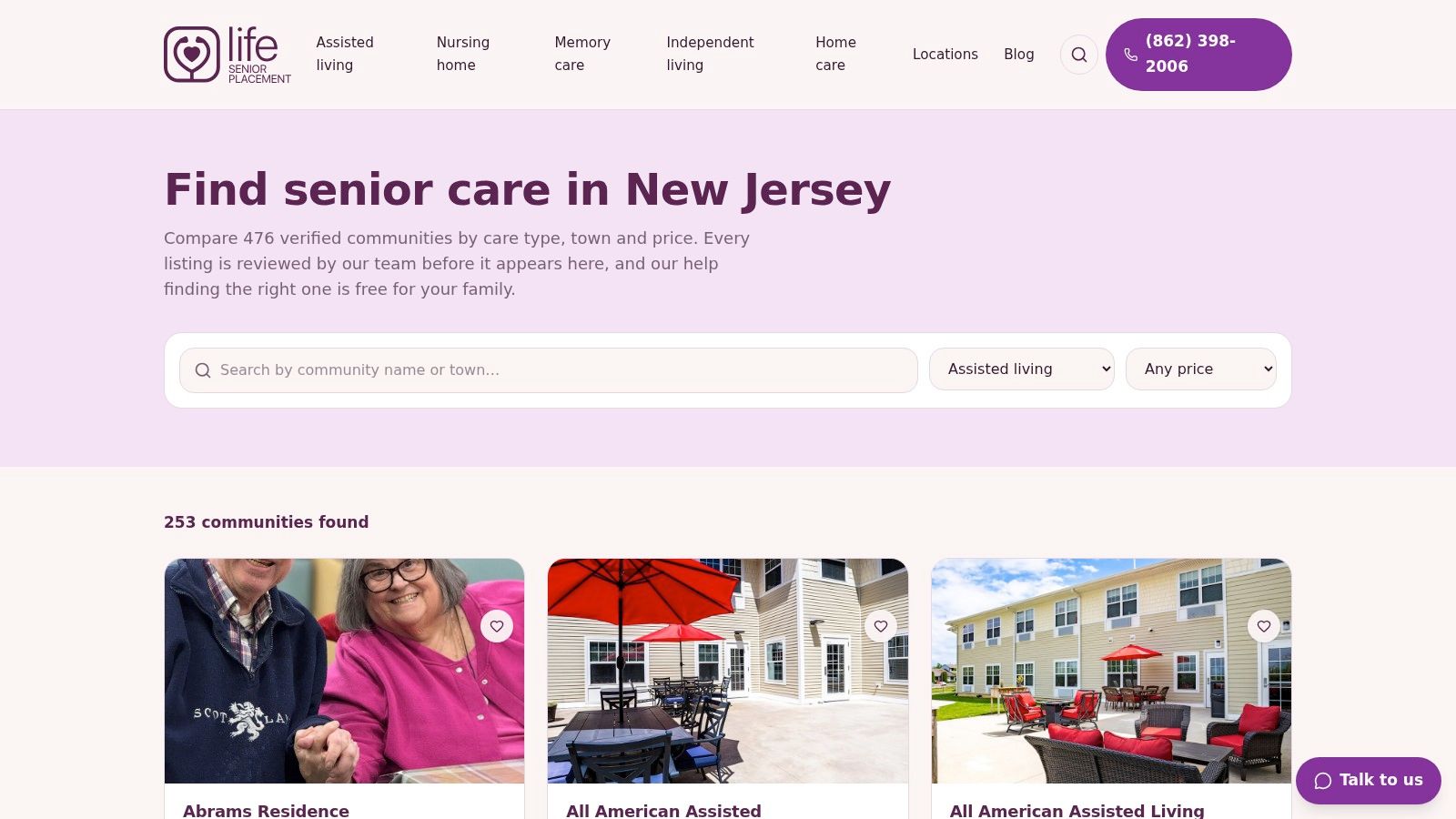
Start here if you need a New Jersey memory care shortlist without wasting time on generic senior housing results. The Memory Care search page on Life Senior Placement lets families search by city, ZIP, and map, then apply care and pricing filters before moving into intake, matched options, and tour support. The platform also points families to its memory care resource page, which keeps the search centered on secure, specialized settings.
Why it works for urgent searches
The value here is speed and sorting. Families can compare licensed, vetted communities side by side, then use one advisor contact to set tours and narrow the list around the resident's actual care needs. That helps after a hospitalization, a wandering incident, or a caregiver burnout point.
Before touring, it may also help to review the physical environment itself. This guide to accessible bathroom remodel Northern Colorado explains what safety-focused bathroom design looks like, which gives useful context when you judge a community's bathing and restroom setup.
Practical rule: If a website only says “call for pricing,” treat it as a starting point, not a decision tool. Get the fee structure, care-level add-ons, and transfer policy in writing before you tour.
Because only participating communities appear in the results, families should verify that no strong local option is missing before they lock in a tour schedule. That selection limit matters, especially if you want to compare more than one neighborhood or facility type.
Pros
- Location-based search for memory care helps you find nearby Alzheimer's and dementia communities fast by city, ZIP, or map.
- Vetted, licensed listings reduce uncertainty about safety and regulatory status.
- No-cost advisor support helps document needs, arrange tours, compare options, and guide move-ins.
- Pricing and care filters with side-by-side comparisons make budget and fit screening quicker.
Cons
- Geographic scope is mainly New Jersey, so usefulness drops outside the state.
- Only participating communities appear, so families should treat the shortlist as a starting point, not a complete market scan.
2. Harmony Village at CareOne Paramus
Harmony Village at CareOne Paramus fits families who want a memory-care-only setting with room to adapt as dementia progresses. The community is organized into six secure neighborhoods, which is useful when a loved one's needs are changing and one floor plan won't work forever. CareOne describes 24/7 dementia-trained staff, an on-site dementia care specialist, respite stays, and secure indoor and outdoor spaces on its Paramus campus CareOne's Harmony Village in Paramus.
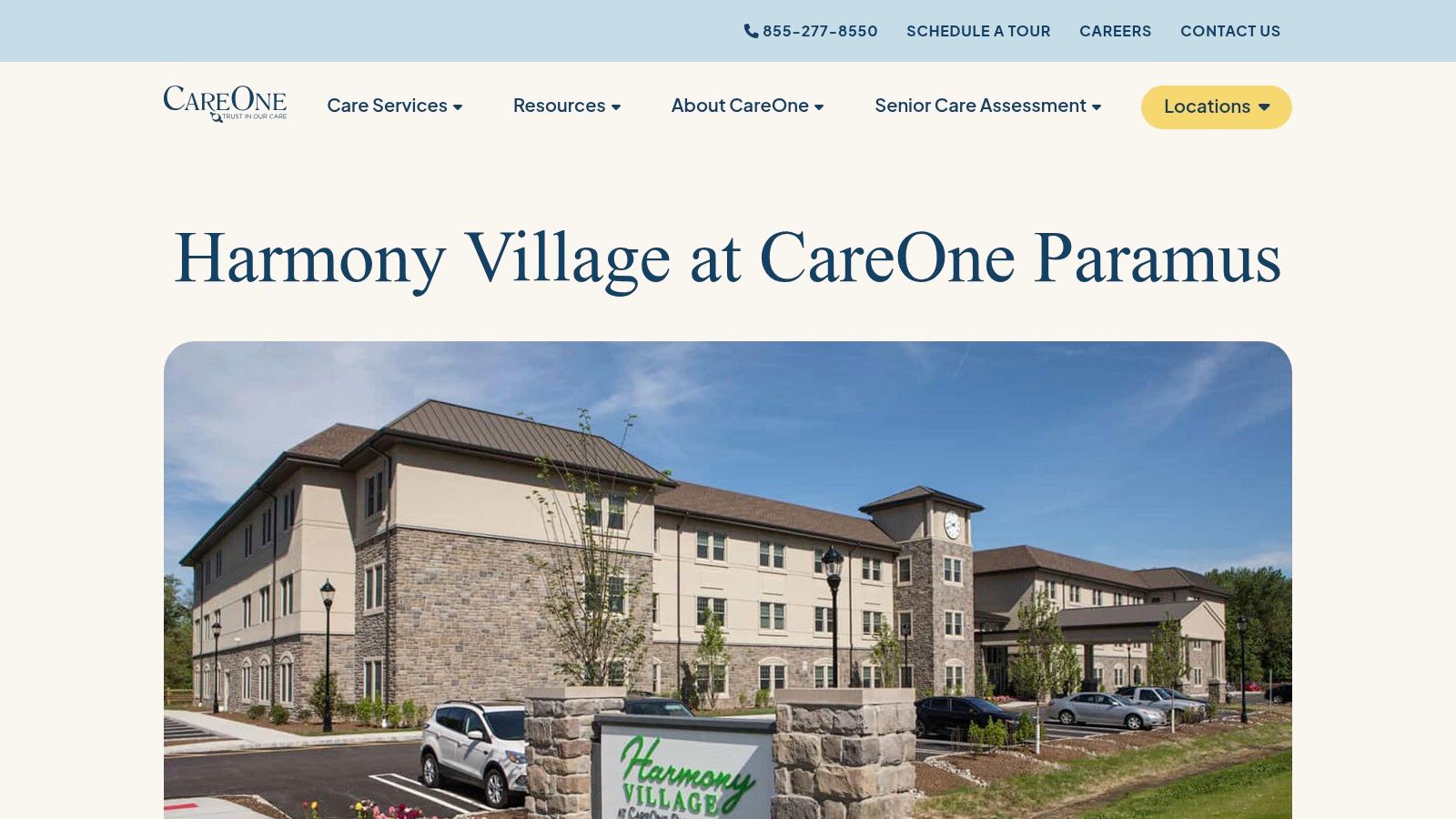
The best reason to tour this community is the stage-based layout. A larger, purpose-built campus can help families who want clear separation between resident needs, but it can also feel busier than a smaller home-like setting. Ask how residents are moved between neighborhoods, what triggers that transition, and how often staffing changes between day, evening, and overnight coverage.
What to verify in person
- Licensing and supervision: Confirm who is physically present overnight and how emergencies are handled.
- Neighborhood assignment: Ask how staff decide which secured neighborhood fits a new resident.
- Respite rules: Get the minimum stay, maximum stay, and move-in requirements in writing.
- Daily life: Watch whether residents are engaged or supervised.
Pros
- Memory-care-only focus can improve staff consistency and dementia-specific routines.
- Six secured neighborhoods support progressive needs over time.
Cons
- Pricing is not public, so the total monthly cost can rise with care add-ons.
- Large footprint may feel less intimate than smaller communities.
3. Arden Courts Memory Care West Orange
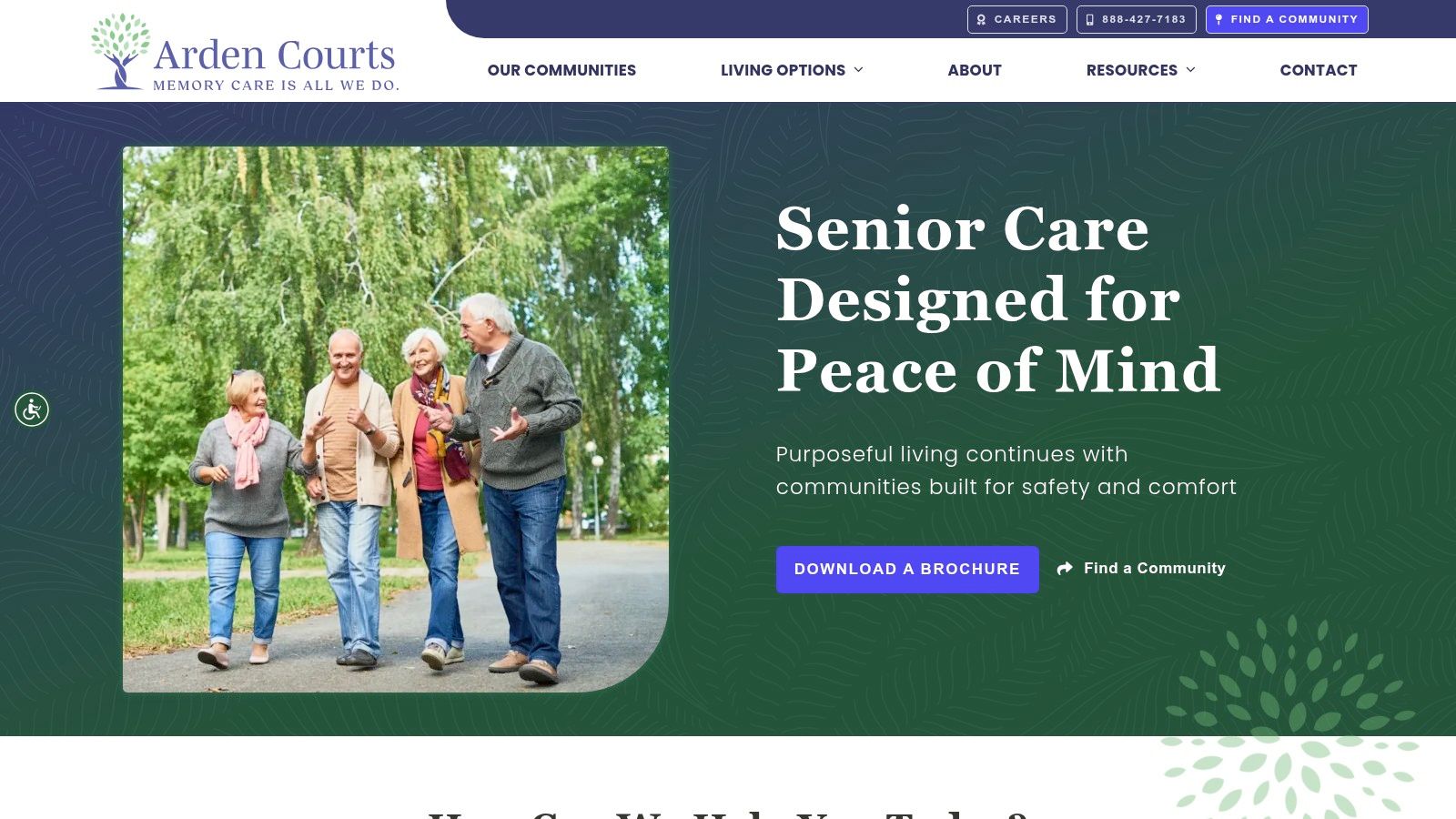
Arden Courts is the kind of place families choose when they want a system built around dementia, not a general senior living model with memory care attached. The brand's “memory care is all we do” approach is the point, and the West Orange option reflects that with secure walking paths, wayfinding cues, and small households designed for people living with Alzheimer's and related dementias Arden Courts. Multiple New Jersey locations also give families some geographic flexibility if one town is closer to doctors, siblings, or a daily routine.
Best fit and limits
This works best when wandering risk is real and the family wants a clearly secured environment. It's also useful when you want a staff model that's built around dementia training rather than layered onto a broader assisted living operation. The trade-off is simple, you're paying for specialization, and the online view doesn't tell you the full rate structure.
Families should ask whether the community can handle changing behaviors without moving the resident again. Stability matters as much as the building.
Pros
- Dementia-specific environment helps with consistency and wayfinding.
- Multiple NJ locations make regional comparison easier.
Cons
- Pricing isn't fully posted online, so the final rate depends on location and care level.
- Medicaid acceptance can vary, so verify payer options before you assume a fit.
4. Brightview Randolph Wellspring Village
Brightview Randolph fits families comparing a memory care neighborhood inside a larger senior living community, especially when they want private apartments and a rental model without a large entrance fee Brightview Randolph. It is a practical option if care needs may change and you do not want to commit to a big upfront payment before the fit is clear.
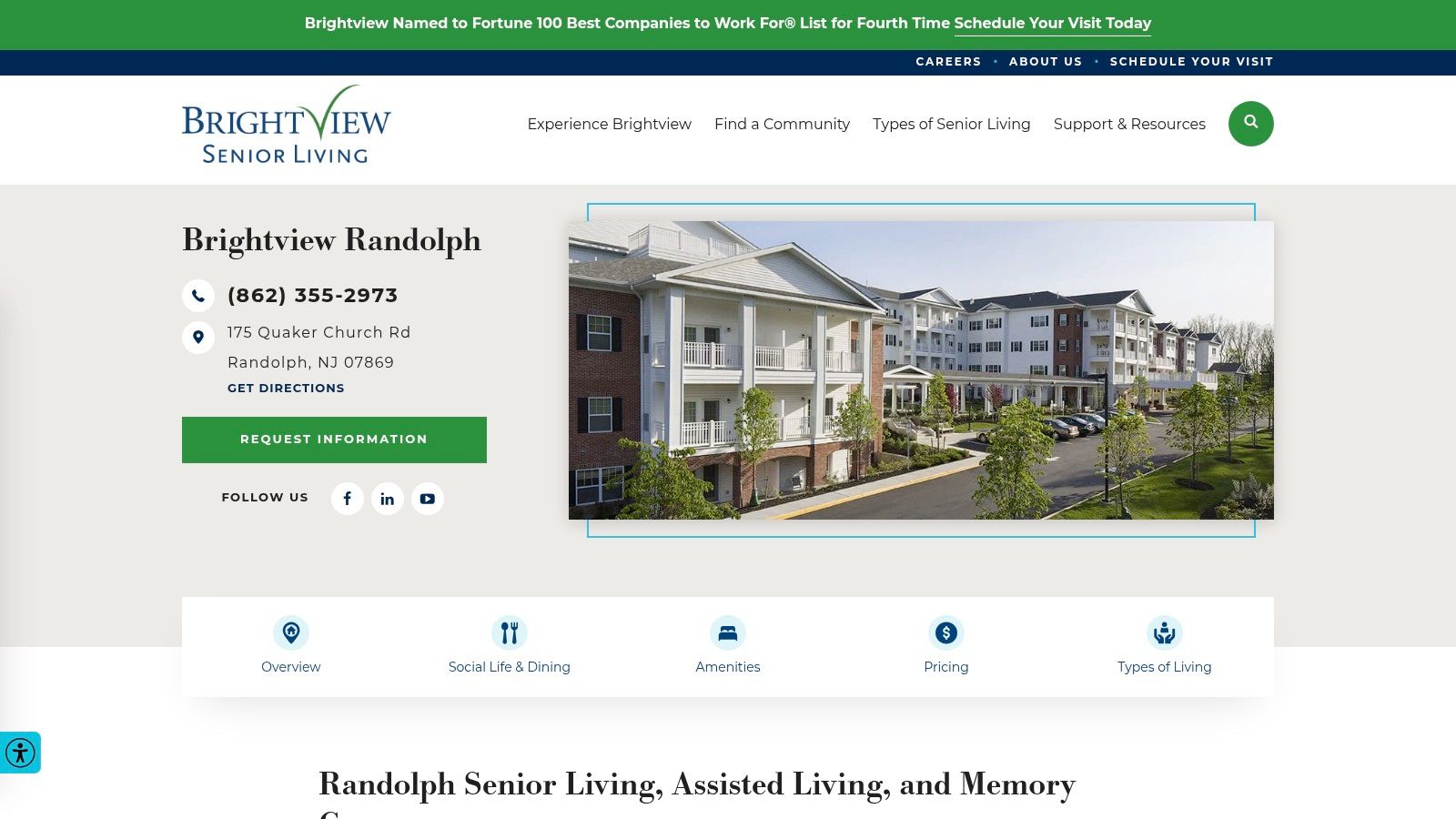
Do not let the polished setting do all the work for you. Ask whether the memory care team can redirect confusion during meals, how the activity calendar is adjusted for cognitive decline, and what happens if a resident starts needing more supervision. A pleasant dining room only matters if it helps the resident eat better and stay calmer.
What to ask on the tour
- Apartment layout: Can the resident orient themselves after the first week, or do they need repeated prompts?
- Care escalation: What changes if behaviors become harder to manage?
- Pricing clarity: Which services are included, and which ones are billed separately?
- Scheduling: Are activities adjusted for residents who cannot tolerate large groups?
The main trade-off here is cost structure versus intensity of specialization. A rental model keeps the entry barrier lower, but monthly rates and care packages still need a quote. A dedicated memory care neighborhood helps keep support focused, yet you still need to verify how well the staff can handle changing needs over time.
Pros
- Rental model avoids a large entrance fee.
- Dedicated memory care neighborhood keeps support focused.
Cons
- Monthly rates and care packages aren't fully posted online, so budget planning needs a quote.
- Mid-sized communities may have waitlists for certain apartment types.
5. Arbor Terrace Morris Plains Evergreen Memory Care
Arbor Terrace Morris Plains fits families who want memory care shaped around routine, calming cues, and close supervision. The Evergreen neighborhood includes 24/7 licensed nursing, dementia-trained caregivers, outdoor access, aromatherapy, therapeutic music, and chef-led dining Arbor Terrace Morris Plains. That model works for residents who settle with structure and do better when the day feels predictable.
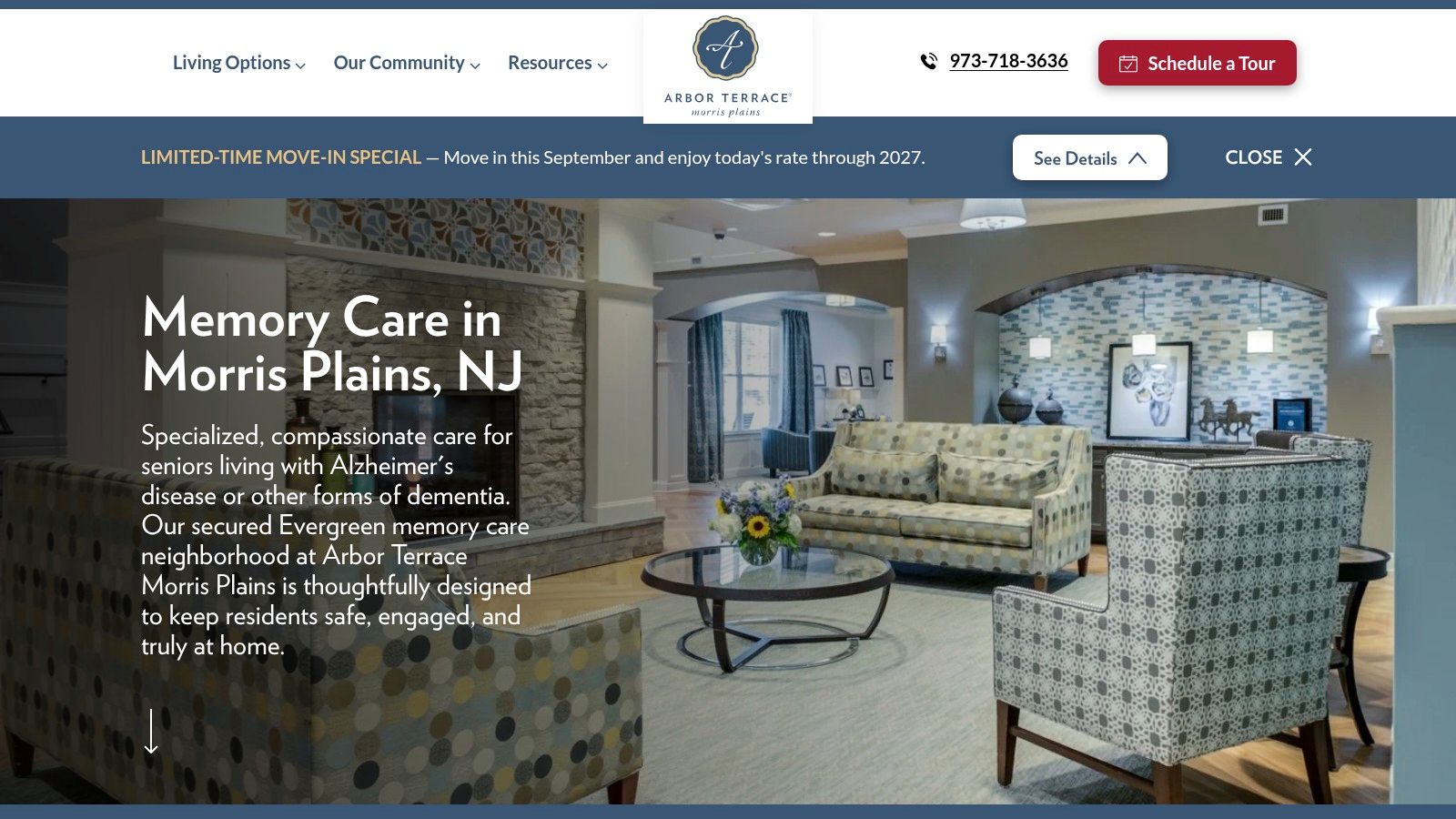
The sensory piece is the main draw. Music, scent, and dining routines can reduce agitation, but only if staff use them consistently, not just as a tour-day feature. For families unsure whether these daily changes signal a need for this level of care, the guide on signs parent needs memory care assisted living NJ walks through the behaviors that usually point to a transition.
Practical rule: If the resident calms in smaller groups, responds to familiar songs, or eats better with routine, choose the calmer setting over the flashier one.
The Morris County location also helps families spread out visits and keep doctors within reach. Still, do not stop at the brochure. Ask how the team handles evening supervision, medication support, meal-time redirection, and changes in behavior, because those are the details that show whether the neighborhood can adapt as needs rise.
Pros
- Calming sensory programming is built into the daily routine.
- Licensed nursing on site adds clinical support beyond basic assistance.
Cons
- Pricing isn't public, and because sensory programming and licensed nursing are bundled into care levels, ask which tier covers the Evergreen neighborhood's clinical staff and which treats it as an add-on.
- Unit variety is limited compared with larger campuses.
6. Sunrise of Summit Reminiscence Memory Care
Sunrise of Summit works for families who want a familiar brand and a smaller memory care setting. The Reminiscence program includes secured access, life-enrichment for dementia support, family-style common areas, and New Jersey Department of Health licensure Sunrise of Summit. That setup suits residents who do better with fewer people around and less visual clutter.

The advantage here is consistency. Families usually get clearer routines, a more predictable service structure, and an intake process that feels familiar across Sunrise communities. The trade-off is cost, because care-level pricing can rise quickly once needs increase. Ask for a full written quote, not a polished tour summary.
What to verify on site
- Licensure: Confirm the current status directly.
- Common areas: Ask how family-style rooms handle busy periods and reduce overstimulation.
- Staffing: Find out who covers evenings and weekends.
- Hospital access: Ask how the community responds when a resident's condition changes.
The setting can help residents settle in, but only if the daily routine matches what they need. If a quieter environment, tighter supervision, and organized care matter more than extras, this is a reasonable option to compare against larger campuses. Keep your questions practical. Ask about medication support, redirection during meals, and how staff handle changes in behavior.
7. Brandywine Living at Livingston Reflections Memory Care
Brandywine Living at Livingston fits families who want a polished setting and memory care that uses personal history as part of daily support. The Reflections neighborhood leans on life story-based programming, flexible routines, respite stays, and a hospitality-forward approach Brandywine Living at Livingston. It works best for a resident who still reacts well to conversation, familiar routines, photos, and identity cues.
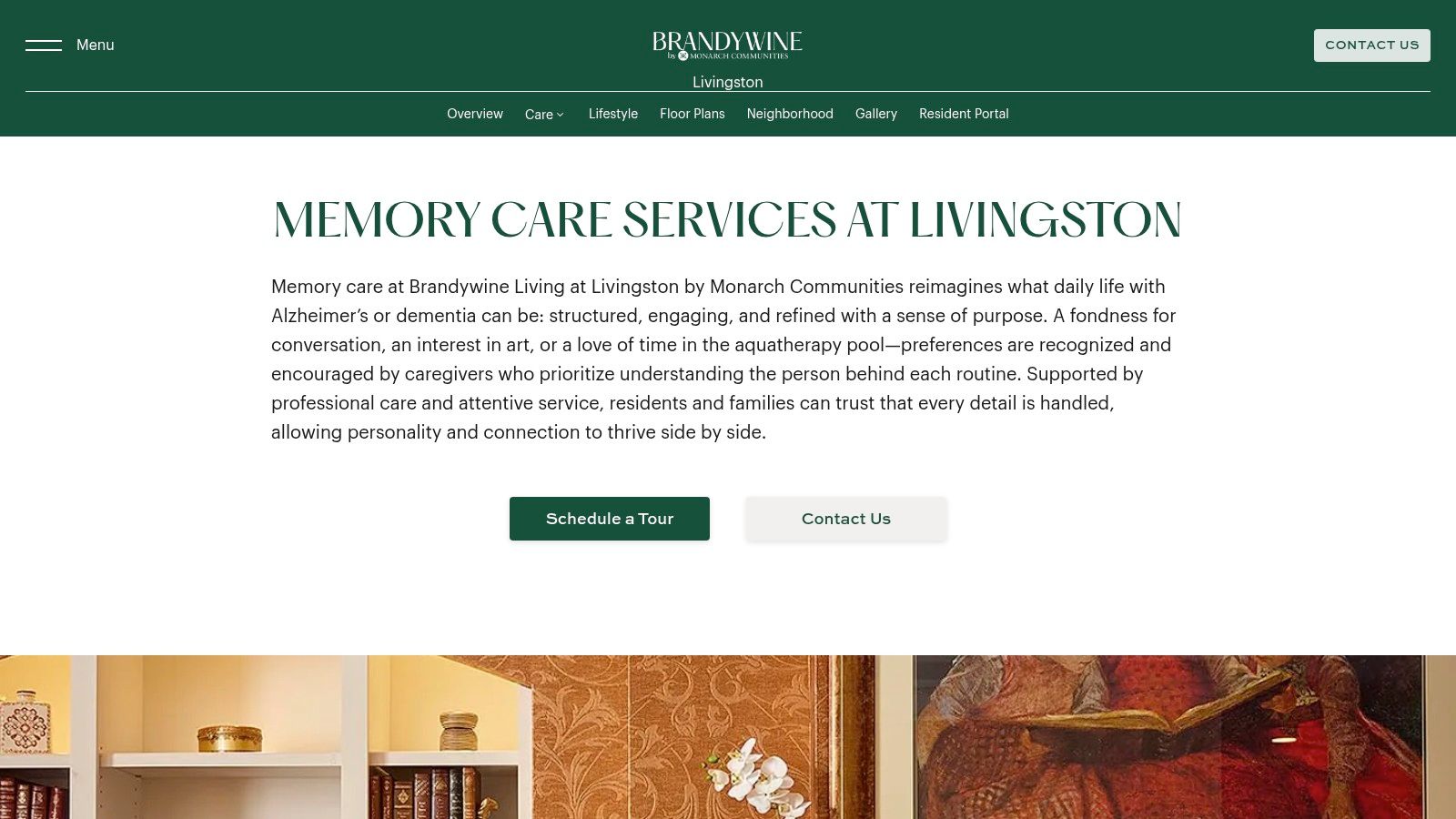
The trade-off is cost. Premium positioning usually means a higher monthly rate, and the site does not publish exact pricing online. Ask for the full fee sheet before you let the dining room or lobby shape your judgment.
Use the tour to check whether the care style matches the resident, not just the decor. Ask how staff use life history in everyday care, whether the routine changes as cognition shifts, and whether respite stays can lead to longer-term placement. Also ask if the broader Brandywine network gives you a realistic transfer path later, because that matters more than the brochure language.
Pros
- Strong activities calendar and a polished setting.
- Respite stays make it easier to test the fit before committing.
Cons
- Premium pricing is likely, so budget screening has to happen early.
- Exact rates aren't posted, which slows comparison shopping.
8. Juniper Village at Chatham Wellspring Memory Care
Juniper Village at Chatham is a good option for families who want relationship-based memory care instead of a heavily institutional feel. The Wellspring program centers on small-group engagement, purposeful daily activities, and integrated health coordination through Juniper's Connect4Life and Catalyst model Juniper Village at Chatham. It's the right kind of place to tour when the resident still benefits from connection, conversation, and a steady rhythm.
This community's strength is tone. A relationship-based setting can reduce stress for residents who resist overly formal care, but you should still inspect the mechanics. Ask how staff coordinate with outside doctors, how much of the day is structured versus self-directed, and what happens on evenings when agitation is more likely.
A good tour reveals more than the brochure. Watch whether staff use the resident's name, make eye contact, and guide without rushing.
Pros
- Wellspring Memory Care is a recognizable program within the Juniper network.
- Small-group engagement can work well for residents who shut down in larger settings.
Cons
- Memory-care specifics may require a deeper tour, because the site leans toward lifestyle language.
- Pricing is not posted publicly, so quote-based comparison is necessary.
9. Parker at River Road Memory Care Within Skilled Nursing
Parker at River Road fits families who have moved past standard assisted living and need memory care inside a skilled nursing setting. The community places memory care households in a secure, home-like environment with private and semi-private rooms Parker at River Road. That setup makes sense when the resident needs constant clinical oversight and may need a higher level of care without another move.
Tour this one with a medical eye. If medication management, mobility help, wound care, or closer monitoring are part of the picture, ask how the nursing team handles those needs day and night. Confirm payer rules, Medicare and insurance implications, and whether the resident is better served by a more clinical setting than a typical memory care neighborhood.
Questions to ask on site
- Nursing coverage: What staff are present overnight, and how quickly do they respond?
- Room availability: Are private rooms open, or is semi-private housing the realistic option?
- Care changes: If the resident declines, can the community absorb that shift without a transfer?
- Ownership and continuity: How does the nonprofit structure affect staffing and care consistency?
The trade-off is clear. Parker at River Road offers more clinical capacity than most assisted living memory care options, but the setting will feel more medical. That makes fit, payment source, and room type the main issues to verify before you commit.
10. Mira Vie at Montville Memory Care Neighborhood
Mira Vie at Montville is worth touring if you want updated physical spaces without giving up the familiarity of a long-standing local site. The community, formerly The Chelsea at Montville, has been renovated and rebranded under Mira Vie Senior Living, with a secured memory care neighborhood, structured activities, and 24/7 support Mira Vie at Montville. For families who care about both appearance and continuity, that mix can be appealing.
The caution here is brand transition. Third-party information can lag behind the current reality, so you need to confirm the present-day features directly. The safest approach is to tour, ask for the current fee schedule, and verify what the secured neighborhood includes before relying on older descriptions or assumptions.
The related memory care cost guide from Life Senior Placement is useful when you're comparing this kind of option against other local communities. It helps families treat cost as part of fit instead of a separate afterthought.
Pros
- Freshly updated community spaces can improve day-to-day comfort.
- Established local presence gives the site continuity.
Cons
- Branding changes can create confusion, so current details must be confirmed directly.
- Pricing isn't posted, so you'll need a formal quote.
Top 10 Alzheimers Memory Care Facilities, Comparison
| Service/Provider | Core Offering & Unique Features ✨ | Quality / Experience ★ | Pricing / Value 💰 | Target Audience 👥 |
|---|---|---|---|---|
| **Life Senior Placement | Search, Memory care near you** 🏆 | Location-based NJ memory-care search; vetted/licensed listings; 3-step advisor workflow (intake → matches → touring); tour coordination ✨ | Trusted local expertise; verified listings; dedicated advisors ★★★★☆ | No-cost guidance for families needing fast, vetted memory care in NJ 👥 |
| Harmony Village at CareOne Paramus | Purpose-built memory-care campus; six secured neighborhoods; 24/7 dementia-certified staff ✨ | Memory-care-only focus; scalable supports ★★★★ | 💰 Rates vary by care level; add-ons increase cost | Families wanting progressive neighborhood model near Bergen County hospitals 👥 |
| Arden Courts Memory Care, West Orange | “Memory care is all we do”; small households, secure walking loops, wayfinding cues ✨ | Consistent dementia-specific training across sites ★★★★ | 💰 Location-based rates; some sites may not accept Medicaid | Families seeking consistent, dementia‑specific environments across NJ 👥 |
| Brightview Randolph, Wellspring Village | Wellspring memory-care neighborhood; solid life-enrichment; rental (no large entry fee) ✨ | Hospitality-forward environment with programming ★★★★ | 💰 Rental model avoids entrance fees; monthly rates vary | Families wanting hospitality-style care without CCRC entrance fees 👥 |
| Arbor Terrace Morris Plains, Evergreen Memory Care | Secured, dementia-friendly neighborhood; 24/7 licensed nursing; sensory therapies; chef-led dining ✨ | Calming sensory approach integrated into daily life ★★★★ | 💰 Pricing by care level; add-ons possible | Families seeking sensory-based, clinical-aware memory care 👥 |
| Sunrise of Summit, Reminiscence Memory Care | Reminiscence neighborhood; tailored life-enrichment; family-style common areas; NJ licensure ✨ | Established national brand with structured memory-care processes ★★★★ | 💰 Needs-based pricing can be high; details vary | Families who value brand consistency and neighborhood-sized care 👥 |
| Brandywine Living at Livingston, Reflections Memory Care | Upscale Reflections program; life‑story engagement; high‑touch amenities ✨ | Polished environment and strong activities calendar ★★★★☆ | 💰 Premium positioning; rates typically above average | Families seeking high-touch, amenity-rich memory care 👥 |
| Juniper Village at Chatham, Wellspring Memory Care | Relationship-based Wellspring program; small-group engagement; integrated health coordination ✨ | Recognized program with coordinated clinical support ★★★★ | 💰 Pricing by assessment; details on tour/quote | Families wanting relationship-focused care with health coordination 👥 |
| Parker at River Road, Memory Care within Skilled Nursing | Memory-care households inside skilled nursing; private/semi-private rooms; nonprofit mission ✨ | Higher clinical capacity; strong nonprofit reputation ★★★★ | 💰 Clinical-level care; Medicare/insurance rules may apply | Families needing 24/7 clinical oversight or bridge to long‑term nursing care 👥 |
| Mira Vie at Montville, Memory Care Neighborhood | Renovated community; secured memory neighborhood; structured activities and refreshed spaces ✨ | Updated physical plant at an established local site ★★★★ | 💰 Pricing by care package; requires tour/request | Families wanting newly refreshed facilities with local continuity 👥 |
Turn a Shortlist Into a Safe Decision
Start with the resident's current care needs, then look one step ahead. If wandering is already a risk, prioritize secured access and staff who can explain how they handle exit-seeking. If the resident is still early in the disease process, compare whether a community can support that stage without forcing another move too soon. If clinical needs are increasing, don't force an assisted living setting to do a skilled nursing job.
Ask each community for a complete fee breakdown, not a headline price. Get the room rate, care-level charges, medication support, meal inclusions, move-in fees, respite terms, and any add-ons that can change the monthly total. Then inspect the secured exits, walking routes, room setup, dining room, bathing support, and activity spaces in person, because photos won't show you how staff move through the building.
Watch the staff when nobody is performing for the tour. Ask who is present evenings and weekends, how they handle agitation, what happens after a fall, how medication support works, and how they communicate with families. Verify licensure, inspection information, emergency procedures, respite availability, and transfer policies directly before you sign anything.
Compare the written answers, not the tour mood. A warm welcome is nice, but the details determine whether the community can care for your loved one safely next month, not just today.
Online descriptions and availability change fast, so confirm every feature, price, and care capability before you decide. If you need a New Jersey shortlist, help with tour coordination, or a faster way to compare participating vetted communities, use Life Senior Placement's intake and advisor process while keeping its provider network scope in mind.
Need a faster NJ memory care shortlist without calling every building yourself? Life Senior Placement can help you compare vetted communities, coordinate tours, and narrow the options around real care needs, budget, and location. If you're dealing with Alzheimer's placement now, start with a guided search and turn confusion into a clear next step.