Yes, paranoia is a common symptom of dementia, and a 2025 review found psychotic symptoms in 34% to 63% of people with dementia. That broader category includes delusions and hallucinations, not paranoia alone.
But if your parent suddenly believes someone is poisoning their food, should you assume their dementia has progressed? The timing matters before the explanation does. A new accusation that appears abruptly calls for a medical check, while a persistent belief calls for a different combination of clinical review, daily support, and safety planning.
Yes, Paranoia Is a Common Dementia Symptom
Paranoia in dementia usually appears as a delusion, a firmly held false belief that remains convincing despite evidence against it. It isn't usually a separate diagnosis. A person may feel certain that an aide stole their jewellery or that their spouse intends to hurt them.
The 2025 review in Progress in Neuro-Psychopharmacology & Biological Psychiatry reported psychotic symptoms in 34% to 63% of individuals with dementia. These estimates include delusions and hallucinations and differ across dementia types, disease stages, and study methods. They shouldn't be read as the percentage of people who become suspicious.
A hallucination means seeing, hearing, or otherwise sensing something that isn't there. A delusion concerns what someone believes. A person can have either symptom without the other, although they sometimes occur together.
Common Paranoid Beliefs in Dementia
| Belief | Typical example | What it often reflects |
|---|---|---|
| Theft | Accusing a family member or aide of taking money or jewellery | Misplaced items the person cannot find, combined with memory gaps |
| Infidelity | Insisting a spouse is having an affair | Confusion about relationships, with a belief that can persist despite reassurance |
| Harm or poisoning | Believing food or medication is being tampered with | Fear and a fixed belief; refusing food or medication needs prompt review |
| Abandonment | Believing family has left them somewhere | Disorientation to place and time |
| Impostor | Believing a familiar caregiver is a stranger or impostor | Misidentification associated with reduced recognition |
These examples describe possible patterns, not proof of a particular cause. Don't dismiss an allegation because someone has dementia. Check whether belongings are missing and whether there could be a genuine care or safety problem.
Paranoia isn't present in everyone with dementia, and its absence doesn't rule dementia out. Conversely, suspiciousness alone doesn't establish that someone has dementia, as the systematic review of psychotic symptoms across dementia types helps clarify.
For now, write down the person's exact words, when the belief began, and whom it concerns. Those details are more useful to a clinician than a general description such as becoming difficult or acting paranoid.
Telling Dementia Apart From Delirium
| Pattern | Possible cause | Response |
|---|---|---|
| Sudden onset over hours to days | Delirium from infection, dehydration, pain, or another acute problem | Call a clinician the same day; seek urgent care if newly confused or feverish |
| New hallucinations or reduced alertness | Delirium, medication toxicity, or acute illness | Urgent medical assessment |
| New paranoia after a medication change | Drug effects from anticholinergics, benzodiazepines, opioids, or sedatives | Ask the prescriber to review the medication promptly |
| Long-standing belief, stable over months | Possible dementia-related delusion | Routine clinician review and a behavioural plan, unless safety changes |
| Belief with threats, weapons, or refusal of food | Risk to self or others | Immediate professional help or emergency services when danger is imminent |
A sudden change may be a medical emergency. Don't wait for a routine dementia appointment when someone becomes abruptly confused, unusually sleepy, or unsafe.
Delirium is a sudden disturbance in attention and awareness that can fluctuate. Someone may follow a conversation at breakfast but struggle to stay awake or understand you later. According to Dementia UK's delirium guidance, dementia increases vulnerability to delirium, but the conditions aren't interchangeable.
Possible triggers include infection, dehydration, constipation, urinary retention, pain, disrupted sleep, and changes in the body's salts and minerals. An existing dementia diagnosis doesn't explain away an abrupt change.
Check Medicines and Changes From Usual
A medication review should include prescriptions, over-the-counter products, and sleep aids. Anticholinergic medicines, which block a chemical involved in memory and other body functions, can worsen confusion. Benzodiazepines, opioid pain medicines, sedatives, and interactions between drugs can also contribute.
Don't stop or change prescribed medication on your own. Tell the prescriber what changed and when, including a new dose or a recently added product.
Before the assessment, compare the person with their usual condition:
- Attention and alertness: Can they follow a familiar conversation and stay awake?
- Sleep and drinking: Have they slept poorly or taken less fluid?
- Pain and toileting: Are they uncomfortable, constipated, or struggling to pass urine?
- Other changes: Note temperature, falls, illness, medication changes, and new hearing or vision difficulties.
The clinician will usually ask someone who knows the person for a history, compare medication lists, examine them, and assess thinking and daily function. Tests depend on the suspected cause.
Urgent rule: New reduced consciousness, serious threats, or immediate danger requires emergency help, not a completed symptom diary.
While help is being arranged, keep the surroundings quiet and offer calm reassurance. Don't delay the call while trying to persuade the person that their belief is wrong.
Why Memory Loss Can Turn Into Suspicion
Say your mother puts her purse inside a laundry basket to keep it safe. Later, she can't find it and has no memory of moving it. From her perspective, the purse has disappeared, and someone else must have taken it.
The emotional experience can be frightening even when the explanation is mistaken.
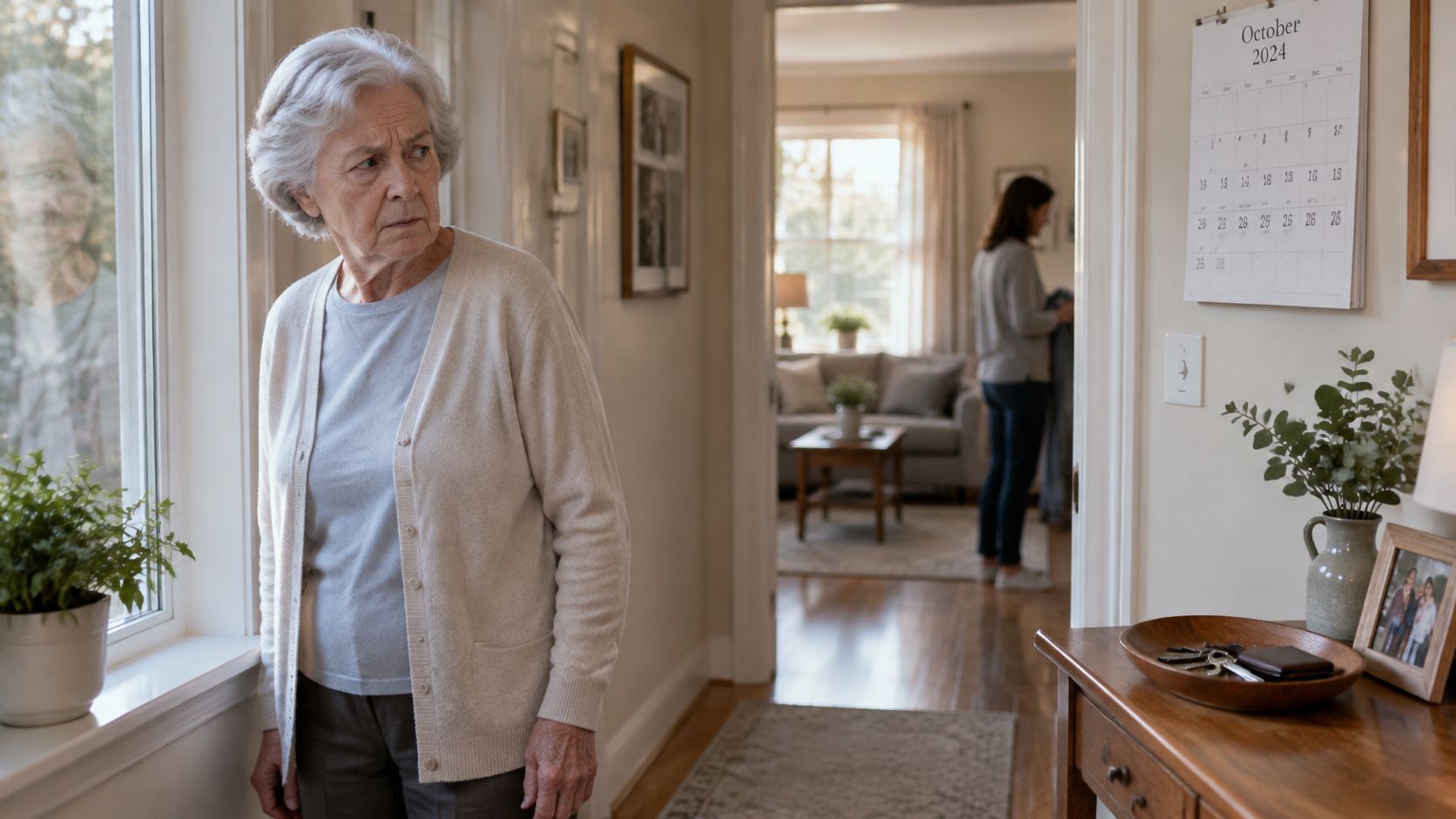
Dementia can affect more than remembering an event. It can interfere with interpreting what the eyes see, weighing possible explanations, and identifying where information came from. The Merck Manual's clinical overview of dementia describes the cognitive and behavioural changes that can accompany these disorders.
Episodic memory is memory for personal events, such as putting away a purse. Source monitoring means keeping track of where a memory or idea came from. When those abilities weaken, a person may struggle to distinguish something they did from something they imagined, saw on television, or were told.
Why Evidence May Not Settle the Belief
Finding the purse doesn't always resolve the accusation. Your mother may conclude that someone returned it after being confronted. Reduced insight, difficulty recognizing one's own thinking problems, can make a memory-based explanation feel less believable than theft.
This isn't necessarily a deliberate accusation or a choice to distrust you. The person may feel unsafe and act defensively because of that fear.
Look for circumstances surrounding an episode:
- Unfamiliar surroundings: A different bedroom or newly arranged furniture may be hard to recognize.
- Visual confusion: Dim lighting, clutter, reflections, or a visitor's changed appearance may cause misunderstanding.
- Unclear context: A new caregiver or an upsetting television programme may be interpreted as a personal threat.
The accompanying video offers another way to consider these experiences.
Ask a practical question after each episode: What happened just before the belief appeared, and did it ease when that circumstance changed? That observation can help you distinguish a recurring environmental trigger from a belief that persists across settings.
How Dementia Type Changes Paranoia
| Dementia type | Psychotic symptoms reported | What to expect |
|---|---|---|
| Alzheimer's disease | 22.5% to 54.1% | Paranoid delusions are often the most common delusion type |
| Dementia with Lewy bodies | 55.9% to 73.9% | Misidentification and visual hallucinations are characteristic patterns |
| Frontotemporal dementia | 18% to 42% | Paranoia may occur, but is generally described less frequently than in Alzheimer's disease |
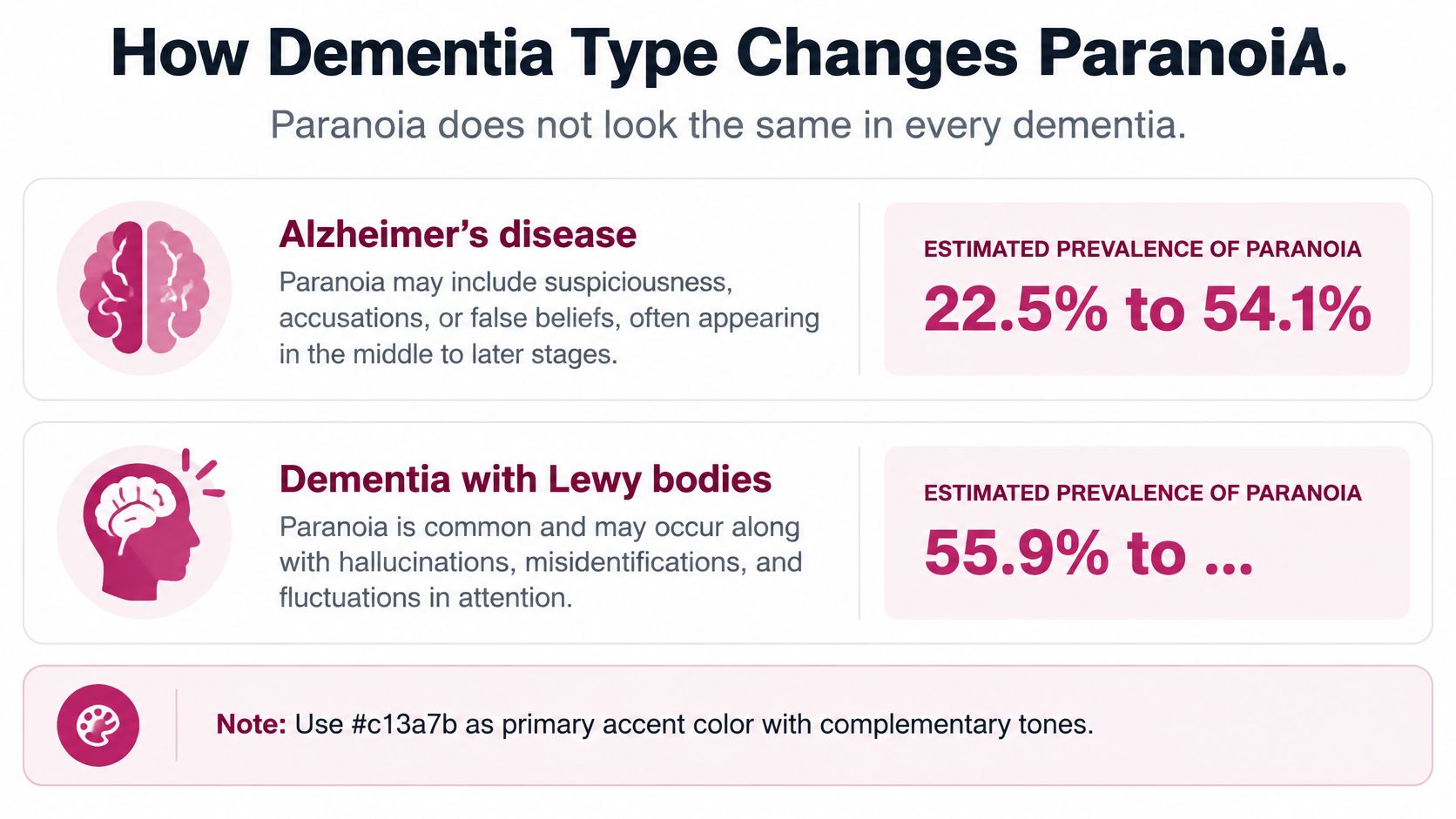
The 2024 systematic review published in the Journal of Alzheimer's Disease reported psychosis, including delusions and hallucinations, in 22.5% to 54.1% of people with Alzheimer's disease, 55.9% to 73.9% of people with dementia with Lewy bodies, and 18% to 42% of people with frontotemporal dementia. These are ranges across studies, not a prediction for an individual.
The comparison below illustrates how the presentation can differ.
Match the Pattern, Not Just the Label
In Alzheimer's disease, families may notice repeated accusations of theft or infidelity. Paranoid beliefs are commonly described, but the presence of an accusation doesn't identify Alzheimer's disease by itself.
In dementia with Lewy bodies, visual hallucinations and misidentification may be particularly prominent. A person might see someone who isn't present or believe a familiar relative is an impostor. Understanding the wider pattern of Lewy body dementia symptoms and progression can help families prepare useful observations for the clinical appointment.
In frontotemporal dementia, paranoia is possible, but families shouldn't expect every behavioural change to follow an Alzheimer's pattern. A clinician needs to consider the person's broader changes in thinking, behaviour, and function.
Why the Ranges Are Broad
Studies use different interviews, caregiver questionnaires, populations, and definitions. The comparative systematic review of dementia-related psychosis also describes differences in the form and frequency of paranoid symptoms across dementia subtypes.
Symptoms may fluctuate, and more advanced disease can bring a greater burden of psychosis. A difficult evening alone doesn't establish a new stage.
The diagnosed dementia subtype helps guide treatment choices. A symptom percentage can't tell a family which medicine or care setting will suit their relative.
How to Respond to Paranoia at Home
Arguing rarely changes a fixed belief. The immediate goal is to reduce fear and maintain safety, not win agreement about what happened.
The following visual provides a simple reminder during tense moments.
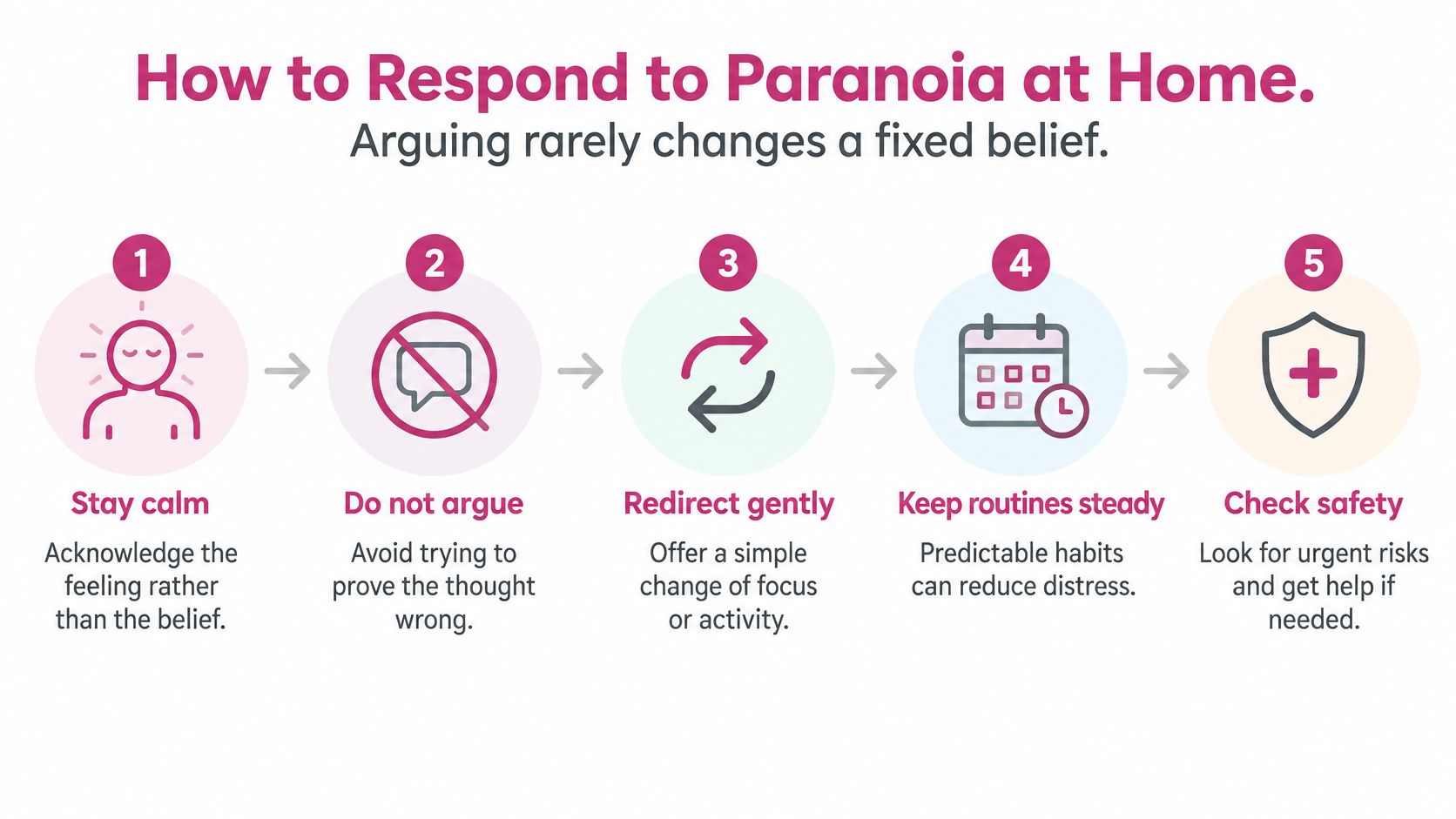
- Respond to the feeling. Speak slowly and acknowledge that the situation seems frightening without confirming the accusation. Repeatedly correcting the story can leave the person feeling unheard; this guide to whether you should correct someone with dementia explains that distinction.
- Check immediate safety. Notice whether the person is trying to leave, refusing essential care, or preparing to defend themselves. Keep a clear exit for yourself and give them space rather than crowding or restraining them.
- Adjust the surroundings. Turn down competing sound, reduce glare, cover a troubling reflection, and keep familiar objects easy to locate. Change one likely trigger at a time so you can tell what helps.
- Offer a gentle change of focus. Suggest a familiar song, folding towels, or a walk if it's safe. Offer an invitation rather than issuing another demand.
- Keep daily routines predictable. Use familiar sequences for meals, bathing, medication, and bedtime. For additional daily-care ideas, Sunridge Medical on whole-person dementia support offers a supplementary resource, not a substitute for assessment of new symptoms.
- Record what worked. Note the episode's timing, likely trigger, duration, and response to your approach. Avoid treating every episode as identical, since one may involve a missing object and another may follow poor sleep.
- Review treatment with the prescriber. Environmental and caregiver approaches generally come first. The Practical Neurology review of psychosis and agitation management describes cautious medication use when symptoms cause substantial distress or danger, or non-drug measures haven't been sufficient.
Medication Requires a Risk Discussion
Antipsychotics, medicines used to treat certain severe disturbances in beliefs or perception, aren't a routine solution to accusations. Before prescribing, the clinician should discuss the boxed warning about increased risk of death in older adults with dementia-related psychosis, along with stroke and fall risks.
When treatment is justified, the plan should specify the target symptom, lowest effective dose, monitoring, and regular review. Periodic attempts to reduce or stop treatment belong in that discussion, with particular attention to the dementia subtype.
When Paranoia Calls for Higher-Support Care
Consider a higher-support assessment when you notice:
- Caregiver risk: Sustained accusations lead to intimidation, threats, or physical aggression.
- Unsafe movement: The person leaves at night or tries to escape an imagined threat.
- Essential care breakdown: Medication, food, hygiene, or other basic needs can no longer be maintained.
- Unmanageable supervision: Family members can't reliably provide the observation and assistance required.
These signs call for clinical and care assessment, not an automatic move. An acute medical problem must be addressed before a family assumes that a residential setting is the answer.
Care Level by Supervision Need
| Care setting | Fits when | Supervision level | Clinical support |
|---|---|---|---|
| Home care with a caregiver | Paranoia is manageable with routines and a consistent caregiver | Scheduled daytime help and overnight support when arranged | Medication assistance and personal care within the agreed service |
| Assisted living | Paranoia is mild and rarely unsafe | Daily staff support and check-ins, not continuous individual observation | Help with personal care, medication, and meals |
| Memory care | Persistent paranoia accompanies wandering, aggression, or self-neglect that the community can safely support | Secured environment with staff around the clock | Dementia-trained staff and structured programmes |
| Skilled nursing | Complex medical needs require nursing oversight | 24-hour nursing availability | Clinical and rehabilitative care |
The right setting follows supervision and clinical needs, not the diagnosis label alone. A person who accepts help from a familiar caregiver may remain at home with a workable schedule. Someone who repeatedly tries to leave because they believe the house is dangerous may need a secured environment.
A specialist assessment can clarify whether symptoms remain persistent after medical contributors are treated and whether subtype-specific treatment is appropriate. For a residential discussion, compare memory care services against the person's actual behaviours, including overnight needs and response to unfamiliar staff.
Plan a Transition Without Assuming a Fixed Ladder
Adding home help may be a reasonable first change. Assisted living may fit later if daily assistance is enough, while memory care may become appropriate when dementia-specific supervision is necessary.
Not everyone needs to pass through each setting. Some people need nursing care because of medical complexity, and some communities can't safely support severe aggression despite offering memory care.
A placement discussion should include what happens during the hardest part of the day, not only how the person behaves during a calm tour.
Document the Pattern and Book a Clinical Review
- Start a usable log. Record the person's words, when the belief began, whom it targets, how often it occurs, and what preceded it. Include what helped and whether eating, medication, sleep, or safety was affected.
- Arrange the appropriate appointment. For a stable, non-urgent pattern, contact the clinician this week rather than waiting indefinitely. Bring the log, a current medication list including nonprescription products and sleep aids, and notes about recent illness, pain, or falls.
- Ask specific clinical questions. Ask whether delirium or a medication effect could be involved and whether the dementia subtype is clear. The MSD Manual's dementia guidance supports evaluating changes from baseline and alternative causes rather than assuming every new symptom is progression.
- Arrange a care consultation if support is failing. Bring the clinician's findings and a realistic account of available family help. If a move is being considered, use those details to discuss supervision, staffing, and the setting's ability to manage the documented behaviours.
Bring Evidence to the Care Decision
For families exploring residential support, memory care is offered in secure, purpose-built communities with staff trained in dementia and Alzheimer's care, structured routines, and therapeutic programming. The important question is whether that support matches the person's assessed needs.
Confirm the medical cause first, then choose the level of care that matches the documented pattern.
Life Senior Placement offers no-cost guidance to help New Jersey families compare home care, assisted living, and memory care against clinical needs, budget, and preferred location. Visit Life Senior Placement to discuss your relative's symptom log, identify suitable options, and get support with comparisons and tours.