
You walk into a bright lobby with your mom, someone hands you a brochure, and within five minutes you're supposed to decide whether she belongs in assisted living, memory care, or a nursing home. Most families can't tell. The furniture looks nice, the dining room smells good, and everyone says they can “meet changing needs.”
That's not enough.
The biggest mistake families make is shopping for the nicest building before they've answered the harder question: is an assisted living community even the right level of care for this person right now? If you get that wrong, the tour doesn't matter. You'll either overpay for support your parent doesn't need, or move them into a place that can't safely handle falls, medications, confusion, or mobility decline.
I'd make this decision based on three things first: cognition, mobility, and medication complexity. Everything else comes after that.
What an Assisted Living Community Actually Is
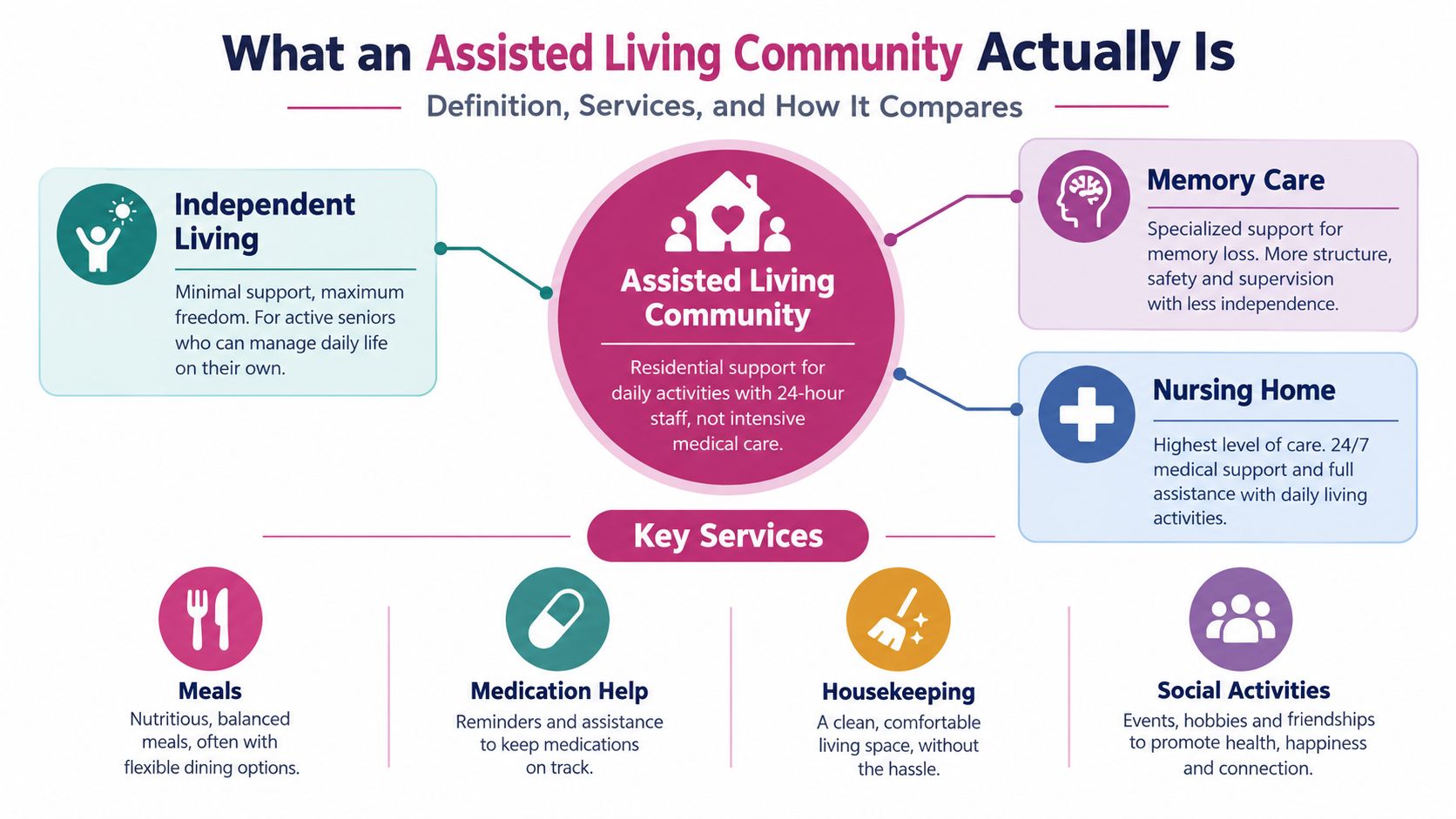
A true assisted living community is a licensed residential setting for older adults who can't safely live alone anymore but don't need round-the-clock skilled nursing care. Residents usually have a private apartment or shared suite, meals, housekeeping, help with daily tasks, and staff available day and night.
That sounds simple. It isn't.
Families often hear “assisted living” and assume it means one standard level of care. It doesn't. Assisted living sits in the middle of the senior care spectrum. It's meant for someone who needs regular help, but not hospital-level oversight.
What it is and what it isn't
Here's the clean distinction families need:
- Independent living fits an older adult who wants easier housing, meals, and social life, but doesn't need hands-on help every day.
- Assisted living fits someone who needs help with bathing, dressing, medications, mobility reminders, meals, or supervision around daily routines.
- Memory care fits a person whose dementia, wandering, confusion, or unsafe decision-making requires a secured environment and staff trained for cognitive decline.
- Skilled nursing fits a person who needs daily clinical care, rehab, wound care, complex medical monitoring, or a level of physical assistance that goes beyond typical assisted living.
Age doesn't decide this. A diagnosis alone doesn't decide it either.
Practical rule: If your parent is forgetting medications, falling, skipping hygiene, losing weight, or calling you to solve routine tasks every day, independent living probably isn't enough.
What families should focus on first
I'd ignore the piano in the lobby and ask these questions first:
- Can they get to the bathroom safely?
- Can they take medications correctly without supervision?
- Can they find their room, follow routines, and ask for help appropriately?
- Can one caregiver usually help them, or do they need heavier physical support?
If the answers are shaky, you're not choosing decor. You're choosing a care model.
Assisted living has grown far beyond a small niche. One market forecast estimated the global assisted living market at USD 177.97 billion in 2025, rising to USD 190.12 billion in 2026 and projected to reach USD 264.68 billion by 2031, while another forecast said North America held more than a 43% share in 2024, with about USD 71.4 billion in revenue, including an estimated USD 67.7 billion in the U.S. (assisted living market analysis from Mordor Intelligence). That scale matters because this is no longer just “senior housing.” It's a major care system.
How Assisted Living Evolved Into Today's Communities
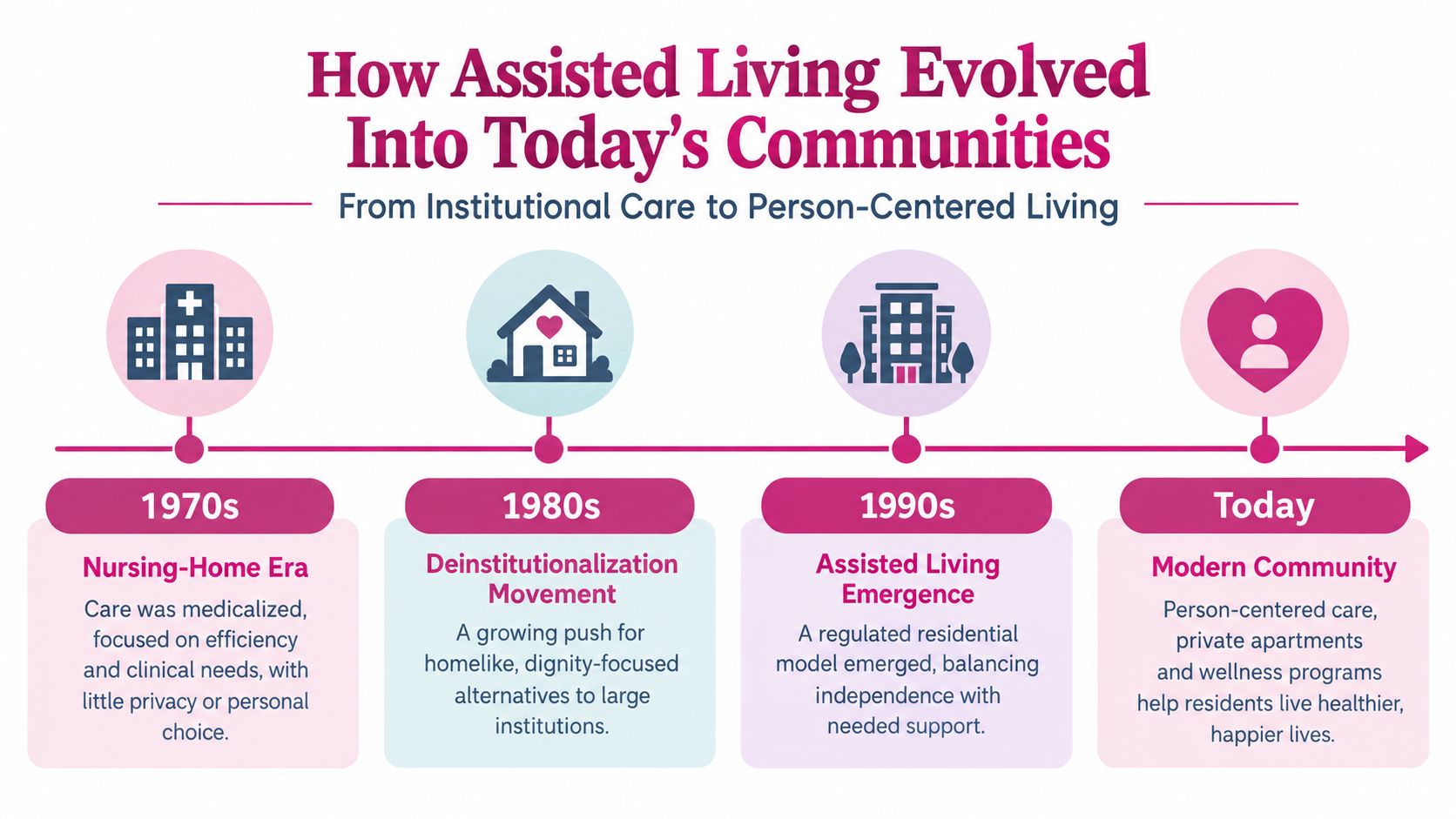
Assisted living exists because families got tired of one old model. For years, the default answer for older adults with rising care needs was the nursing home. That model handled medical needs, but it often traded privacy and normal daily life for efficiency.
Then the industry shifted. Families wanted something less institutional. Operators started building residential settings that offered support without making every resident live like a patient. That push is why assisted living became its own category instead of just a lighter nursing home.
Why communities vary so much now
This history explains a problem families run into on tours. Two assisted living communities can use the same words and deliver very different care.
One building feels residential. Another feels clinical. One operator leans hard into hospitality. Another runs the place like a tightly managed care environment. Neither surprise is accidental. The model developed unevenly, and that unevenness never disappeared.
A few factors drive the difference:
- State rules differ. Licensure standards, medication rules, staffing requirements, and discharge thresholds vary.
- Ownership differs. Nonprofits, regional operators, family-owned buildings, and large investor-backed groups don't always make the same operating decisions.
- Philosophy differs. Some communities still center dignity and independence. Others market lifestyle first and only reveal their care limits later.
A beautiful building can still be a weak care setting if the operator staffs thinly or avoids higher-acuity residents.
Why this matters on a tour
Families often assume consistency because the category sounds standardized. It isn't. Assisted living is a broad label attached to communities with very different capabilities, cultures, and service boundaries.
That's also why public descriptions of assisted living often leave families unsatisfied. The issue isn't “what is assisted living in general.” The issue is whether it's the correct level of support for your parent, especially when you're comparing it with independent living, memory care, or skilled nursing. That gap matters because assisted living serves nearly 1 million people and is meant to bridge the gap between independent living and institutional care, while occupancy and demand are shifting differently across care types. AARP noted assisted living occupancy at 87.7% in 2025, while independent living exceeded 90% in some periods, and new supply remained tight with construction below 1% growth in 4Q25 and fewer than 1,900 new units opened (AARP analysis of assisted living demand and care fit).
Tight availability can make families rush. Don't let urgency answer a care-fit question for you.
Core Services and Daily Support You Can Expect
Brochures tend to blur hospitality and care. Families need the operational version. In most assisted living communities, you're paying for housing plus a package of support services that can expand as needs rise.
Start with the apartment. That may be a studio, one-bedroom, or shared suite. Expect a private bath in many communities, basic safety features, and an emergency call system. Don't assume every floor plan supports a walker well or gives enough room for transfers. Check that in person.
What daily help usually includes
Personal care is the heart of assisted living. Staff commonly help with:
- Bathing and grooming
- Dressing
- Toileting reminders or hands-on help
- Mobility support for routine movement
- Escort assistance to meals or activities
Most of this work is handled by direct-care staff such as aides or caregivers, not by nurses doing constant bedside care. That distinction matters. Assisted living is built around support with daily living, not intensive medical treatment.
Medication help is where many families underestimate the workload. A national study found that more than half of assisted living communities administered medications to 80% to 100% of residents, which tells you medication workflow is not a side service. It's central to operations (national study on medication administration in assisted living).
If your parent takes multiple daily medications, has cognition issues, or misses doses at home, medication handling should be one of your first screening questions.
Meals, housekeeping, laundry, scheduled transportation, and social programming are usually part of the baseline offering. Dining may include modified textures or special diets, but you need to ask how consistent that really is. Activities matter too, though they shouldn't distract you from care capability.
For a fuller checklist of common offerings, review this guide on services you should expect in assisted living.
What often costs extra
Families get blindsided. The base monthly rate usually isn't the whole story.
| Core Services vs. What Is Typically Included | ||
|---|---|---|
| Service Category | Typically Included | Common Extra-Cost Add-Ons |
| Housing | Apartment or suite, basic utilities, emergency call access | Premium floor plans, second occupant fees |
| Personal care | Help with routine ADLs at an entry care level | Higher care tiers, frequent toileting, extensive mobility help |
| Medication support | Routine medication reminders or administration | Complex medication handling, special administration needs |
| Dining | Daily meals, snacks, standard menu options | Enhanced special diets, guest meals |
| Housekeeping | Regular cleaning and linen service | Extra laundry, deep cleaning, frequent personal laundry |
| Transportation | Scheduled local trips | Private escorts, expanded transportation needs |
| Supervision | General oversight in a staffed setting | One-on-one supervision, companion support |
Don't assume heavier care is available
Ask directly about three pressure points: incontinence support, two-person transfers, and one-on-one supervision. Many communities charge more for these, restrict them, or won't provide them at all.
That's the pattern I see most often. A family tours for atmosphere, asks about activities, likes the apartment, and only later learns the building can't manage the care tasks that matter.
Assisted Living Compared to Other Senior Care Options
Most families don't need more information. They need a sharper filter.
If your parent is mostly independent and wants convenience, start with independent living. If they need daily hands-on help but not constant clinical care, assisted living may fit. If dementia is driving unsafe decisions, wandering, or agitation, memory care is often the better door. If they need ongoing medical treatment or heavy physical care, skilled nursing is usually the correct setting.
The comparison that matters
The cleanest way to sort options is by staffing intensity, medical capability, and unit design.
| Assisted Living vs. Independent Living, Memory Care, and Skilled Nursing | ||||
|---|---|---|---|---|
| Setting | Staffing Intensity | Medical Capability | Security / Unit Type | Best-Fit Resident |
| Independent living | Low hands-on care presence | Minimal medical support | Standard residential setting | Active senior who wants amenities, housing, and less home maintenance |
| Assisted living | Moderate support throughout the day and night | Routine medication help and personal care, but not high-acuity clinical care | Standard residential setting, sometimes with added safety features | Senior who can't live safely alone and needs daily support |
| Memory care | Higher supervision focused on cognition and behavior | Similar daily care support plus dementia-specific oversight | Secured or controlled setting | Person with dementia, wandering risk, or unsafe judgment |
| Skilled nursing | Highest care intensity | Ongoing clinical treatment, rehab, and complex nursing care | Clinical setting with medical infrastructure | Resident with major medical needs or heavy transfer assistance |
A recent workforce survey made the staffing gap clearer than most consumer sites do. It found assisted living staffing at roughly one caregiver per 10 to 15 residents, compared with one per 5 to 8 in memory care and one per 6 to 10 in skilled nursing (NIC workforce and demand report). That doesn't make assisted living bad. It means you shouldn't expect memory care or nursing-home response capacity from a standard assisted living floor.
One practical example
A parent with mild mobility issues, stable behavior, and manageable medications may do well in assisted living. A parent who gets up all night, forgets where they are, resists care, and needs constant redirection usually needs more than that.
Home setup matters too. Families trying to delay a move can learn a lot from practical design ideas around aging in place kitchen design. Sometimes those changes buy time. Sometimes they reveal that the home can't safely support the next stage.
The nicest lobby should lose to the correct care level every single time.
What Really Separates One Community From Another
Families need to stop listening to sales language and start asking for operating detail.
Two communities can look almost identical online and perform very differently in real life. The difference usually shows up in staffing depth, medication systems, and how the building responds when something goes wrong.
Staffing is the first separator
You need the staffing pattern, not the brochure version.
Ask what staffing looks like on day shift, evenings, overnights, and weekends. Ask whether caregivers float between units. Ask who responds first when a resident presses the call button at night. A building may be fully legal and still feel thin when several residents need help at once.
Falls are one of the clearest reasons this matters. A U.S. National analysis found that 22% of residential care community residents had at least one fall in the prior 90 days, equal to about 175,000 residents, and 15% of those falls caused injury while 19% led to a hospital visit (national fall data in residential care communities). If a community can't tell you how it tracks falls, repeat fallers, and emergency response, that's a problem.
Medication systems tell you how disciplined the building is
Ask whether the community uses paper MARs or an electronic medication record. Then ask the harder follow-up: how do they handle refused doses, late passes, insulin, anticoagulants, and pharmacy changes?
Good operators can explain the workflow clearly. Weak operators stay vague.
| Operational Metrics That Distinguish Communities | ||
|---|---|---|
| Metric | What to Ask For | Benchmark to Aim For |
| Staffing by shift | Scheduled caregiver count by shift and unit | Clear written staffing pattern, not a vague average |
| Night response | How overnight call responses are handled | Defined responder process and escalation path |
| Medication management | MAR or eMAR process, missed-dose procedure, complex med handling | Consistent documented system with oversight |
| Falls | Internal fall tracking and follow-up process | Regular review of repeat falls and prevention updates |
| Staff tenure | Average tenure of caregivers and med staff | Stable team with low churn |
| Survey history | Recent inspection findings and corrections | Transparent disclosure and documented follow-through |
Safety isn't just inside the apartment
Families often focus on bathrooms and grab bars, but perimeter and access control matter too, especially in larger campuses or settings with secured areas. If you want a practical primer on gate and access standards in residential environments, UL 325 safety for gated communities is useful background.
What I'd request before signing anything is simple:
- A recent survey or inspection summary
- A written fee sheet
- A care-level grid
- Medication policy details
- Their process after a fall or hospitalization
If a community won't put key facts in writing, keep looking.
Questions Every Family Should Ask on the Tour
Most tours are too passive. Families let the salesperson lead, react to what they see, and leave with a folder full of glossy pages that don't answer the hard questions.
Go in with a checklist. Ask the same questions everywhere. Write down the answers while you're standing there, not later in the parking lot when details blur.
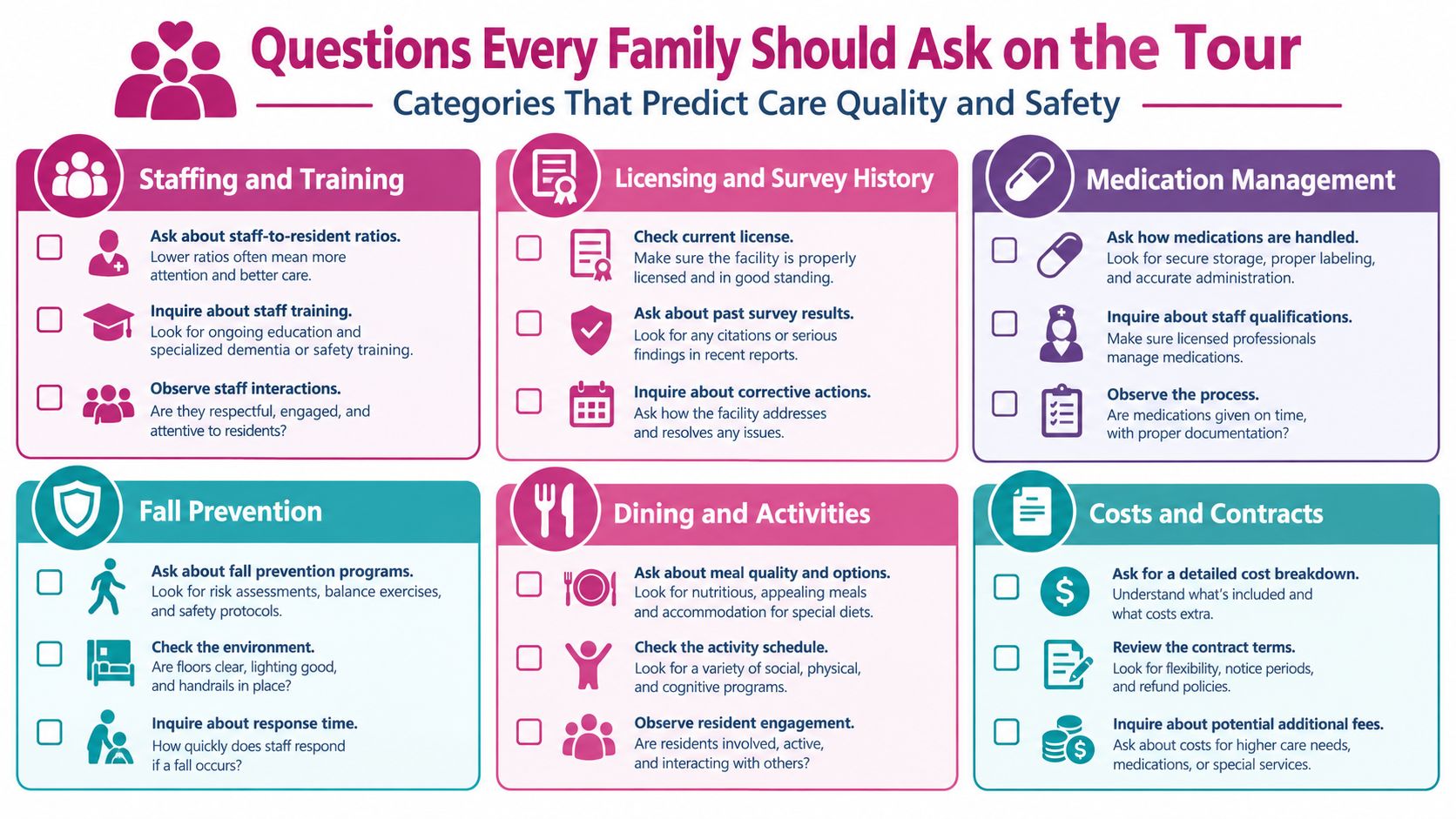
This checklist is worth bringing with you:
Staffing and oversight questions
Ask, “What's the resident-to-staff coverage on the morning shift and around 11 p.m.?” You're listening for a direct answer, not a dodge like “we staff based on needs.”
Ask who is in the building after business hours. Ask whether a nurse is on site, on call, or off site. Ask what training direct-care staff receive before working alone.
A helpful companion list is this guide to questions to ask at every assisted living tour.
Good answers are specific. Weak answers sound polished but slippery.
Medication and fall-prevention questions
Ask how medications are documented, who administers them, and how the team handles refused doses or med changes from a hospital discharge. If your parent takes insulin, blood thinners, oxygen, or frequent PRN medications, ask that separately.
Then move to falls. Ask what happens after a resident falls, how the team updates the care plan, and whether repeated falls trigger a care conference or reassessment.
Watch this before your next visit if you want a quick visual reset on touring priorities.
Cost and contract questions
Many families get burned.
Ask for:
- The base monthly rate
- The current care-level charges
- Move-in fees
- What triggers a rate increase
- Which supplies or services are billed separately
- Whether the community can force a move-out for changing needs
Also ask what happens after a hospitalization. Can the resident return automatically, or do they need a new assessment? That answer matters more than the bistro menu.
What a strong answer sounds like
A strong community usually does three things well:
- Explains care limits plainly
- Provides paperwork without resistance
- Describes reassessment and communication processes clearly
A weak community redirects you to amenities, tells you “every case is different,” or avoids specifics about discharge triggers. Take that seriously.
Using a Placement Service to Shorten the Search
Families often spend too long on the wrong part of the search. They compare websites, save photos, and schedule tours before anyone has sorted out the actual care level, budget range, and priorities.
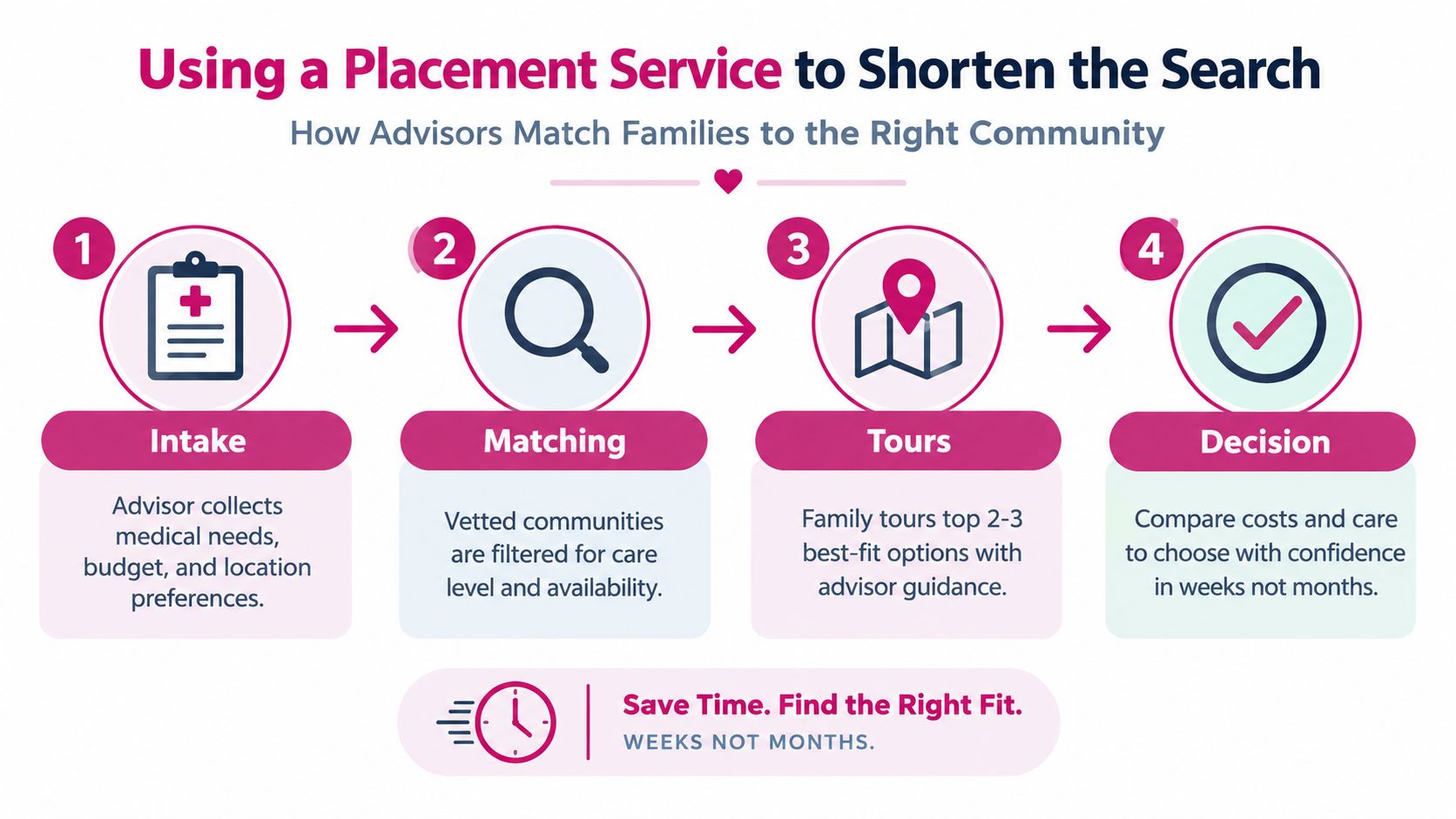
A good placement advisor compresses that process. Instead of visiting six buildings that were never realistic, you start with the few that match the person's medical, financial, and geographic situation.
What an advisor actually does
The working model is straightforward. An advisor gathers the core facts, narrows the field, helps arrange tours, and flags care issues families often miss.
That usually includes:
- Care-level filtering first based on mobility, cognition, medication needs, and likely discharge risk
- Budget screening so families aren't touring places they can't sustain
- Geographic narrowing around family access, doctors, and preferred towns
- Tour coordination so you can compare communities while details are still fresh
- Side-by-side tradeoff review on staffing, pricing structure, and care boundaries
For families in New Jersey, Life Senior Placement's senior placement services describe that advisor-guided model and how it narrows options across assisted living, memory care, skilled nursing, and home care.
How to use a directory without wasting time
Online directories can help, but only if you use them correctly. Most families search by appearance or amenities first. That's backward.
Use this order instead:
- Filter by care level. If the resident may need memory support, don't start with luxury features.
- Compare service lists. Look for medication handling, transfer limits, supervision boundaries, and dining support.
- Request a shortlist. Ask for a written summary of tradeoffs before booking tours.
- Tour only the top few. Too many tours create confusion, not clarity.
The fastest searches start with care fit, not curb appeal.
What an advisor doesn't replace
An advisor can shorten the hunt and improve the starting list. They should not replace your own due diligence. You still need to ask tough questions, read the contract, and watch how staff interact with current residents.
The families who move with the most confidence usually do two things well. They accept that this is a care decision first, and they refuse to sign until the community has answered the operational questions in plain English.
If you're trying to figure out whether assisted living is the right level of care, and which communities can handle your parent's needs, Life Senior Placement can help you narrow the field before you waste time on the wrong tours. They help families compare care levels, review practical fit, and coordinate next steps across New Jersey. Visit Life Senior Placement to start with a shortlist built around care needs, budget, and location.


