Your mother came home from the hospital on Thursday with a new list of meds and a discharge planner who wants a facility name by Monday. She wandered the hallway twice last month. Your brother thinks she can still manage at home with a few more hours of help. You are staring at brochures that all look calm, bright, and interchangeable.
That weekend is a bad time to judge a community by its lobby. A useful answer to how to choose a memory care facility starts with what she needs now and what she is likely to need next, not with the sample menu.
Why Memory Care Choice Is More Than Decor
You have a few days, not a season. After the hospitalization, the question is blunt. Can she stay home with worsening memory loss, or does she need a secure program that can supervise her through the night? A pleasant lobby, a printed activity list, and a taste of the lunch special do not answer that.
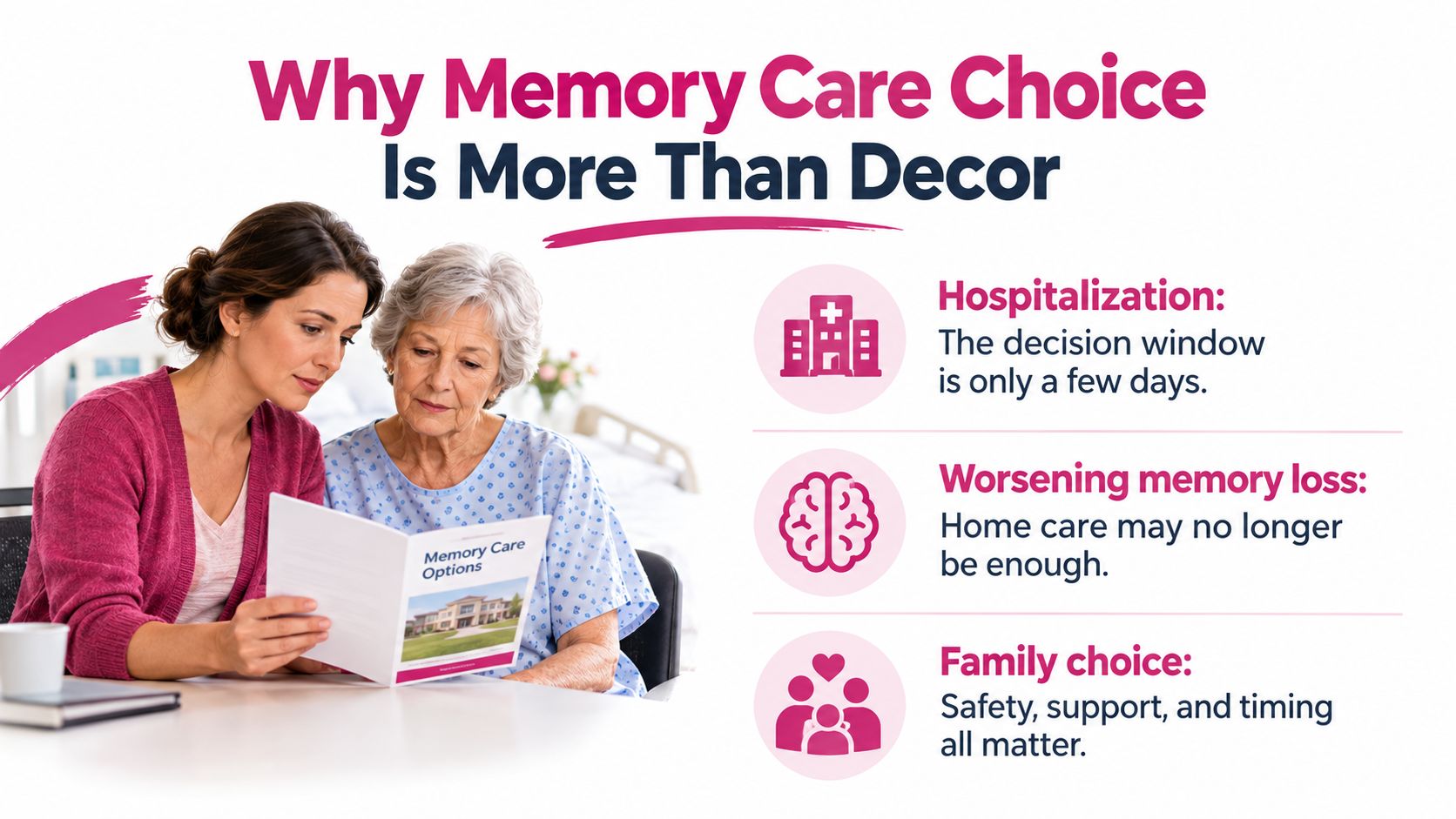
The scale of the problem is why families get boxed in. In 2025, an estimated 7.2 million Americans aged 65 and older were living with Alzheimer's dementia, according to the Alzheimer's Association 2025 facts and figures executive summary. In 2024, nearly 12 million family members and friends provided about 19.2 billion hours of unpaid dementia care, valued at about $413.4 billion. Total U.S. Costs for Alzheimer's and other dementias were projected to reach $384 billion in 2025. The estimated lifetime cost of dementia care exceeded $405,000, with roughly 70% borne by families through unpaid care and out-of-pocket spending.
What a tour cannot show you
Those numbers are not a reason to panic-sign. They are a reason to stop treating room décor as the first filter. Ask whether the community can manage her current symptoms, likely progression, medications, behavior changes, mobility limits, and the amount of supervision she needs. Then ask how staffing and services change if she needs more help, whether higher-acuity care is on site, and what forces a move.
Do this before the crisis hardens: bring in her physician, a social worker, and the family caregivers who already know the 2 a.m. Pattern. They have seen the nights the brochure never mentions.
An initially affordable community can become unsuitable, or just more expensive, if it cannot support progressive dementia. The rest of this process is a sequence. Write the needs down, check public records, tour with one checklist, demand a written plan for the day the unit is no longer enough, and score clinical practice before you talk about furniture.
Build a Needs Profile Before You Tour
Do not compare brochures until you have one page that describes the person, not the apartment. That page is the filter. Communities that cannot take her now, or that would discharge her after a change you can already predict, should fall off the list before anyone spends a Saturday in a model room.
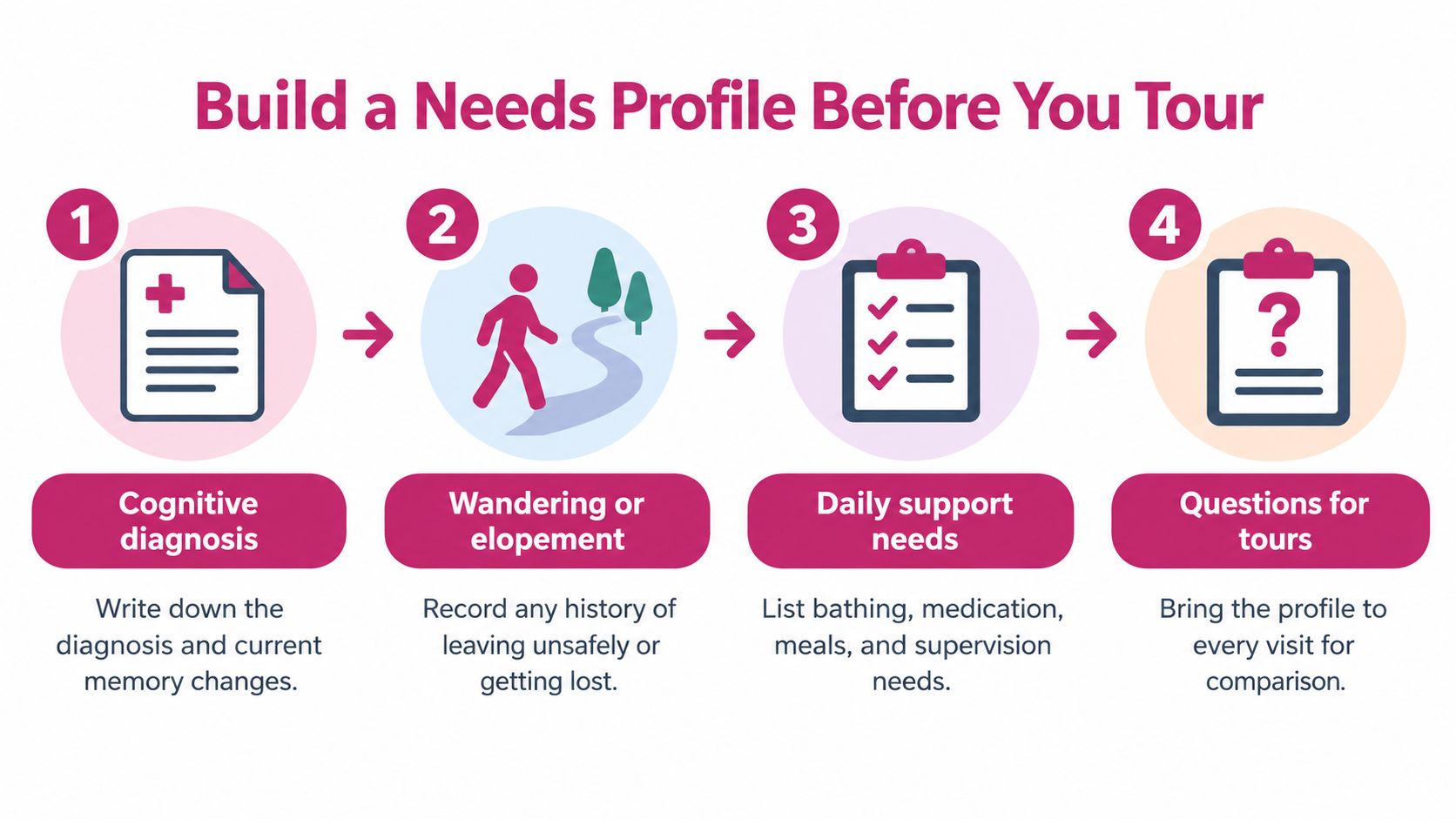
Write these items in plain language.
- Cognitive diagnosis: name the diagnosis and what has changed in the last six months, including confusion at night.
- Wandering or elopement risk: note any time she left unsafely, got lost, or tried a door.
- Activities of daily living: bathing, dressing, toileting, eating, and how much prompting each one takes.
- Medication management: number of doses, insulin, crushed pills, refusals, and who currently gives them.
- Mobility and falls: walker, wheelchair, recent falls, and whether she needs one person or two to transfer.
- Behavioral symptoms: aggression, exit-seeking, sundowning, refusal of care, and what calms her.
- Medical complexity: oxygen, wounds, diabetes swings, psychiatric symptoms, or frequent hospital trips.
- Place and money: preferred New Jersey towns and a monthly budget that includes fees, not just rent.
Turn the page into a phone screen
Call with that sheet in front of you. Ask about licensure or certification, a bed or apartment that is open right now, and dementia-specific services. Demand total pricing, not the base rate on the website. Ask who is on the floor overnight, how a nurse and a physician are reached, how the care plan is written and updated, and how often the executive director, director of nursing, and memory-care lead have turned over.
Two siblings often stall here. One wants the town where she lived for forty years. The other wants someone awake and trained at 3 a.m. The written profile settles it. If she has left the house twice and cannot manage night medications, overnight supervision outranks a familiar zip code. Location still matters for visits. It does not outrank safety you have already documented.
The main trap is choosing from a marketing impression or a base rent. The National Institute on Aging's guidance on choosing a long-term care facility tells families to compare several places, ask about availability and costs, review staffing and training, and read the contract.
If a caller cannot answer those items, you are not being difficult by hanging up. You are saving a tour.
Screen Facilities With Records and Calls
A sales caller will describe a calm unit and a caring team. Public files, where they exist, let you test that sentence.
When the candidate is a nursing home, the CMS nursing home data sources page is the right starting point. The inspection database covers deficiencies from the three most recent standard inspections, plus complaint investigations and infection-control inspections from the preceding three years. CMS also collects auditable quarterly staffing through the Payroll-Based Journal, including registered nurses, licensed practical nurses, certified nursing assistants, medication aides, and nurse aides in training. Care Compare shows an overall Five-Star rating and separate ratings for health inspections, staffing, and quality measures.
What the stars are for
Compare communities of similar size. Look at recent deficiencies and complaint patterns, staffing levels, and registered-nurse coverage, then set quality measures beside similar buildings. The Government Accountability Office has noted that Care Compare lets consumers compare information such as the number of nurses employed, and that CMS uses automated checks and federal monitoring to assess data completeness and inspection accuracy. That is a reason to open the files. It is not a guarantee that the building in front of you is fine this month.
A star rating is a screen, not a verdict. Use it to shorten the tour list and to build a written question sheet.
| Family question | CMS source when it is a nursing home | Question to ask on the call |
|---|---|---|
| What went wrong recently? | Standard inspection deficiencies and complaint investigations | Which deficiencies are still open, and what changed? |
| Is infection control a pattern? | Infection-control inspections from the prior three years | Who owns infection control on evenings and weekends? |
| Who is actually working? | Payroll-Based Journal hours by nurse and aide role | What is RN coverage overnight, and how much is agency staff? |
| How does it compare? | Care Compare overall, inspection, staffing, and quality stars | Why is one star lower than the others? |
Many memory care programs in New Jersey are assisted living, not nursing homes, so those CMS files may not apply. The issues do not disappear. Ask them out loud. Turnover, overnight coverage, agency staff, response times, dementia-specific training, and how many caregivers are in the dining room and on the floor after dinner. For assisted living inspection language, read how to read an NJ assisted living inspection report before you treat a clean hallway as proof.
Walk into tours with the printout and the unanswered items circled. If the numbers and the phone answers do not match, believe the mismatch.
Use the Same Checklist on Every Visit
Paper gets you to the door. The visit tells you whether the building matches the file. Go more than once, and make at least one visit unannounced. Score every place with the same checklist so a charming tour guide cannot reset the comparison.
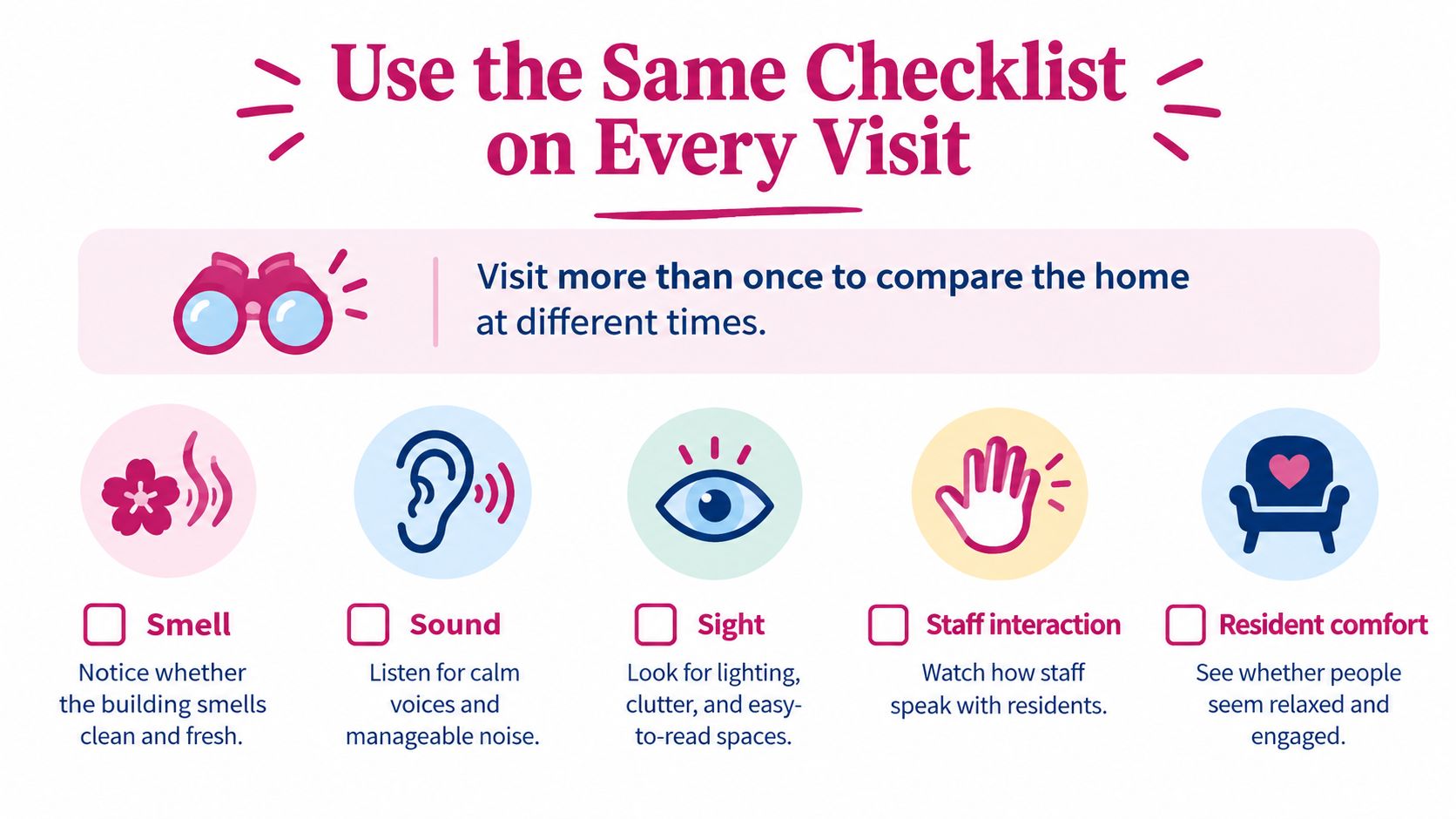
Arrive near dinner if you can. That hour shows staffing, noise, and whether people are actually eating together. Watch a call light. If it sits unanswered while the guide keeps talking about the courtyard, write down the minutes. Then look at that courtyard. A locked door to a patio nobody uses is not outdoor time.
What to mark on the sheet
National selection guidance, including recommendations associated with the Alzheimer's Association in the NIA's facility-choice guidance, points families toward unannounced visits and toward security, fall rates, dementia training, staff tenure, and staffing ratios. Put those items on the walk, not in a follow-up email you never send.
- Residents: clean, appropriately dressed, and not lined up in front of a television with an unused activity calendar on the wall.
- Staff talk: patient, specific, and directed at the resident, not performed for you.
- Building: odor, maintenance, accessibility, and secured indoor and outdoor areas that people can use.
- Participation: residents joining an activity, not sitting beside a printed schedule.
- Numbers they should know: resident-to-staff ratio, dementia-training requirements, fall rate, response to challenging behavior, emergency procedures, and average employee tenure.
Score each item the same way at every community, even the one your cousin likes. A 1-to-5 column beats a feeling about the model apartment.
The observation step confirms or contradicts the records and the phone screen. It does not replace them. A fresh smell and a kind aide on Tuesday at 2 p.m. Can both be real and still hide a thin night shift.
If you want a short visual on what a structured memory care day can look like, watch this before you score activities.
Bring the scores home and line them up. The community that wins is the one that holds up at dinner, not the one with the nicest sofa in the sample room.
Plan for the Day Needs Outgrow the Unit
Stop leading with “How secure is the memory-care unit?” Locked doors are common. They do not prove the staff can manage wandering, aggression, falls, incontinence, nighttime behavior, psychiatric symptoms, or medical instability.
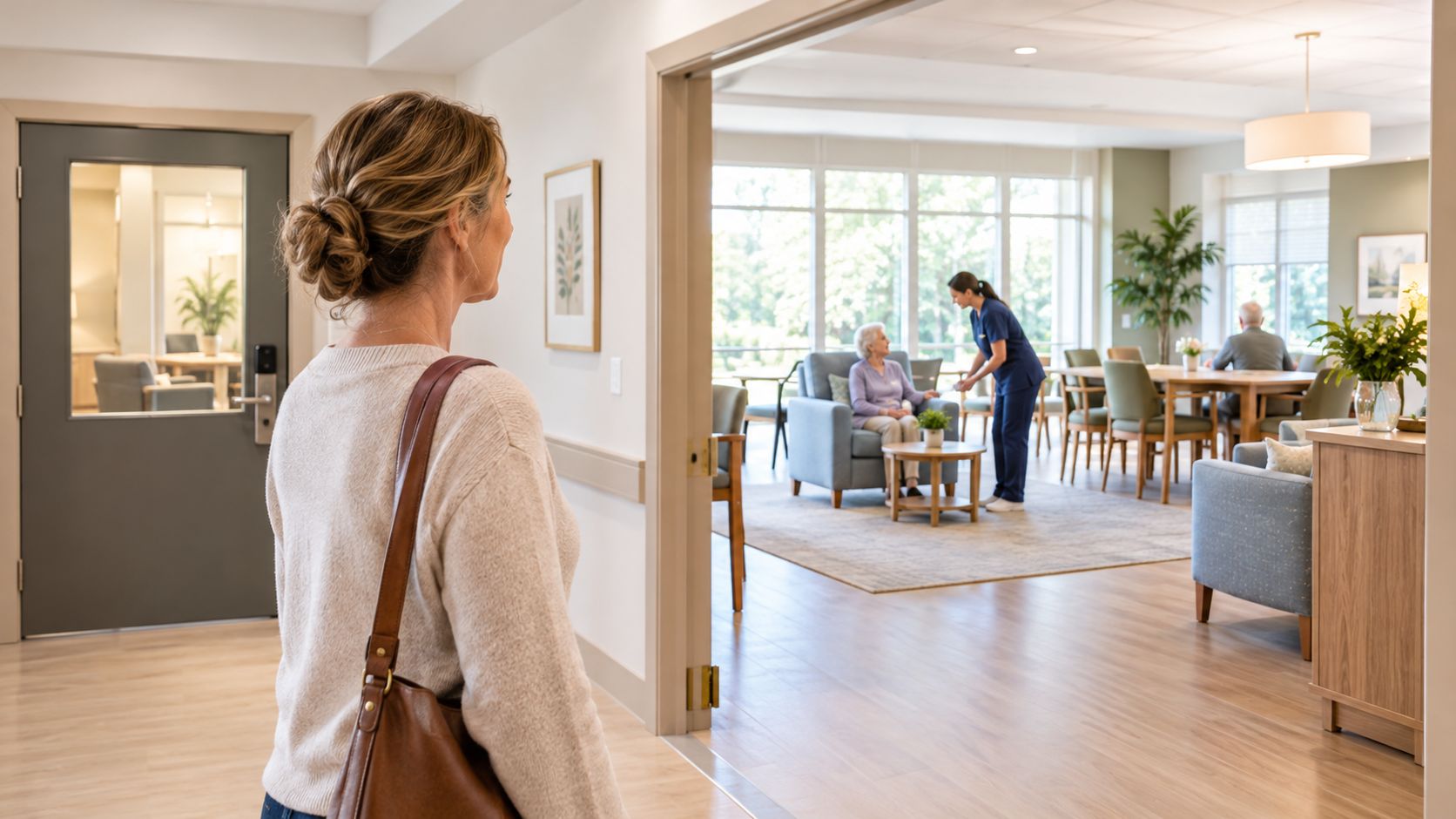
A 2025 study found that 89% of memory-care units were locked and 73% used elopement alarms, while specialized dementia training was required before starting work by only 53.6% of nursing homes and 60.0% of assisted-living communities, as reported in Health Affairs Scholar. Visible security can create a false sense of quality when it is not paired with staff competence, individualized behavioral support, and transparent discharge criteria.
The escalation interview
Ask these questions of every finalist, and get the answers in writing before a keypad or an activity calendar becomes a reason to choose.
- Which behaviors trigger a transfer? Name wandering, aggression, falls, incontinence, nighttime disruption, and psychiatric symptoms. Vague “we take it case by case” is not a policy.
- What clinical limits exist? Can they manage a two-person assist or oxygen, or does either one end the stay?
- Who decides, and how fast? Ask who makes the discharge decision, how much notice the family gets, and whether a hospital stay restarts the argument.
- Where would she go next? Name the higher-acuity partners that accept residents, not a generic “we work with several nursing homes.”
For New Jersey families, this is the question that prevents a second move six months after the first. Match her likely future needs against each finalist's admission rules, retention rules, staffing, and hospital-transfer policy.
A security feature is incomplete evidence. Retention rules are the decision.
If they will not put the discharge triggers on paper, assume you will learn them during a crisis, on their timeline.
Read Staffing and Medication Practices
A polished tour can show a calm common room without explaining how staff respond when a resident becomes agitated at night. Ask what care looks like on the difficult shifts, not just what the unit looks like at midday.
Staffing hours matter, but they do not establish quality on their own. Ask whether staff have dementia-specific training and whether the community has clear care processes for behavioral symptoms. The Pension Research Council's staffing and medication analysis discusses the relationship between staffing and medication practices. Use it as context, not as a substitute for a facility's own records.
What to request before you talk about a move-in date
- Recent antipsychotic rate: Ask for the facility's own rate and how it reviews cases, rather than relying on a national average.
- As-needed psychotropics: Ask how often residents receive them and who can authorize a dose on weekends.
- Medication review: Find out how often a clinician reviews each resident's medications, and how consent and documentation are handled.
- Non-drug responses: Request a specific example, such as a behavior plan for exit-seeking, and ask what staff try before medication.
- Shift staffing: Ask about evenings and weekends, not just a daily average. Use these staff-turnover questions for NJ memory care to ask how staffing changes affect residents' care.
Compare what each community can explain. One may describe who meets after a resident becomes agitated, what approaches staff try first, and when a medication is reviewed. Another may offer little beyond naming the drug. Ask what symptom the medication is intended to address and how the team checks whether it is helping.
Add medication practice to the finalist scorecard. A low antipsychotic rate alone does not prove good care, and a higher rate deserves a clear explanation of clinical need and review. Look for an explained rate, a regular review schedule, trained staff on evening shifts, and written care processes. Those details tell you more than a calm tour.
Compare Options and Take the Next Step
Memory care is not the default just because memory is slipping. Set it beside the other levels using the needs profile you already wrote.
Independent living fits someone who is still safe alone and wants meals and maintenance, not supervision. Assisted living fits help with daily tasks when judgment and wayfinding are mostly intact. A secure dementia program fits wandering, night confusion, and behavior that a standard assisted living floor will not keep. Nursing home or skilled nursing fits medical instability, heavy hands-on care, or needs the memory unit has already said it will not retain. Home care can stretch a safe home stay. It cannot lock the front door or replace a night shift when elopement is already happening.
Cold-calling every community is one path. Another is a no-cost placement service. Life Senior Placement, a New Jersey directory and advisor service at assistedliving.life, headquartered at 120 Eagle Rock Ave, Suite 200, East Hanover, runs a three-step process. Intake covers health needs, budget, lifestyle, and location. Matches are limited to licensed, vetted providers. Advisors then help coordinate tours, side-by-side comparisons, and move-in. Participating communities compensate the service, so ask how that works.
Whichever route you use, the contract finishes the choice. Identify included services versus add-ons, medication and incontinence fees, transfer or discharge triggers, staffing assumptions, annual increases, and refund terms. Price ranges for this level of care are easier to judge beside your budget if you also read a breakdown of the cost for memory care.
Tour only the communities that survived the records, the visits, the retention rules, and the medication questions. Then call (862) 398-2006 or email hello@seniorplacement.life with the needs profile in hand.
Life Senior Placement helps New Jersey families match dementia needs, budget, and location to licensed memory care, then lines up tours and a side-by-side comparison before a hospital deadline picks the building. Bring the needs profile, the discharge questions, and the contract items on this page. Start at Life Senior Placement.