
You're sitting in a hospital room in Morristown or Newark, your mom is in the bed with a new hip, and a case manager just told you she'll be discharged soon but can't go home yet. You need a skilled nursing facility, you need it fast, and you have no idea what it'll cost or who pays. That panic is normal. What's dangerous is Googling a single average price and building a plan around it. Skilled nursing facility cost isn't one number. It's a timeline, and the bill changes depending on which week you're in and who's paying.
The Discharge Day Reality Most Families Underestimate
The call usually sounds calm. Your dad is stable after surgery. The hospital team is pleased. Then the case manager says he needs skilled rehabilitation before he can manage stairs, transfers, and medication at home. You're handed a list of facilities, asked for your top choices, and told beds move quickly.
Most families start by asking about location and star ratings. Those matter. They don't answer the money questions that'll hit first. Is this a Medicare-covered rehabilitation stay or the start of long-term residence? Did the hospital stay qualify him for that benefit? Does the facility have a Medicare-certified bed open today, not next week? If he stops progressing, when does coverage end?
The first decisions you actually face
- Confirm the discharge type: Ask whether the order is for short-term skilled rehabilitation with a goal of going home, or whether the team expects long-term custodial care. Those are different placements with different payers.
- Verify coverage before you tour: A beautiful facility that won't accept his payer pathway isn't an option. Get the benefit check in writing.
- Ask about the cliff: Find out what you'll owe if he needs to stay after coverage changes. Don't wait for the invoice.
I've watched families choose the closest building, assume Medicare covers everything, and then learn the stay was never structured as a covered skilled stay at all. That's not a billing surprise. That's a planning failure that started at discharge.
If you're in that window right now, don't start with a price list. Start with the sequence in this hospital discharge to New Jersey rehab guide, because your first task is matching clinical need, payer, and an available bed at the same time. A daily rate means nothing if the bed isn't certified for your payer, the facility can't handle his wound care, or discharge happens before authorization is sorted. Treat cost as a calendar from day one, and you'll ask better questions in that first meeting than most families ask in a month.
What Skilled Nursing Actually Means in 2026
Skilled nursing means care that requires licensed clinical skill, ordered by a physician, and delivered under a plan of care. Think IV medication, complex wound care, and rehabilitation therapy after a hospital stay. It isn't just supervision, meals, and help getting dressed.
That distinction decides who pays. Medicare's skilled nursing facility benefit is built for medically necessary skilled care after a qualifying hospital stay, not for indefinite personal assistance. When the need shifts from skilled treatment to custodial help with daily life, the payer logic changes with it.
The map below separates four options families often blur together during a rushed discharge.
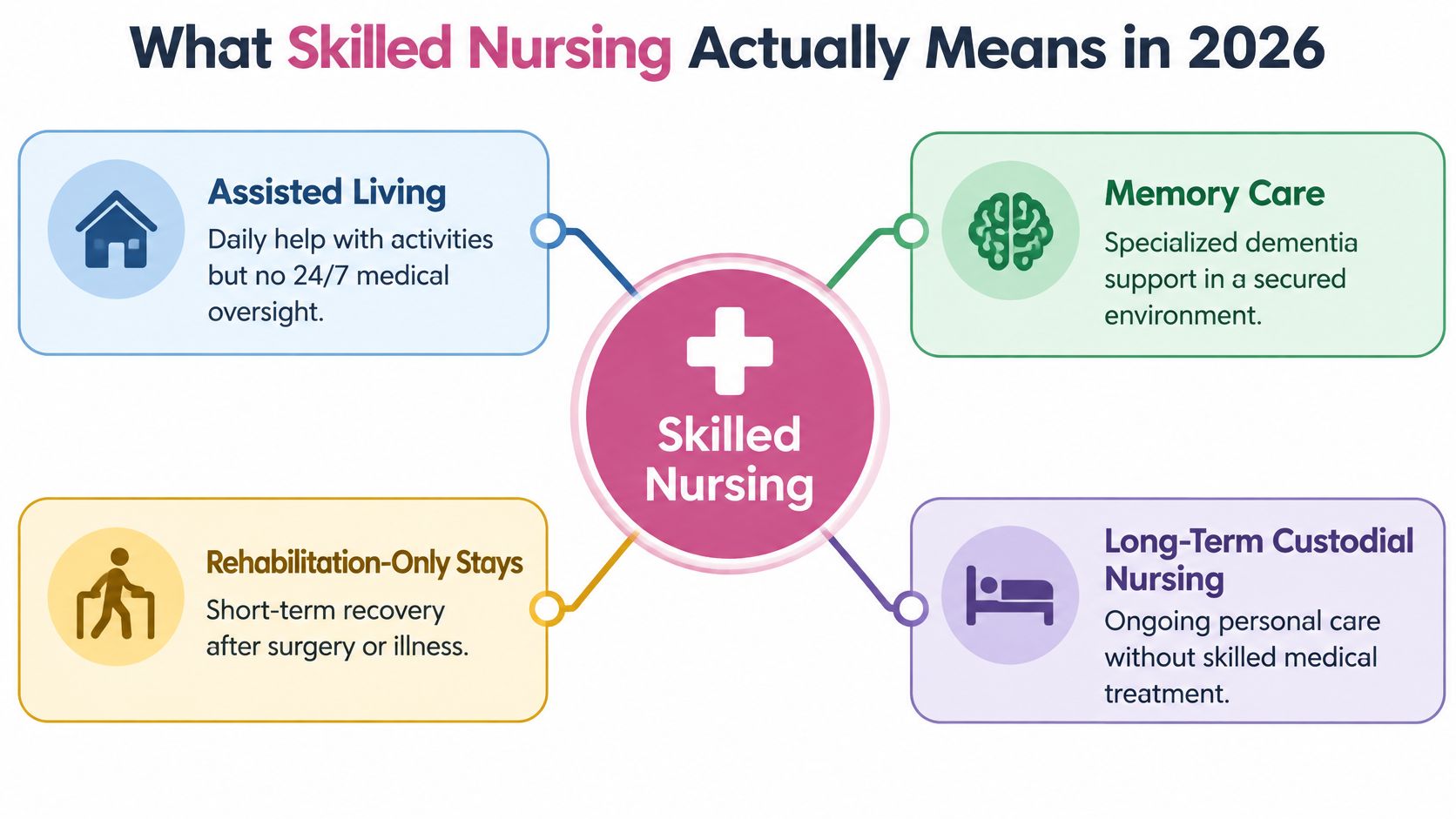
Four settings families confuse
Assisted living provides housing, meals, and help with daily activities, but it doesn't provide round-the-clock skilled medical treatment. Memory care adds a secured environment and specialized dementia support. It may sit inside assisted living or a nursing facility, and that setting affects both rules and price.
A rehabilitation-only stay is short term and goal driven. Your parent works with physical, occupational, or speech therapy to recover function and go home. Long-term custodial nursing is ongoing residence for someone who needs continuous personal care, even when no skilled procedure is driving the day.
If a nurse or therapist must perform the task because of its clinical complexity, you're in skilled territory. If a trained aide can safely help with bathing, dressing, and meals, you're usually discussing custodial care.
Get the label right before you compare prices. A facility can offer rehabilitation and long-term beds under one roof, but your parent's placement, coverage, and eventual bill depend on which type of stay is ordered, documented, and authorized. Don't let a shared building name blur that line.
National Benchmarks and Why Headline Medians Mislead
National numbers give you a starting benchmark, not a quote for a bed in Bergen, Essex, or Ocean County. In 2024, the national median was $111,325 per year for a semi-private nursing home room and $127,750 for a private room, roughly $9,277 and $10,646 per month, according to Genworth and CareScout's 2024 Cost of Care Survey results. That gap of more than $16,000 a year shows how much privacy alone moves the baseline before a single service gets added.
The same release reported increases of 7% for semi-private rooms and 9% for private rooms over the prior survey period. Do not treat that as a forecast for your family's bill. Treat it as proof that a quote from two years ago has already gone stale.
Five variables that move your real price
- State and metro area: Labor, property, and demand differ sharply by market, so a national median can't price a specific New Jersey county.
- Room type: A private room adds substantial cost over shared accommodation, even before services differ.
- Clinical intensity: Wound care, dementia support, and rehabilitation capacity change staffing needs and what a facility can safely accept.
- Payer arrangement: Medicare, Medicaid, managed care, and private pay don't reimburse the same way, and they don't cover the same services.
- Expected length of stay: A short rehabilitation stay and permanent residence create completely different total exposure, even at a similar daily rate.
There's another trap. The rate on a consumer price list isn't the same thing as Medicare's payment to the facility. CMS pays qualifying skilled nursing facilities through a per-diem prospective payment system that's adjusted for resident case mix and geographic wage variation, rather than reimbursing a room and board charge. Your family may never see that internal calculation, but it explains why a facility asks detailed clinical questions before accepting a referral. They're assessing care needs, classification, and whether the payer pathway works.
Use medians to sanity-check whether a quote sits in a plausible range. Then stop. Your real skilled nursing facility cost depends on the room offered, the care ordered, what's excluded, and how long your parent stays after each coverage phase ends. Anyone who hands you one national number and calls it your budget is skipping the decisions that determine the bill.
The Medicare SNF Benefit Day by Day
Original Medicare pays for a limited, post-hospital rehabilitation window when strict conditions are met: a qualifying inpatient hospital stay and a continuing need for medically necessary skilled care. Miss either condition and the clock below never starts. I've watched families learn this on discharge day, with 48 hours to find a bed.
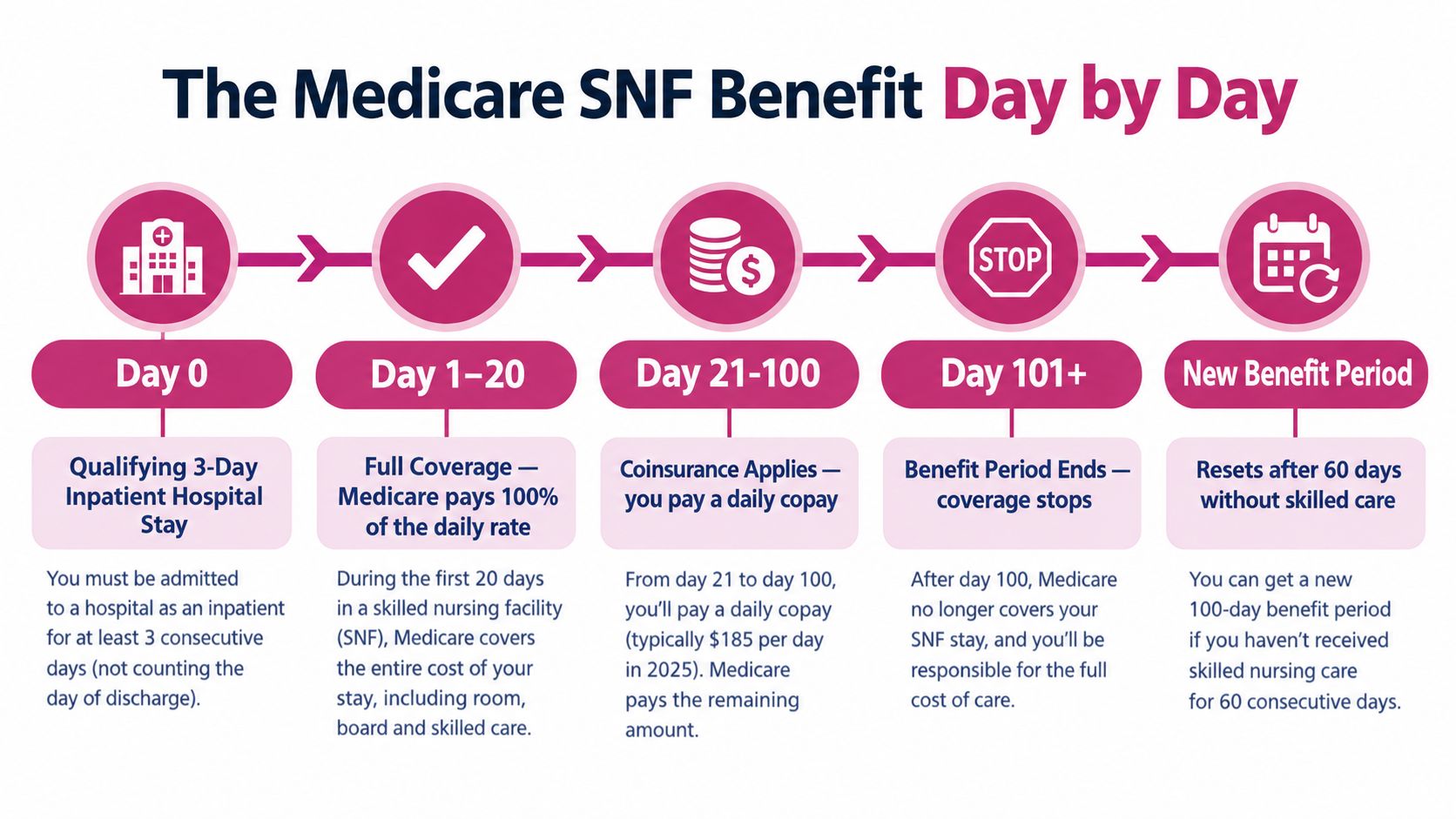
For 2025, Part A charges a $1,676 deductible per benefit period, though the hospital stay may have already satisfied it, according to Medicare's guide to skilled nursing facility care coverage. The same Medicare publication sets the daily split: $0 per day for days 1 through 20, then $209.50 per day for days 21 through 100, with the beneficiary owing everything after day 100 in that benefit period. For 2026, the days 21 through 100 coinsurance rises to $217 per day, and coverage still ends after day 100, per Medicare's published cost figures.
Medicare SNF Coverage Timeline at a Glance
| Coverage Period | 2025 Beneficiary Cost | 2026 Beneficiary Cost | Notes |
|---|---|---|---|
| Days 1 to 20 | $0 per day | $0 per day | Applicable Part A deductible still applies |
| Days 21 to 100 | $209.50 per day | $217 per day | Skilled need and eligibility must continue |
| Day 101 onward | Full cost | Full cost | Same benefit period has ended |
Run the arithmetic on those figures. The 2025 coinsurance window can reach $16,760 across days 21 through 100, before deductibles and non-covered services. Medicare's published figures put a 2026 stay reaching day 50 at $6,510 for days 21 through 50 alone.
Say your mother had a hip replacement and needs 30 covered days. The first 20 feel free because they are. Then day 21 hits, and every covered day carries a daily charge unless a Medigap or other supplemental policy absorbs it. If she plateaus and no longer needs skilled care, coverage can end well before day 100. If she still needs custodial help afterward, the family is staring at private pay or another payer pathway.
The video below gives useful background before you sit down with a discharge planner or admissions office.
Do not build your plan around the idea that Medicare hands you a guaranteed block of rehab days. This breakdown of the Medicare rehab days coverage myth explains why the "100 days" number misleads so many families. Before admission, verify four things: the benefit period status, the qualifying hospital stay, ongoing skilled need, and any secondary coverage. The quoted daily rate is rarely your first problem. The coinsurance window and the hard stop at day 100 are where the shock lands.
Medicare Advantage, Medicaid, and Private Pay Compared
Admissions offices sort every referral into one of four payer categories before they look at anything else. Original Medicare covers qualifying short-term rehabilitation. Medicare Advantage runs those same benefits through a private insurer with its own rules. Medicaid carries long-term custodial care for people who meet the state's financial and clinical tests. Private pay fills whatever gap remains, and it fills it at full price.
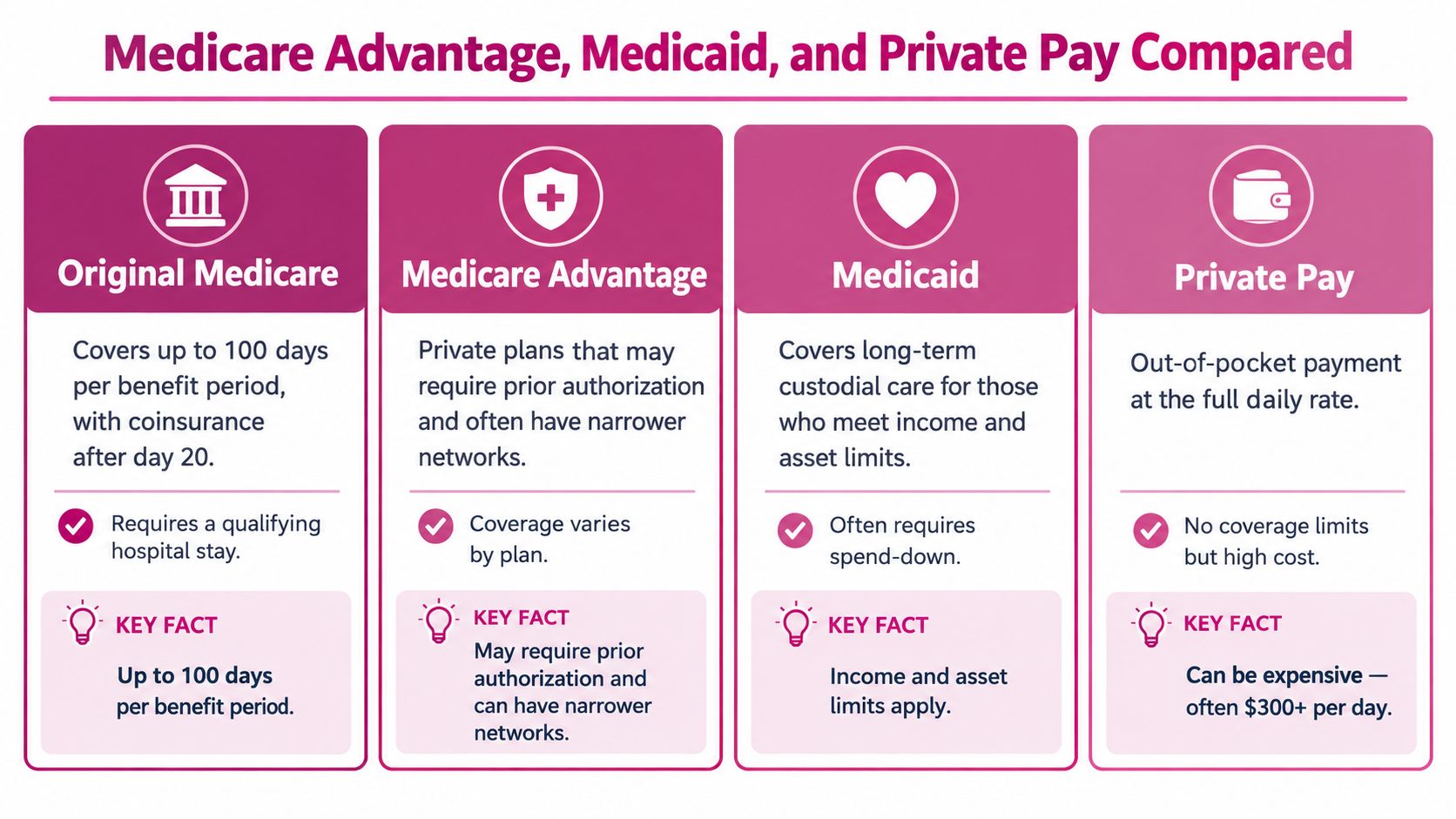
Medicare Advantage must cover at least what Original Medicare covers. On paper. In practice, expect prior authorization requirements, network restrictions, plan-specific cost sharing, and authorized stays measured in days rather than weeks, with each extension requiring fresh clinical justification. A facility can sit two miles from your house and still be unusable if it falls outside the plan's network or the authorization stalls while the hospital pushes for discharge.
Medicaid becomes the conversation when care turns custodial and the person qualifies under New Jersey's income and asset rules. Many families arrive in a Medicaid-pending position, application filed, approval still out. Before you sign anything, ask whether the facility accepts Medicaid-pending admissions, what deposit it requires, and how it handles the conversion if approval drags. The details in this overview of what New Jersey Medicaid covers in nursing homes will sharpen those questions, though the facility's own policy makes the final call.
Private pay offers the widest choice and the fastest bleed. You pay the facility's rate plus non-covered extras directly. There is no day limit. There is also no program absorbing the daily cost. Families outside New Jersey sometimes start by cataloging public and charitable resources like California Freedom funding options, and that exercise is worth copying anywhere: inventory every assistance source before assuming savings are the only bridge. In New Jersey, confirm state-specific eligibility and facility acceptance before counting on outside help.
One more number belongs in this comparison, on the payer side. For fiscal year 2026, CMS finalized a 3.2% increase in SNF prospective payment rates, raising aggregate Medicare payments by an estimated $1.16 billion over FY 2025, according to CMS's FY 2026 SNF prospective payment final rule fact sheet.
What the Quoted Daily Rate Actually Covers
A quoted daily rate is a starting line, not a receipt. Families hear one number on the phone and assume it covers the room, nursing, therapy, medication, supplies, and every ride to an outside appointment. Sometimes it covers a broad bundle. Sometimes it doesn't. You need the contract and the charge list, not the sales summary.
The diagram below breaks the daily rate into the service lines you should ask about individually.
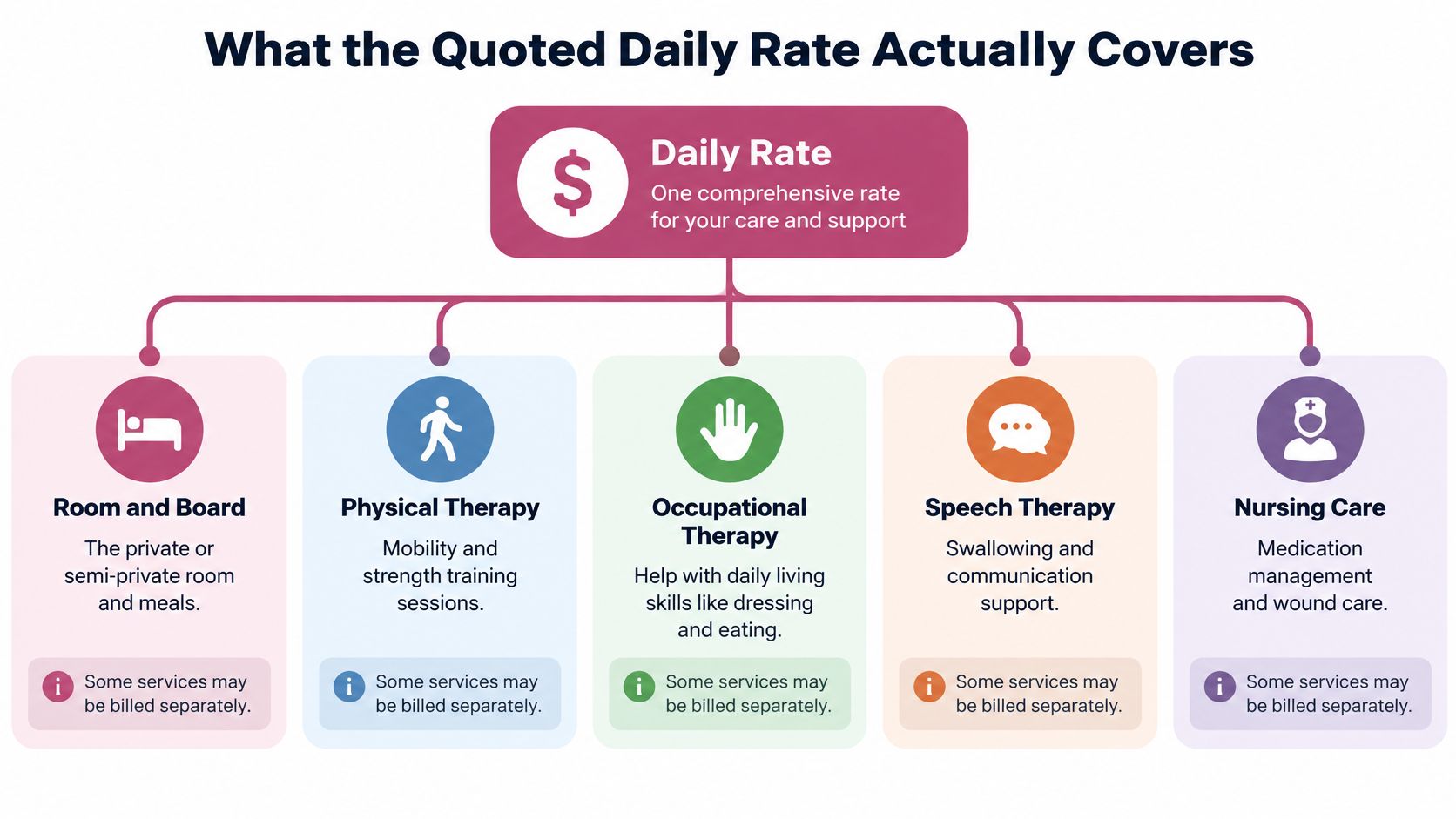
Line items to separate before admission
- Room and board: Confirm whether the quote is for a private or semi-private bed, and whether meals and basic personal services are included.
- Therapy: Ask how physical, occupational, and speech therapy are covered during a Medicare stay, and what changes if the stay becomes private pay.
- Pharmacy and supplies: Medication, wound supplies, and other consumables may be bundled into a covered per diem or billed separately outside it.
- Transportation and outside providers: Dialysis trips, specialist visits, and outside clinician fees can sit outside the facility's base charge.
- Deposits and personal extras: Ask about upfront deposits, phone or cable, beauty services, and other personal charges before move-in.
Under Medicare's SNF prospective payment approach, qualifying Part A payment is designed around routine, ancillary, and capital-related costs for covered services. That bundled logic doesn't mean every item your parent wants or needs is covered, and it definitely doesn't mean the same inclusions apply once the stay becomes long-term private pay. The billing rules change when the payer changes.
Practical rule: Never compare two facilities on daily rate alone. Compare the written list of inclusions, exclusions, deposits, and what triggers a separate charge.
Ask admissions to walk through a sample month for your parent's actual situation. Include therapy, pharmacy, transportation, supplies, and any dementia or higher-acuity care needs. If they can't explain what sits outside the rate, you don't have a real skilled nursing facility cost yet. You have a marketing number.
New Jersey Cost Variables Families Should Pressure-Test
A family choosing between New Jersey facilities needs to look beyond the national daily rate. CareScout reports 2025 national median rates of $315 per day for a semi-private room and $355 per day for a private room, or about $114,975 and $129,575 annually. Rates rose 2% and 1%, respectively, according to CareScout's analysis of where senior care costs are rising. The same CareScout analysis discusses regional variation, but a national median cannot tell you what a suitable New Jersey bed will cost or whether it is available.
Your parent's care needs and payer can change the price and the placement options. A private room, specialized dementia support, intensive rehabilitation, or a facility's Medicaid-pending policy may all affect which beds are realistic. Model the costs across the full stay, from Medicare-covered rehabilitation to private pay or Medicaid-supported long-term care.
Quoted rate versus usable rate
A lower rate has little value if the facility cannot meet your parent's needs or accept the payer they will need next. Pressure-test the fit before comparing prices.
- Bed certification: Does the open bed match the required payer pathway?
- Clinical fit: Can the team manage the wound, dementia-related behavior, dialysis schedule, or rehabilitation needs?
- Payer conversion: If Medicare rehabilitation ends, can your parent stay under private pay or Medicaid?
- Authorization risk: If a managed care plan authorizes fewer days than expected, what changes?
- Relocation risk: Could a payer change force your parent to move during recovery?
Facilities near Newark and Jersey City may price differently from options in suburban or South Jersey communities. Availability also shapes the choice. A lower rate elsewhere does not help if there is no appropriate bed, the facility will not accept the payer, or your parent would have to move after rehabilitation.
CMS publishes facility-level cost report data, including costs, charges, utilization, and Medicare settlements. Families do not need to analyze those reports. Ask how the facility's quoted rate may change across the expected care timeline, and whether it can support the next payer stage as well as admission day.
A low rate without a suitable bed and a workable payer path is a false bargain. Choose a facility that can admit your parent for the current need and explain how the placement could continue if rehabilitation ends and long-term care is required.
A Cost-Smart Placement Checklist for New Jersey Families
Bring structure to the discharge meeting. Emotions run high, beds move, and verbal assurances fade. Use this checklist to pin down the actual cost before you choose.
- Confirm benefit status: Verify the qualifying hospital stay, benefit period, skilled need, secondary coverage, and any Medicare Advantage authorization requirement.
- Request a written estimate: Ask for daily room charges, therapy treatment, pharmacy, supplies, transportation, deposits, and personal extras in one document.
- Model several stay lengths: Price a short rehabilitation stay, an extended coinsurance window, and a move into private pay or Medicaid-supported long-term care.
- Ask about Medicaid-pending policy: Confirm whether the facility accepts pending applications, what documentation it needs, and whether a deposit is required.
- Verify continuity: Find out whether your parent can remain in the same facility if rehabilitation ends but custodial care continues.
- Review quality records: Request recent state inspection results and ask how staffing matches your parent's clinical needs.
Life Senior Placement is one New Jersey placement service families can use alongside hospital case managers and facility admissions teams. It matches families with assisted living, memory care, nursing home, independent living, and home care options, and it can help coordinate comparisons and tours. Whether you use an advisor or work alone, run clinical fit, payer acceptance, availability, and total skilled nursing facility cost in parallel. Doing them one at a time wastes the narrow discharge window and leads families to choose a bed they'll have to leave.
If discharge is close and you're trying to separate a Medicare rehab stay from long-term nursing cost, Life Senior Placement can help you compare New Jersey facilities by clinical fit, payer pathway, availability, and budget before you commit. Visit the site to start an intake, review matched options, and get advisor support for tours and next steps across New Jersey.


