
Life Senior Placement lists independent living around Lodi at $3,200 to $5,200 a month, and its broader New Jersey range runs $3,000 to $6,000. Those figures are starting points for planning, not the amount every resident will pay.
The bigger affordability risk can be the cash due before moving in. Entrance fees at continuing-care communities can be substantial, and a community with an attractive monthly rate may require far more cash than a rental community does. Demand from older households is rising while new construction stays low, a pattern Senior Housing News tracks, and that pressure tends to show up in monthly rates.
For New Jersey families, the useful question is what the household will spend to move in, live comfortably, and obtain additional care if needs change.
Independent Living Costs at a Glance
Published independent-living figures disagree because they measure different products. An advertised asking rent is not the same as an all-in occupancy budget. Averages, medians, and asking rents aren't interchangeable, even when they describe the same housing category.
The benchmarks below show the spread. Use each as a separate measurement, not as pieces of one market average.
Independent living monthly cost benchmarks
| Benchmark | Monthly figure | What it tells you |
|---|---|---|
| US average, 2025 estimate | $3,145 | Combines housing with services such as dining and maintenance |
| US reported range, 2025 | $1,500 to $10,000 | Reflects differences in location, services, and luxury level |
| US average asking price, ASHA year-end 2023 | $4,126 | Tracks advertised independent-living asking prices |
| US average occupancy budget, ASHA estimate | About $4,351 | Adds estimated utilities, communications, and renter's insurance |
| Maine, high-cost state | About $6,162 | Among the most expensive states in the cited estimate |
| Mississippi, low-cost state | About $1,282 | Among the least expensive states in the cited estimate |
Assisted Living Magazine's comprehensive cost guide supplies the $3,145 national average, the $1,500 to $10,000 reported range, and the Maine and Mississippi estimates. These are not guaranteed minimums or maximums for a particular apartment.
Why published totals disagree
The American Seniors Housing Association analysis reported an average independent-living asking price of $4,126 at year-end 2023, increasing to approximately $4,351 monthly after adding estimated utilities, communications, and renter's insurance. That distinction matters: an asking price describes the advertised housing offer, while an occupancy budget describes what the household expects to spend.
State extremes also require care. A low statewide estimate doesn't establish that suitable apartments are available at that price in the town a parent prefers. A high statewide estimate doesn't mean every community charges a premium. For New Jersey families, the advertised monthly rate is only the starting point. Service packages and future care transitions can change the total, so compare written apartment-specific numbers rather than statewide labels.
Practical rule: Start with the benchmark closest to the target location, then replace it with a written, apartment-specific total.
For a useful comparison, record the apartment type, occupancy arrangement, included services, and mandatory charges beside every quote. Without those details, a spreadsheet may rank communities by price while comparing substantially different purchases.
What the Monthly Rate Usually Covers
Say two communities advertise similar apartment rents. One includes daily meals, regular housekeeping, and scheduled transportation; the other bills separately for those services. The second community could cost more for a resident who uses them, even if its advertised rent is lower.
The service bundle is the starting point for evaluating value.

Independent-living fees can combine housing, maintenance, dining, housekeeping, transportation, and social amenities, but there isn't a universal package. Assisted Living Magazine's independent-living guide identifies location, services, and luxury level as reasons prices differ.
Match services to the resident's routine
Don't stop at whether a service appears on the brochure. Determine what the resident can use and what restrictions apply.
- Utilities and internet: Identify included utilities, individual metering, internet access inside the apartment, and any separate service contracts.
- Meal plans: Check meal allowances, dining hours, unused credits, guest charges, and whether preferred dining venues cost extra.
- Housekeeping: Establish the cleaning schedule and whether laundry, linens, or heavier cleaning are separate.
- Transportation: Request the route map, appointment-booking rules, service hours, and charges for trips outside the regular area.
- Activities and fitness: Distinguish included programs from ticketed outings, personal instruction, and paid classes.
- Emergency response: Ask what the call system does, who responds, and whether equipment or monitoring costs extra.
An included shuttle isn't equivalent to transportation whenever it's needed. Likewise, dining credits may offer limited value if the resident regularly prepares meals or cannot use them at preferred times.
For a visual introduction to the living arrangement, consider the following video.
Compare usable benefits
Create a service checklist based on the senior's actual week, not the community's longest amenity list. Someone who no longer drives may place greater value on reliable appointment transportation than on upgraded common spaces.
Line up each community's included-services list against its base rent. Then price the missing services the resident will realistically use, rather than assuming every exclusion will matter equally.
Why New Jersey Prices Run Higher
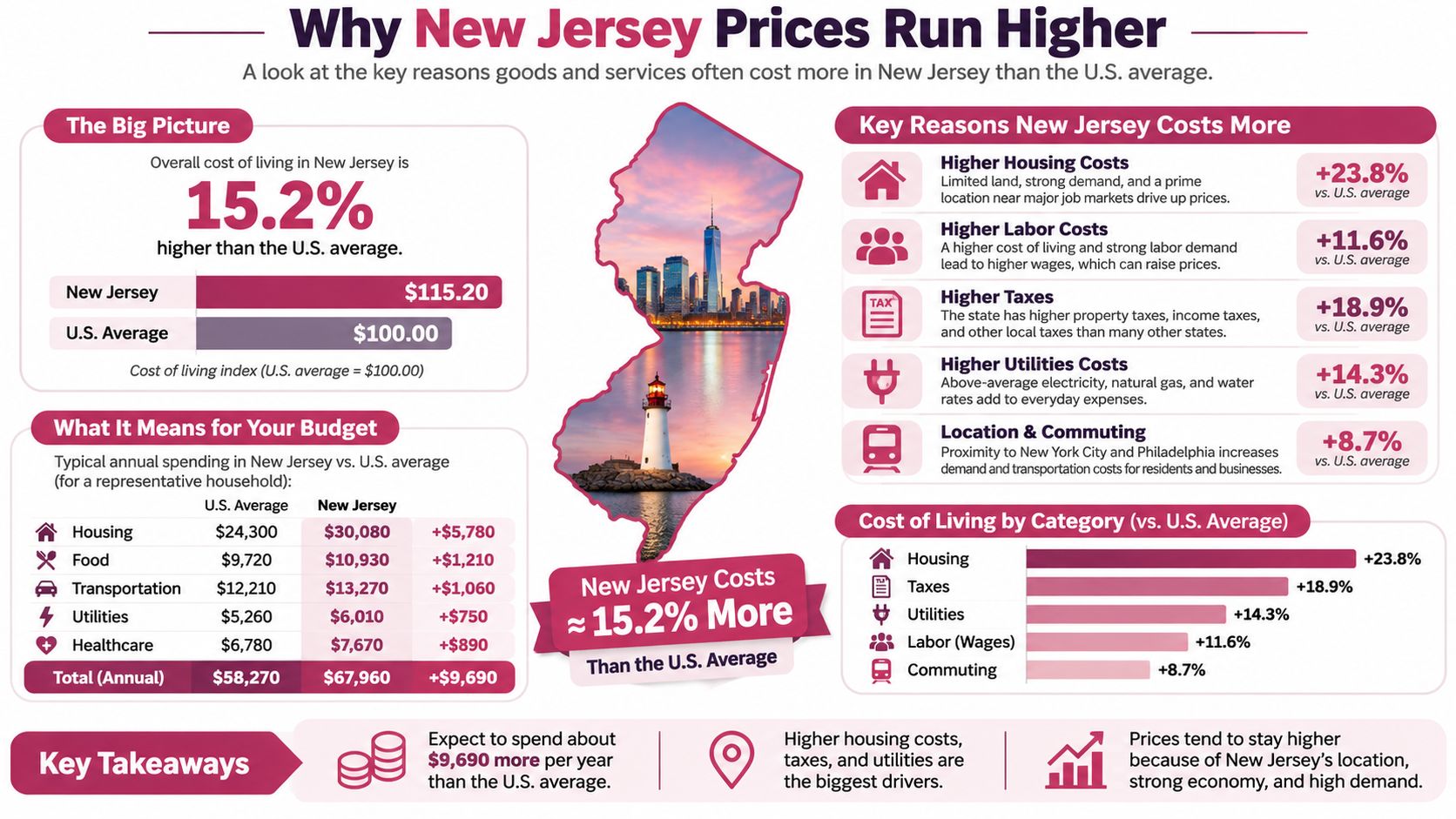
New Jersey families should use a local affordability test rather than assuming a national estimate will buy a comparable apartment nearby. The Funding Dependency New Jersey cost comparison places independent living at approximately $3,982 monthly, or $47,784 annually, in 2025, against a national median near $3,200 monthly. The resulting difference is approximately $782 a month, or $9,384 annually.
That comparison uses its own national benchmark. It shouldn't be interpreted as a precise premium over every other published national average.
The location graphic below provides broader context, rather than an independent-living quote.
Operating costs and available apartments
Operators must pay staff, purchase food, maintain buildings, insure properties, and cover utilities. Higher expenses in those categories can lead operators to raise resident charges. Constrained development can also limit the alternatives available to families.
The New Jersey comparison cites NIC's finding that national independent-living occupancy exceeded 90% in 2025. National occupancy doesn't establish availability in a particular New Jersey town, but it supports asking about actual vacancies early rather than assuming a preferred floor plan will be ready when needed.
A practical search should therefore distinguish a community you like from an apartment you can secure. Request the available unit list, the conditions attached to a reservation, and the refund policy before paying to hold a place.
Budget for the next rate, too
According to NIC figures reported by Senior Housing News on independent-living pricing, operators had increased asking rates 6.7% year over year and in-place rents 8.1% year over year as of June 2025. Those are historical market measures, not a prediction for an individual lease.
Asking rates concern marketed prices; in-place rents concern existing residents. Families need to investigate both because a move-in offer doesn't necessarily describe the household's later costs.
Ask when the quoted rate expires, when the first increase could apply, and whether promotional discounts end separately from ordinary increases. Test affordability using the contract's actual terms, not an assumption that the initial payment will remain unchanged.
Fees Beyond the Monthly Rent and Your Total Budget
The monthly price is a starting point, not the full move-in budget. Communities may charge separately for admission, occupancy, pets, services, and contract features. Continuing-care entrance fees can reach as much as $1 million, though that structure is different from a standard independent-living lease.
Those obligations deserve separate lines in a budget. A community fee may address admission or administrative costs. An entrance-fee contract carries a larger upfront commitment and requires close review of refund terms.
Build an itemized worksheet
Request a fee sheet that covers second-person occupancy, parking, meals, utilities, transportation, housekeeping, pets, wellness services, and any available assistance. Don't assume a listed service is included, or that an independent-living community provides personal care because a fee sheet mentions it.
Fees to confirm before signing
| Fee | Typical figure | Type | Confirm before signing |
|---|---|---|---|
| One-time community fee | Varies by community | One-time | Whether any portion is refundable |
| Pet fee | Varies by community | Recurring | Pet policy, deposit, and size limits |
| Entrance fee, continuing-care communities | Up to $1 million | Upfront | Refund terms and payment timing after departure |
| Second-person charge | Community's written occupancy charge | Recurring | What it covers and whether care is assessed separately |
| Meals, utilities, and transport add-ons | Itemized package or usage charges | Often recurring | Which items are included in base rent |
| Annual rate increase | Contract's escalation terms | Recurring | Notice period and any limits or exclusions |
Our guide to the hidden costs of premium senior living offers another checklist for evaluating charges beyond the headline rate.
Calculate the first-year cash requirement
Consider a hypothetical example, not a community quote: base rent of $3,500, meals and transportation of $300, and a pet charge of $50 produce a monthly total of $3,850. Over a full year, that is $46,200; adding a hypothetical $5,000 move-in fee brings first-year spending to $51,200.
Use this order in a spreadsheet:
- Enter base rent for the actual apartment and household.
- Add recurring charges based on expected usage.
- Annualize the recurring total using the months of occupancy.
- Add upfront obligations, separating refundable deposits from nonrefundable spending.
- Compare available funding with both ongoing expenses and move-in cash needs.
A refunded charge still has a cost while the money is held. Its conditions matter as much as its label. Record when a refund becomes payable, not just whether one exists. Also obtain a separate cost illustration for a later move to assisted living or memory care, since care settings can change the total.
Life Senior Placement provides free, objective guidance to help families evaluate local options and choose care settings. Participating communities pay a placement fee only after move-in, and that fee does not change rent or care costs.
How Independent Living Compares With Higher Care
Independent living is intended for active seniors who want community, amenities, and freedom from home maintenance. It isn't a substitute for hands-on daily assistance. Access to additional care must be verified for the specific community rather than inferred from its name or campus appearance.
The comparison below is a planning framework, not a universal price ranking. Apartment choice, service intensity, and contract structure can change the financial comparison.
Independent living compared with higher care levels
| Care level | Support included | Who it suits | Cost direction |
|---|---|---|---|
| Independent living | Housing, maintenance, dining options, activities; no hands-on daily care | Active seniors seeking community without home upkeep | Generally the lowest starting point among these residential options |
| Assisted living | Housing plus help with bathing, dressing, and medication | Seniors needing daily assistance | Higher charges may include tiered care fees |
| Memory care | Secured environment, specialized cognitive programming, and additional staffing | People living with dementia who need specialized support | Generally higher than assisted living |
| Nursing home | Skilled nursing, clinical monitoring, and rehabilitation as appropriate | Residents needing skilled nursing | Higher clinical intensity; requires a separate cost comparison |
| Home care | In-home personal care and companionship billed by time | Seniors who want to remain at home | Total reflects hours and services, plus household expenses |
Use care needs as the decision point
Assisted living becomes relevant when a resident needs reliable help with personal care or medication. Ask how the community assesses needs and which changes trigger a higher fee tier. Our New Jersey comparison of independent living and assisted living can help organize that distinction.
Memory care addresses a different problem: cognitive changes may require specialized supervision and a secured setting. Wandering, repeated falls, or medication mistakes should prompt a professional assessment, not merely a search for a more convenient apartment.
Nursing-home placement concerns skilled clinical needs rather than amenities. A hospital discharge recommendation should be evaluated on that basis before comparing residential lifestyle packages.
Compare staying home honestly
Home care doesn't replace the mortgage, taxes, repairs, food, or utilities. Include those household costs when comparing it with a community fee, and use Rx360's resource on planning a safe, independent home to consider environmental changes alongside paid assistance.
Before choosing a campus, establish whether the resident can remain in the same apartment as needs rise and how care fees are assessed at each stage. Care available nearby isn't the same as care included in the contract.
How to Pay for Independent Living
Build the funding plan around spendable income and accessible assets, not the value of everything the senior owns. A home may represent substantial wealth without providing cash for a move-in payment. Investment withdrawals may require planning before they become dependable monthly income.
Start with Social Security, pension payments, annuity income, and other reliable receipts. Subtract the full recurring community expense and the senior's remaining personal obligations to identify the amount that must come from elsewhere.
Match each expense to a funding source
Use separate spreadsheet columns for recurring income, liquid savings, investments, and money available only after a transaction. That prevents the family from counting home-sale proceeds before the property has sold or treating an uncertain contribution as guaranteed income.
- Savings and investments: Decide which accounts will fund withdrawals and review tax consequences with an independent financial or tax adviser.
- Home equity: Compare sale proceeds after selling expenses, outstanding debt, moving costs, and any overlap between homes.
- Insurance: Obtain the policy's benefit triggers and covered-service definitions. Don't count long-term-care insurance toward housing expenses unless the insurer confirms eligibility.
- Family contributions: Put the amount, timing, and limits in writing so relatives share the same expectations.
Keep move-in cash separate from the reserve intended for later care. Spending the same money twice on paper won't make either obligation affordable.
Test sustainability, not just admission
Ask a benefits counselor to confirm whether any public assistance applies to the person and the specific expense. Don't assume Medicare or Medicaid will pay independent-living rent, and don't treat coverage for a care service as coverage for the entire community bill.
Likewise, a reverse mortgage or loan requires an independent review of repayment obligations, occupancy conditions, and the effect of moving. Borrowing may change when a bill is paid without resolving whether the household can sustain it.
Our guide to ways to pay for assisted living without draining savings can help families prepare funding questions for a possible care transition. Keep the independent-living budget distinct from any later care budget, and test both before committing a large share of available assets.
Questions to Ask Before You Compare Communities
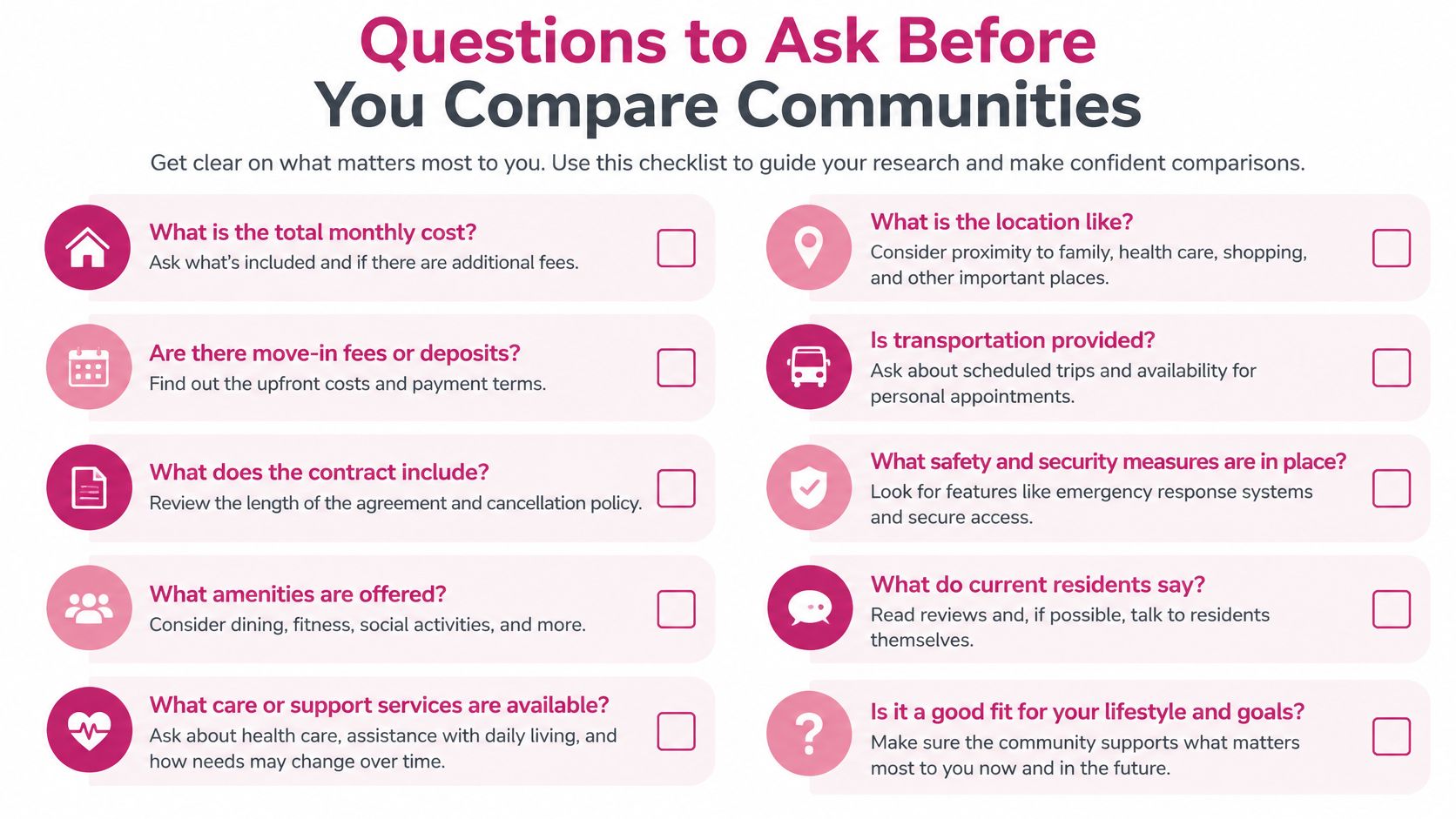
Use the same questions for every community, and attach the answers to the relevant apartment quote. A verbal estimate is difficult to compare when another community has supplied an itemized contract.
Bring the checklist below to tours and pricing calls.
Pricing
- [ ] 1. Total monthly payment: What will this specific household pay after mandatory fees and selected services?
- [ ] 2. Common extras: Which optional charges do residents commonly incur, and which would fit this senior's routine?
- [ ] 3. Rate history: Can you provide recent annual increases and distinguish ordinary increases from expiring discounts?
Ask the representative to identify excluded expenses directly on the quote. A blank field shouldn't be interpreted as an included service or a zero charge.
Contract
- [ ] 4. Refunds: Which deposits and fees are refundable, under what conditions, and when is payment due back?
- [ ] 5. Increases: What notice applies before a price change, and which charges can change separately?
Read the reservation agreement as well as the residency contract. Confirm what happens if the move is delayed, the resident's health changes, or the family decides not to proceed.
Care transitions
- [ ] 6. Future pricing: How would charges change if the resident needed assisted living or memory care?
- [ ] 7. Remaining in place: Can the resident stay in the same apartment, and what would require a transfer?
Request the assessment criteria and applicable care-fee schedule. A general assurance that the community can support changing needs doesn't explain the financial or practical limits.
Daily life and availability
- [ ] 8. Available apartments: Which suitable units are move-in ready, and what are the waitlist and reservation terms?
- [ ] 9. Oversight: Which New Jersey licenses or certifications apply to this community and any separately provided care services?
Record answers in writing and compare written totals, not verbal estimates. Keep the quote date, apartment description, service selections, and contract conditions together so family members aren't reviewing different offers.
For pricing on real options for your family, call (862) 398-2006. Treat published local ranges as area benchmarks rather than quotes, and confirm service terms directly before relying on them.
Life Senior Placement helps New Jersey families identify independent-living options, compare costs and care needs, and coordinate tours and move-in decisions. Visit Life Senior Placement to discuss your preferred location, available budget, and the services your family needs included in a written comparison.